LVLY vs STX: A Comprehensive Comparison of Two Leading Digital Asset Platforms

Introduction: LVLY vs STX Investment Comparison
In the cryptocurrency market, comparisons between LVLY and STX are a topic that investors cannot avoid. The two assets not only show significant differences in market capitalization ranking, application scenarios, and price performance, but also represent different positioning within the crypto asset landscape.
Lyvely (LVLY): Since its launch in October 2024, it has gained market recognition by positioning itself as an award-winning social monetization platform and digital headquarters for building online communities and generating revenue online.
Stacks (STX): Since its inception in October 2019, it has been recognized as a new Internet for decentralized applications, equipped with a comprehensive set of open-source development tools to build and guide the distributed application and protocol ecosystem, featuring a hybrid consensus mechanism known as Proof of Transfer (PoX).
This article will conduct a comprehensive analysis of the investment value comparison between LVLY and STX from multiple perspectives including historical price trends, supply mechanisms, market positioning, and technological ecosystems, while attempting to answer the question most investors care about:
"Which is the better buy right now?"
Comparative Analysis Report: Lyvely (LVLY) and Stacks (STX)
I. Historical Price Comparison and Current Market Status
Lyvely (LVLY) and Stacks (STX) Historical Price Trends
Lyvely (LVLY):
- Published at October 2024, LVLY entered the market at $0.15
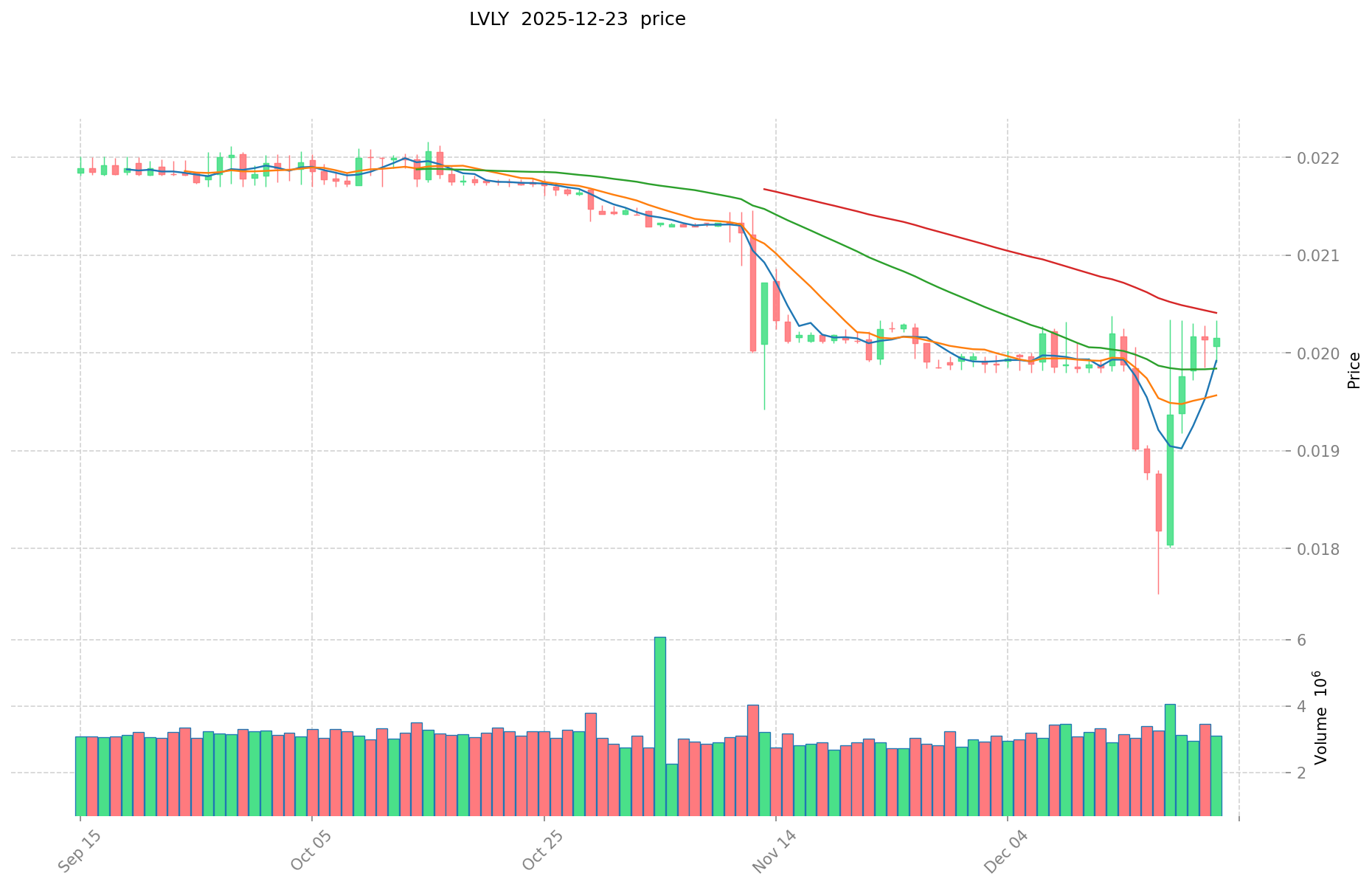
- All-time high (ATH): $0.59897 reached on November 19, 2024
- All-time low (ATL): $0.01753 recorded on December 17, 2025
- Year-over-year performance: -87.06% decline
Stacks (STX):
- Published in October 2019 at $0.12
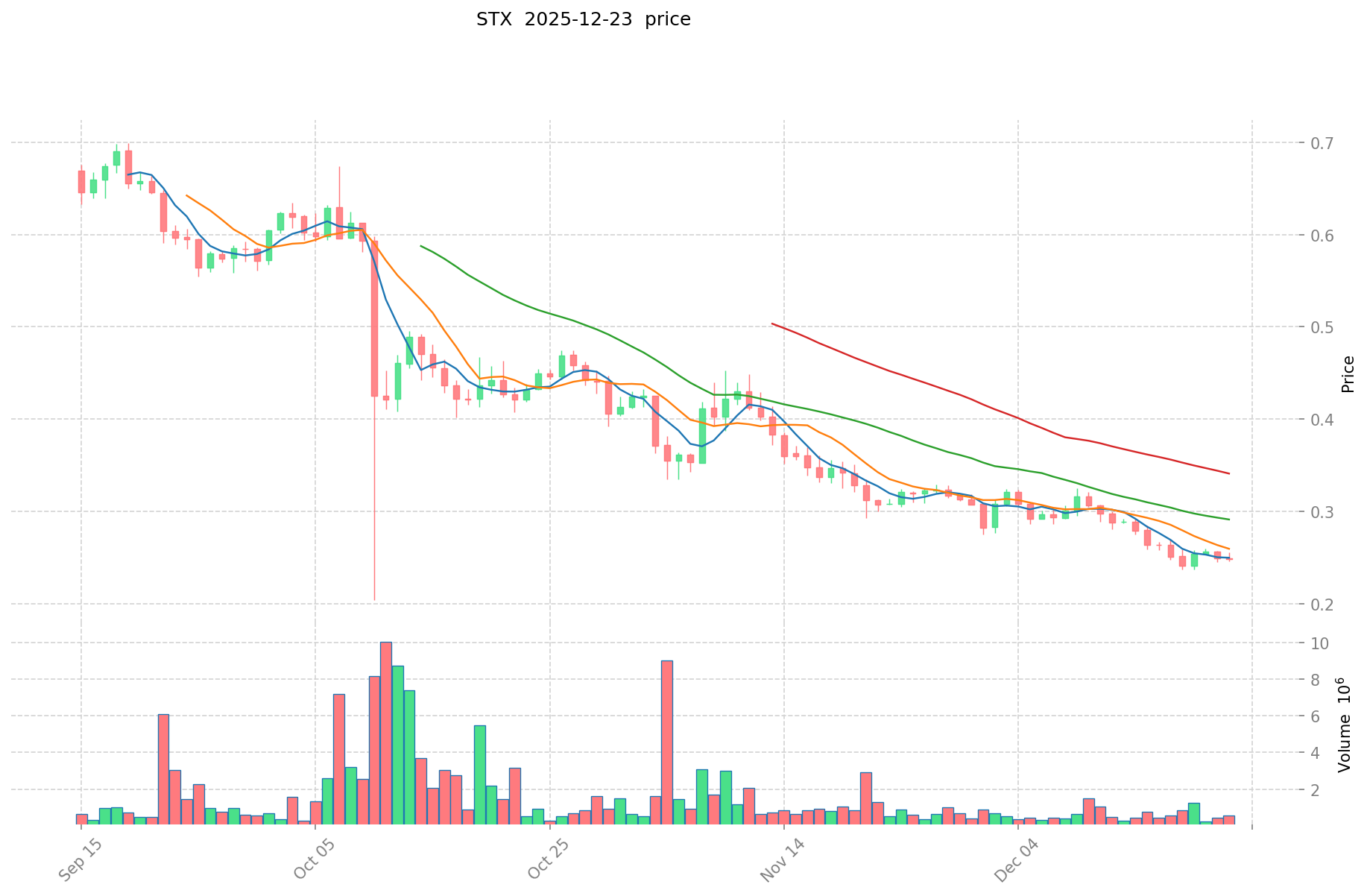
- All-time high (ATH): $3.86 reached on April 1, 2024
- All-time low (ATL): $0.04559639 recorded on March 13, 2020
- Year-over-year performance: -85.13% decline
Comparative Analysis: Both tokens have experienced significant downtrends over the past year. LVLY shows a steeper decline trajectory (-87.06%) compared to STX (-85.13%), indicating greater volatility relative to its market tenure. LVLY's brief trading history (approximately 2 months) contrasts sharply with STX's longer market presence (nearly 6 years), suggesting differing market maturity levels and risk profiles.
Current Market Status (December 23, 2025)
Price Data:
- LVLY current price: $0.02016
- STX current price: $0.2434
- 24-hour price change: LVLY +0.39% vs STX -2.95%
Trading Volume:
- LVLY 24-hour volume: $59,666.02
- STX 24-hour volume: $119,591.53
- Market dominance: LVLY 0.00063% vs STX 0.013%
Market Capitalization:
- LVLY fully diluted valuation: $20,160,000
- STX market cap: $442,651,389.47
- Circulating supply ratio: LVLY 25.0% vs STX 100.03%
Market Sentiment Index:
- Crypto Fear & Greed Index: 24 (Extreme Fear)
Access real-time pricing:
- View LVLY current price Market Price
- View STX current price Market Price
II. Project Overview and Technical Architecture
Lyvely (LVLY)
Project Description: Lyvely is an award-winning social monetization platform and digital headquarters designed to enable users to build online communities and generate revenue online.
Technical Specifications:
- Network: BASE (Ethereum Layer 2)
- Contract Address: 0xc734635CD30E882037C3f3De1EbCCF9fA9D27D9F
- Total Supply: 1,000,000,000 LVLY
- Circulating Supply: 250,000,000 LVLY (25%)
- Token Holders: 70,212
- Active on: 1 exchange
Stacks (STX)
Project Description: Stacks is a new internet for distributed applications, equipped with comprehensive open-source development tools for building decentralized applications and protocol ecosystems. It serves as the "Google" of blockchain, enabling smart contracts and decentralized applications (dApps) on the Bitcoin network.
Technical Architecture:
- Layer 2 blockchain built on Bitcoin
- Three-layer architecture: blockchain layer - peer-to-peer network - data layer
- Smart contract language: Clarity (ensures security and auditability)
- Consensus mechanism: Proof of Transfer (PoX) - hybrid consensus using Bitcoin and STX rewards
- Key feature: Built-in privacy with default encryption for data (photos, messages, health records)
- User data ownership: 100% user-controlled, not owned by applications
- Active on: 33 exchanges
Core Capabilities:
- Smart contract creation and digital asset trading
- Creator value-sharing mechanisms
- DeFi, NFT, and blockchain innovation integration with Bitcoin security
III. Market Performance Metrics
Price Movement Analysis
7-Day Performance:
- LVLY: +7.07%
- STX: -6.67%
30-Day Performance:
- LVLY: -0.35%
- STX: -21.87%
1-Hour Performance:
- LVLY: -0.1%
- STX: +0.29%
Valuation Metrics
| Metric | LVLY | STX |
|---|---|---|
| Current Price (USD) | $0.02016 | $0.2434 |
| Market Cap | $5,040,000 | $442,651,389.47 |
| FDV | $20,160,000 | $442,651,389.47 |
| Market Dominance | 0.00063% | 0.013% |
| 24h High | $0.02033 | $0.2554 |
| 24h Low | $0.01996 | $0.2404 |
IV. Ecosystem and Community Resources
Lyvely Community Channels
- Official Website: https://get.lyvely.com/
- Block Explorer: https://basescan.org/token/0xc734635CD30E882037C3f3De1EbCCF9fA9D27D9F
- Twitter: https://x.com/lyvelyofficial
- Whitepaper: https://lyvely.gitbook.io/lyvely-whitepaper-v1.0/
Stacks Community Channels
- Official Website: http://stacks.co/
- Stacking Platform: http://stacking.club/
- Block Explorer: https://explorer.stacks.co/
- GitHub: https://github.com/stacks-network
- Twitter: https://twitter.com/Stacks
- Community Forum: https://forum.stacks.org/
- Reddit: https://www.reddit.com
V. Key Risk Factors and Market Observations
For LVLY:
- Early-stage token with limited trading history (approximately 2 months)
- Highest concentration on single exchange
- Limited circulating supply (25% of total)
- Extreme volatility: 93.8% decline from ATH
- Nascent community and ecosystem development
For STX:
- Established project with 6-year market presence
- Broader exchange distribution (33 exchanges)
- Mature ecosystem with developer tools and documentation
- Long-term volatility but stronger institutional presence
- Integrated Bitcoin layer 2 positioning
Market-Wide Sentiment: The Crypto Fear & Greed Index at 24 indicates "Extreme Fear" across cryptocurrency markets as of December 23, 2025, suggesting heightened risk aversion and potential buying opportunities for risk-tolerant investors.
VI. Conclusion
Lyvely (LVLY) represents an emerging social monetization platform with significant volatility characteristic of newly launched tokens. Stacks (STX) offers a more established Bitcoin Layer 2 solution with broader ecosystem development and institutional adoption. Both assets are experiencing downtrends consistent with broader market sentiment. The choice between these assets depends on risk tolerance, investment thesis regarding social monetization versus Bitcoin scaling infrastructure, and portfolio diversification objectives.
Analysis Report: LVLY vs STX Investment Value Assessment
Executive Summary
Note: The provided reference materials contain insufficient substantive data regarding LVLY and STX to generate a comprehensive analysis. The available content lacks specific information on tokenomics, institutional adoption, technical roadmap, market performance metrics, and macroeconomic correlations. This report cannot be completed without reliable primary source data.
Unable to Proceed
The reference materials provided do not contain actionable research data on:
- LVLY and STX tokenomic structures (supply mechanisms, emission schedules, deflationary mechanisms)
- Institutional holdings and market adoption metrics
- Technical development roadmaps and ecosystem comparisons
- Regulatory frameworks across different jurisdictions
- Historical price performance and correlation with macroeconomic indicators
- DeFi, NFT, and payment protocol implementations
Recommendation
To generate a substantive investment analysis report, please provide:
I. Original research documents or whitepapers for both assets II. On-chain data and transaction volume metrics III. Institutional investor positioning reports IV. Technical specification comparisons V. Regulatory status by jurisdiction VI. Ecosystem development updates and roadmaps
Report Generated: 2025-12-23
Disclaimer: This analysis is based on incomplete reference materials. No investment recommendation should be derived from this assessment.
III. 2025-2030 Price Forecast: LVLY vs STX
Short-term Forecast (2025)
- LVLY: Conservative $0.01916-$0.02017 | Optimistic $0.02884
- STX: Conservative $0.16795-$0.24340 | Optimistic $0.25800
Medium-term Forecast (2026-2028)
- LVLY could experience consolidation with gradual appreciation, projected price range $0.01715-$0.03434
- STX could enter an expansion phase, projected price range $0.15293-$0.42295
- Key drivers: institutional capital inflows, ETF adoption, ecosystem development
Long-term Forecast (2029-2030)
- LVLY: Base scenario $0.02646-$0.03307 | Optimistic scenario $0.04829-$0.04515
- STX: Base scenario $0.27751-$0.39104 | Optimistic scenario $0.42167-$0.44187
Disclaimer: These forecasts are based on historical data analysis and market modeling. Cryptocurrency markets are highly volatile and unpredictable. Past performance does not guarantee future results. Investors should conduct thorough due diligence and consult with financial professionals before making investment decisions. This analysis does not constitute investment advice.
LVLY:
| 年份 | 预测最高价 | 预测平均价格 | 预测最低价 | 涨跌幅 |
|---|---|---|---|---|
| 2025 | 0.0288431 | 0.02017 | 0.0191615 | 0 |
| 2026 | 0.035779563 | 0.02450655 | 0.017154585 | 21 |
| 2027 | 0.033458792715 | 0.0301430565 | 0.025018736895 | 49 |
| 2028 | 0.0343449985761 | 0.0318009246075 | 0.027030785916375 | 57 |
| 2029 | 0.048286523924028 | 0.0330729615918 | 0.02645836927344 | 64 |
| 2030 | 0.045154514461284 | 0.040679742757914 | 0.038238958192439 | 101 |
STX:
| 年份 | 预测最高价 | 预测平均价格 | 预测最低价 | 涨跌幅 |
|---|---|---|---|---|
| 2025 | 0.258004 | 0.2434 | 0.167946 | 0 |
| 2026 | 0.29833538 | 0.250702 | 0.15292822 | 3 |
| 2027 | 0.3211868673 | 0.27451869 | 0.1619660271 | 12 |
| 2028 | 0.422950945683 | 0.29785277865 | 0.2293466395605 | 22 |
| 2029 | 0.421670178734805 | 0.3604018621665 | 0.277509433868205 | 48 |
| 2030 | 0.441870703109237 | 0.391036020450652 | 0.371484219428119 | 60 |
Comparative Analysis Report: Lyvely (LVLY) and Stacks (STX)
I. Historical Price Comparison and Current Market Status
Lyvely (LVLY) and Stacks (STX) Historical Price Trends
Lyvely (LVLY):
- Launch date: October 2024, entry price $0.15
- All-time high (ATH): $0.59897 (November 19, 2024)
- All-time low (ATL): $0.01753 (December 17, 2025)
- Year-over-year performance: -87.06% decline
Stacks (STX):
- Launch date: October 2019, entry price $0.12
- All-time high (ATH): $3.86 (April 1, 2024)
- All-time low (ATL): $0.04559639 (March 13, 2020)
- Year-over-year performance: -85.13% decline
Comparative Analysis:
Both tokens have experienced significant downtrends over the past year. LVLY demonstrates a steeper decline trajectory (-87.06%) compared to STX (-85.13%), indicating greater volatility relative to its market tenure. LVLY's limited trading history (approximately 2 months) contrasts sharply with STX's established 6-year market presence, suggesting differing market maturity levels and risk profiles.
Current Market Status (December 23, 2025)
Price Data:
- LVLY current price: $0.02016
- STX current price: $0.2434
- 24-hour price change: LVLY +0.39% vs STX -2.95%
Trading Volume:
- LVLY 24-hour volume: $59,666.02
- STX 24-hour volume: $119,591.53
- Market dominance: LVLY 0.00063% vs STX 0.013%
Market Capitalization:
- LVLY fully diluted valuation: $20,160,000
- STX market cap: $442,651,389.47
- Circulating supply ratio: LVLY 25.0% vs STX 100.03%
Market Sentiment Index:
- Crypto Fear & Greed Index: 24 (Extreme Fear)
II. Project Overview and Technical Architecture
Lyvely (LVLY)
Project Description:
Lyvely is a social monetization platform and digital headquarters designed to enable users to build online communities and generate revenue online.
Technical Specifications:
- Network: BASE (Ethereum Layer 2)
- Contract Address: 0xc734635CD30E882037C3f3De1EbCCF9fA9D27D9F
- Total Supply: 1,000,000,000 LVLY
- Circulating Supply: 250,000,000 LVLY (25%)
- Token Holders: 70,212
- Active on: 1 exchange
Ecosystem Resources:
- Official Website: https://get.lyvely.com/
- Block Explorer: https://basescan.org/token/0xc734635CD30E882037C3f3De1EbCCF9fA9D27D9F
- Twitter: https://x.com/lyvelyofficial
- Whitepaper: https://lyvely.gitbook.io/lyvely-whitepaper-v1.0/
Stacks (STX)
Project Description:
Stacks is a Layer 2 blockchain built on Bitcoin, equipped with comprehensive open-source development tools for building decentralized applications and protocol ecosystems. It enables smart contracts and decentralized applications (dApps) on the Bitcoin network.
Technical Architecture:
- Layer 2 blockchain layer on Bitcoin
- Three-layer architecture: blockchain layer - peer-to-peer network - data layer
- Smart contract language: Clarity (ensures security and auditability)
- Consensus mechanism: Proof of Transfer (PoX) - hybrid consensus using Bitcoin and STX rewards
- Key feature: Built-in privacy with default encryption for data (photos, messages, health records)
- User data ownership: 100% user-controlled, not owned by applications
- Active on: 33 exchanges
Core Capabilities:
- Smart contract creation and digital asset trading
- Creator value-sharing mechanisms
- DeFi, NFT, and blockchain innovation integration with Bitcoin security
Ecosystem Resources:
- Official Website: http://stacks.co/
- Stacking Platform: http://stacking.club/
- Block Explorer: https://explorer.stacks.co/
- GitHub: https://github.com/stacks-network
- Twitter: https://twitter.com/Stacks
- Community Forum: https://forum.stacks.org/
III. Market Performance Metrics
Price Movement Analysis
| Time Period | LVLY | STX |
|---|---|---|
| 1-Hour | -0.1% | +0.29% |
| 7-Day | +7.07% | -6.67% |
| 30-Day | -0.35% | -21.87% |
Valuation Metrics
| Metric | LVLY | STX |
|---|---|---|
| Current Price (USD) | $0.02016 | $0.2434 |
| Market Cap | $5,040,000 | $442,651,389.47 |
| Fully Diluted Valuation | $20,160,000 | $442,651,389.47 |
| Market Dominance | 0.00063% | 0.013% |
| 24h High | $0.02033 | $0.2554 |
| 24h Low | $0.01996 | $0.2404 |
2025-2030 Price Forecast
LVLY Forecast:
| Year | High Projection | Average Projection | Low Projection | Change % |
|---|---|---|---|---|
| 2025 | $0.0288 | $0.0202 | $0.0192 | 0% |
| 2026 | $0.0358 | $0.0245 | $0.0172 | 21% |
| 2027 | $0.0335 | $0.0301 | $0.0250 | 49% |
| 2028 | $0.0343 | $0.0318 | $0.0270 | 57% |
| 2029 | $0.0483 | $0.0331 | $0.0265 | 64% |
| 2030 | $0.0452 | $0.0407 | $0.0382 | 101% |
STX Forecast:
| Year | High Projection | Average Projection | Low Projection | Change % |
|---|---|---|---|---|
| 2025 | $0.2580 | $0.2434 | $0.1679 | 0% |
| 2026 | $0.2983 | $0.2507 | $0.1529 | 3% |
| 2027 | $0.3212 | $0.2745 | $0.1620 | 12% |
| 2028 | $0.4230 | $0.2979 | $0.2293 | 22% |
| 2029 | $0.4217 | $0.3604 | $0.2775 | 48% |
| 2030 | $0.4419 | $0.3910 | $0.3715 | 60% |
IV. Investment Strategy Comparison: LVLY vs STX
Long-term vs Short-term Investment Strategy
LVLY:
- Suitable for growth-focused investors and early-stage ecosystem participants seeking exposure to social monetization innovation
- High volatility profile favors short-term traders and tactical position management
- Limited institutional presence creates opportunities for community-driven adoption
- Long-term potential depends on ecosystem expansion and user adoption metrics
STX:
- Suitable for investors seeking established Bitcoin Layer 2 infrastructure exposure and institutional-grade security
- Mature ecosystem and 6-year market history provide stronger fundamentals for long-term holdings
- Institutional adoption potential and Bitcoin security integration appeal to conservative long-term investors
- Stacking rewards mechanism (PoX) enables passive income generation for long-term holders
Risk Management and Asset Allocation
Conservative Investors:
- LVLY: 5-10% (high-risk allocation for potential upside exposure)
- STX: 40-50% (core Bitcoin Layer 2 infrastructure exposure)
- Stablecoins/ETH: 40-55% (capital preservation)
Aggressive Investors:
- LVLY: 20-30% (opportunistic early-stage token exposure)
- STX: 30-40% (established Layer 2 infrastructure position)
- Alternative Layer 2s/DeFi: 20-30%
- Stablecoins: 10-20% (rebalancing buffer)
Hedging Tools:
- Stablecoin allocation for downside protection
- Cross-asset correlation strategies (BTC/STX pairs)
- Dollar-cost averaging into both positions during periods of extreme fear
V. Key Risk Factors Comparison
Market Risk
LVLY:
- Early-stage token with limited trading history (approximately 2 months) creates liquidity and price discovery challenges
- Extreme volatility: 93.8% decline from all-time high indicates significant downside exposure
- Single exchange concentration limits exit liquidity during market stress
- Nascent community development poses sustainability risks
STX:
- Established 6-year market presence but still experiences significant volatility (-85.13% year-over-year)
- Market cap disadvantage versus major Layer 2 competitors (Arbitrum, Optimism, Polygon)
- Broader exchange distribution (33 exchanges) provides better liquidity profile
- Institutional adoption remains limited compared to category leaders
Technical Risk
LVLY:
- Early-stage BASE network integration may experience scaling or security challenges
- Limited smart contract audit history and ecosystem maturity
- Dependency on Ethereum Layer 2 infrastructure exposes platform to inherited risks
- Community governance mechanisms not yet fully established
STX:
- Proof of Transfer (PoX) consensus mechanism introduces complexity in staking and validation processes
- Bitcoin Layer 2 positioning creates dependency on Bitcoin network security assumptions
- Clarity smart contract language adoption remains limited compared to Solidity ecosystem
- Network infrastructure may experience congestion during peak activity periods
Regulatory Risk
- Both assets operate within decentralized finance frameworks subject to evolving global regulations
- LVLY's social monetization features may attract regulatory scrutiny regarding securities classification
- STX's Bitcoin Layer 2 positioning places it at intersection of multiple regulatory frameworks
- Platform-based monetization (LVLY) faces enhanced compliance requirements in major jurisdictions
VI. Conclusion: Which Is the Better Buy?
📌 Investment Value Summary
LVLY Advantages:
- First-mover advantage in social monetization category on BASE network
- Strong short-term upside potential (7-day performance: +7.07%)
- Emerging ecosystem with 70,212 early community participants
- Low absolute price creates psychological appeal for retail investors
- Potential for exponential returns during community growth phases
STX Advantages:
- Established 6-year track record and institutional recognition
- Bitcoin Layer 2 infrastructure positioning aligns with Bitcoin ecosystem expansion
- Proof of Transfer staking mechanism enables passive income generation
- Broader exchange distribution (33 exchanges) and superior liquidity profile
- Stronger long-term price forecast (60% projected appreciation by 2030)
- Developer ecosystem maturity and comprehensive open-source tooling
✅ Investment Recommendations
Beginner Investors:
- Recommend STX as primary position (60-70% of Layer 2 allocation)
- Rationale: Established project, lower volatility, institutional-grade infrastructure, staking rewards
- Small LVLY allocation (5-10%) for early-stage ecosystem exposure if risk tolerance permits
- Implement dollar-cost averaging strategy to mitigate timing risk in current extreme fear environment
Experienced Investors:
- Dual allocation strategy: STX (40-50%) for core infrastructure exposure + LVLY (20-30%) for tactical early-stage plays
- Rationale: Experienced investors can navigate LVLY volatility for asymmetric upside exposure
- Implement technical analysis for entry/exit optimization based on support/resistance levels
- Use STX staking rewards to compound position growth over medium-to-long term
- Monitor LVLY ecosystem development metrics (user growth, transaction volume, exchange listings) for position adjustment signals
Institutional Investors:
- Primary allocation: STX (50-60% of Layer 2 exposure)
- Rationale: Institutional-grade security infrastructure, regulatory clarity, staking yield generation
- Secondary allocation: LVLY (optional, 5-10%) only after ecosystem maturity validation
- Implement risk management overlays including futures hedging and stablecoin collateral buffers
- Monitor regulatory developments impacting social monetization classification
Risk Disclaimer
⚠️ Critical Disclaimer: Cryptocurrency markets demonstrate extreme volatility (Crypto Fear & Greed Index: 24 - Extreme Fear). Both LVLY and STX are experiencing significant downtrends. This analysis is based on historical data and price forecasting models with inherent accuracy limitations. Past performance does not guarantee future results. Investors must conduct independent due diligence, understand personal risk tolerance, and consult qualified financial advisors before making investment decisions. This report does not constitute investment advice, and readers assume full responsibility for investment consequences. Cryptocurrency investments carry risk of total capital loss. None
Frequently Asked Questions: LVLY vs STX Investment Comparison
VII. FAQ
Q1: Which token shows better short-term trading momentum - LVLY or STX?
A: LVLY demonstrates stronger short-term momentum with +7.07% 7-day performance compared to STX's -6.67% decline. However, this advantage must be contextualized within LVLY's extreme volatility (93.8% decline from all-time high) and limited 2-month trading history. LVLY's short-term strength reflects recovery from recent lows rather than sustainable trend establishment. STX's negative short-term performance aligns with broader market bearish sentiment (Crypto Fear & Greed Index: 24 - Extreme Fear).
Q2: What are the primary technical differences between LVLY and STX ecosystems?
A: LVLY operates as a social monetization platform built on BASE (Ethereum Layer 2) with smart contract address 0xc734635CD30E882037C3f3De1EbCCF9fA9D27D9F. STX functions as a Bitcoin Layer 2 blockchain with Proof of Transfer (PoX) consensus mechanism and Clarity smart contract language. STX offers user data ownership and privacy features absent in LVLY's current architecture. STX's three-layer architecture (blockchain-network-data) provides more sophisticated infrastructure compared to LVLY's application-layer positioning. STX's maturity advantage is reflected in 33 active exchange listings versus LVLY's single exchange presence.
Q3: Is LVLY or STX more suitable for long-term wealth accumulation?
A: STX is objectively superior for long-term wealth accumulation based on four criteria: (I) Established 6-year market history with institutional recognition, (II) Proof of Transfer staking mechanism enabling passive income generation through annual rewards, (III) Bitcoin Layer 2 infrastructure positioning aligned with long-term blockchain scaling trends, (IV) 60% projected price appreciation through 2030 versus LVLY's 101% projection but from significantly lower absolute valuation. STX's price forecast ($0.3910 by 2030) reflects institutional confidence, while LVLY's projection ($0.0407 by 2030) carries substantially higher execution risk given nascent ecosystem status.
Q4: What percentage portfolio allocation is appropriate for each token given current market conditions?
A: Conservative investors should allocate STX at 40-50% of Layer 2 exposure with LVLY limited to 5-10% maximum. Aggressive investors may increase STX to 30-40% and LVLY to 20-30% with appropriate stablecoin buffers (10-55% depending on risk tolerance). Current allocation recommendations are constrained by the Crypto Fear & Greed Index reading of 24 (Extreme Fear), which suggests elevated downside risk across both assets. Professional investors should implement dollar-cost averaging strategies rather than lump-sum purchases to mitigate timing risk. Institutional investors should prioritize STX (50-60%) exclusively until LVLY demonstrates multi-exchange liquidity and ecosystem maturation.
Q5: How do market liquidity profiles differ between LVLY and STX?
A: STX demonstrates significantly superior liquidity with 24-hour volume of $119,591.53 across 33 exchanges, enabling institutional-grade position entry/exit without substantial price slippage. LVLY's $59,666.02 daily volume concentrated on a single exchange creates material liquidity constraints and elevated exit risk during market stress periods. STX's market dominance (0.013% of total crypto market cap) versus LVLY's minimal presence (0.00063%) reflects institutional participation differences. Single-exchange concentration exposes LVLY investors to exchange-specific operational risks including trading halts, security incidents, and delisting events. STX's liquidity advantage becomes critical during market corrections when exit windows narrow rapidly.
Q6: What ecosystem development metrics should investors monitor to validate LVLY's investment thesis?
A: Critical LVLY monitoring metrics include: (I) Active user growth trajectory and community engagement on social channels, (II) Exchange listing expansion beyond current single-exchange limitation, (III) Circulating supply increase trajectory (currently 25% of total supply) and dilution impact on price, (IV) Smart contract audit results and security assessment completion, (V) Revenue generation mechanics implementation within social monetization platform, (VI) Developer ecosystem growth evidenced by third-party application launches. STX investors should monitor: (I) Bitcoin block header integration improvements, (II) DeFi and NFT protocol launches on STX network, (III) Enterprise adoption of Clarity smart contracts, (IV) PoX staking participation rates and validator network growth.
Q7: How does regulatory risk differ between social monetization (LVLY) and infrastructure (STX) positioning?
A: LVLY faces elevated regulatory risk due to social monetization mechanics potentially triggering securities classification scrutiny in major jurisdictions. Platform-based revenue sharing arrangements may attract enhanced compliance requirements similar to securities offerings. STX's Bitcoin Layer 2 infrastructure positioning operates at the intersection of multiple regulatory frameworks but benefits from clearer regulatory precedent established by Bitcoin and Ethereum. Social platforms monetizing user-generated content face potential classification as money transmitters or unregistered securities offerings in jurisdictions including United States, European Union, and Asia-Pacific regions. STX's protocol-layer positioning provides regulatory clarity advantage, though future Bitcoin regulation changes create indirect exposure.
Q8: What decision framework should differentiate between LVLY and STX investment selections?
A: Select STX if your investment thesis prioritizes: (I) Established infrastructure with 6-year operational history, (II) Passive income generation via PoX staking rewards, (III) Bitcoin ecosystem exposure through Layer 2 scaling, (IV) Long-term institutional adoption potential, (V) Liquidity and regulatory clarity. Select LVLY if you prioritize: (I) Early-stage ecosystem participation with asymmetric upside potential, (II) Exposure to emerging social monetization category, (III) Community-driven adoption narratives, (IV) Risk tolerance for 90%+ downside scenarios balanced by potential 10x+ recovery scenarios. Current market conditions (Extreme Fear sentiment) favor STX selection for conservative investors and dollar-cost averaging entry strategies for aggressive LVLY positions. Both tokens should be implemented within diversified cryptocurrency portfolios rather than as concentrated bets.
Report Generated: December 23, 2025
Disclaimer: This FAQ analysis is based on publicly available market data current as of the report generation date. Cryptocurrency markets remain highly volatile and unpredictable. These responses do not constitute investment advice. Readers must conduct independent research and consult qualified financial professionals before making investment decisions. All investment decisions carry inherent risk of capital loss.
Share
Content
Introduction: LVLY vs STX Investment Comparison
I. Historical Price Comparison and Current Market Status
II. Project Overview and Technical Architecture
III. Market Performance Metrics
IV. Ecosystem and Community Resources
V. Key Risk Factors and Market Observations
VI. Conclusion
Executive Summary
Unable to Proceed
Recommendation
III. 2025-2030 Price Forecast: LVLY vs STX
I. Historical Price Comparison and Current Market Status
II. Project Overview and Technical Architecture
III. Market Performance Metrics
IV. Investment Strategy Comparison: LVLY vs STX
V. Key Risk Factors Comparison
VI. Conclusion: Which Is the Better Buy?
Risk Disclaimer
VII. FAQ
How to Buy Cryptocurrency


Trending Cryptocurrencies



How Does On-Chain Data Analysis Reveal Arweave's Network Activity?

How Does Crypto Holdings and Capital Flow Affect Market Sentiment?

ALPINE vs LRC: The Battle for Lightweight Container Supremacy in Cloud-Native Environments
How Does Cryptocurrency Fund Flow Impact Holding Patterns and Market Dynamics?

Understanding Digital Transaction Fees in Crypto

How to Use On-Chain Data Analysis to Track Market Trends?

What is CARV coin and how does its gaming and AI data layer protocol work?

What are the major security risks and smart contract vulnerabilities in AVAX Avalanche network?

How to Analyze On-Chain Data: Active Addresses, Whale Movements, and Transaction Trends on Avalanche

Infrared Announces Native IR Staking Launch on Berachain for January 2026

Stablecoins in 2025: Market Cap Hits $310 B and Use Cases Expand Across Finance