Discussion around the role of the ACN token usually centers on three core questions: whether the token has real use cases, whether fee payments are tied to network services, and whether the deflationary mechanism can connect platform usage with changes in supply.
This issue can be understood through six areas: network positioning, the payment model, AI services, the deflationary mechanism, staking rewards, and supply and demand. Among them, payment and deflation are the two most important variables in ACN’s token economic model.
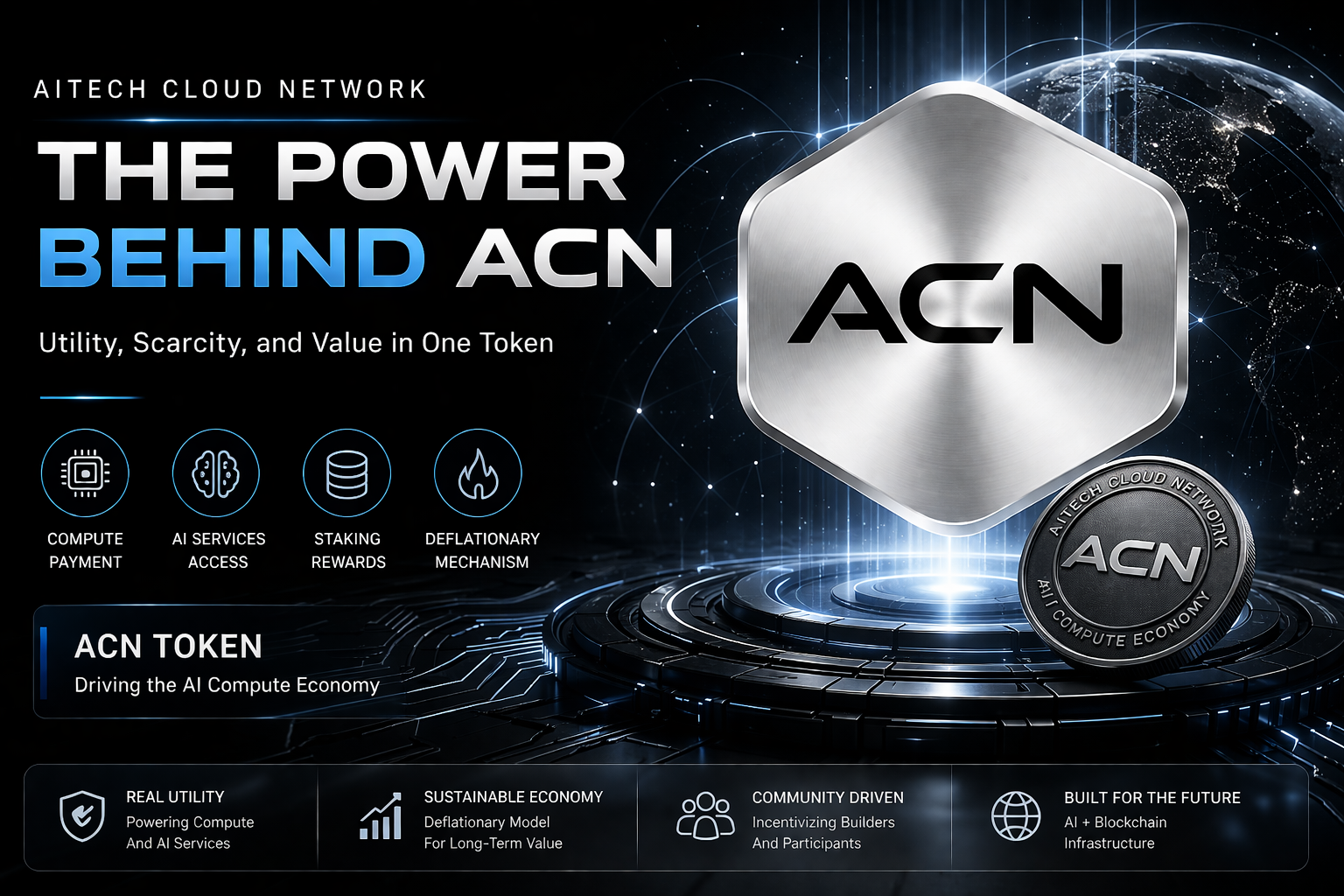
What the ACN Token Is and Its Position in the Network
The ACN token is the native economic asset of AITECH Cloud Network. It mainly serves payment, settlement, incentive, and ecosystem coordination functions. In simple terms, ACN connects AI compute usage, Agent service calls, and network economic activity within one shared settlement system.
Structurally, ACN sits in the network’s economic layer, forming a complete AI infrastructure together with the compute layer and the AI Agent orchestration layer. First, users or developers submit requests for compute power, models, or Agent services. The system then calls the corresponding resources based on the service type, such as GPU clusters, AI models, or automated Agents. Next, fees are paid or settled through ACN. Finally, the token enables value to circulate among users, service providers, and ecosystem participants.
The importance of this positioning is that ACN is not a standalone asset detached from the product. It is a functional token embedded in the compute service process. Only when compute power, Agents, and AI services are used continuously can the token’s payment and settlement functions become visible within the network.
Core Token Functions and Ecosystem Role
The token’s core functions can be summarized as compute payment, AI service access, Agent task settlement, staking incentives, and ecosystem coordination. At its core, ACN brings different AI infrastructure services into one settleable economic system.
In practice, when users need computing resources or AI tools, they enter the Compute Marketplace, Agent Forge, or related service portals. The system then determines the fee structure based on the task type, such as GPU rental, model calls, Agent deployment, or service subscriptions. Users then pay fees with the token, and service providers or network participants receive the corresponding income. In the end, the ecosystem maintains service supply through payments, rewards, and staking mechanisms.
| Function Category |
Main Use |
Corresponding Scenario |
| Compute payment |
Pays for GPU computing resources |
AI training, inference, large scale tasks |
| AI service access |
Calls models and tools |
Agent Forge, model services |
| Task settlement |
Pays Agent execution fees |
Automated workflows, on chain interactions |
| Staking incentives |
Encourages long term participation |
Network stability, user rewards |
| Deflationary mechanism |
Adjusts token supply |
Buybacks, burns, supply management |
This table shows that the role of the ACN token is not limited to single point payments. It runs through the entire process of service use, resource allocation, ecosystem incentives, and supply management. For an AI compute network, whether the token is tied to real services is the foundation for judging whether its economic model is effective.
How the Token Is Used for Compute and AI Service Payments
The core of ACN’s payment model is to turn AI compute power and service calls into billable on chain economic activity. Through token payments, users can access GPU compute power, model deployment, AI inference, Agent services, and other resources.
In terms of the usage process, users first choose the service they need, such as GPU compute power, an AI model, data processing, or Agent task execution. The system then calculates the fee based on task complexity, compute consumption, and service type. Next, users pay with ACN, and the network allocates the request to the corresponding resource or service module. Finally, the system returns the computation result, model output, or Agent execution result, while also completing fee settlement.
The importance of this mechanism is that compute resources are no longer just backend infrastructure. They become service units that can be clearly priced and called. For developers, token payments reduce the complexity of cross service settlement. For the network, higher service usage means payment demand and transaction activity can better reflect ecosystem activity.
How the Deflationary Mechanism Affects ACN Token Supply
ACN’s deflationary mechanism is centered on reducing the circulating market supply through buybacks or burns, creating a link between platform revenue and changes in token supply. This mechanism can be understood as a supply adjustment method driven by network usage.
In the operating process, users first use the Compute Marketplace, Agent Forge, or related AI services and pay fees. The platform then takes a certain percentage from service revenue or transaction fees for token buybacks or burns. The burned tokens are then permanently removed from circulating supply. As network services continue to be used, token supply is affected by the burn mechanism.
The effect of this mechanism is that it connects ecosystem revenue with token scarcity. For ACN, the deflationary effect is not a standalone narrative. It depends on whether compute leasing, AI service calls, and Agent task execution can generate steady demand. If network usage is low, the scale of burns will also be limited. If service revenue expands, the burn mechanism will have a more noticeable impact on the supply structure.
How Staking and Reward Mechanisms Incentivize Network Participants
Staking and reward mechanisms are mainly used to increase network participation and user retention. Their core purpose is to create a closer relationship between token holders and ecosystem service use through yield, discounts, or rights based designs.
Structurally, users first stake tokens into a designated mechanism to obtain participation eligibility or ecosystem rights. The system then distributes rewards based on staking amount, duration, or specific rules. Some rewards may take the form of yield, service discounts, compute discounts, or ecosystem access rights. Finally, the staking mechanism reduces short term circulation to some extent and strengthens the connection between users and network services.
The impact of this design is that staking is not only about reward distribution. It can also serve real usage scenarios. For example, if heavy developers or enterprise users receive compute discounts through staking, token holding becomes connected to GPU resource consumption. For the network, staking can help improve ecosystem stickiness, but its effectiveness still depends on whether service demand and reward sources are sustainable.
How the Token Model Affects ACN Supply and Demand
The token model affects ACN’s supply and demand mainly through four variables: payment demand, service revenue, staking lockups, and deflationary burns. In other words, supply and demand are not determined only by token issuance. They are also shaped by network usage frequency and ecosystem revenue.
In the actual process, users first generate demand for compute power or AI services, creating payment side demand. Services such as the Compute Marketplace and Agent Forge then generate revenue, part of which may enter the buyback or burn mechanism. Staking may also reduce part of the circulating supply. Ultimately, payment demand, burn scale, and staking lockups jointly influence the effective circulating structure in the market.
| Variable |
Impact on Demand |
Impact on Supply |
| Compute payment |
Increases demand for service use |
No direct reduction |
| AI service calls |
Increases application payment demand |
No direct reduction |
| Staking mechanism |
Strengthens holding incentives |
Reduces short term circulation |
| Deflationary burn |
Depends on platform revenue |
Permanently reduces supply |
| Ecosystem growth |
Expands the scope of service use |
Indirectly affects burn scale |
This table shows that the key question in ACN’s token model is not simply whether deflation exists, but whether that deflation is driven by real revenue. The token’s supply and demand relationship ultimately depends on whether AI compute power, Agent services, and ecosystem applications achieve sustained usage.
Conclusion
The ACN token serves payment, settlement, staking, incentive, and supply adjustment functions within AITECH Cloud Network. Its core process includes users submitting compute or AI service requests, the system calling corresponding resources, users paying with tokens, the network delivering services, and staking or burn mechanisms affecting ecosystem participation and token supply.
Overall, the value logic of the ACN token is built on the relationship among AI compute demand, Agent service usage, platform revenue, the deflationary mechanism, and staking incentives. Its functionality does not come only from the token design itself, but also from whether network services are used continuously.
FAQ
What Is the Role of the ACN Token?
The ACN token is mainly used to pay for GPU compute power, AI services, Agent tasks, and ecosystem fees within AITECH Cloud Network. It may also be used for staking rewards, deflationary mechanisms, and network economic activity.
How Is the ACN Token Used for AI Compute Payments?
After users select GPU compute power or AI services, the system calculates fees based on task type and resource consumption. Users pay with ACN, and the network allocates the corresponding resources and returns the computation results.
What Does ACN’s Deflationary Mechanism Mean?
ACN’s deflationary mechanism refers to reducing circulating supply through buybacks or burns. Its logic is usually tied to platform revenue or service usage, with the goal of linking network activity to changes in token supply.
What Is the Purpose of ACN Staking?
ACN staking can be used to encourage long term participation and may provide rewards, compute discounts, or ecosystem rights. Its role is to reduce short term circulation while strengthening the connection between users and network services.
Does the ACN Token Model Affect Supply and Demand?
Yes. ACN’s supply and demand are jointly affected by compute payments, AI service calls, staking lockups, and deflationary burns. Real service usage is the key variable in judging whether the token model is effective.







