Tea Protocol is a decentralized, open-source software platform built on the Base layer-2 blockchain. It recognizes open-source contributors and rewards developers, empowering them.
Tea Protocol is a decentralized open-source software platform built on the Base Layer 2 blockchain. Its mission is to establish an open, public, and stable registry for all open-source software, enabling individual developers to monetize their projects.
Tea Protocol introduces a revolutionary consensus mechanism called "Proof of Contribution" to measure the value, status, and impact of open-source software projects. This system assigns a dynamic score—teaRank—to each project and distributes rewards accordingly.
In December of the same year, Tea Protocol raised an additional $8.9 million in an extended seed round from investors including WAX, StrongBlock, Betaworks, and Percival VC, bringing total funding to $16.9 million.
In February 2024, its testnet officially launched, rekindling market momentum.
Tea Protocol co-founder and CEO Max Howell brings extensive experience in Web2 and Web3 open-source software. He created Homebrew—one of the world's most influential open-source package management tools, now one of the most widely adopted open-source projects in the developer ecosystem.
Tea Protocol co-founder and CEO Max Howell has deep experience in Web2 and Web3 open-source software. He created Homebrew, one of the most widely contributed open-source software projects globally.
Key Components of Tea Protocol
Tea Protocol is a decentralized technical protocol powered by Proof of Contribution. Its core components include a package manager, a decentralized registry, and a storage system.
Package Manager
The four essential tools engineers need to build applications are a browser, terminal, editor, and package manager. The package manager orchestrates the tools and frameworks required for development, tracking every open-source dependency from the top down. Each project and package version records all necessary components and their exact versions.
Decentralized Registry
Every package manager comes with a built-in registry that often contains duplicate metadata. In some cases, registry data may be inconsistent with the project manifest, allowing malicious actors to inject harmful code undetected. Tea Protocol leverages blockchain technology to create a decentralized registry. As an immutable distributed ledger, the blockchain ensures that all version data remains secure, verifiable, and tamper-proof.
Technology evolves rapidly, and so do hacker methods, leaving software programs vulnerable to attacks. In addition to the decentralized registry, Tea Protocol embeds incentive and penalty mechanisms to protect the software supply chain.
Storage System
Open-source packages are feature-rich. Tea Protocol aims to be cross-compatible with major package managers such as Homebrew, npm, APT, Crate, PyPI, RubyGems, and pkgx. Developers can continue using their familiar package managers while enjoying the version security and immutability offered by Tea's decentralized registry. This cross-compatibility paves the way for seamless integration with existing ecosystems, providing a more flexible and reliable option.
Today, most open-source software struggles due to a lack of incentives. With reasonable economic rewards, more developers can build, improve, and update open-source software, thereby driving the entire tech industry. Tea Protocol's vision is to empower the open-source community and ensure that those building the internet's core infrastructure receive the support they deserve.
Proof of Contribution is the key innovation—a novel consensus mechanism that quantifies the impact of each project within the open-source ecosystem. It assigns a dynamic score (teaRank) based on the project's position within the ecosystem and its adoption across the broader ecosystem over time. This mechanism favors underlying software (often less visible than application-layer projects) and extends rewards to all components that contribute to a project's success.
Proof of Contribution also identifies and isolates useless packages, ensuring that only impactful projects receive fair rewards. Full technical details will be outlined in a dedicated whitepaper.
TEA Tokenomics
Any TEA holder can stake tokens in open-source software projects registered on Tea Protocol. The web application provides a simple staking interface for all participants.
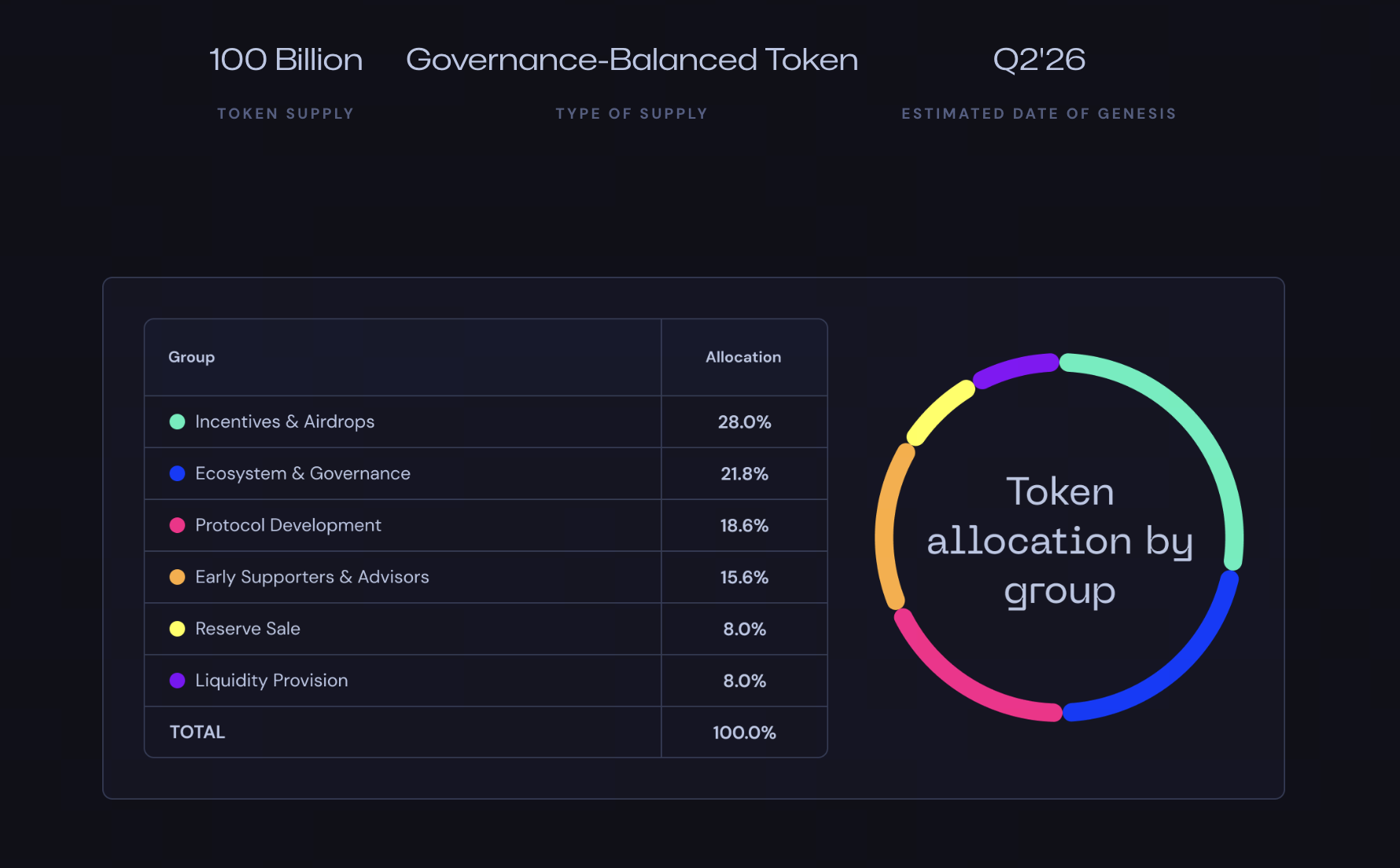
The TEA issuance schedule determines the speed at which tokens enter circulation. At the Token Generation Event (TGE), approximately 19% of the maximum supply will be unlocked. Nearly half of the circulating tokens at TGE will be allocated to the DAO for governance purposes.
Four types of participants are eligible to receive TEA through protocol incentive issuance: open-source software project maintainers, Tea community members, project supporters, and bug reporters.
As the native token of Tea Protocol, TEA grants holders the following rights:
Stake TEA into specific packages to provide support.
Contribute to software supply chain security by challenging packages, conducting reviews, and reporting vulnerabilities or security flaws.
Support open-source software projects and protect the supply chain through staking, including the right to challenge project codebases via reviews and vulnerability reports. Additionally, reward registered open-source developers and participate in Tea Protocol governance.
Future Development
As Tea Protocol evolves, the community will drive changes and expansion through governance. The following are future plans for different stakeholders:
For Wholesalers:
The open-source community continuously generates new software, and each development affects upstream and downstream dependencies, causing frequent fluctuations in loan-to-value (LTV) ratios and rewards. Tea Protocol plans to build a system that dynamically monitors each project's LTV ratio and automatically rebalances TEA allocations based on stakers' preferences.
For Software Royalties:
Package maintainers can transfer their rewards to one or more developers. Such transfers must be managed solely by the maintainer and their partners, with no TEA intervention. Tea Protocol will provide tools to support full or partial transfers and allow staking rewards to be automatically distributed across multiple accounts—whether through multiple participants, a single account under one controller, or using static or dynamic ratios.
Regarding Reward Distribution Among Multiple Maintainers:
Maintaining a software package often involves multiple teams. Before TEA rewards begin to flow, teams should consider automated value distribution. The distribution method must be determined at the discretion of the maintainers who best understand contributions and rewards. Each team (or multiple teams) can establish a DAO to automatically distribute rewards, or implement more complex systems based on DAO member voting, ongoing contributions, completed bounties, or time allocation.
Regarding Software Package Forks:
We believe forks are necessary but often underutilized. Forks have great potential when they gain competitive advantages in functionality, performance, security, or visibility. However, forks must acknowledge original contributions. Through future work or potential contributions, the Tea community may strengthen the system to require declaring forks, or even automatically detect forks upon submission. Undeclared forks discovered by validators could result in partial slashing of staked tokens, with the slashed amount transferred to the original package maintainer and the validator who discovered the fork.
Runtime Dependencies vs. Build Dependencies:
At launch, Tea may not distinguish between build dependencies and runtime dependencies when distributing rewards. However, if the community strongly requests differentiation, a proposal can be made to improve the staking reward algorithm to consider the importance of each dependency and its value contribution to the dependent package. Such proposals will be voted on and implemented based on community decisions.
Summary
Tea Protocol addresses the chronic undercompensation of open-source developers, breaks down barriers between programming communities, and opens the entire ecosystem. It introduces revolutionary sustainability, ensuring that developers' contributions are rewarded and recognized.
Tea Protocol's official V1.0 mainnet is expected to launch in June, followed by the TEA token issuance. With Binance leading the investment, its market cap and token price have significant upside potential. Although Tea Protocol has not yet launched, zero-barrier point tasks are now open, and everyone is welcome to actively participate.
Author: Grace
Translator: Piper
Reviewer(s): KOWEI、Wayne、Hin、Ashley、Joyce
Disclaimer
* The information is not intended to be and does not constitute financial advice or any other recommendation of any sort offered or endorsed by Gate.
* This article may not be reproduced, transmitted or copied without referencing Gate. Contravention is an infringement of Copyright Act and may be subject to legal action.
Solana faces both opportunities and challenges in its development. Recently, severe network congestion has led to a high transaction failure rate and increased fees. Consequently, some have suggested using Layer 2 and appchain technologies to address this issue. This article explores the feasibility of this strategy.
Sui is a PoS L1 blockchain with a novel architecture whose object-centric model enables parallelization of transactions through verifier level scaling. In this research paper the unique features of the Sui blockchain will be introduced, the economic prospects of SUI tokens will be presented, and it will be explained how investors can learn about which dApps are driving the use of the chain through the Sui application campaign.
This article introduces the technical principles, framework, and applications of Zero-Knowledge (ZK) technology, covering aspects from privacy, identity (ID), decentralized exchanges (DEX), to oracles.
Tronscan is a blockchain explorer that goes beyond the basics, offering wallet management, token tracking, smart contract insights, and governance participation. By 2025, it has evolved with enhanced security features, expanded analytics, cross-chain integration, and improved mobile experience. The platform now includes advanced biometric authentication, real-time transaction monitoring, and a comprehensive DeFi dashboard. Developers benefit from AI-powered smart contract analysis and improved testing environments, while users enjoy a unified multi-chain portfolio view and gesture-based navigation on mobile devices.