From an industry perspective, shared security is fast becoming a cornerstone of the modular blockchain era. As the number of Rollups, application chains, and decentralized service networks continues to rise, more protocols are seeking to leverage the security resources of mature blockchains to lower their cold-start costs.
In this landscape, Babylon and EigenLayer represent two distinct paths: Bitcoin Security and Ethereum Restaking.
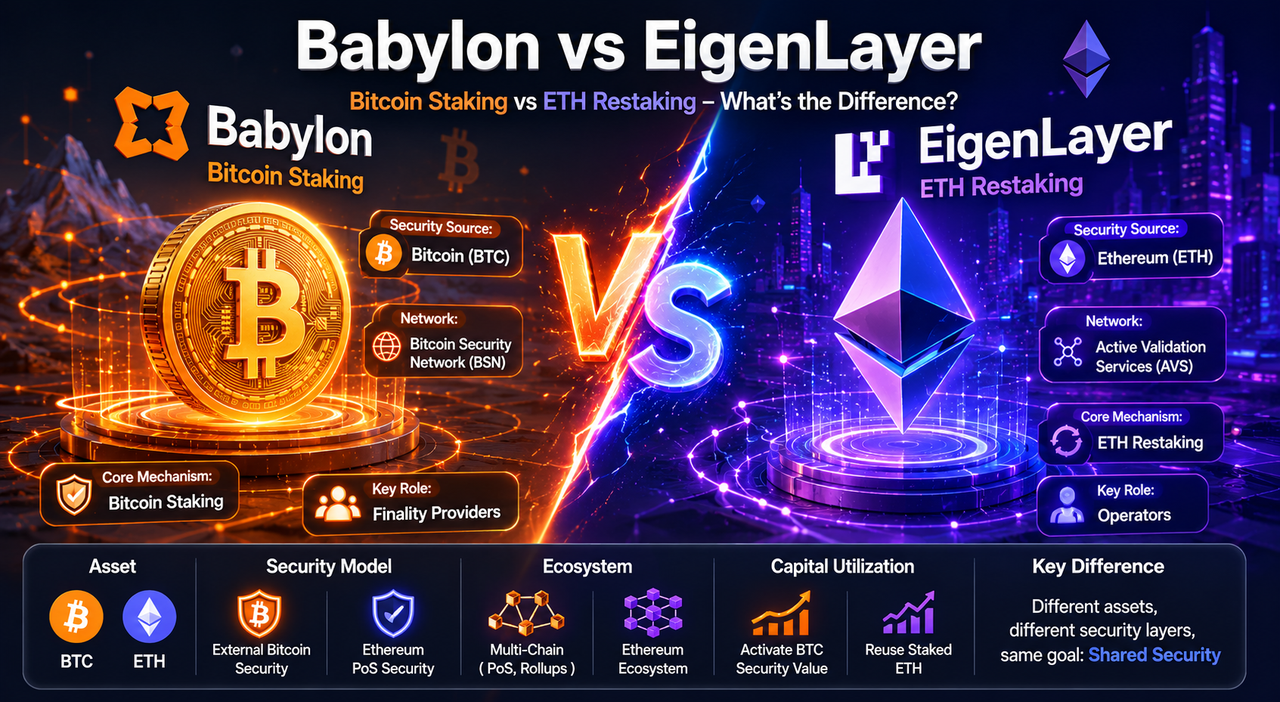
What Is Babylon?
Babylon is a shared security protocol built on Bitcoin Staking that aims to leverage Bitcoin's security to provide economic security guarantees across multiple blockchain networks.
In Babylon's architecture, BTC holders can lock their assets via Bitcoin Staking and participate in building the Bitcoin Security Network (BSN). By combining a timestamping protocol, Finality Provider, and a shared security model, Babylon transforms Bitcoin from a store of value into a cross-chain security resource.
Babylon’s core value lies in unlocking the massive economic security scale Bitcoin has accumulated and applying it to PoS networks, application chains, and the modular blockchain ecosystem.
What Is EigenLayer?
EigenLayer is a Restaking protocol within the Ethereum ecosystem. Its core mission is to enable already-staked ETH to be reused across other protocols and services.
In EigenLayer's model, users can re-delegate their staked ETH or liquid staking tokens (LSTs) to additional networks, thereby providing security support for Active Validation Services (AVS).
This design allows the same ETH to simultaneously secure both the Ethereum mainnet and external protocols—hence the term "Restaking."
The Core Difference Between Bitcoin Staking and ETH Restaking
The most fundamental difference between Babylon and EigenLayer lies in the source of their security assets.
Babylon leverages BTC to build a shared security system. Bitcoin Staking does not participate in Bitcoin's consensus—instead, it uses BTC's economic value to secure other networks.
EigenLayer, by contrast, uses ETH that is already participating in Ethereum's consensus. Restaking is essentially the reuse of existing staked assets to serve multiple protocols at once.
In short, Bitcoin Staking emphasizes introducing new security sources, while ETH Restaking focuses on reusing existing security resources.
How Their Security Models Differ
The security model is one of the most distinctive dimensions.
Babylon's Security Source
Babylon's security derives primarily from the economic scale and decentralization that the Bitcoin network has built up over time.
BTC does not participate in Babylon's own consensus; it exists as an external economic security resource.
This model allows Babylon to inherit Bitcoin's security strengths without needing to modify the Bitcoin protocol directly.
EigenLayer's Security Source
EigenLayer's security comes from Ethereum's established PoS system.
The ETH used in Restaking already serves as validation on the Ethereum mainnet, so EigenLayer effectively builds a secondary security market on top of the existing security layer.
This approach improves capital efficiency but also adds complexity to staking responsibilities.
How Their Network Architectures Differ
Babylon and EigenLayer also differ significantly in overall architecture.
Babylon's Network Structure
Babylon consists of:
- Bitcoin Staking Layer
- Bitcoin Timestamping Layer
- Babylon Genesis
- Finality Provider
- Bitcoin Security Network (BSN)
The entire system revolves around BTC as its core security resource.
EigenLayer's Network Structure
The EigenLayer ecosystem includes:
- Ethereum Validator
- Restaker
- Operator
- Active Validation Service (AVS)
The entire system is built around the Ethereum validator network.
Thus, Babylon functions more as a Bitcoin security extension layer, while EigenLayer operates as an Ethereum security market platform.
Differences in Target Audiences
Though both belong to the shared security track, they serve different ecosystems.
Babylon primarily targets:
- Cosmos application chains
- Modular blockchains
- Rollup networks
- Bitcoin Layer 2
- PoS public chains
EigenLayer mainly serves:
- Ethereum AVS
- Data availability networks
- Oracle networks
- Decentralized sequencers
- Ethereum infrastructure protocols
This divergence means their ecosystem expansion paths are not fully overlapping.
How Verification Mechanisms Work
The verification mechanisms reflect two different approaches to shared security.
Babylon introduces a Finality Provider to deliver finality confirmation services and strengthens security with a timestamping protocol.
EigenLayer, on the other hand, uses Operators to perform the verification tasks demanded by AVS.
In Babylon, the emphasis is on channeling BTC as a security resource to external networks. In EigenLayer, the focus is on having ETH validators take on additional duties.
Core Differences Between Babylon and EigenLayer
| Comparison Dimension |
Babylon |
EigenLayer |
| Core Asset |
BTC |
ETH |
| Security Model |
Bitcoin Staking |
ETH Restaking |
| Ecosystem |
Bitcoin |
Ethereum |
| Security Source |
Bitcoin economic security |
Ethereum validator security |
| Main Participants |
BTC holders |
ETH stakers |
| Core Role |
Finality Provider |
Operator |
| Target Networks |
PoS chains, app chains, Rollups |
AVS and infrastructure protocols |
| Shared Security Form |
Bitcoin Security Network |
Restaking Security Market |
| Capital Utilization Method |
Activate BTC security value |
Reuse ETH security value |
| Core Concept |
Bitcoin Security |
Ethereum Restaking |
Which Model Is Better for Shared Security Development?
Babylon and EigenLayer are not direct substitutes—they represent two different paths for shared security.
Babylon emphasizes bringing Bitcoin security into a multi-chain world, making BTC a reusable security resource.
EigenLayer emphasizes improving the utilization of Ethereum staked assets, providing security services to a wide range of infrastructure protocols.
From an industry perspective, both models are advancing shared security and are likely to coexist in different ecosystems for the long term.
Summary
Both Babylon and EigenLayer are building shared security infrastructure, but their core logics are fundamentally different. Babylon, based on Bitcoin Staking, extends BTC security to multi-chain ecosystems and constructs the Bitcoin Security Network. EigenLayer, through ETH Restaking, reuses Ethereum validator security to provide security guarantees for Active Validation Services.
From asset sources and verification models to ecosystem structures and target audiences, the two represent the shared security paths of the Bitcoin and Ethereum ecosystems, respectively.
FAQs
What is the biggest difference between Babylon and EigenLayer?
The biggest difference lies in their security sources. Babylon uses BTC to build a shared security system, while EigenLayer reuses already-staked ETH for security.
Are Bitcoin Staking and Restaking the same concept?
Both are shared security mechanisms, but they differ in execution. Bitcoin Staking uses BTC to provide security resources, while Restaking reuses already-staked ETH to provide security services again.
Can EigenLayer only serve the Ethereum network?
EigenLayer is built on the Ethereum ecosystem, but it serves not only Ethereum itself but also various Active Validation Services (AVS), decentralized infrastructure, and extension protocols.
What is the difference between the Bitcoin Security Network (BSN) and AVS?
BSN is a shared security network built by Babylon that leverages BTC for security. AVS is a collection of external services in EigenLayer that require security support. They operate at different conceptual levels.
Do Babylon and EigenLayer compete with each other?
Both belong to the shared security track, so they are conceptually competitive. However, because they rely on different underlying assets and ecosystems, they are better seen as explorations of different technical routes.