These differences are not just about which stocks are included—they also show up in how these companies make money, how they are valued, and where market risks come from. Understanding the key differences between EUSTX50 and US500 gives you a broader lens to track global capital flows and the distinct growth patterns of different economies.
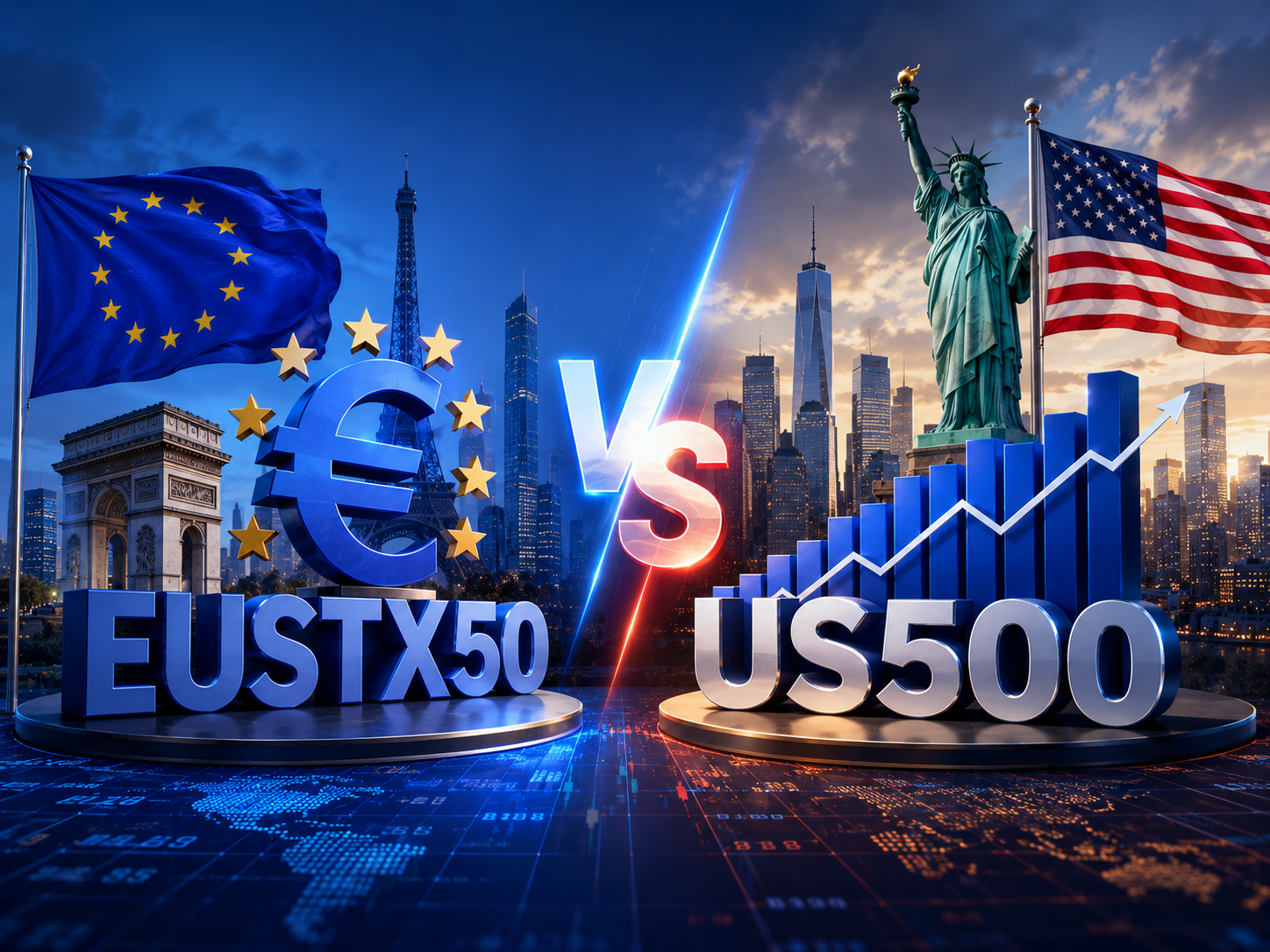
What Is EUSTX50?
EUSTX50—the Euro Stoxx 50 Index—is one of Europe's flagship blue-chip indices. It picks the 50 largest and most liquid companies from the eurozone's big-cap universe, making it a go-to barometer for the European economy.
Unlike single-country indices, EUSTX50 covers core eurozone economies like France, Germany, the Netherlands, Spain, and Italy. Its components span industrials, financials, energy, consumer goods, healthcare, and tech—so it paints a pretty comprehensive picture of how European businesses are performing overall.
Companies like ASML, SAP, LVMH, Hermès, Siemens, Airbus, and Allianz have been mainstays at the index's core. These aren't just big players in Europe—they're global heavyweights in their sectors.
From a market standpoint, EUSTX50 is essentially a concentrated snapshot of Europe's real economy muscle.
What Is US500?
US500 tracks the S&P 500 Index—one of the most-watched stock benchmarks worldwide. It covers 500 large-cap U.S. companies and captures the most critical industries in the American economy.
Over the last two decades, the U.S. tech sector has been on a roll. Microsoft, Apple, Nvidia, Alphabet, Amazon, and Meta have become the engine driving the index upward. Meanwhile, the U.S. capital market hosts the world's most mature venture capital ecosystem and innovation pipeline, giving tech companies room to keep growing.
So US500 isn't just a U.S. economic gauge—it's also a powerful lens on global tech innovation and digital economy trends.
From a global capital allocation perspective, US500 has become the essential benchmark for international investors sizing up risk assets.
How Their Industry Structures Differ
Industry makeup is the most fundamental difference between the two.
America's growth over the past decade-plus has been almost all about tech. From mobile internet and cloud computing to AI, big U.S. tech firms have kept expanding their market share and their weight in the index. Today, US500's performance is tightly tied to the tech sector.
Europe, by contrast—represented by EUSTX50—has a much more balanced industry mix.
Europe leads in industrial manufacturing, luxury conglomerates, energy, and financial services. So the index weight is spread across industrial automation, premium manufacturing, consumer brands, insurance, finance, and energy. ASML stands for advanced semiconductor gear, LVMH and Hermès for global luxury, and Siemens and Schneider Electric for Europe's industrial engineering prowess.
This structural difference means the two indices react differently to economic cycles. When AI, software, and the digital economy are booming, the U.S. market typically outperforms. But when global manufacturing picks up, consumer demand rises, or energy prices climb, Europe tends to benefit more.
At its core, US500 is more of a growth market; EUSTX50 is more of a mature-industry market.
How Their Profit Models Differ
Industry structure eventually shapes how companies make money.
US500 components tend to build their profits on technology platforms and intellectual property. Microsoft's subscription model, Alphabet's ad business, Amazon's cloud services, and Meta's social platforms are all highly scalable digital businesses.
The big advantage of digital businesses? Low marginal costs. As their user bases grow, revenue usually outpaces costs. That's why U.S. tech companies often enjoy higher margins and faster profit growth.
EUSTX50 companies lean more on tangible economic activity.
Whether it's Airbus building planes, Siemens selling industrial equipment, or LVMH moving luxury goods—these businesses depend on production capacity, supply chains, and global consumer demand. They grow slower than digital platforms, but their profits tend to be more stable.
That's why U.S. stocks often command a growth premium, while European stocks appeal more to value-focused investors.
How Their Weight Concentration Differs
In recent years, the U.S. market has seen a "super-weighted stock phenomenon."
As tech giants' market caps keep soaring, Microsoft, Apple, Nvidia, Alphabet, Amazon, and Meta have an outsized influence on the index. In some periods, just a few names can drive the entire index higher.
That structure can supercharge returns during tech bull markets, but it also makes the index more dependent on a single sector.
EUSTX50, on the other hand, has a more spread-out weight distribution.
Yes, ASML, LVMH, and SAP carry higher weights—but industrials, financials, consumer, and energy still form major pillars. So the European market doesn't swing as wildly on sector-specific shocks.
What this means: US500's upside is more concentrated; EUSTX50's growth drivers are more diversified.
How Their Risk Sources Differ
Because their industries are different, the risks they face are different too.
US500's biggest risk right now? Tech valuations. If AI investment returns fall short of expectations, or if big tech earnings growth slows, the index could face a serious valuation reset.
Also, U.S. markets are exposed to antitrust regulation, interest rate shifts, and changing competitive dynamics in tech.
EUSTX50's risks are more macroeconomic.
Europe's growth rate is relatively low. Energy price swings, ECB policy, and euro exchange rate moves all hit corporate profits. Plus, European companies are highly international, so changes in global trade conditions affect the index significantly.
In short: The U.S. market is more exposed to growth risk; the European market is more exposed to economic cycle risk.
How Their Investment Logic Differs
The market prices these two indices based on different logic.
Investors buy US500 to tap into tech innovation and growth. The focus is on AI, cloud computing, software services, and future earnings potential.
Investors buy EUSTX50 for stable cash flows, global consumer brand value, and the long-run competitiveness of industrial leaders.
That difference shapes how they perform in different environments.
When global liquidity is abundant and risk appetite is high, US500 tends to lead. When the market prizes profit stability, dividend yields, and valuation safety margins, EUSTX50 becomes more attractive.
So they're not substitutes—they represent two distinct investment philosophies and asset allocation strategies.
Summary
EUSTX50 and US500 are the flagship large-cap indices for Europe and the U.S., but they sit on very different economic foundations and growth models. US500 is more about tech innovation and digital economy outcomes; EUSTX50 is about Europe's industrial manufacturing, consumer brands, and financial system strength.
From industry structure, profit models, and weight distribution to risk sources, these two indices show very different market personalities. Understanding these differences helps you not only analyze index trends but also see capital market direction from a global vantage point.
FAQ
What's the biggest difference between EUSTX50 and US500?
The biggest difference is industry structure. US500 is tech-driven; EUSTX50 leans more toward industrials, financials, consumer brands, and energy.
Why does US500 tend to grow faster over the long term?
US500 is packed with high-growth tech companies whose digital businesses scale easily, so their profit growth outpaces traditional industries.
Does EUSTX50 include tech companies?
Yes—companies like ASML and SAP are in there—but the tech weight is much lower than in the U.S. market.
Which index is more sensitive to AI?
US500 is far more AI-sensitive, with Microsoft, Nvidia, Alphabet, and Amazon all deeply involved in AI infrastructure.
Which index is more volatile?
US500 is generally more volatile because of its heavy tech weighting—tech valuations swing faster than traditional sectors.
Why should crypto users care about EUSTX50 and US500?
These two indices reflect global capital flows and risk appetite shifts, giving you valuable context for cross-market asset allocation and global economic cycles.