With the rapid advancement of generative AI and large language models (LLMs), GPUs have become an essential component of AI infrastructure. Whether for model training, inference services, AI Agents, or automated tasks, substantial high-performance GPU support is required. However, traditional cloud platforms often price GPU resources at a premium, and some popular models remain in persistent short supply, prompting more developers to turn their attention to decentralized GPU marketplaces.
Akash Network stands out as one of the leading decentralized cloud computing projects in the Web3 sector. Its core innovation is an open marketplace that directly connects GPU providers with developers. Unlike the fixed resource allocation of traditional cloud platforms, Akash employs on-chain bidding and leasing mechanisms to dynamically match GPU resources, enabling developers to access AI hash power more flexibly while maximizing global idle GPU utilization.
What Is the Akash Network GPU Marketplace?
The Akash Network GPU marketplace is a blockchain-based open computing resource market that links GPU providers (Providers) with resource users (Tenants).
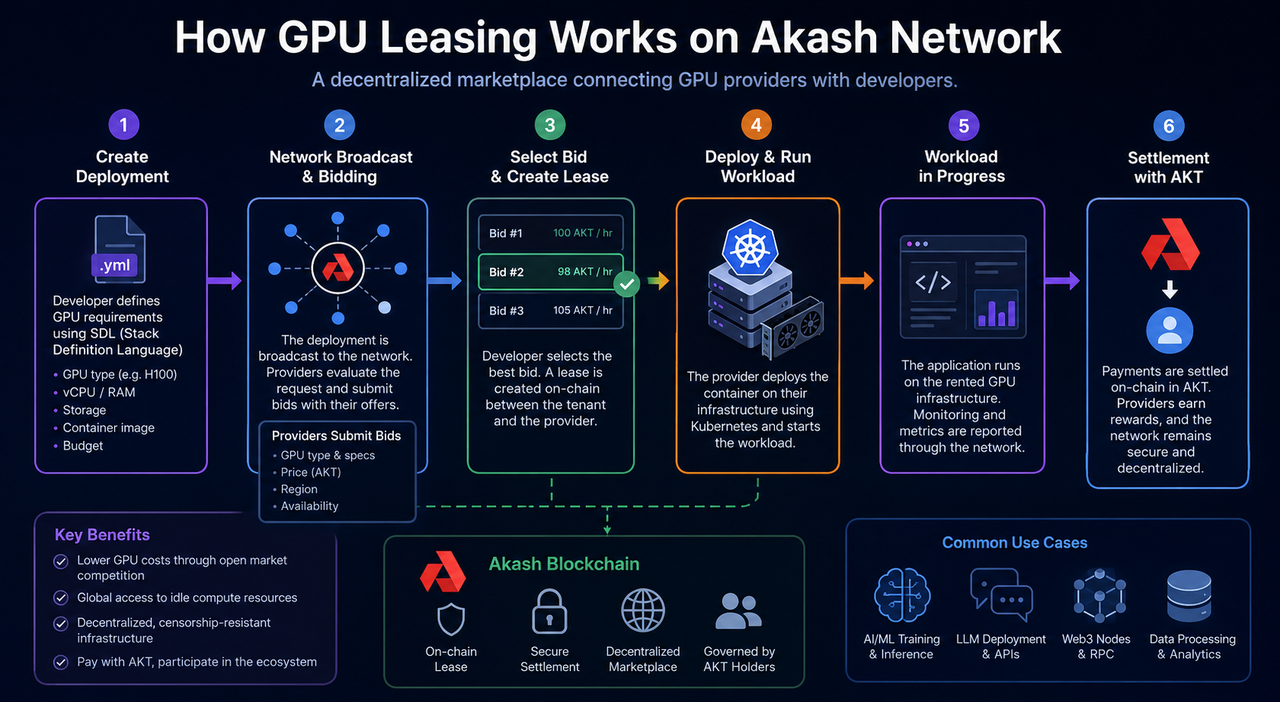
Developers post their GPU requirements—including GPU type, CPU, memory, storage, and runtime environment—on the network. Providers then submit offers (Bids) based on available resources, and developers select the optimal resources for deployment.
Unlike traditional cloud platforms, Akash’s resource pricing is determined dynamically by market supply and demand, not by a single platform’s fixed rates.
Who Are the Key Roles in the GPU Leasing Process?
The Akash GPU leasing process features four primary roles:
Tenant
The Tenant is a developer or organization in need of GPU resources, typically to deploy AI models, machine learning tasks, inference services, or Web3 applications.
Tenants specify their resource requirements and pay the associated fees.
Provider
A Provider is a node operator offering GPU and server resources to the network. Anyone with idle GPUs—including individuals, mining farms, or data centers—can become a Provider.
Providers submit offers based on market demand and supply the actual computing resources once a lease is activated.
Validator
Validators secure the Akash blockchain, maintaining consensus, verifying transactions, confirming orders, and overseeing on-chain governance.
AKT Holder
AKT holders participate in network governance and security by staking, and also play a role in the resource settlement ecosystem.
How Do Developers Request GPU Resources on Akash?
To request GPU resources, developers create a Deployment (deployment request) on the Akash network.
A Deployment file typically specifies:
- GPU model requirements
- CPU and memory configuration
- Storage requirements
- Container image
- Network configuration
- Leasing budget
Akash uses Stack Definition Language (SDL) to define these resource needs, integrating with Kubernetes for container management.
After submitting the Deployment, the system broadcasts the requirements across the network, awaiting Provider offers.
How Does the Provider Bidding Mechanism Work?
Upon receiving a Deployment request, eligible Providers submit Bids based on their available resources.
Each Bid details the GPU rental price, available GPU models, deployment region, network configuration, and service reliability. The Tenant can then select the most suitable Provider from multiple Bids.
Because Providers compete, Akash’s GPU prices are often lower than those of traditional cloud platforms. This market-driven approach is a hallmark of decentralized GPU networks.
What Happens After a Lease Is Created?
When a Tenant accepts a Provider’s offer, the system generates a Lease.
A Lease is an on-chain agreement outlining both parties, GPU configuration, usage period, payment method, and service status. Once the lease is established, the Provider automatically deploys the agreed resources and launches the developer’s application.
This workflow leverages Kubernetes and Docker containers, allowing developers to deploy AI services and applications as seamlessly as on traditional cloud platforms.
How Are AI Models Run After GPU Deployment?
Once GPU deployment is complete, developers can run a variety of AI workloads on Akash, including:
- Large language models (LLMs)
- AI inference services
- Stable Diffusion image generation
- Machine learning training
- AI Agents
- Data analysis tasks
Because Akash supports Kubernetes, many existing AI workflows can be migrated directly to the network.
Some developers also use Akash to deploy Hugging Face models, open-source AI applications, and GPU API services.
What Role Does AKT Play in the GPU Leasing Process?
AKT is the core settlement asset of the Akash Network.
In the GPU leasing process, AKT serves several key functions:
Resource Payment
Tenants pay for GPU and server rentals using AKT.
Network Trading Fees
On-chain activities—such as Deployment, Lease creation, and governance—require Gas fees.
Network Security
AKT is used in the PoS staking mechanism to secure network operations and validation.
Governance
AKT holders can vote on protocol upgrades and parameter adjustments.
How Does the Akash GPU Marketplace Differ from Traditional GPU Cloud Services?
Akash’s principal distinction from traditional GPU cloud platforms is its resource organization model.
Traditional platforms rely on centralized data centers for GPU resources, while Akash allows idle GPUs worldwide to enter the market freely.
This approach yields several notable differences:
| Comparison |
Akash Network |
Traditional GPU Cloud Platform |
| Resource Source |
Decentralized Providers |
Official Data Centers |
| GPU Pricing |
Market Bidding |
Fixed Platform Price |
| Cost Structure |
Typically Lower |
Typically Higher |
| Deployment |
Kubernetes + Docker |
Platform Ecosystem |
| Censorship Risk |
Lower |
Higher |
| GPU Utilization |
Leverages Idle Resources |
Centrally Managed |
However, traditional platforms still excel in enterprise support, stability, and global service infrastructure.
What Challenges Does the Akash GPU Marketplace Face?
Despite the openness and cost advantages of decentralized GPU markets, Akash faces several real-world challenges.
First, hardware quality and network stability can vary across Providers. Compared to standardized, centrally managed data centers, decentralized resources are less uniform.
Second, AI market demand for high-end GPUs is growing rapidly, making it crucial for Akash to continuously expand its Provider base and GPU supply.
Additionally, competition in decentralized AI infrastructure is intensifying, with projects like io.net, Render, and Gensyn all moving into the GPU marketplace.
Going forward, developer experience, stability, and ecosystem scale will be key to Akash’s long-term competitiveness.
Summary
Akash Network reorganizes global idle hash power through an open GPU marketplace, enabling developers to access AI computing resources more flexibly and cost-effectively.
The GPU leasing process consists of several core stages—Deployment, Bid, Lease, and resource deployment—automated through Kubernetes and blockchain-based settlement.
As demand for AI model training and inference accelerates, GPUs are becoming a cornerstone of digital infrastructure. The decentralized GPU marketplace pioneered by Akash is driving cloud computing’s evolution from centralized platforms to open resource markets.
FAQs
What Are the Steps in Akash’s GPU Leasing Process?
The process includes Deployment (deployment request), Bid (offer), Lease (lease creation), resource deployment, and AKT settlement.
What Is a Provider?
A Provider is a node operator supplying GPU and server resources to the Akash network, including individuals, mining farms, or data centers.
Does Akash Support AI Model Deployment?
Yes. Akash is widely used for LLMs, AI inference, Stable Diffusion, machine learning training, and AI Agent deployments.
What Role Does AKT Play in GPU Leasing?
AKT is used for GPU rental payments, network trading fees, PoS staking, and on-chain governance.
How Does Akash Differ from Traditional GPU Cloud Platforms?
Akash organizes GPU resources with an open marketplace and Provider bidding, while traditional cloud platforms use centralized data centers and fixed pricing models.







