Pre-IPO companies often experience their most significant value creation phase before going public. For a long time, these investment opportunities were reserved for venture capital firms, high-net-worth individuals, and internal employees — making them largely inaccessible to retail investors. As real-world asset (RWA) tokenization advances, a growing number of projects are bringing private market assets onto the blockchain.
PreStocks aims to create an open private equity marketplace by mapping the economic interests of Pre-IPO companies onto on-chain assets.
What Is the SPV Shareholding Structure?
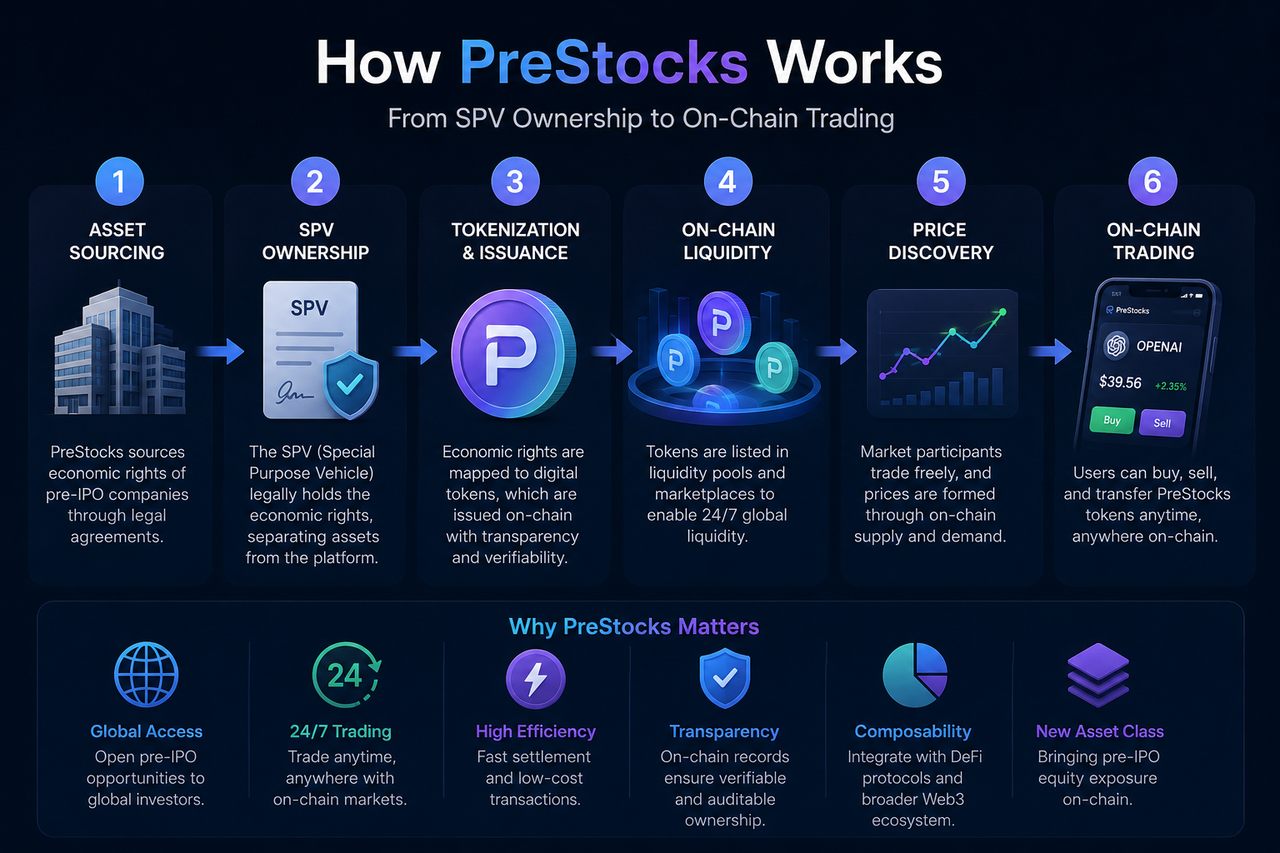
The Special Purpose Vehicle (SPV) forms the legal backbone of PreStocks’ operations.
Holding equity in traditional private markets typically involves complex legal agreements and strict investor qualification requirements. Directly putting those interests on-chain would significantly increase both management overhead and compliance complexity.
To address this, the platform uses an independent legal entity to hold the assets. The SPV manages the underlying interests, while on-chain tokens represent the economic value tied to them.
This structure is already widely used in real estate tokenization, bond tokenization, and digital fund shares.
How Does PreStocks Acquire Its Underlying Assets?
PreStocks begins by establishing economic exposure to the target company.
In traditional private markets, employees, early investors, or existing shareholders may hold equity interests. Through legally compliant transactions, the SPV acquires those interests or their economic equivalent.
Once acquired, the SPV serves as the value anchor for the on-chain tokens.
This step establishes the critical link between the token and the company’s value — and forms the trust foundation for the entire system.
How Are PreStocks Tokens Issued?
After asset allocation is finalized, the platform issues on-chain tokens proportional to the value of the underlying interests.
The token itself is not a direct share certificate; instead, it represents the economic value of those interests.
Issuance requires determining the asset valuation, token supply, and initial market structure.
Since unlisted companies lack a public market price, valuation is typically based on recent funding rounds, secondary equity trades, and market consensus.
What Happens When a User Buys PreStocks?
When a user buys PreStocks tokens, they gain market exposure to changes in the target company’s economic value.
For instance, if market expectations for OpenAI or SpaceX shift, the corresponding token prices may move accordingly.
Holders can trade, transfer, or hold these assets on supported on-chain markets.
Importantly, token holders generally do not hold the legal status of shareholders and therefore do not enjoy traditional voting or governance rights.
How Is PreStocks Priced?
PreStocks’ price discovery mechanism differs markedly from public stock markets.
Listed companies have continuous public pricing, but unlisted companies have no single market quote. PreStocks pricing therefore draws on multiple inputs.
Key reference factors include:
- Latest funding round valuations
- Private market transaction prices
- Industry growth forecasts
- Supply and demand dynamics
- On-chain trading activity
As buyers and sellers interact, the market develops a dynamic price.
This mirrors traditional securities price discovery, though transparency and data sources differ significantly.
How Does PreStocks Provide On-Chain Liquidity?
A major challenge of traditional Pre-IPO investing is illiquidity.
Private equity deals can take weeks or months to settle and face strict transfer restrictions.
PreStocks leverages blockchain to create a 24/7 trading environment, enabling real-time transfer and settlement.
By building on Solana’s high throughput and low fees, the platform supports frequent trading activity.
This dramatically improves asset circulation efficiency and allows Pre-IPO valuations to be reflected in market prices faster.
What’s the Difference Between PreStocks and Traditional Pre-IPO Investment?
Although both involve unlisted companies, their mechanisms differ sharply.
| Dimension |
PreStocks |
Traditional Pre-IPO Investment |
| Asset form |
On-chain token |
Equity agreement |
| Trading environment |
Blockchain network |
Private market |
| Market hours |
24/7 |
Limited hours |
| Settlement |
Real-time |
Days to weeks |
| Liquidity |
Relatively high |
Relatively low |
| Infrastructure |
Blockchain |
Traditional finance |
PreStocks does not alter the underlying assets themselves — it restructures their circulation and trading through blockchain.
What’s the Difference Between PreStocks and Traditional Tokenized Stocks?
PreStocks is often compared to tokenized stocks, but their underlying assets differ.
Tokenized stocks represent already-listed securities like Apple, Microsoft, or Tesla.
PreStocks, by contrast, targets unlisted companies, resulting in different pricing, liquidity, and risk profiles.
This distinction leads to different market behaviors and value discovery mechanisms.
Summary
By combining an SPV equity structure, token issuance, and on-chain trading, PreStocks converts the economic interests of Pre-IPO companies into tradeable digital assets. The full process involves acquiring underlying assets, managing the SPV, issuing tokens, determining market pricing, and building on-chain liquidity.
This model lowers the barrier to private market investing, boosts asset circulation, and highlights the potential of RWA and on-chain capital markets. However, PreStocks’ value discovery remains influenced by valuation transparency, market liquidity, and regulation. Understanding its full lifecycle is key to grasping the tokenized equity market.
FAQs
Does a PreStocks holder own real stocks?
PreStocks holders typically have economic exposure to the target company — not official shareholder status. The exact rights depend on the product structure and legal framework.
Why does PreStocks need to use blockchain?
Blockchain enables 24/7 trading, fast settlement, and asset transferability. Compared with traditional private markets, on-chain systems improve trading efficiency and liquidity.
How is the price of PreStocks determined?
The price reflects a combination of the company’s funding valuation, private market trades, supply and demand, and investor expectations.
What’s the difference between PreStocks and tokenized stocks?
Tokenized stocks represent already-listed companies; PreStocks represents interests in unlisted companies. Their valuation sources, risk structures, and market behavior differ accordingly.
Is PreStocks an RWA?
Yes. PreStocks is a key application of real-world asset (RWA) tokenization, with underlying assets rooted in real-world private equity and corporate interests.