When users search for how uniBTC works, they usually want to understand how BTC becomes a liquid asset after being deposited into Bedrock, where the yield comes from, and how these assets can continue to be used in on-chain scenarios. For users interested in BTCFi, uniBTC is the core entry point for understanding Bedrock’s yield structure.
This topic usually involves several layers, including the asset conversion process, yield sources, liquidity use, Restaking connections, and cross-chain risks.
What Is uniBTC?
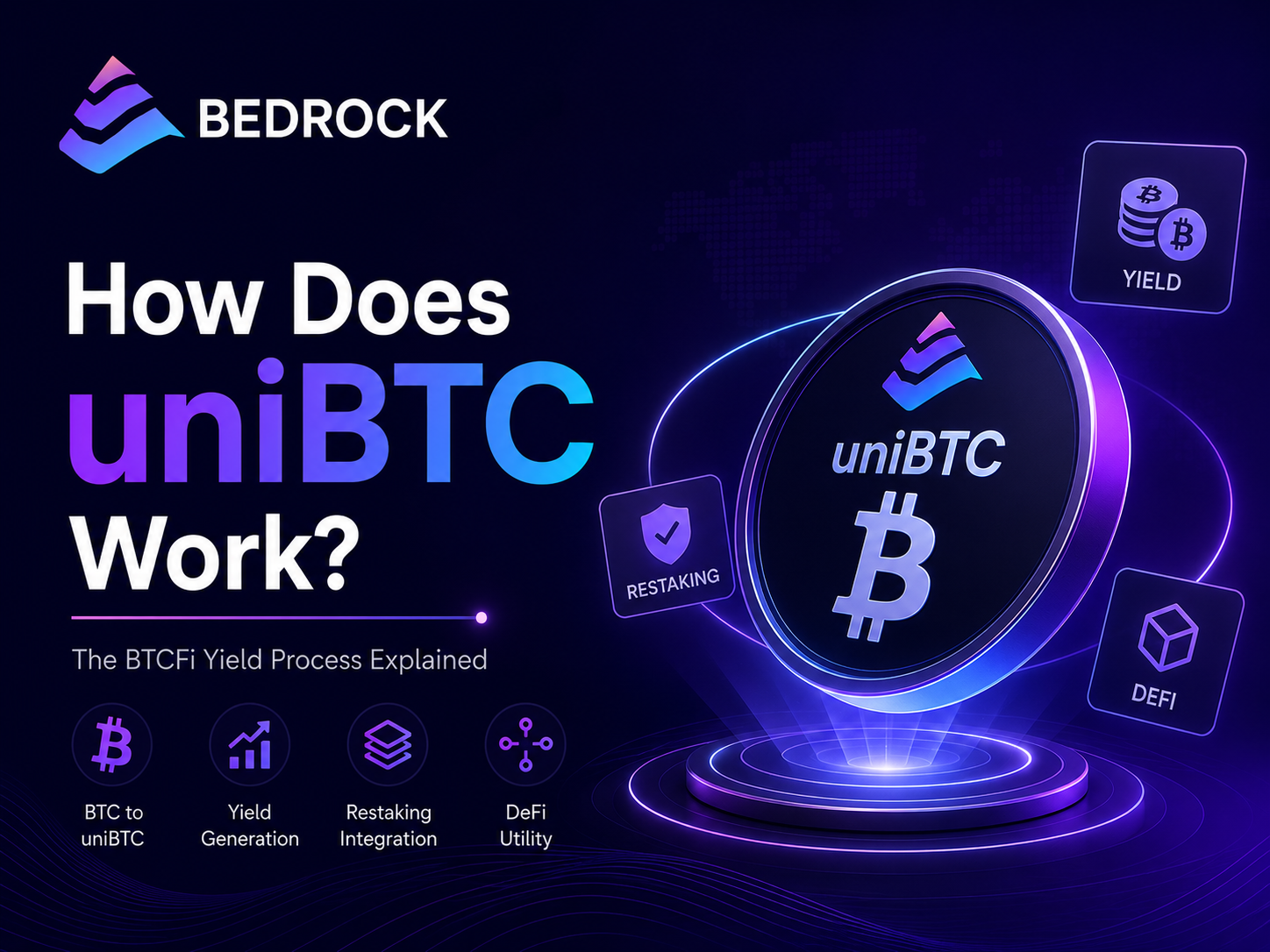
uniBTC can be understood as the liquid BTC asset built by the Bedrock protocol around BTCFi. Its core purpose is to allow BTC to enter on-chain yield and DeFi scenarios while maintaining its value-mapping relationship.
Structurally, users do not use native BTC directly for every on-chain operation. Instead, they first convert BTC into uniBTC through Bedrock. First, users submit BTC or a supported related asset. The system then completes asset confirmation and minting. Next, users receive uniBTC, which can be used for on-chain interactions. Finally, uniBTC can enter yield pools, liquidity markets, or Restaking-related scenarios.
The significance of uniBTC lies in turning BTC, which originally has relatively limited liquidity and application scenarios, into an asset that can be used more easily by DeFi protocols. For Bedrock, uniBTC is an important intermediate layer connecting BTC holders with on-chain yield networks.
How Users Convert BTC into uniBTC
The core process of converting BTC into uniBTC is “asset deposit, system confirmation, on-chain minting, and user receipt of the credential.” The user action is to submit BTC-related assets, while the system action is to generate the corresponding uniBTC according to protocol rules.
First, users need to submit BTC or designated BTC assets through an entry point supported by Bedrock. The system then confirms the asset based on asset type, network status, and protocol rules. Next, the protocol mints the corresponding amount of uniBTC for the user on the target chain. Finally, users can hold uniBTC in their wallet and use it in later DeFi or yield scenarios.
| Process Stage |
User Action |
System Action |
| Asset submission |
Deposit BTC-related assets |
Receives and confirms assets |
| Asset confirmation |
Wait for on-chain confirmation |
Verifies transaction status |
| uniBTC minting |
Receive the liquid asset |
Generates corresponding uniBTC |
| Subsequent use |
Participate in DeFi scenarios |
Records asset flow |
The key point in this process is that users do not receive ordinary wrapped BTC. They receive a liquid asset within Bedrock’s yield structure. Through asset mapping and on-chain minting, the system allows BTC to enter more composable scenarios.
What Are uniBTC’s Yield Sources?
uniBTC’s yield sources do not rely on a single channel. They are connected to Bedrock’s BTCFi, Restaking, and DeFi structure. The core idea is to improve the on-chain utilization efficiency of BTC assets through multi-protocol connections.
First, users hold uniBTC or use it to enter supported yield scenarios. The system then connects the related assets to Restaking, liquidity pools, or external protocols. Next, the protocol records and distributes yield based on different yield sources. Finally, whether users receive yield, how much they receive, and how it is distributed depend on the specific product rules and market environment.
Mechanically, uniBTC may involve liquidity incentives, Restaking yield, DeFi protocol yield, and ecosystem incentives. Different yield sources have different levels of stability and may also be affected by protocol security, market liquidity, and the performance of third-party networks.
The importance of this structure is that uniBTC allows BTC to move beyond passive holding and participate in a more complex on-chain yield network. But the more yield sources involved, the more users need to understand the protocol risks behind them.
How Bedrock Combines BTC Liquidity and Yield
The key to how Bedrock combines BTC liquidity and yield lies in converting BTC into composable uniBTC. The core idea is to allow users to retain BTC exposure while using a liquid asset to participate in on-chain yield.
First, users connect BTC-related assets to Bedrock. The system then mints uniBTC, giving it the ability to circulate on the target chain. Next, uniBTC can enter lending, liquidity pools, or yield aggregation scenarios. Finally, BTC’s value-mapping relationship and on-chain usability are placed within the same asset structure.
Structurally, Bedrock does not simply wrap BTC onto another chain. Instead, it uses uniBTC to connect BTC with yield networks. The user action is to hold and use uniBTC, while the system action is to maintain asset mapping, record protocol interactions, and support yield distribution.
The effect of this mechanism is that BTC capital efficiency improves. For the BTCFi ecosystem, uniBTC provides a standardized asset form that allows BTC to enter the DeFi system.
How uniBTC Participates in Restaking and DeFi Scenarios
uniBTC participates in Restaking and DeFi scenarios mainly through Bedrock’s ability to connect with external protocols and on-chain applications. It can enter different protocols as a liquid asset and serve functions related to yield generation or asset allocation.
First, after users receive uniBTC, they can choose to enter supported DeFi applications. The system or relevant protocols then handle asset flows according to product rules. Next, uniBTC may be used for liquidity provision, lending, yield aggregation, or Restaking-related scenarios. Finally, users gain asset use opportunities through these on-chain interactions while also taking on the corresponding protocol risks.
The key point is that uniBTC is not a credential that can only be held statically. It is a BTCFi asset that can enter multiple on-chain financial scenarios. Through Restaking, uniBTC can connect to broader security or yield networks. Through DeFi, uniBTC can participate in liquidity and trading-related applications.
This mechanism improves BTC composability and also allows Bedrock to build more ecosystem entry points around uniBTC.
What Cross-Chain and Protocol Risks Does uniBTC Face?
uniBTC’s risks mainly come from cross-chain structures, smart contracts, third-party protocols, and yield volatility. Because uniBTC needs to connect BTC, target chains, and DeFi applications, its system complexity is higher than simply holding BTC.
First, when users connect BTC-related assets to Bedrock, they need to rely on cross-chain or asset-mapping mechanisms. The system then needs to maintain the relationship between uniBTC and the underlying assets. Next, after uniBTC enters DeFi or Restaking scenarios, it is also affected by the security of external protocols. Finally, any cross-chain abnormality, contract vulnerability, or lack of liquidity may affect the user’s asset experience.
Structurally, uniBTC’s risks do not come only from Bedrock itself. They also come from the external networks it connects to. Yield-bearing assets usually require multiple protocols to operate together, so risk sources become more distributed.
This point is very important for understanding BTCFi. uniBTC provides higher asset utilization efficiency, but users also need to recognize that yield opportunities usually come with smart contract, cross-chain, and market liquidity risks.
What Is uniBTC’s Position in the BTCFi Ecosystem?
uniBTC’s position in the BTCFi ecosystem is to serve as the liquid asset connecting BTC holders with on-chain yield scenarios. It allows BTC to move from a single holding asset into Restaking, DeFi, and multi-chain yield networks.
First, users convert BTC into uniBTC through Bedrock. uniBTC then enters supported application scenarios as an on-chain asset. Next, Bedrock expands the use range of uniBTC through multi-chain deployment and yield structures. Finally, uniBTC becomes an asset entry point in the BTCFi ecosystem with both liquidity and yield attributes.
Structurally, uniBTC’s value does not only lie in representing BTC. It also lies in improving BTC’s on-chain usability. It carries three functions in the BTCFi ecosystem: asset mapping, liquidity use, and yield connection.
This positioning makes uniBTC a key asset for understanding Bedrock. For the broader BTCFi direction, uniBTC shows one path for bringing BTC into a multi-chain financial system.
Summary
The operating process of uniBTC can be summarized as follows: users first deposit BTC-related assets, Bedrock then completes asset confirmation and mints uniBTC, users then use uniBTC in DeFi, Restaking, or liquidity scenarios, and finally participate in the BTCFi yield network through the protocol structure.
Mechanically, uniBTC connects BTC assets, on-chain liquidity, and yield scenarios. Its core value is improving BTC capital efficiency, but it also comes with cross-chain, smart contract, third-party protocol, and market liquidity risks.
FAQs
What kind of asset is uniBTC?
uniBTC is a liquid BTC asset in the Bedrock protocol. It is used to connect BTCFi, Restaking, and DeFi scenarios, allowing BTC to participate in more on-chain yield and liquidity applications.
How is BTC converted into uniBTC?
Users need to submit BTC-related assets through an entry point supported by Bedrock. After the system completes confirmation, it mints the corresponding uniBTC on the target chain. Users can then hold or use the asset.
Where does uniBTC yield come from?
uniBTC yield may come from Restaking, liquidity incentives, DeFi protocol yield, and ecosystem rewards. Specific yield depends on protocol rules, market conditions, and the operation of external networks.
How is uniBTC different from ordinary wrapped BTC?
Ordinary wrapped BTC mainly solves cross-chain circulation, while uniBTC places more emphasis on BTCFi yield potential. It not only represents BTC exposure, but also connects Bedrock’s yield and application scenarios.
What are the main risks of uniBTC?
uniBTC faces cross-chain risk, smart contract risk, third-party protocol risk, and liquidity risk. Because it connects multiple on-chain scenarios, its risk sources are more complex than simply holding BTC.