As the Web3 industry gradually expands beyond purely financialized models toward content and entertainment, “digital entertainment ecosystems” have become a major focus of the market. From NFTs and the metaverse to AI virtual characters, different projects are exploring very different development paths. The difference between My Pet Hooligan and The Sandbox also reflects how Web3 entertainment is moving away from a single unified narrative and toward greater diversity.
From an industry positioning perspective, The Sandbox is closer to a virtual world platform, while My Pet Hooligan is more like a digital entertainment brand built around character IP. This difference affects not only their game models, but also their user ecosystems, content structures, and long-term development directions.
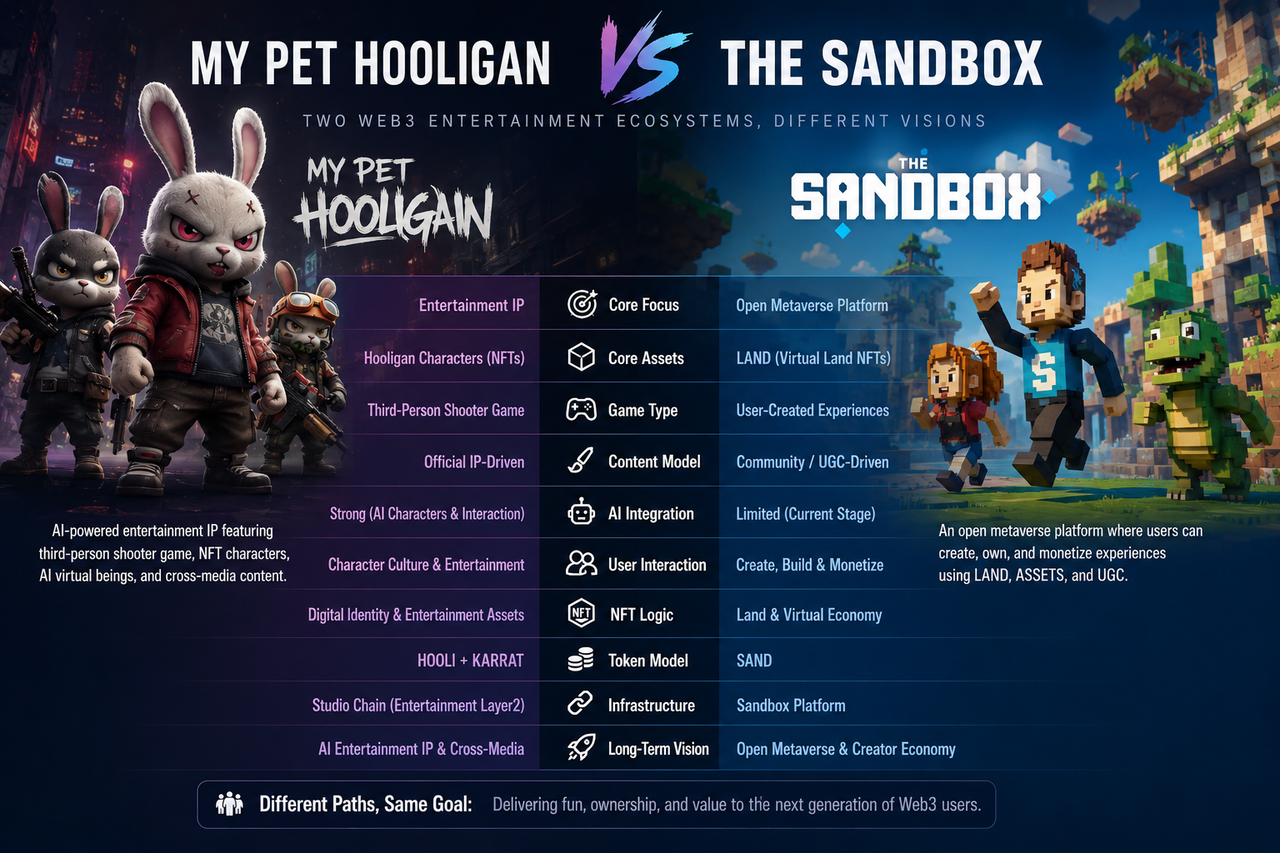
My Pet Hooligan vs. The Sandbox: Overview & Core Differences
As a Web3 entertainment project launched by AMGI Studios, My Pet Hooligan builds an AI-powered transmedia IP ecosystem around its “Hooligan” rabbit characters. Its core elements include a third-person shooter, NFT assets, AI virtual characters, and Studio Chain Layer2 infrastructure, while the project is gradually expanding into animation, social media content, and digital entertainment.
As one of the earlier metaverse platforms in the Web3 industry, The Sandbox is built around the idea of creating an open digital world through virtual land, NFTs, and user-generated content, or UGC. In The Sandbox ecosystem, users can buy LAND, create game content, host events, and build a virtual economy through NFTs and digital assets.
| Comparison Dimension |
My Pet Hooligan |
The Sandbox |
| Core Positioning |
AI-powered transmedia entertainment IP |
Open Web3 metaverse platform |
| Ecosystem Focus |
Games, character IP, AI virtual characters, animated content |
Virtual land, UGC, open world |
| Core Asset |
Hooligan character NFTs |
LAND NFTs |
| Game Type |
Third-person shooter |
User-created sandbox experiences |
| Content Model |
Official IP-driven |
Community creator-driven |
| AI Capabilities |
Emphasizes AI virtual characters and interactive content |
Currently has weaker AI attributes |
| User Participation |
Interaction around character culture and entertainment content |
Creating virtual spaces and games |
| NFT Logic |
Digital identity and entertainment content |
Land and virtual asset economy |
| Economic Structure |
HOOLI + KARRAT dual-token ecosystem |
SAND single-token ecosystem |
| Infrastructure |
Studio Chain entertainment-focused Layer2 |
Centered on the metaverse platform |
| Long-Term Direction |
AI entertainment ecosystem and digital IP |
Open metaverse and creator economy |
How Do the Core Positions of My Pet Hooligan and The Sandbox Differ?
The biggest difference between My Pet Hooligan and The Sandbox lies in their core positioning.
The Sandbox places greater emphasis on an “open virtual world.” Its core purpose is to allow users to create content and digital spaces, which makes the platform feel more like a Web3 version of an open metaverse.
My Pet Hooligan, by contrast, places greater emphasis on “entertainment IP.” Its core asset is not land, but the “Hooligan” characters themselves. The project builds games, animation, and AI content around these characters, with the goal of creating a long-term digital brand.
Put simply, the core of The Sandbox is a “world,” while the core of My Pet Hooligan is “character IP.”
This difference also means that the two projects encourage very different forms of user participation. The Sandbox encourages users to create virtual spaces, while My Pet Hooligan focuses more on interaction around character culture.
How Do the Game and Content Ecosystems of My Pet Hooligan and The Sandbox Differ?
In terms of game structure, My Pet Hooligan is closer to a traditional action game, emphasizing third-person shooting, character progression, and entertainment experience.
The Sandbox is more like an open platform where users can create their own games and scenes, so its gameplay is more fragmented.
This difference also shapes the direction of each project’s content ecosystem.
My Pet Hooligan relies more on official IP and character storytelling, using a unified world to expand animation, community content, and virtual character experiences. The Sandbox places greater emphasis on a platform-based ecosystem, with much of its content coming from community creators and brand collaborations.
As a result, My Pet Hooligan is more “IP-driven,” while The Sandbox is more “platform-driven.”
For users, the former feels more like participating in an entertainment brand, while the latter feels more like entering an open virtual world.
How Do the AI Capabilities and Virtual Character Directions of My Pet Hooligan and The Sandbox Differ?
AI is one of the clearest differences between My Pet Hooligan and The Sandbox.
My Pet Hooligan treats AI virtual characters as an important part of its future entertainment ecosystem and attempts to improve the user experience through AI motion capture, character interaction, and digital identity technologies.
As AI content generation technology continues to develop, future “Hooligan” characters may not only exist in the game, but may also participate in livestreams, community interaction, and digital content creation.
By comparison, The Sandbox currently follows a more traditional metaverse logic, with its focus still on virtual spaces and user-generated content rather than an AI-driven character ecosystem.
Therefore, the two projects actually represent two different paths for the Web3 entertainment industry. The Sandbox leans more toward “metaverse platformization,” while My Pet Hooligan leans more toward “AI entertainment IP.”
This shift also shows that Web3 entertainment is gradually moving from “competition over virtual spaces” toward “competition over digital content and characters.”
How Do the NFT and Economic Models of My Pet Hooligan and The Sandbox Differ?
The Sandbox’s NFT system mainly revolves around LAND, avatars, and game assets, with virtual land serving as one of its core assets.
My Pet Hooligan’s NFTs, by contrast, are more closely tied to character identity and entertainment content. Its focus is not a “land economy,” but the “Hooligan” character IP.
In terms of economic structure, The Sandbox places greater emphasis on the creator economy and virtual real estate ecosystem, while My Pet Hooligan places more emphasis on content consumption and community interaction.
This difference means The Sandbox depends more on an open creative economy, while My Pet Hooligan depends more on character culture and content operations.
Over the long term, these two models serve different user needs. Some users care more about open virtual spaces, while others care more about entertainment content and digital characters.
Conclusion
My Pet Hooligan and The Sandbox are both important projects within the Web3 entertainment ecosystem, but they differ clearly in core positioning, content structure, and development direction. The Sandbox emphasizes an open metaverse and virtual land economy, while My Pet Hooligan places greater emphasis on AI-powered entertainment IP and character culture.
This difference reflects how Web3 entertainment is gradually expanding beyond a unified “metaverse narrative” into a richer digital content ecosystem.
FAQs
What Is the Biggest Difference Between My Pet Hooligan and The Sandbox?
The Sandbox places greater emphasis on an open virtual world and land economy, while My Pet Hooligan focuses more on AI entertainment IP and character culture.
Is The Sandbox a Blockchain Game?
The Sandbox is closer to an open metaverse platform rather than a blockchain game in the traditional sense.
Why Does My Pet Hooligan Emphasize AI?
The project aims to build a longer-term entertainment ecosystem and community culture through AI virtual characters and digital content interaction.
What Are the Core Assets of The Sandbox?
The core assets of The Sandbox include LAND, avatars, and NFTs related to user-generated content.
What Makes My Pet Hooligan NFTs Different?
Its NFTs are more closely tied to character identity and entertainment content, rather than simply functioning as tradable assets.
Which Model Will Web3 Entertainment Favor in the Future?
In the future, multiple models may coexist, including metaverse platforms, AI entertainment IP, and digital character ecosystems, rather than a single dominant direction.