Cloud gaming is becoming an important trend in the gaming industry. As AAA games continue to raise the bar for hardware performance, more platforms are turning to remote computing to lower the entry barrier for users. In this landscape, GeForce Now represents the traditional cloud gaming platform model, while YOM embodies a DePIN-powered decentralized cloud gaming infrastructure—two models reflecting different development paths in the industry.
What Is YOM
Built on DePIN (Decentralized Physical Infrastructure Network), YOM is a cloud gaming infrastructure network that aims to aggregate idle GPU resources from around the world into a unified real-time computing network. Through its HyperOrch intelligent scheduling system, it delivers low-latency cloud gaming services to both game developers and players.
Unlike traditional gaming platforms, YOM prioritizes infrastructure development. Developers can deploy games directly on the network, while node operators contribute GPU resources to provide services and earn network incentives.
What Is GeForce Now
GeForce Now is a centralized cloud gaming platform launched by NVIDIA.
It allows users to run PC games they already own on remote servers and stream the gameplay in real time to devices such as computers, phones, tablets, and smart TVs.
All computing power comes from NVIDIA-owned or operated data centers. Users typically access the service through a subscription and receive different tiers of performance support depending on the plan.
GeForce Now is positioned as a cloud gaming platform, not an open infrastructure network.
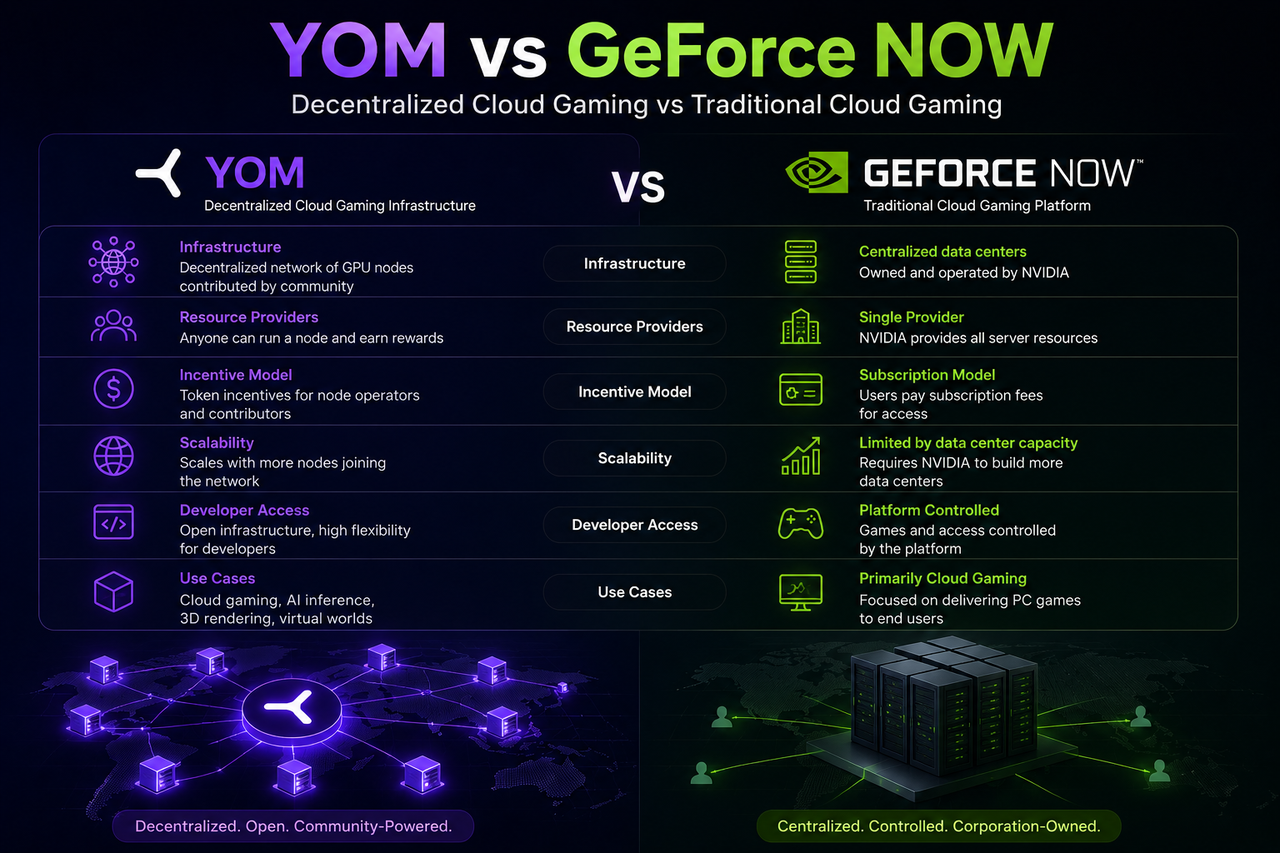
How Do the Infrastructure Architectures of YOM and GeForce Now Differ
The most fundamental difference between YOM and GeForce Now lies in their infrastructure architecture.
GeForce Now uses a centralized data center model. NVIDIA handles all server procurement, deployment, maintenance, and upgrades centrally.
YOM, on the other hand, operates on a distributed GPU network model. Global node operators contribute hardware resources to join the network, and the intelligent scheduling system weaves them into a unified computing layer.
From an architectural standpoint, GeForce Now resembles traditional internet services, while YOM is closer to an open infrastructure protocol.
How Do GPU Resource Sources Differ Between YOM and GeForce Now
The source of GPU resources directly determines how each network scales.
GeForce Now's GPU resources come from NVIDIA's own or partner data centers. When user demand grows, the platform must build new server infrastructure.
YOM's GPU resources come from community node operators. Any qualified participant can connect to the network and provide computing power.
This model allows YOM to tap into a vast pool of idle hardware, whereas GeForce Now relies on corporate capital investment to expand capacity.
GeForce Now's Resource Model
GeForce Now delivers standardized services through unified procurement and operations.
This approach ensures hardware consistency and service quality.
YOM's Resource Model
YOM aggregates global GPU nodes through an open network.
Resource capacity expands as more participants join the network, effectively creating a distributed Hashrate market.
Are There Differences in User Experience Between YOM and GeForce Now
From a player's perspective, both platforms support remote game execution.
Once a game launches, the video feed is streamed to the user's device, while input commands are sent back to the server for processing in real time.
However, due to differences in resource deployment, the two platforms may have distinct characteristics in terms of network coverage and edge node distribution.
GeForce Now relies more on regional data center placement, while YOM's performance depends on the reach of its node network.
How Do the Developer Ecosystems of YOM and GeForce Now Compare
GeForce Now is primarily player-focused.
Game publishers must form partnerships with the platform, and users access supported games through the service.
YOM places more emphasis on the developer ecosystem.
Developers can directly deploy games or real-time interactive applications onto the network and leverage distributed GPU resources to run them.
This makes YOM more of an infrastructure platform than a mere content distribution channel.
How Do the Incentive Mechanisms Work
GeForce Now's business model is built on subscription fees.
Users pay for access, and the platform handles server operation and maintenance.
YOM introduces a token-based incentive mechanism.
Node operators earn rewards by contributing GPU hashrate, while developers pay to use computing resources, creating a supply-and-demand incentive loop.
These two models illustrate the different design philosophies of centralized platform economics and decentralized network economics.
GeForce Now mainly serves the consumer gaming market.
Its goal is to let players enjoy high-end PC games without needing a powerful gaming rig.
In addition to cloud gaming, YOM also targets real-time 3D rendering, virtual worlds, digital twins, and AI inference.
As such, YOM positions itself as real-time computing infrastructure rather than just a player-facing gaming platform.
Core Differences: YOM vs GeForce Now
| Dimension |
YOM |
GeForce Now |
| Network Type |
Decentralized GPU Network |
Centralized Cloud Gaming Platform |
| Infrastructure Source |
Community Nodes |
NVIDIA Data Centers |
| Core Positioning |
Cloud Gaming Infrastructure |
Cloud Gaming Service Platform |
| Scaling Method |
Node Network Expansion |
Data Center Expansion |
| Incentive Mechanism |
Token Incentives |
Subscription Fees |
| Developer Openness |
High |
Relatively Limited |
| Resource Ownership |
Distributed |
Centralized Corporate Control |
| Use Cases |
Gaming, AI, 3D Rendering |
Primarily Cloud Gaming |
Conclusion
Both YOM and GeForce Now are built on cloud gaming technology, but their underlying logic differs. GeForce Now follows the traditional centralized data center model, delivering stable cloud gaming services through unified operations. YOM, on the other hand, uses the DePIN model to pool global GPU node resources and build an open real-time computing network.
From an industry perspective, these two models represent two paths for the cloud gaming sector. Traditional platforms emphasize service quality and centralized operations, while decentralized networks focus on resource sharing, open participation, and elastic scalability. As edge computing and GPU networks evolve, both models are likely to coexist over the long term, serving different types of application needs.
FAQs
Is GeForce Now a DePIN project?
No, GeForce Now is not a DePIN project. It is a cloud gaming platform centrally built and operated by NVIDIA, with server resources and service management fully controlled by the company.
Why is YOM classified as a decentralized cloud gaming platform?
YOM is classified as a decentralized cloud gaming platform because its computing resources come from an open network of GPU nodes rather than a single corporate data center.
Do YOM and GeForce Now both support AAA games?
Yes, both platforms can support AAA games. The difference is that GeForce Now primarily operates as a gaming platform offering access to games, while YOM focuses more on cloud gaming infrastructure and resource orchestration.
Who provides the GPU nodes for YOM?
YOM's GPU nodes are provided by community operators. Participants contribute computing resources to the network and receive incentives proportional to their contributions.
Can YOM be used for applications other than gaming?
Yes. YOM's infrastructure supports not only cloud gaming but also real-time 3D rendering, virtual worlds, digital twins, and low-latency AI inference workloads.