

Trade
Basic
Futures
Futures
Hundreds of contracts settled in USDT or BTC
TradFi
Gold
Trade global traditional assets with USDT in one place
Options
Hot
Trade European-style vanilla options
Unified Account
Maximize your capital efficiency
Demo Trading
Futures Kickoff
Get prepared for your futures trading
Futures Events
Participate in events to win generous rewards
Demo Trading
Use virtual funds to experience risk-free trading
Earn
Launch
CandyDrop
Collect candies to earn airdrops
Launchpool
Quick staking, earn potential new tokens
HODLer Airdrop
Hold GT and get massive airdrops for free
Launchpad
Be early to the next big token project
Alpha Points
Trade on-chain assets and enjoy airdrop rewards!
Futures Points
Earn futures points and claim airdrop rewards
Investment
Simple Earn
Earn interests with idle tokens
Auto-Invest
Auto-invest on a regular basis
Dual Investment
Buy low and sell high to take profits from price fluctuations
Soft Staking
Earn rewards with flexible staking
Crypto Loan
0 Fees
Pledge one crypto to borrow another
Lending Center
One-stop lending hub
VIP Wealth Hub
Customized wealth management empowers your assets growth
Private Wealth Management
Customized asset management to grow your digital assets
Quant Fund
Top asset management team helps you profit without hassle
Staking
Stake cryptos to earn in PoS products
Smart Leverage
New
No forced liquidation before maturity, worry-free leveraged gains
GUSD Minting
Use USDT/USDC to mint GUSD for treasury-level yields

More


4 months of investing $13.16 million in cryptocurrencies almost entirely lost! "Brother Ma Ji's" account now has $53,000 remaining.
3h ago
The probability of Bitcoin falling below $65,000 exceeds 70%. What is the market worried about?
3h ago
Trending Topics
View More14.39K Popularity
9.53K Popularity
8.28K Popularity
3.24K Popularity
5.24K Popularity
Hot Gate Fun
View More- MC:$0.1Holders:10.00%
- MC:$0.1Holders:10.00%
- MC:$0.1Holders:00.00%
- MC:$2.65KHolders:10.00%
- MC:$0.1Holders:10.00%





The probability of Bitcoin falling below $65,000 exceeds 70%. What is the market worried about?
The weekend sell-off caused Bitcoin’s price to briefly dip below the psychological threshold of $75,000, and market sentiment seems to have shifted overnight. On the prediction platform Polymarket, a compelling bet is heating up: the odds of Bitcoin falling below $65,000 in 2026 have surged to 72%, attracting nearly one million dollars in bets. This is not just a numbers game; it’s a mirror reflecting the deep undercurrents currently roiling the crypto market—from the euphoria after Trump’s election victory to the widespread anxiety about “deep dips,” with the rapid shift being astonishing.
What’s more, some veteran players are on alert because this decline has put the world’s largest publicly traded Bitcoin holder, Strategy, to its first test since late 2023: its average cost basis has been breached. It’s like a marathon leader suddenly finding the track beneath their feet turning slippery.
Why has market sentiment taken a sharp turn? On the surface, it appears to be a price correction. But upon closer inspection, several forces are pulling together like a rope, jointly tugging at the market.
First, there are technical “breakdown” signals. According to observations from some on-chain analysis firms, Bitcoin has been in a “bear market” cycle since falling below its 365-day moving average in November 2025. This long-term moving average is often seen as the “bull-bear dividing line”; once lost, it typically triggers systematic de-risking among technical investors. I remember during the 2018 bear market, similar long-cycle moving average breaches led to months of downward drift and bottoming processes, where early bottom fishing was akin to “catching a flying knife.”
Second, the “water tap” of macro liquidity seems to be tightening. Some macro analysts point out that the current correction is more due to liquidity tightening in the overall U.S. financial environment rather than any fundamental issues with cryptocurrencies themselves. Changes in the Federal Reserve’s balance sheet, the draining effect of Treasury issuance—these seemingly distant macro factors—are actually transmitted through risk asset pricing logic directly to Bitcoin’s price. When the tide (liquidity) recedes, the most volatile assets are the first to reveal their swimwear.
Lastly, an interesting perspective comes from industry insiders. Mati Greenspan, CEO of Quantum Economics, reminds us that perhaps we’ve been focusing on the wrong point all along. He wrote on social media that Bitcoin’s core design goal is to be a currency independent of the traditional banking system; price appreciation is merely a “side effect,” not its purpose. This viewpoint is like a cold shower, prompting us to think: when the market only focuses on price ups and downs, has it already strayed from its original vision?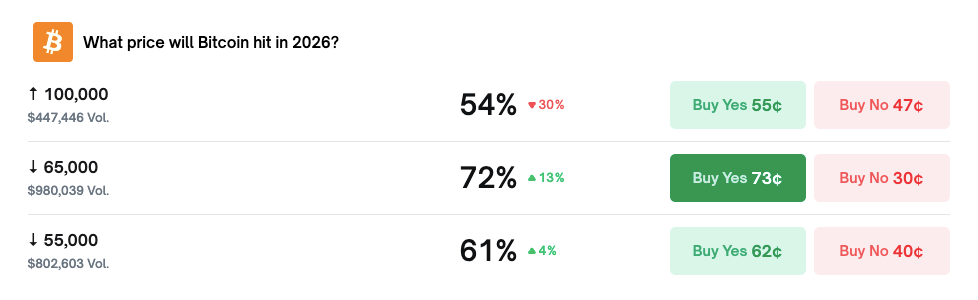
Are prediction markets’ “crystal balls” accurate? The high-probability bets on Polymarket undoubtedly amplify market pessimism. Besides the chance of falling below $65,000, the odds of Bitcoin dropping to $55,000 have reached 61%. Meanwhile, there’s still a 54% chance it could return to $100,000 before the end of the year. This tug-of-war between bulls and bears precisely illustrates the market’s significant disagreement.
But here’s a key question: does the “probability” in prediction markets equal the “truth” of the future? Not necessarily. It more reflects the collective sentiment of market participants voting with real money. This sentiment is highly contagious, capable of self-fulfillment, but can also reverse instantly due to a sudden positive development. Just like during the March 2020 crash, no one could have predicted the epic bull run that followed. Prediction markets are an excellent window into market sentiment, but they are not a navigation chart for investing.
Additionally, Polymarket itself faces some regulatory challenges, such as restrictions in Nevada and other regions due to licensing issues. This reminds us that this “sentiment barometer” is also in a dynamic environment.
Institutional opinions clash, so who should retail investors listen to? Faced with market confusion, the viewpoints of large institutions are also showing interesting “clashes.”
On one hand, bearish sentiment is prevalent among prediction markets and some analysts. On the other hand, just a few months ago, several top institutions issued quite optimistic forecasts. For example, Grayscale Investments predicted Bitcoin could hit a new all-time high of $126,000 in the first half of 2026, based on ongoing institutional adoption and gradually clarifying regulations. Analysts from Standard Chartered and Bernstein also set a target of $150,000 in 2026, though they later revised downward due to slowing ETF fund inflows.
Such contradictions are not uncommon. The long-term logic of institutions (like Bitcoin’s scarcity and the narrative of digital gold) often exists in a different language system from short-term market fluctuations (liquidity, sentiment, technical signals). For investors, the key is to discern which voice you’re hearing—are you following a multi-year trend judgment or a warning about risks in the coming quarters?
What should investors focus on now? Market noise is abundant, but I believe we can concentrate on a few more substantive points rather than being led by simple price probability swings.
Markets always swing between excessive optimism and excessive pessimism. When 72% of people on Polymarket bet on a decline, perhaps it’s time for us to stay calm and think contrarily. After all, in the crypto world, consensus is often very expensive, and true opportunities often arise when consensus breaks down. Of course, any judgment should be combined with your own situation. The market always contains uncertainties, and proper position management and risk control are essential lessons for navigating any cycle.