As blockchain analytics tools, MEV bots, and address profiling systems evolve, the transparent nature of public blockchains is exposing more user behavior than ever. Wallet balances, trading strategies, and fund flows can all be traced. Against this backdrop, Railgun has emerged as a key privacy infrastructure within the Ethereum ecosystem. It not only enables anonymous transfers but also aims to build a more comprehensive private transaction framework in DeFi.
What Are Railgun's Private Transactions?
Railgun's private transactions are anonymous on-chain interactions powered by zk-SNARK zero-knowledge proofs. Unlike standard transfers that publicly reveal sender and receiver addresses along with the amount, Railgun encrypts transaction data and uses mathematical proofs to verify its validity.
In Railgun, user assets reside in a Private Balance. All transactions are conducted through a privacy-focused account system, not directly through public EVM wallet addresses.
This means external observers can confirm that a valid on-chain transaction took place, but they cannot see who sent or received the assets, or the exact amount involved.
Railgun's goal is not to leave Ethereum but to add a privacy layer on top of the native chain, allowing users to continue leveraging the existing DeFi ecosystem while minimizing asset and identity exposure.
How Do Users Shield Assets Into Railgun?
A Railgun private transaction typically starts with a Shield operation.
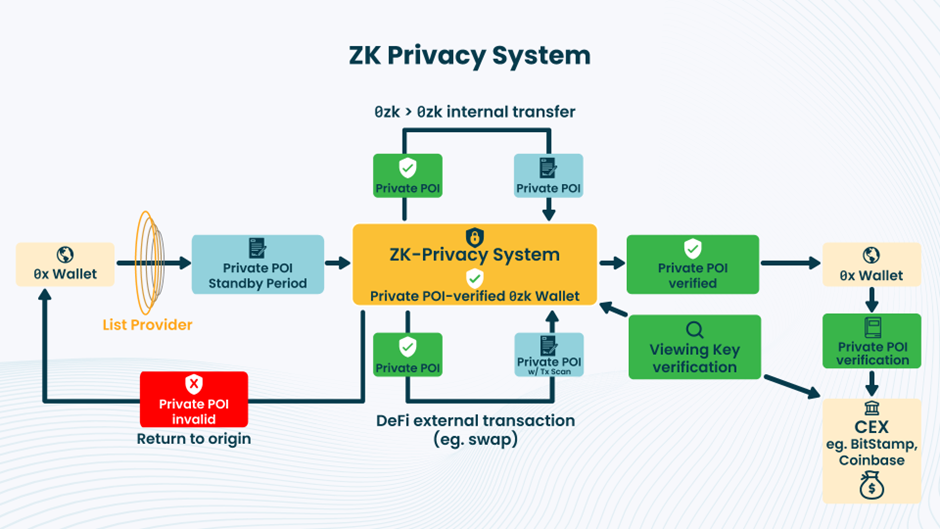
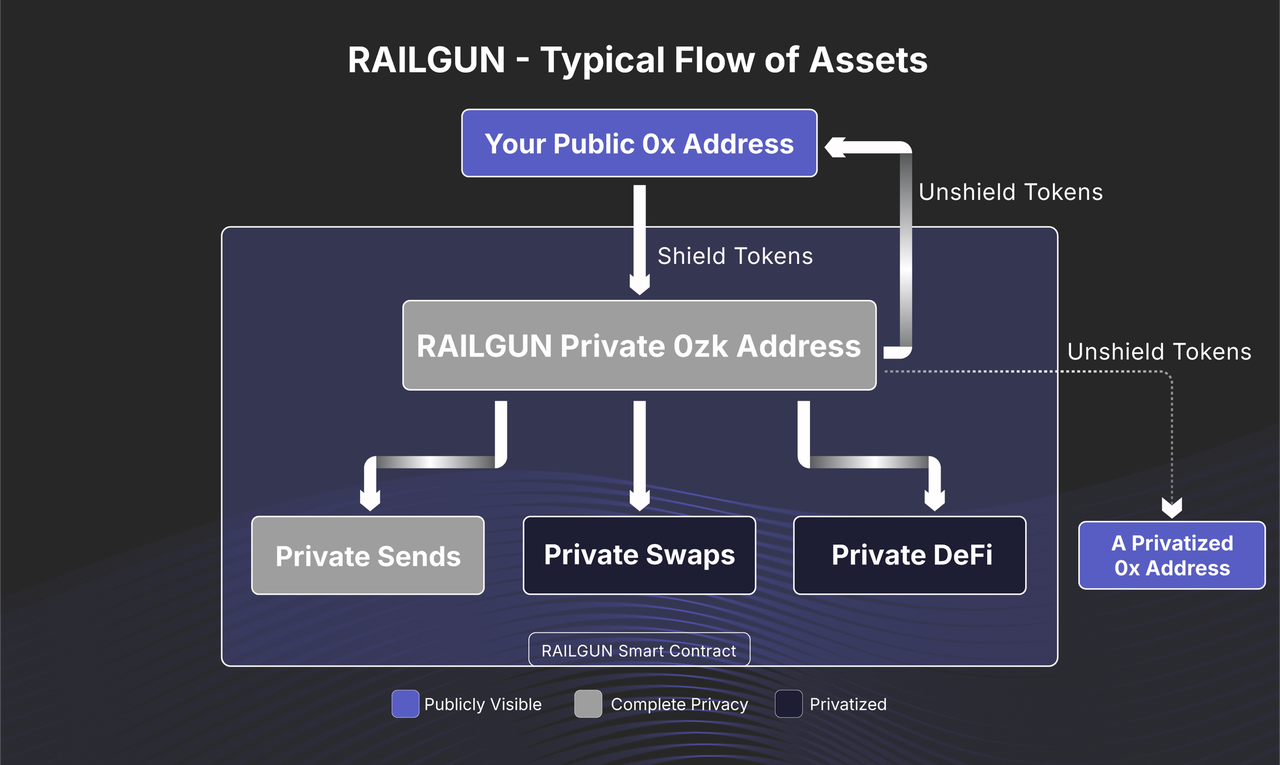
Shielding involves transferring public assets like ETH, USDC, or DAI into Railgun's privacy system. When a user initiates a Shield, the assets are sent to Railgun's smart contract, which generates encrypted commitments.
From the blockchain's perspective, the assets are locked inside Railgun's privacy pool, but their subsequent movements can no longer be tracked by outsiders.
Simultaneously, the user receives a corresponding Private Balance. This balance is not displayed publicly like a regular wallet balance; instead, it exists in encrypted form within Railgun's privacy account system.
The Shield acts as an "entry to the privacy layer" and serves as the starting point for all anonymous transactions and Private DeFi operations.
How Does Private Balance Work?
Private Balance is the core component of Railgun's privacy system.
Standard blockchain account models publicly display wallet balances. In contrast, Railgun uses a UTXO-like structure to store private assets. Users hold a set of encrypted Notes rather than a conventional public account balance.
These Notes are recorded in a Merkle Tree, with each transaction updating the tree and generating a new state proof.
When a user initiates a transaction, the system verifies:
- The user legitimately owns the assets.
- The assets have not been double-spent.
- The transaction complies with protocol rules.
However, this verification process does not reveal specific balances or identity information.
This design allows Railgun to perform on-chain state verification without exposing asset details.
What Role Does zk-SNARK Play in Railgun?
zk-SNARK is the foundational technology of Railgun's privacy system.
The core idea of zero-knowledge proofs is that users can prove "something is true" without revealing the specifics.
In Railgun, zk-SNARK verifies:
- The user owns valid assets.
- The transaction amount is correct.
- The Notes have not been double-spent.
- The transaction follows protocol rules.
But the proof process does not disclose:
- Wallet addresses.
- Balance amounts.
- Source of funds.
- Recipient identity.
As a result, Railgun achieves a "verifiable but invisible" transaction structure on a public blockchain.
This mechanism is fundamentally different from regular transfers. Standard transactions rely on fully open data for verification, whereas Railgun replaces public data with mathematical proofs.
How Does the Broadcaster Broadcast Private Transactions?
In a normal Ethereum transaction, the user must broadcast it directly from their wallet and pay the Gas Fee, which exposes the sender's identity.
Railgun solves this by introducing a Broadcaster network.
After the user generates a zk-Proof, they do not submit the transaction themselves. Instead, a Broadcaster relays it to the blockchain.
From an on-chain perspective, outsiders only see the Broadcaster's address, not the real user's address.
The Broadcaster acts as an anonymous relay layer, separating "transaction verification" from "transaction broadcasting" to reduce identity exposure.
Additionally, the Broadcaster helps users achieve a nearly gasless private transaction experience.
What Role Does the Relayer Play in the Transaction Process?
The Relayer handles relay services and fee structures.
Since users do not broadcast transactions directly, a Relayer pays the on-chain Gas costs on their behalf. The corresponding fees are deducted from the user's Private Balance rather than paid through a public wallet.
This mechanism prevents users from exposing their identity by paying Gas.
The Relayer and Broadcaster together form Railgun's anonymous transaction network:
- zk-SNARK hides the data.
- Private Balance hides the asset state.
- Broadcaster hides the broadcast source.
- Relayer hides the Gas payment relationship.
Only with all these components combined does Railgun form a complete private transaction system.
What Happens During an Unshield?
To exit Railgun's privacy system, users perform an Unshield operation.
Unshielding converts assets from the Private Balance back into standard on-chain assets and sends them to a public wallet address.
In this process, Railgun generates a new zk-Proof to verify asset ownership and prevent double-spending.
Although the funds eventually leave the privacy pool, the multiple rounds of encryption and mixing along the way make it nearly impossible for external observers to fully reconstruct the fund's history.
However, when unshielding to a public address, users should still be cautious about on-chain behavior correlations—such as repeatedly using the same wallet address or interacting directly with KYC platforms.
What Is the Difference Between Railgun and Regular On-Chain Transfers?
The key difference between Railgun and standard Ethereum transfers is "privacy by default."
Regular transfers expose:
- Sender address.
- Receiver address.
- Amount.
- Time.
- Asset type.
Railgun, in contrast, masks this information as much as possible, revealing only the necessary verification data.
Moreover, Railgun supports not just anonymous transfers but also Private DeFi operations. Users can perform swaps, manage liquidity, and interact with protocols without revealing their identity.
This makes Railgun more of a "private financial layer" than a simple anonymizing transfer tool.
Summary
Railgun's private transaction system uses zk-SNARK, Private Balance, Broadcaster, and Relayer networks to conceal on-chain identity, balances, and fund flow paths.
Unlike traditional mixers, Railgun emphasizes long-term privacy accounts and Private DeFi structures, enabling users to engage in ongoing anonymous financial activities within open ecosystems like Ethereum.
FAQs
Why does Railgun need a Broadcaster?
The Broadcaster broadcasts transactions on behalf of users, preventing them from exposing their public wallet addresses directly.
How does zk-SNARK hide transaction data?
zk-SNARK verifies transaction validity without revealing specific information.
Does Railgun support Private DeFi?
Yes. Railgun supports anonymous transfers as well as swaps, liquidity management, and other Private DeFi operations.
What is the difference between Railgun and Tornado Cash?
Railgun focuses on ongoing Private DeFi and privacy account systems, rather than just anonymous coin mixing.
Which chains does Railgun support?
Railgun primarily supports EVM networks, including Ethereum, Arbitrum, and BNB Chain.