As on-chain derivatives trading volume expands, Perp DEXs are shifting from the early AMM model toward an order book model. More traders want to keep control of their on-chain assets while enjoying matching speed, depth, and a trading experience on par with centralized exchanges.
Hyperliquid has gained traction precisely in this context. Unlike traditional AMM-based perpetual protocols, it uses a native Layer 1 architecture and an on-chain order book, allowing trade matching, position management, and risk control to operate within a single unified system.
What Is Hyperliquid's On-Chain Trading Process?
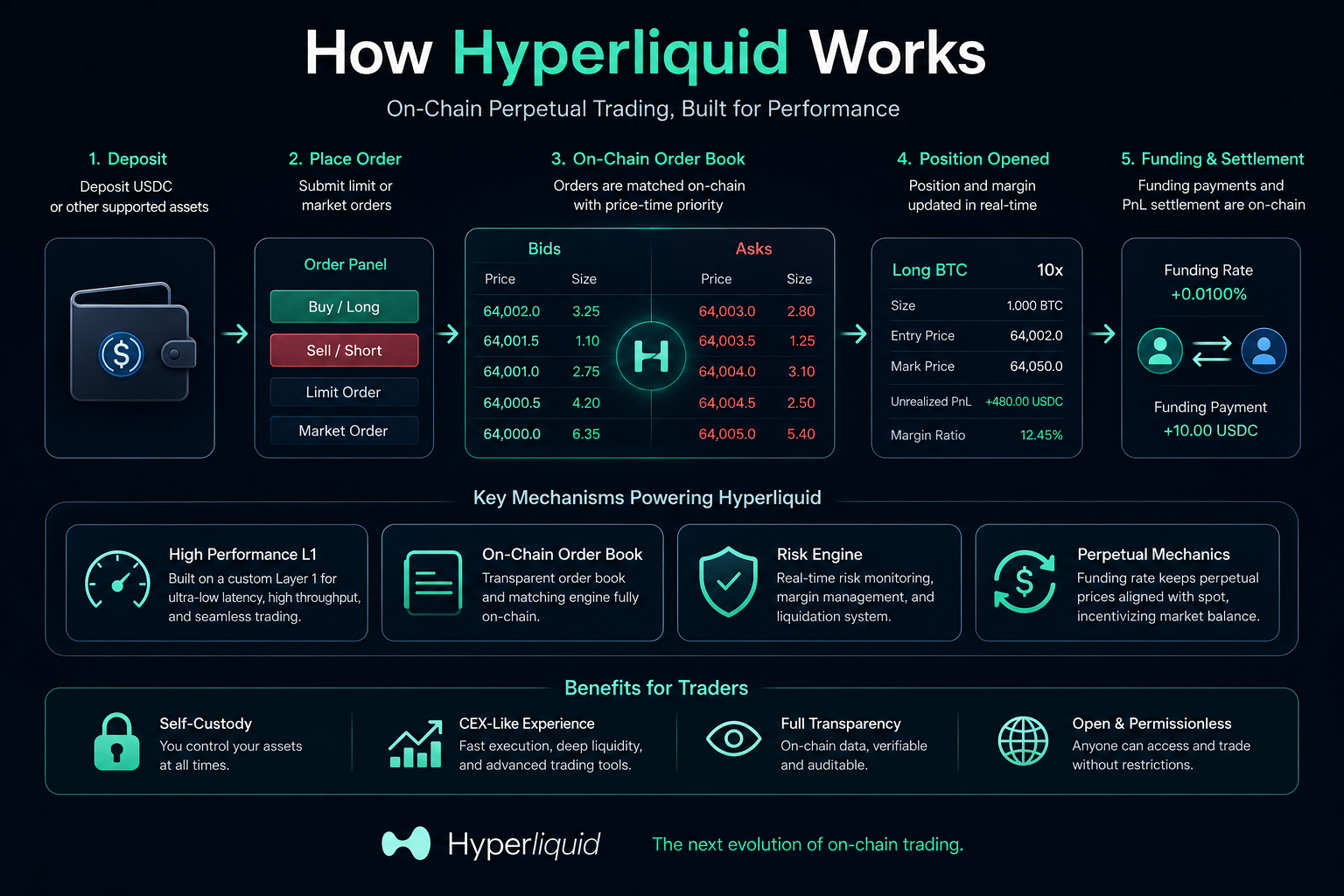
On Hyperliquid, a perpetual futures trade involves far more than just "placing an order and having it filled." Internally, the system goes through multiple stages: asset deposit, order broadcast, matching, position update, margin calculation, funding rate settlement, and risk monitoring.
Unlike most Perp DEXs that rely on AMM pricing, Hyperliquid uses an on-chain order book to manage bids and asks. Its logic closely resembles the matching engine of a traditional exchange. After a user submits an order, the system matches based on price and time priority and updates the account in real time.
A full trade cycle typically includes depositing assets, submitting an order, matching, opening a position, managing margin, settling funding rates, and finally closing the position. Several modules work together to form Hyperliquid's on-chain perpetual trading framework.
How Do User Assets Enter the Hyperliquid System?
Before trading, users must bridge or deposit assets into the Hyperliquid network. Because Hyperliquid runs on its own native Layer 1, assets don't stay on the Ethereum mainnet; they move into Hyperliquid's execution environment.
Once inside, assets are recorded in the on-chain account state and serve as margin for future trades. Unlike centralized exchanges, users don't need to hand assets over to a traditional custodian. Instead, they control funds directly through their on-chain account.
The system dynamically tracks available margin, occupied margin, and unrealized PnL. When the user selects a leverage level, the account's risk profile changes accordingly. Higher leverage means a smaller safety buffer to maintain the position, making liquidation more likely.
This stage defines the risk range the user can bear and is a foundational part of the perpetual futures system.
How Does Hyperliquid's Order Book Match Trades?
A key feature of Hyperliquid is using an on-chain order book instead of an AMM pool for pricing. When a user submits an order, the system broadcasts it to the on-chain matching engine, which matches based on price and time priority.
This process is similar to a traditional exchange. Buy orders match against the lowest ask, and sell orders match against the highest bid. If an order can't be filled immediately, it sits in the order book waiting for a counterparty.
Users can place market orders or limit orders. Market orders fill instantly at the best available price, while limit orders only execute when the specified price is reached. Whether an order fills immediately also affects the fee structure and the maker/taker role.
| Role |
Definition |
Impact on Liquidity |
| Maker |
Provides liquidity by placing orders |
Increases market depth |
| Taker |
Aggressively takes orders to fill |
Consumes market liquidity |
This structure is why Hyperliquid is often compared with AMM-based Perp DEXs. The order book model emphasizes real bid-ask depth and efficient price discovery, while the AMM model relies on liquidity pool pricing.
After Opening a Position, How Does the System Calculate PnL and Margin?
Once an order fills, the system creates the position and continuously tracks market price movements. Account equity changes in real time with the market, updating data like entry price, current mark price, unrealized PnL, and margin ratio.
The margin ratio can be expressed as:
$\text{Margin Ratio}=\frac{\text{Account Equity}}{\text{Position Value}}$
When the market moves favorably, account equity increases; when it moves against you, equity decreases. To reduce the risk of market manipulation, most perpetual platforms don't use the latest trade price for risk assessment. Instead, they use a mark price mechanism. Hyperliquid also calculates risk by combining external market data with its internal order book.
This dynamic update ensures perpetual trading is always under real-time risk evaluation.
Why Does the Funding Rate Mechanism Run Continuously?
Since perpetual futures have no expiration date, the system uses a funding rate mechanism to keep the contract price close to the spot market.
The funding rate is a periodic payment between long and short traders. When the perpetual price is above the spot price, longs typically pay shorts; when below, shorts pay longs.
The funding payment formula is:
$\text{Funding Payment}=\text{Position Size}\times\text{Funding Rate}$
This mechanism encourages the market to self-balance between longs and shorts, reducing long-term price deviations from the spot. The funding rate is not a platform fee but a dynamic exchange between traders, and it's a key differentiator from traditional futures.
Under What Conditions Does Hyperliquid's Liquidation Mechanism Trigger?
The risk engine constantly monitors margin levels across all accounts. When account equity drops below the maintenance margin requirement, the system may trigger liquidation.
The core condition is:
$\text{Account Equity}<\text{Maintenance Margin}$
Once this threshold is breached, the system automatically reduces or closes part of the position, using market liquidity to complete the closure. The goal is to prevent negative balances and maintain overall market stability.
Because Hyperliquid uses a high-performance order book, its liquidation process is closer to that of a traditional exchange compared to some AMM-based protocols. However, under extreme market conditions, slippage, reduced liquidity, and cascading liquidations can still occur, so high-leverage trading always carries substantial risk.
How Does Hyperliquid's Native Layer 1 Affect the Trading Experience?
Most on-chain perpetual protocols are built on general-purpose smart contract chains. Hyperliquid, however, chose to build its own native Layer 1. This design unifies order matching, state updates, risk calculation, and liquidation logic within a single execution environment.
As a result, Hyperliquid delivers lower latency, higher-frequency state updates, and more stable order book depth.
| Capability |
Impact on Trading Experience |
| Lower latency |
Faster order response |
| High-frequency state updates |
Less price desynchronization |
| On-chain order book |
Better depth and price discovery |
| Native risk engine |
Optimized liquidation and margin management |
This architecture is why Hyperliquid is often described as offering a "CEX-like on-chain trading experience"
What Are the Operational Differences Between Hyperliquid and Traditional CEXs?
Even though Hyperliquid's trading experience feels like a centralized exchange, its underlying structure is distinctly different.
| Dimension |
Hyperliquid |
Traditional CEX |
| Asset custody |
On-chain account control |
Platform centralized custody |
| Matching transparency |
On-chain verifiable |
Internal system invisible |
| Liquidation mechanism |
On-chain rule execution |
Platform internal control |
| Order book |
On-chain order book |
Centralized order book |
| Risk |
Smart contract and on-chain risk |
Custody and platform risk |
This difference explains why more traders are exploring the "on-chain CEXification" trend. Hyperliquid aims to strike a new balance between self-custody and high-performance trading.
Summary
Hyperliquid's operating model is built on an on-chain order book, a native Layer 1, and perpetual futures risk management. A complete trade is not just a simple buy or sell—it involves coordinated systems including matching, margin management, funding rates, risk monitoring, and liquidation.
Compared to early Perp DEXs, Hyperliquid emphasizes high-performance matching and a trading experience close to centralized exchanges, while maintaining on-chain transparency and self-custody. This model is driving the on-chain derivatives market from an AMM structure toward a high-performance order book architecture.
FAQ
Does Hyperliquid use AMM?
No. Hyperliquid primarily uses an on-chain order book for matching, not AMM liquidity pool pricing.
Why is Hyperliquid's trading experience close to a CEX?
Because its native Layer 1 and high-performance matching engine deliver lower latency, higher-frequency state updates, and more stable order book depth.
What role does Hyperliquid's funding rate play?
The funding rate balances long and short positions and helps keep the perpetual price close to the spot market.
How does Hyperliquid's liquidation mechanism work?
When account equity falls below the maintenance margin requirement, the system automatically reduces or closes positions to control risk and prevent negative balances.
What is the biggest difference between Hyperliquid and traditional Perp DEXs?
The biggest difference is its on-chain order book and native Layer 1 architecture, while most traditional Perp DEXs rely on the AMM model and general-purpose blockchains.







