Over the past few years, Web3 wallets have become a crucial gateway to the blockchain ecosystem. Whether managing assets, trading NFTs, or interacting with DeFi, users typically rely on wallets to complete signatures and on-chain approvals. MetaMask has long been one of the most iconic traditional wallets, while Infinex represents the new wave of account abstraction (AA) wallets.
As the multi-chain ecosystem expands, the limitations of traditional wallets in terms of user experience are becoming increasingly apparent. Managing seed phrases, preparing Gas Tokens, and frequently switching networks remain major barriers for many retail investors entering Web3. To address this, Infinex is reimagining the on-chain account experience through Passkey and account abstraction mechanisms. This shift not only changes how users interact with wallets but also signals a broader industry move from “private key logic” to “account logic” in Web3 infrastructure.
Infinex is a non-custodial DeFi super app built on account abstraction. Leveraging Passkey logins, a unified account system, and multi-chain aggregation, Infinex empowers users to manage on-chain assets, execute cross-chain transactions, and access DeFi protocols—all in one place.
Unlike traditional wallets, Infinex puts the “account experience” front and center. Users don’t need to manually store seed phrases; instead, they can log in and sign transactions using Face ID, Touch ID, or device verification.
MetaMask, one of the most widely used Web3 wallets, was originally designed for the Ethereum ecosystem. Users create wallets with a seed phrase and sign on-chain transactions with a private key. MetaMask is a classic EOA (Externally Owned Account) wallet, meaning full control is tied to the private key. As long as users have their seed phrase, they can recover their account and manage their assets.
How Do Account Abstraction Wallets Differ from EOA Wallets?
EOA (Externally Owned Account) wallets are the most common wallet type today, characterized by accounts fully controlled via private keys—MetaMask is a prime example.
Account abstraction (AA) wallets, in contrast, use smart contract logic to manage accounts, enabling more advanced permissions and execution rules. For instance, AA wallets can support:
- Multi-device verification
- Automated trading
- Social recovery
- Gas abstraction
- Batch transaction execution
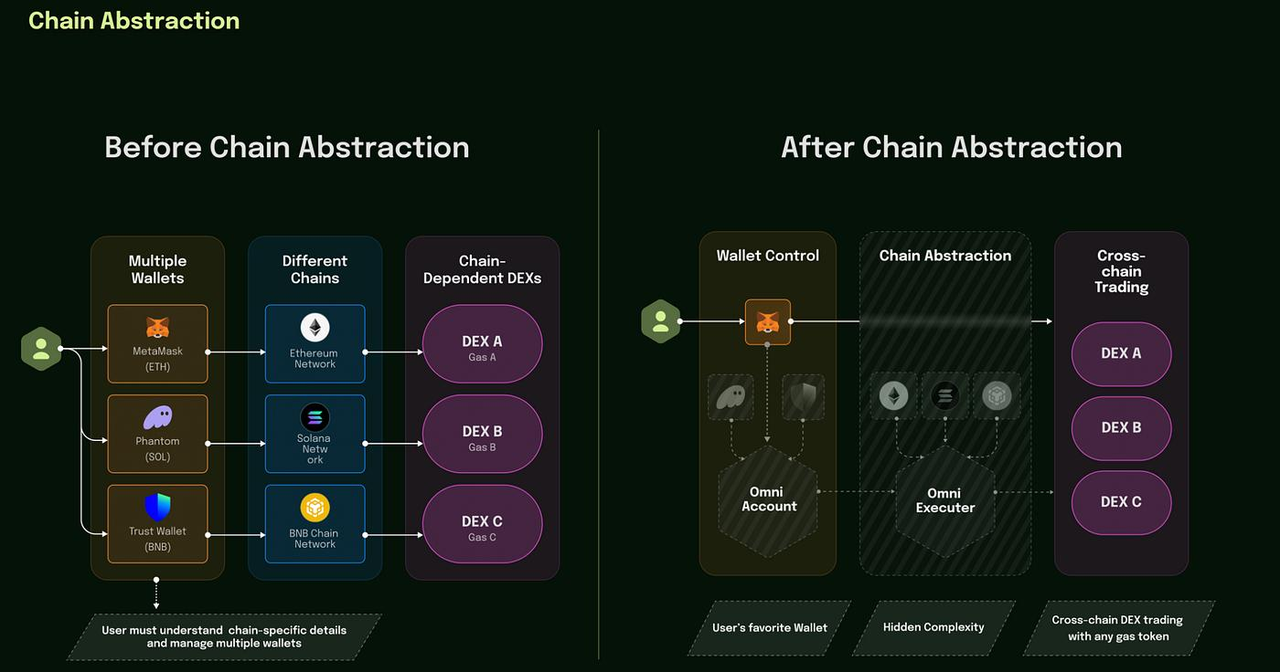
This model transforms wallets into “smart accounts” rather than just blockchain addresses.
Infinex’s account system is built on account abstraction, making its user experience distinctly different from traditional wallets.
How Is Gas Management Different?
With traditional wallets, users must manually prepare the right Gas Token for each chain. For example, you need ETH to transact on Ethereum, and ETH again for Arbitrum as Gas.
While consistent with blockchain mechanics, this setup is complex for many retail investors. Users might hold assets but still be unable to transact due to a lack of Gas Tokens.
By introducing Gas abstraction, Infinex handles part of the trading fee process automatically, reducing the need for users to constantly swap Gas Tokens. Users no longer have to track fee differences across chains or switch networks repeatedly.
Gas abstraction doesn’t eliminate on-chain fees—it simply makes them less of a headache for users.
Why Is the Multi-Chain Experience Different?
MetaMask’s multi-chain model is essentially “single-chain switching.” Users must manually change networks to view assets and transactions on each chain.
As blockchain ecosystems grow, this approach is showing its limitations. Assets can be scattered across chains, and frequent network switching adds unnecessary complexity.
Infinex addresses this by aggregating multi-chain assets under a unified account system. Users can view assets, returns, and trading activity across chains in a single interface, with the system handling chain switching behind the scenes.
This experience is more like managing an internet account than using a traditional wallet.
MetaMask has long been the go-to tool for native Web3 users. Those comfortable with private key management, network switching, and DeFi interactions will appreciate its flexibility and broad ecosystem compatibility.
Infinex is better suited for users seeking a simpler on-chain experience. Passkey login, multi-chain aggregation, and unified account logic make it accessible to mainstream internet users.
Rather than being direct substitutes, these two wallets represent different stages and styles of the Web3 user journey.
| Comparison |
Infinex |
MetaMask |
| Log In Method |
Passkey |
Seed Phrase |
| Account Structure |
Account Abstraction |
EOA |
| Multi-Chain Experience |
Aggregated Account |
Manual Network Switching |
| Gas Management |
Gas abstraction |
User Prepares Manually |
| Target Users |
Retail & Multi-Chain Users |
Native Web3 Users |
What Are the Challenges for Account Abstraction Wallets?
While account abstraction wallets improve user experience, the supporting ecosystem is still in its early days.
First, protocol and infrastructure compatibility with AA wallets is still evolving. Many DeFi protocols were built for EOA wallets, so some features may require further adaptation.
Second, account abstraction relies on smart contracts, making its security model different from traditional wallets. Account recovery, permission management, and device security all impact the overall experience.
Additionally, Passkey support varies across devices and browsers, and optimizing account migration and recovery remains a key industry focus.
Summary
The differences between Infinex and MetaMask reflect the broader evolution of Web3 wallets from “private key management” to “account experience.” MetaMask exemplifies the traditional EOA wallet, prioritizing private key control and open compatibility. Infinex, on the other hand, leverages account abstraction, Passkey, and multi-chain aggregation to reduce user reliance on complex chain operations.
That said, traditional and AA wallets will continue to coexist for the foreseeable future, each serving different user needs.
FAQs
What’s the main difference between Infinex and MetaMask?
MetaMask is built on the traditional EOA wallet structure, while Infinex utilizes account abstraction and Passkey login, focusing on unified accounts and a seamless multi-chain experience.
Will Passkey replace seed phrases?
Passkey offers a login experience similar to mainstream internet apps, but seed phrase and private key models will persist for the foreseeable future.
Is Infinex a non-custodial wallet?
Infinex prioritizes user self-custody of assets and is generally considered a non-custodial account system.
Why are account abstraction wallets getting so much attention?
Account abstraction reduces the complexity of on-chain interactions and enables more flexible account permissions and Gas management, making Web3 more accessible.
Can MetaMask support account abstraction?
Some EOA wallets may eventually integrate account abstraction features, but their underlying architecture remains different from AA-first products like Infinex.