What Are the Use Cases of Ontology? From Digital Identity to the Data Economy

Last Updated 2026-04-03 12:47:16
Reading Time: 2m
Ontology’s use cases center on “identity and data,” including decentralized identity (ONT ID), data ownership, privacy protection, cross-chain trust, and enterprise applications. Through verifiable credentials and on-chain trust mechanisms, Ontology enables identity authentication and trusted data exchange without relying on centralized institutions, providing foundational infrastructure for the data economy.

As blockchain technology expands beyond financial use cases into the broader digital economy, identity authentication and trusted data exchange have become essential capabilities. In traditional internet environments, identities are controlled by platforms, and data is scattered across isolated systems, making cross-platform collaboration and verification difficult.

Ontology offers a solution built around decentralized identity and trust mechanisms. Its focus is not on asset trading, but on creating a “trusted connection between identity and data.” Through ONT ID and verifiable credentials, Ontology is gradually establishing itself as infrastructure within digital identity and data economy systems, providing a verifiable trust framework for multi-party collaboration.

What Are the Use Cases of Ontology? From Digital Identity to the Data Economy

Core Logic Behind Ontology Use Cases

Ontology’s applications can be understood through a unified logic: transforming trust relationships that once depended on centralized institutions into verifiable, on-chain structures by binding identity ownership with data.

In this framework, decentralized identity (ONT ID) serves as the entry point, data is managed and authenticated through credentials, and trust is established through verification mechanisms and on-chain records. This logic is then applied across different scenarios, forming diverse real-world use cases.

Scenario 1: Decentralized Identity (ONT ID) and Digital Identity Management

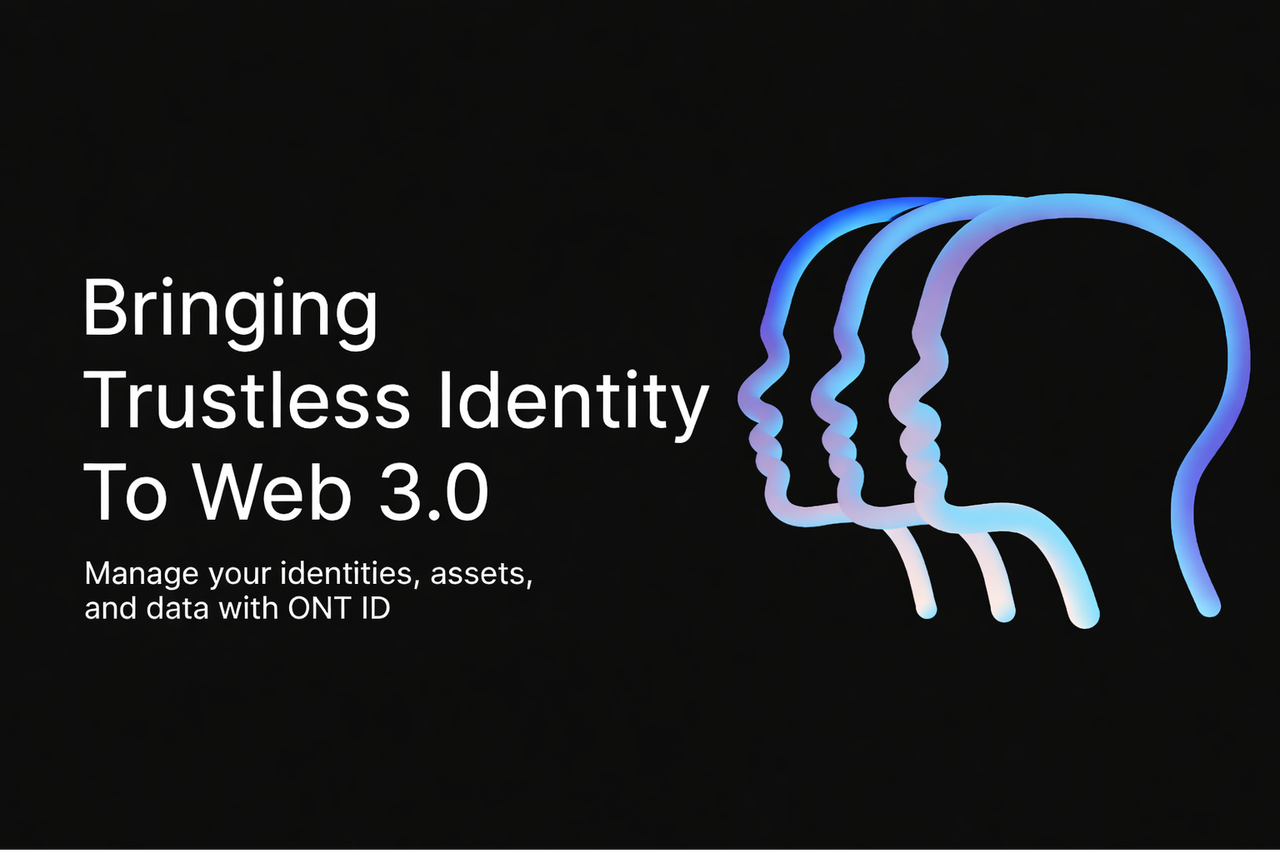
In digital identity management, Ontology provides a decentralized identity system. ONT ID acts as a unique identifier, allowing users to control their own identity rather than relying on a single platform.

This system can be applied in various scenarios, such as identity verification (KYC), digital certificate management, and Web3 login systems. With verifiable credentials, users can reuse identity information across platforms without repeatedly submitting the same data.

Compared to traditional identity systems, this model reduces the risk of data breaches while improving portability and verifiability.

Scenario 2: Data Ownership and Data Assetization

In the data economy, the value of data depends on ownership and authenticity. Ontology binds data to ONT ID to establish ownership, laying the foundation for data assetization.

In practice, data is not stored directly on-chain. Instead, hashes or credential-based representations are recorded. This approach preserves proof of ownership while avoiding privacy exposure.

Through this mechanism, data can circulate between different parties and be used under authorized conditions, enabling a sustainable data value ecosystem.

Scenario 3: Data Exchange and Privacy Protection

The core challenge of data exchange is verifying information without exposing raw data. Ontology addresses this through verifiable credentials and encryption, allowing data to be validated while preserving privacy.

For example, in healthcare or finance, users can prove they meet certain conditions without revealing all underlying data. This “verifiable but not visible” approach makes data exchange more secure and efficient.

It also provides a new pathway for cross-institutional data collaboration.

Scenario 4: Combining DeFi with On-Chain Identity

In decentralized finance (DeFi), anonymity enables openness but also introduces risk and uncertainty. Ontology enhances DeFi by integrating on-chain identity mechanisms.

Through ONT ID and credential systems, identity dimensions such as credit scoring or risk assessment can be introduced while maintaining a level of privacy. This expands the boundaries of DeFi, making it capable of supporting more complex financial use cases.

Scenario 5: Enterprise Blockchain and Compliance Use Cases

Ontology is designed with enterprise needs in mind, making it suitable for enterprise blockchain environments. Its identity and data management capabilities support applications such as supply chain management, data sharing, and compliance auditing.

In these scenarios, organizations can establish unified identity and permission systems through Ontology, enabling cross-organizational collaboration. Meanwhile, on-chain records provide traceability, improving transparency across systems.

Scenario 6: A Trust Bridge in Cross-Chain and Multi-Chain Ecosystems

As blockchain ecosystems evolve into multi-chain environments, interoperability of identity and data becomes a key challenge. Ontology can act as a trust intermediary, enabling identity and data verification across different chains.

With a unified identity system and verification mechanisms, Ontology facilitates trust transfer in multi-chain environments, reducing the complexity of cross-chain collaboration.

Key Characteristics of Ontology Use Cases

The key characteristics can be summarized as follows:

Dimension Ontology Application Characteristics
Core Capability Decentralized identity + data management
Trust Mechanism Verifiable credentials + on-chain records
Application Focus Identity and data first
Typical Scenarios DID, data exchange, enterprise applications
Technical Features Privacy protection + verifiability

Limitations and Challenges of Ontology Applications

Although Ontology provides a structured solution for identity and data, several challenges remain. For instance, decentralized identity standards are not yet fully unified, and compatibility across systems still needs improvement.

In addition, real-world adoption depends on ecosystem development and actual demand. Without sufficient use cases, its technical advantages may not be fully realized. Balancing privacy protection with data verifiability is also an ongoing challenge that requires continuous optimization.

Conclusion

At its core, Ontology is about building “trusted data relationships.” Through decentralized identity, data ownership, and verification mechanisms, it transforms identity and data into a verifiable trust foundation that supports a wide range of applications.

As digital identity and the data economy continue to evolve, this trust-centric infrastructure provides a viable path for blockchain expansion beyond financial use cases.

FAQs

What are the main application areas of Ontology?

It is mainly used in digital identity management, data ownership, data exchange, enterprise blockchain, and cross-chain trust.

What practical scenarios can ONT ID be used for?

It can be applied in identity verification, digital certificate management, Web3 login, and more.

Is Ontology mainly used for DeFi?

No, its primary focus is on identity and data layers, though it can complement DeFi applications.

How does Ontology protect data privacy?

It uses verifiable credentials and encryption to enable validation without exposing raw data.

What role does Ontology play in multi-chain ecosystems?

It acts as a trust intermediary, providing identity and data verification to facilitate collaboration across blockchains.

Author: Jayne
Translator: Jared
Reviewer(s): Ida
Disclaimer
* The information is not intended to be and does not constitute financial advice or any other recommendation of any sort offered or endorsed by Gate.
* This article may not be reproduced, transmitted or copied without referencing Gate. Contravention is an infringement of Copyright Act and may be subject to legal action.

Share

Crypto Calendar
Tokenların Kilidini Aç
Pyth Network, 19 May'da 2.130.000.000 PYTH tokenini serbest bırakacak ve bu, mevcut dolaşım arzının yaklaşık %36,96'sını oluşturacak.
PYTH
2.25%
2026-05-18
Tokenların Kilidini Aç
Pump.fun, 12 Temmuz'da 82,500,000,000 PUMP token'ı kilidini açacak ve bu, mevcut dolaşımdaki arzın yaklaşık %23,31'ini oluşturacak.
PUMP
-3.37%
2026-07-11
Token Kilidi Açma
Succinct, 5 Ağustos'ta mevcut dolaşımdaki arzın yaklaşık %104,17'sini oluşturan 208,330,000 PROVE token'ını serbest bırakacak.
PROVE
2026-08-04
sign up guide logosign up guide logo
sign up guide content imgsign up guide content img
Sign Up

Related Articles

The Future of Cross-Chain Bridges: Full-Chain Interoperability Becomes Inevitable, Liquidity Bridges Will Decline
Beginner

The Future of Cross-Chain Bridges: Full-Chain Interoperability Becomes Inevitable, Liquidity Bridges Will Decline

This article explores the development trends, applications, and prospects of cross-chain bridges.
2026-03-24 11:52:54
Solana Need L2s And Appchains?
Advanced

Solana Need L2s And Appchains?

Solana faces both opportunities and challenges in its development. Recently, severe network congestion has led to a high transaction failure rate and increased fees. Consequently, some have suggested using Layer 2 and appchain technologies to address this issue. This article explores the feasibility of this strategy.
2026-03-24 11:54:39
Sui: How are users leveraging its speed, security, & scalability?
Intermediate

Sui: How are users leveraging its speed, security, & scalability?

Sui is a PoS L1 blockchain with a novel architecture whose object-centric model enables parallelization of transactions through verifier level scaling. In this research paper the unique features of the Sui blockchain will be introduced, the economic prospects of SUI tokens will be presented, and it will be explained how investors can learn about which dApps are driving the use of the chain through the Sui application campaign.
2026-03-24 11:54:36
Navigating the Zero Knowledge Landscape
Advanced

Navigating the Zero Knowledge Landscape

This article introduces the technical principles, framework, and applications of Zero-Knowledge (ZK) technology, covering aspects from privacy, identity (ID), decentralized exchanges (DEX), to oracles.
2026-03-24 11:53:01
What is Tronscan and How Can You Use it in 2025?
Beginner

What is Tronscan and How Can You Use it in 2025?

Tronscan is a blockchain explorer that goes beyond the basics, offering wallet management, token tracking, smart contract insights, and governance participation. By 2025, it has evolved with enhanced security features, expanded analytics, cross-chain integration, and improved mobile experience. The platform now includes advanced biometric authentication, real-time transaction monitoring, and a comprehensive DeFi dashboard. Developers benefit from AI-powered smart contract analysis and improved testing environments, while users enjoy a unified multi-chain portfolio view and gesture-based navigation on mobile devices.
2026-03-24 11:52:42
What Is Ethereum 2.0? Understanding The Merge
Intermediate

What Is Ethereum 2.0? Understanding The Merge

A change in one of the top cryptocurrencies that might impact the whole ecosystem
2026-03-24 11:52:15