As the DeFi market gradually expands into more professional trading use cases, more users are paying attention to whether on-chain protocols can truly approach the execution efficiency of centralized exchanges. Phoenix and Hyperliquid represent two different answers to that question.
In the on-chain derivatives sector, performance, matching speed, liquidity, and risk control have always been the core areas of competition. Early DeFi protocols mainly relied on the AMM model, but as demand for high frequency trading and professional market making has grown, more protocols have begun exploring order books, high performance execution layers, and dedicated trading networks.
Brief Overview of Phoenix and Hyperliquid and Their Core Differences
As an on-chain perpetual futures trading protocol built on the Solana blockchain, Phoenix uses a Fully On-Chain Order Book architecture.
On Phoenix, orders submitted by users enter an on-chain central limit order book, or CLOB, directly and are matched based on price priority and time priority. All orders, trades, and market states are recorded on-chain.
Phoenix’s core goal is to use Solana’s high throughput and low latency to deliver a trading experience closer to that of a centralized exchange while preserving on-chain transparency. Compared with traditional AMM based protocols, Phoenix places greater emphasis on low slippage, high frequency matching, and professional market making.
As a high performance protocol focused on on-chain perpetual futures trading, Hyperliquid is defined by its dedicated Layer 1 network, rather than relying entirely on existing public blockchain infrastructure.
Through a custom execution environment and a matching system optimized specifically for trading, Hyperliquid delivers a low latency trading experience. Its goal is also to offer performance close to that of centralized exchanges, but its technical path is clearly different from Phoenix.
Compared with Phoenix, which relies on Solana’s infrastructure, Hyperliquid places more emphasis on a dedicated trading network and a high performance execution layer. This design allows Hyperliquid to optimize more deeply for derivatives trading use cases.
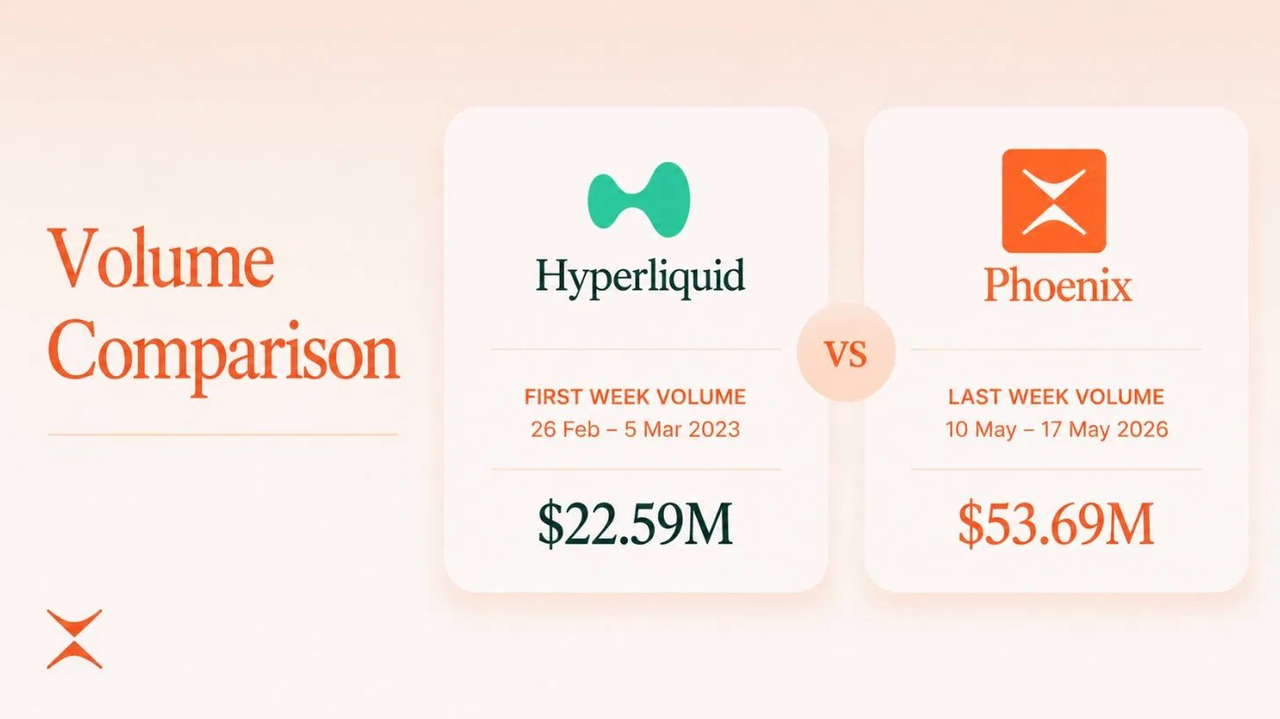
Source: DeFi on Solana
How Do the Underlying Architectures of Phoenix and Hyperliquid Differ?
The biggest difference between the two lies in their underlying execution layer and network structure.
Phoenix is built on the Solana public blockchain, and its order book and risk system run on the Solana network. As a result, Phoenix can directly use wallets, assets, and DeFi composability within the Solana ecosystem.
Hyperliquid uses an independent Layer 1 network architecture, with its matching system and execution environment controlled by the protocol itself. This gives Hyperliquid greater autonomy over network performance, although its ecosystem compatibility and open composability differ from the public chain model.
Simply put:
| Comparison Dimension |
Phoenix |
Hyperliquid |
| Underlying infrastructure |
Solana |
Dedicated Layer 1 |
| Order book structure |
Fully On-Chain |
High performance dedicated architecture |
| Execution environment |
Solana virtual machine |
Custom execution layer |
| Ecosystem composability |
Stronger |
More independent |
| Network control |
Dependent on Solana |
Controlled by the protocol |
Phoenix is more like an on-chain financial protocol built within a public blockchain ecosystem, while Hyperliquid is closer to an independent trading network designed specifically for trading.
How Do the Order Matching Models of Phoenix and Hyperliquid Differ?
Phoenix uses a Fully On-Chain Order Book model.
This means order submission, matching, and state updates are all completed on-chain, with market data fully public and transparent. Its advantages lie in strong verifiability and deep integration with the Solana DeFi ecosystem.
Although Hyperliquid also emphasizes order book trading, its architecture leans more toward a high performance dedicated system. Because it has an independent execution layer, Hyperliquid can further reduce trading latency and improve high frequency matching efficiency.
From a user experience perspective:
This is also the core difference in their design philosophies.
How Do the Liquidity Sources of Phoenix and Hyperliquid Differ?
Phoenix’s liquidity mainly comes from limit orders placed on the on-chain order book and from professional market makers.
Because its market structure is close to that of traditional exchanges, market depth depends on real order book liquidity. Phoenix is better suited for quantitative trading teams and professional market makers.
Hyperliquid also relies on order book liquidity, but because its execution environment is closer to a dedicated trading system, it can support higher frequency market-making activity.
That said, both differ clearly from the traditional AMM model:
-
They do not rely on liquidity pools for automatic pricing
-
They place greater emphasis on real market price discovery
-
They are better suited to high frequency trading scenarios
As the on-chain derivatives market matures, the order book model is once again becoming a major direction of exploration.
How Do Phoenix and Hyperliquid Differ in Risk Control?
Phoenix’s risk system mainly relies on margin mechanisms, Oracle price systems, and an on-chain risk engine. Because all states run on Solana, risk data is fully public.
Hyperliquid, by contrast, has an independent execution layer, allowing it to customize its risk system more deeply. For example, its matching and liquidation logic can be further optimized for lower latency and faster market response.
Even so, both must address the core challenges of the on-chain derivatives market, including extreme market volatility, liquidation efficiency, insufficient liquidity, and Oracle risk. Risk control remains a key factor in determining the long term stability of on-chain perpetual futures protocols.
Which Users Are Phoenix and Hyperliquid Best Suited For?
Phoenix is better suited for Solana ecosystem users, professional market makers, and traders who want to preserve on-chain transparency. Because Phoenix has strong compatibility with the Solana DeFi ecosystem, it can more easily integrate with wallets, aggregators, and other protocols.
Hyperliquid is better suited for users who trade high frequency derivatives and professional traders who place greater value on ultra low latency execution. Its independent network architecture makes it feel more like a professional trading platform on-chain.
In terms of overall positioning, Phoenix is more DeFi native, while Hyperliquid leans more toward a high performance trading network.
Conclusion
Phoenix and Hyperliquid both aim to provide an on-chain perpetual futures trading experience close to that of centralized exchanges, but they follow different development paths.
Phoenix builds a Fully On-Chain Order Book system on Solana, emphasizing on-chain transparency, ecosystem composability, and an order book based trading structure. Hyperliquid uses an independent Layer 1 network and a dedicated execution environment to deliver a more extreme high performance trading experience.
Neither model is absolutely better than the other. Instead, they represent different technical paths for the on-chain derivatives market.
FAQs
What is the biggest difference between Phoenix and Hyperliquid?
Phoenix runs on the Solana public blockchain, while Hyperliquid has its own independent Layer 1 network.
Does Phoenix use an order book?
Yes. Phoenix uses Fully On-Chain Order Book architecture.
Why did Hyperliquid choose an independent network?
An independent execution layer can further optimize trading performance and matching efficiency.
Which protocol is better suited for high frequency trading?
Both support high frequency trading, but Hyperliquid places greater emphasis on ultra low latency execution.
What are Phoenix’s advantages?
Phoenix offers stronger compatibility with the Solana ecosystem and greater on-chain transparency.







