As modular blockchain architectures have gained traction, more networks are splitting execution, data, and settlement functions into separate layers. The data availability layer has become a core component of Rollup networks. For BSquared Network, B² Hub does more than store data—it also connects ecosystem modules like B² Rollup, Mining², and AI Signal, making it a linchpin of the network architecture.
What Role Does B² Hub Play in the BSquared Network?
B² Hub serves as the middleware layer in BSquared's modular architecture.
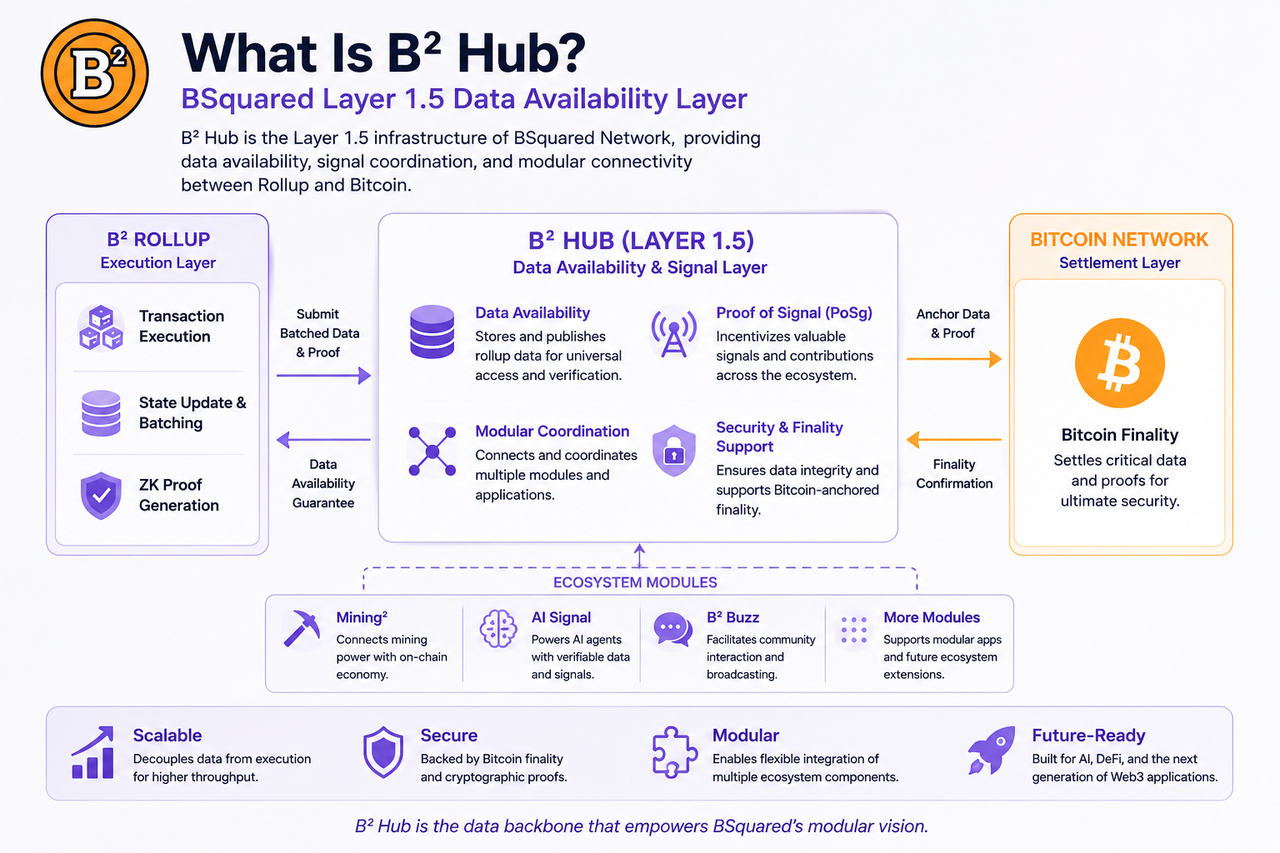
In the BSquared Network, B² Rollup handles smart contract execution and transaction processing, while the Bitcoin network manages final settlement. B² Hub sits between them, orchestrating data flow.
B² Hub records rollup state data, transaction batches, and proof information, then makes that data accessible to ecosystem participants. This design lets each module scale independently while maintaining seamless coordination.
Why Is B² Hub Called Layer1.5?
Layer1.5 is an architectural concept introduced by BSquared.
Traditional Layer1 handles consensus, execution, and data management, while Layer2 focuses on scaling and application execution. B² Hub sits between these two layers, hence the name Layer1.5.
Functionally, B² Hub does not directly process user transactions or handle final settlement. Instead, its primary role is to connect the execution and settlement layers, providing data infrastructure and ecosystem coordination for the entire network.
This sets it apart from conventional public chains or standalone rollup networks.
How Does B² Hub's Data Availability Mechanism Work?
One of B² Hub's core functions is guaranteeing data availability.
After a user transaction is executed on B² Rollup, the resulting state updates, transaction records, and proof data are submitted to B² Hub. Network nodes then store and synchronize this data. Any participant can access it to verify the authenticity of the rollup state.
This mechanism prevents data from being hidden or lost, increasing the network's transparency and verifiability.
What Is Proof of Signal (PoSg)?
Proof of Signal (PoSg) is a key mechanism introduced by B² Hub.
Traditional blockchain incentives revolve around hashrate, staked assets, or validation activity. Proof of Signal, by contrast, focuses on the value of data and signals contributed by network participants.
In the B² Hub ecosystem, data generated by nodes, applications, and users forms verifiable signals. These signals drive ecosystem incentives, resource allocation, and network governance. Through this approach, BSquared aims to build a richer, data-driven economic system.
How Does B² Hub Support Modular Blockchain Architecture?
Modular blockchains separate different functions into independent layers. B² Hub is a crucial part of BSquared's modular design.
- The execution layer runs smart contracts.
- The data layer stores state data.
- The settlement layer handles final confirmation and security.
This separation lets each layer focus on its core function, boosting overall scalability and system efficiency.
How Does B² Hub Work with B² Rollup?
B² Hub and B² Rollup operate in tight coordination.
B² Rollup processes user transactions and executes smart contracts. After generating a new state, it submits the relevant data to B² Hub. B² Hub stores, manages, and exposes that data to validator nodes.
Key proof information is then anchored to the Bitcoin network for final settlement. The result is a three-layer collaborative structure spanning execution, data, and settlement.
What's the Difference Between B² Hub and Traditional DA Layers?
Many modular blockchains use a data availability layer, but implementations vary.
Projects like Celestia focus primarily on data storage and availability verification. EigenDA emphasizes data scaling within the Ethereum ecosystem. B² Hub, by contrast, takes on data availability while also integrating ecosystem coordination and Proof of Signal.
Thus, B² Hub is not just a data layer—it's a central coordination hub for the BSquared ecosystem.
| Comparison Dimension |
B² Hub |
Celestia |
EigenDA |
| Core Positioning |
Layer1.5 |
DA Layer |
DA Layer |
| Data Availability |
Supported |
Supported |
Supported |
| Bitcoin Ecosystem Integration |
Deep integration |
Limited |
None |
| Signal Incentive Mechanism |
PoSg |
None |
None |
| Ecosystem Coordination Function |
Supported |
Limited |
Limited |
What Application Scenarios Does B² Hub Support?
B² Hub's role extends beyond the underlying network.
In BTC DeFi, B² Hub manages transaction data and state synchronization. In AI Agent ecosystems, it handles data validation and signal management. For chain games, NFTs, and modular applications, B² Hub provides stable data access and storage.
Summary
B² Hub is the Layer1.5 data availability layer built by BSquared Network, responsible for data storage, ecosystem coordination, and signal management. By bridging B² Rollup and the Bitcoin settlement layer, B² Hub serves as a vital hub in the BSquared modular architecture.
Compared with traditional data availability networks, B² Hub goes beyond data management, introducing a novel ecosystem incentive model through the Proof of Signal mechanism.
FAQs
Why Is B² Hub Called Layer1.5?
B² Hub sits between the execution layer and the settlement layer. It neither executes transactions directly nor handles final settlement, so it's defined as Layer1.5 infrastructure connecting Layer1 and Layer2.
What Are the Main Functions of B² Hub?
B² Hub handles data availability management, state storage, ecosystem coordination, and Proof of Signal (PoSg) management.
What Is Proof of Signal (PoSg)?
Proof of Signal is a data-driven incentive mechanism introduced by B² Hub. It evaluates the value of data and signals contributed by network participants to allocate resources and drive ecosystem incentives.
How Are B² Hub and B² Rollup Related?
B² Rollup handles transaction execution and state updates. B² Hub stores the resulting data and provides access to validator nodes. Together, they form the modular architecture of BSquared.
What's the Difference Between B² Hub and Celestia?
Both support data availability, but B² Hub deeply serves the BSquared ecosystem and integrates Proof of Signal and ecosystem coordination, while Celestia primarily focuses on general-purpose data availability services.