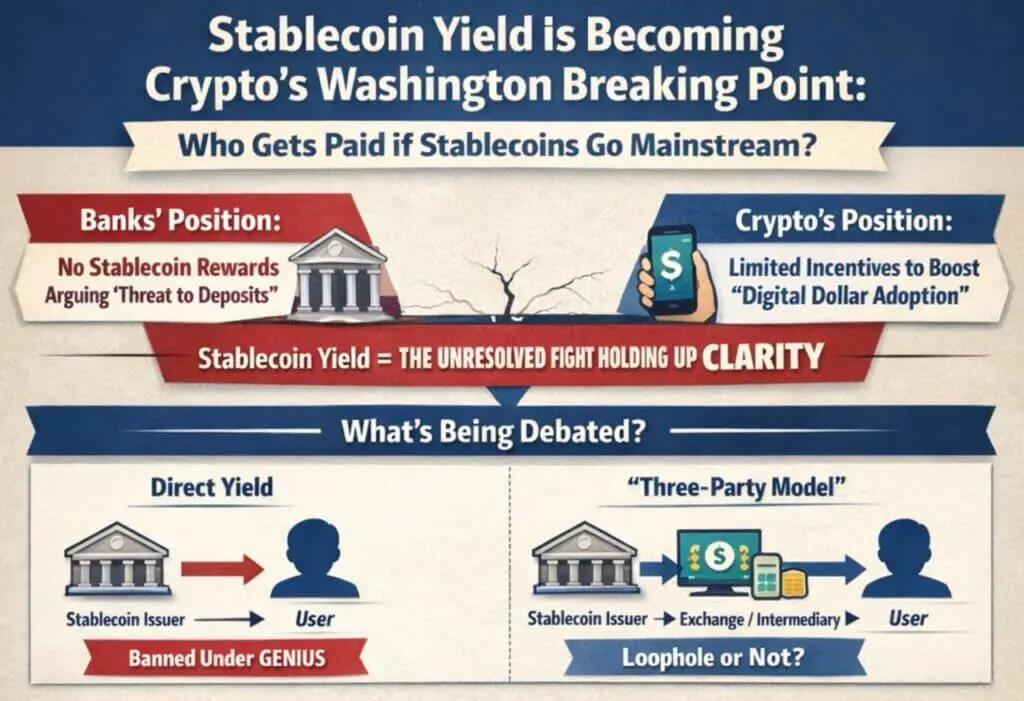



The CLARITY Act (Crypto Market Structure Act) negotiations in the US Senate are stalled due to a debate over whether yield-bearing stablecoins should be paid. Banks are demanding a complete ban, viewing yield-bearing stablecoins as a "deposit flight," while the crypto sector considers it a major obstacle to innovation and global competition. This debate will directly determine the future of the $281 billion stablecoin market.
Brief Background
The GENIUS Act, passed in 2025, imposed a direct yield ban on payment-oriented stablecoins. However, by 2026, yield-bearing models (like Ethereum USDe) had doubled the market. Banks predict a deposit loss of $182-908 billion by 2030, calling it "regulatory arbitrage."
Positions of the Parties
👉Banks:
Yield competes with traditional savings accounts and creates systemic risk. The American Bankers Association is demanding a complete ban.
👉Crypto Sector:
According to Coinbase, Circle, and Brian Armstrong, a ban would leave the US behind China and Europe. Yield increases liquidity and accelerates user adoption. "Anti-consumer and anti-innovation" backlash is growing.
Current Situation (March 2026)
- The Senate Banking Committee is discussing a ban on passive yield and limited permission for transaction-based rewards in closed-door meetings.
- The White House is seeking a compromise.
- Yield-bearing stablecoins have grown 10 times faster than the total market in the last 6 months (APY 4-8%).
The discussion summarizes the question of whether stablecoins will be "just a means of payment" or "yield-generating digital dollars."
🤔If a ban is implemented: US exports will slow, innovation will flee to Asia.
🤔 If a compromise is reached: A hybrid model with limited yield + transaction rewards will emerge; both stability and competition will prevail.
Conclusion
#StablecoinDeYieldDebateIntensifies represents a power struggle between Wall Street and crypto. Congress is expected to reach a compromise by May. Otherwise, both the US and global crypto markets will face uncertainty. A delicate balance remains between opportunities for consumers and systemic risks.
Brief Background
The GENIUS Act, passed in 2025, imposed a direct yield ban on payment-oriented stablecoins. However, by 2026, yield-bearing models (like Ethereum USDe) had doubled the market. Banks predict a deposit loss of $182-908 billion by 2030, calling it "regulatory arbitrage."
Positions of the Parties
👉Banks:
Yield competes with traditional savings accounts and creates systemic risk. The American Bankers Association is demanding a complete ban.
👉Crypto Sector:
According to Coinbase, Circle, and Brian Armstrong, a ban would leave the US behind China and Europe. Yield increases liquidity and accelerates user adoption. "Anti-consumer and anti-innovation" backlash is growing.
Current Situation (March 2026)
- The Senate Banking Committee is discussing a ban on passive yield and limited permission for transaction-based rewards in closed-door meetings.
- The White House is seeking a compromise.
- Yield-bearing stablecoins have grown 10 times faster than the total market in the last 6 months (APY 4-8%).
The discussion summarizes the question of whether stablecoins will be "just a means of payment" or "yield-generating digital dollars."
🤔If a ban is implemented: US exports will slow, innovation will flee to Asia.
🤔 If a compromise is reached: A hybrid model with limited yield + transaction rewards will emerge; both stability and competition will prevail.
Conclusion
#StablecoinDeYieldDebateIntensifies represents a power struggle between Wall Street and crypto. Congress is expected to reach a compromise by May. Otherwise, both the US and global crypto markets will face uncertainty. A delicate balance remains between opportunities for consumers and systemic risks.