# BitminePlans300MPreferredStockOffering

1.47M

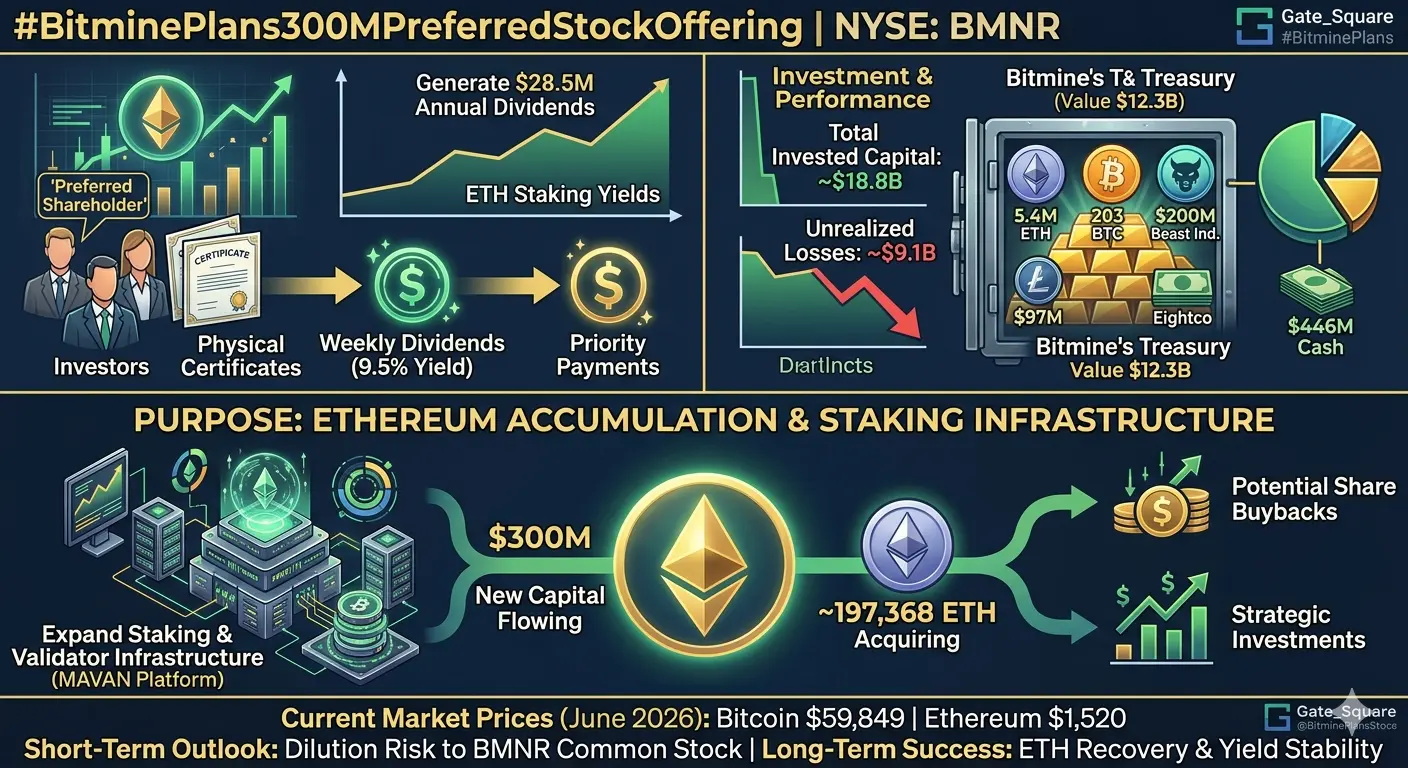
On June 3, Bitmine filed with the SEC to issue 3 million shares of 9.5% Series A perpetual preferred stock at $100 per share, seeking to raise approximately $300 million under the ticker BMNP. Proceeds will be used to acquire more ETH, expand staking infrastructure, and repurchase common stock. The company currently holds about 5.42 million ETH (approximately $10.8 billion), representing 4.49% of total supply, with unrealized losses exceeding $8.5 billion. Whether the 9.5% fixed dividend will attract investors remains to be seen.

#BitminePlans300MPreferredStockOffering #PredictNBAFinalsWin20000U
𝐁𝐈𝐓𝐌𝐈𝐍𝐄 𝐓𝐀𝐑𝐆𝐄𝐓𝐒 $𝟑𝟎𝟎𝐌 𝐏𝐑𝐄𝐅𝐄𝐑𝐑𝐄𝐃 𝐒𝐓𝐎𝐂𝐊 𝐓𝐎 𝐄𝐗𝐏𝐀𝐍𝐃 𝐄𝐓𝐇 𝐓𝐑𝐄𝐀𝐒𝐔𝐑𝐘
Bitmine Immersion Technologies (NYSE: BMNR) has filed a preliminary prospectus with the SEC to raise up to $300 million through a Series A Perpetual Preferred Stock offering. This represents one of the most aggressive corporate treasury strategies in the crypto space, directly challenging the Bitcoin-centric model pioneered by Strategy.
𝐓𝐇𝐄 𝐎𝐅𝐅𝐄𝐑𝐈𝐍𝐆 𝐒𝐓𝐑𝐔𝐂𝐓𝐔𝐑𝐄
The proposed offering consists of
ETH-5.93%
BTC-2.04%
SoominStar
#BitminePlans300MPreferredStockOffering #PredictNBAFinalsWin20000U
𝐁𝐈𝐓𝐌𝐈𝐍𝐄 𝐓𝐀𝐑𝐆𝐄𝐓𝐒 $𝟑𝟎𝟎𝐌 𝐏𝐑𝐄𝐅𝐄𝐑𝐑𝐄𝐃 𝐒𝐓𝐎𝐂𝐊 𝐓𝐎 𝐄𝐗𝐏𝐀𝐍𝐃 𝐄𝐓𝐇 𝐓𝐑𝐄𝐀𝐒𝐔𝐑𝐘
Bitmine Immersion Technologies (NYSE: BMNR) has filed a preliminary prospectus with the SEC to raise up to $300 million through a Series A Perpetual Preferred Stock offering. This represents one of the most aggressive corporate treasury strategies in the crypto space, directly challenging the Bitcoin-centric model pioneered by Strategy.
𝐓𝐇𝐄 𝐎𝐅𝐅𝐄𝐑𝐈𝐍𝐆 𝐒𝐓𝐑𝐔𝐂𝐓𝐔𝐑𝐄
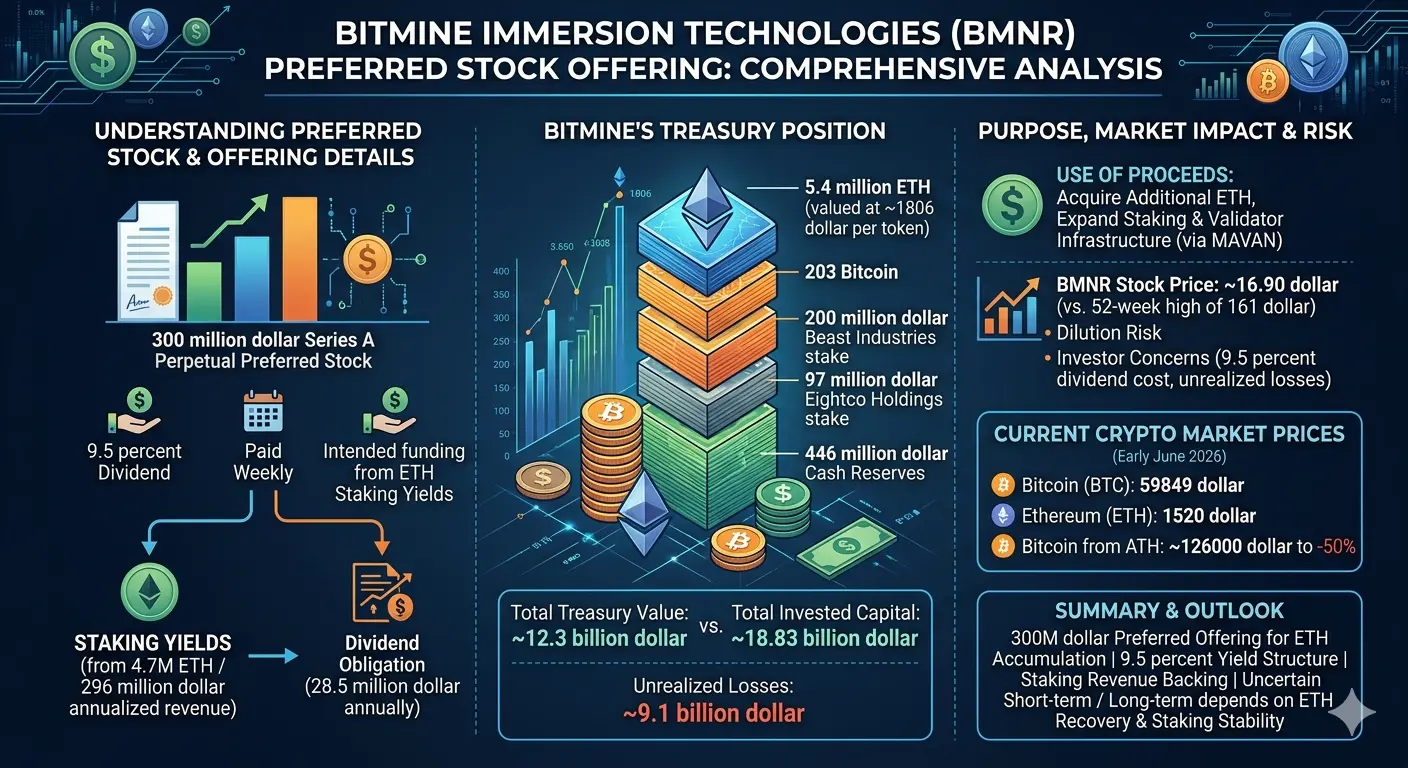
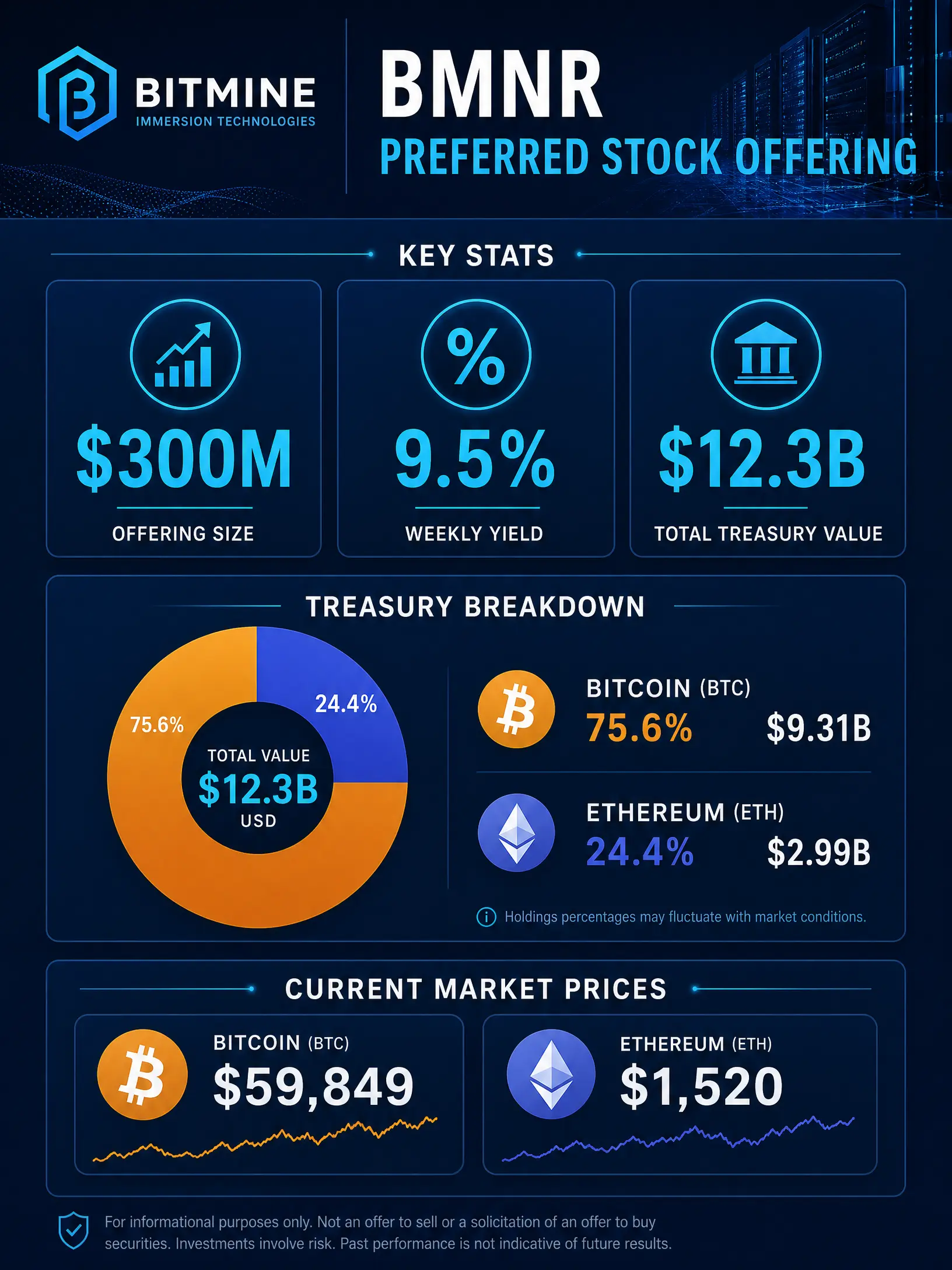
The proposed offering consists of 3 million shares at $100 per share, carrying a 9.50% cumulative annual dividend paid weekly in cash. The preferred stock will trade under the ticker BMNP on NYSE upon approval. With an annual dividend obligation of approximately $28.5 million, Bitmine's existing ETH staking infrastructure is positioned to cover this obligation by a factor of nine to ten times.
𝐄𝐓𝐇 𝐇𝐎𝐋𝐃𝐈𝐍𝐆𝐒 𝐀𝐍𝐃 𝐒𝐓𝐀𝐊𝐈𝐍𝐆 𝐘𝐈𝐄𝐋𝐃
Bitmine currently holds approximately 5.42 million ETH, representing roughly 4.5% of Ethereum's circulating supply. At current market prices, this treasury is valued at approximately $9.6-9.9 billion. The company projects annual staking income of up to $296 million, creating a sustainable yield mechanism that distinguishes ETH treasury strategies from Bitcoin holdings.
Unlike Bitcoin, which generates no native yield, Ethereum's proof-of-stake consensus enables institutional-grade passive income. This structural advantage allows Bitmine to fund dividend obligations without liquidating underlying assets—a critical differentiator from Strategy's recent BTC sale to cover preferred dividends.
𝐌𝐀𝐑𝐊𝐄𝐓 𝐈𝐌𝐏𝐋𝐈𝐂𝐀𝐓𝐈𝐎𝐍𝐒
The offering signals a potential shift in institutional crypto treasury strategy. While Bitcoin remains the dominant corporate treasury asset, Bitmine's approach leverages Ethereum's staking economics to create a self-sustaining capital structure. The 9.50% yield compares favorably to traditional fixed-income alternatives while maintaining exposure to ETH price appreciation.
Standard Chartered's analysis suggests Ethereum may outperform Bitcoin in the current cycle, with institutional interest shifting toward assets that combine capital appreciation with yield generation. Bitmine's treasury model directly capitalizes on this trend.
𝐑𝐈𝐒𝐊 𝐂𝐎𝐍𝐒𝐈𝐃𝐄𝐑𝐀𝐓𝐈𝐎𝐍𝐒
The company's total invested cost in ETH stands at approximately $18.83 billion, implying an unrealized loss of roughly $9.2 billion at current prices. This concentration risk and exposure to ETH volatility represent key vulnerabilities. Additionally, controlling approximately 5% of Ethereum's circulating supply raises questions about market concentration and potential regulatory scrutiny.
𝐁𝐓𝐂 𝐀𝐍𝐃 𝐄𝐓𝐇 𝐎𝐔𝐓𝐋𝐎𝐎𝐊
Bitcoin faces mounting pressure from treasury company premium unwinding, with the sector losing approximately $62 billion in market value since October. Strategy's recent BTC sale for dividend funding has triggered broader market risk-off behavior.
Ethereum's relative underperformance since 2022 may be reversing. Analysts project ETH targets of $4,500-$7,500 based on DeFi activity growth and institutional ETF demand. The ETH/BTC ratio, which peaked at 0.042 in August 2024, shows potential for recovery as institutional capital rotates toward yield-generating assets.
Bitmine's $300 million preferred offering represents a calculated bet that Ethereum's staking yield economics will outperform Bitcoin's store-of-value narrative in the institutional treasury space. The success of this offering will serve as a bellwether for corporate adoption of ETH-centric treasury strategies.
repost-content-media
  • Reward
  • Comment
  • Repost
  • Share
#BitminePlans300MPreferredStockOffering
Bitmine is Raising $300 Million to Buy More ETH While Sitting on $8.5 Billion in Unrealized Losses — Bold or Reckless?
This filing landed quietly this week but it deserves a lot more attention from this community than it's currently getting because the story here is genuinely complicated.
Bitmine filed with the SEC to raise approximately $300 million through 3 million shares of 9.5% Series A perpetual preferred stock at $100 per share under ticker BMNP. The proceeds go directly toward acquiring more ETH, expanding staking infrastructure and repurchasing
ETH-5.93%
post-image
  • Reward
  • 2
  • Repost
  • Share
LittleGodOfWealthPlutus:
Hop on now!🚗
View More
#BitminePlans300MPreferredStockOffering
Bitmine Immersion Technologies (NYSE: BMNR), the world's largest corporate Ethereum treasury company led by Fundstrat co-founder Tom Lee, announced on June 3, 2026, a proposed offering of 3 million shares of 9.50 percent Series A Perpetual Preferred Stock at a stated value of 100 dollars per share, targeting gross proceeds of up to 300 million dollars.
The preferred shares, expected to list on the New York Stock Exchange under the ticker BMNP within 30 days of first issuance, will carry a fixed cumulative annual dividend rate of 9.50 percent payable we
ETH-5.93%
BTC-2.04%
post-image
Yusfirah
#BitminePlans300MPreferredStockOffering
# Bitmine’s $300M Preferred Stock Plan Signals Aggressive Ethereum Treasury Expansion and Rising Market Risk Debate
As of June 2026, Bitmine’s decision to file for a 300 million US dollar preferred stock issuance has become one of the most closely examined corporate finance developments in the digital asset sector. The proposed structure involves issuing 3 million shares of 9.5% Series A perpetual preferred stock at 100 US dollars per share under the ticker BMNP. The move reflects a highly aggressive balance sheet strategy centered on expanding Ethereum exposure while simultaneously introducing high-yield capital instruments into the company’s funding structure.
The filing comes at a time when Bitmine already holds one of the largest institutional Ethereum positions in the world. With approximately 5.42 million ETH under custody, valued near 10.8 billion US dollars, the company controls roughly 4.49% of the total Ethereum supply. This scale places Bitmine among the most influential corporate participants in the Ethereum ecosystem, effectively turning its financial performance into a leveraged reflection of ETH market cycles.
However, beneath the scale of its holdings lies a significant financial strain. The company is currently carrying unrealized losses exceeding 8.5 billion US dollars, reflecting the difference between acquisition costs and current market valuations. While these losses remain non-cash in nature, they create substantial pressure on investor perception, financing flexibility, and long-term capital planning. In highly leveraged treasury strategies, mark-to-market volatility can heavily influence market confidence even when operational cash flow remains stable.
The introduction of a 9.5% perpetual preferred stock instrument adds a new layer of complexity to Bitmine’s financial structure. In traditional capital markets, preferred equity sits between debt and common equity, offering fixed dividend payments while typically lacking voting control. A yield of 9.5% is considered elevated in most institutional contexts, which suggests that the company is positioning the instrument toward investors seeking high income returns in exchange for accepting higher risk exposure.
This yield structure raises important questions about sustainability. A fixed annual dividend of 9.5% on 300 million US dollars implies approximately 28.5 million US dollars in annual payout obligations. These payments must be supported either through operational cash flow, staking rewards, capital appreciation of Ethereum holdings, or additional financing activity. The reliance on multiple potential funding sources introduces variability into long-term financial stability assumptions.
Bitmine’s stated use of proceeds reflects a highly expansionary strategy. A portion of the capital is earmarked for further Ethereum acquisitions, effectively increasing exposure at a time of existing unrealized losses. This approach suggests a conviction-driven accumulation strategy, where management continues to build position size despite market downturns, anticipating long-term appreciation in Ethereum’s value.
Another portion of the proceeds is allocated toward staking infrastructure development. This element is particularly important in the context of Ethereum’s proof-of-stake mechanism, where network participation allows holders to earn yield by validating transactions. Expanding staking capacity can generate recurring income streams, which may partially offset dividend obligations associated with the preferred stock issuance. However, staking returns fluctuate based on network participation rates and overall Ethereum ecosystem conditions, making them variable rather than guaranteed.
The third component of the capital plan involves share repurchases. Buybacks are typically used to support share price stability, reduce outstanding dilution, or signal confidence in long-term valuation. However, in Bitmine’s case, buybacks financed indirectly through capital raised at a 9.5% fixed cost introduce an unusual dynamic. Investors may evaluate whether capital recycling through buybacks creates net value when compared to the cost of preferred dividend obligations.
From a structural perspective, Bitmine’s model increasingly resembles a hybrid between an operating company and a leveraged digital asset holding vehicle. This dual identity creates both opportunities and risks. On one hand, the company benefits from potential Ethereum appreciation and staking yield generation. On the other hand, it remains exposed to significant downside risk if Ethereum experiences prolonged volatility or bearish cycles.
The scale of Ethereum holdings also introduces liquidity considerations. While 5.42 million ETH represents a substantial long-term position, converting large portions of such holdings into cash during adverse market conditions could impact price stability and execution efficiency. This creates a strategic constraint where balance sheet strength and market liquidity are closely interconnected.
Investor sentiment toward the proposed preferred stock issuance is expected to depend heavily on perceived risk-reward balance. A 9.5% yield may attract income-focused investors in search of elevated returns, particularly in environments where traditional fixed-income instruments offer lower yields. However, the underlying asset exposure to Ethereum introduces a volatility layer that is absent from conventional preferred equity structures.
Credit-like analysis becomes increasingly relevant in this context. Although the instrument is equity-based, its fixed dividend structure encourages investors to evaluate Bitmine similarly to a high-yield issuer rather than a traditional growth equity company. Factors such as asset volatility, cash flow stability, and refinancing risk may therefore play a central role in pricing and demand formation.
The broader market environment also plays a significant role in shaping outcomes. Digital asset markets in 2026 continue to experience cyclical volatility driven by macroeconomic conditions, liquidity flows, and shifting institutional sentiment. Ethereum, as a major smart contract platform, remains sensitive to changes in network usage, decentralized finance activity, and broader risk appetite across crypto markets.
In this environment, Bitmine’s strategy effectively amplifies both upside and downside exposure. If Ethereum appreciates significantly, the company’s large holdings combined with staking yield could generate substantial gains, potentially enhancing its ability to service preferred dividends and strengthen equity valuation. Conversely, prolonged price weakness could intensify unrealized losses and place pressure on capital structure sustainability.
Another key consideration is the signaling effect of the transaction. Large-scale issuance of high-yield preferred stock often signals either strong growth conviction or elevated financing needs. In Bitmine’s case, the combination of continued accumulation and high dividend obligations suggests a deliberate strategy of leveraging capital markets to deepen exposure rather than de-risking its balance sheet.
This approach reflects a broader trend among crypto-native firms that adopt treasury strategies centered around long-term conviction in digital assets. Instead of diversifying away from volatility, these firms often increase exposure during downturns, operating under the assumption that long-term adoption and scarcity dynamics will outweigh short-term fluctuations. This strategy, while potentially rewarding in bullish cycles, carries significant drawdown risk during extended bearish phases.
Market analysts are also closely watching whether the 9.5% yield will be sufficient to attract sustained investor demand. In traditional markets, high-yield preferred equity often competes with corporate bonds, dividend stocks, and alternative yield instruments. The key differentiator in this case is exposure to a rapidly evolving digital asset ecosystem, which may appeal to investors seeking asymmetric upside potential alongside fixed income returns.
However, institutional adoption may depend on how risk frameworks classify Ethereum exposure embedded within the issuer’s balance sheet. Some investors may treat the instrument as a hybrid crypto-linked security rather than a traditional preferred share, adjusting required return thresholds accordingly. This classification challenge could influence both pricing and liquidity in secondary markets.
The introduction of BMNP also contributes to the ongoing evolution of crypto-linked capital markets. Over recent years, digital asset companies have increasingly explored hybrid financial instruments that combine traditional equity structures with blockchain asset exposure. These developments reflect a gradual convergence between conventional financial engineering and crypto-native treasury management strategies.
Looking ahead, the performance of Bitmine’s preferred stock issuance may serve as a key reference point for future capital raising activity in the sector. Strong investor demand could encourage similar structures across other Ethereum-focused or crypto treasury companies, while weak uptake may signal limits to appetite for high-yield crypto-linked securities.
Ultimately, Bitmine’s strategy represents a high-conviction, high-leverage approach to Ethereum accumulation financed through structured capital markets instruments. The outcome will depend on a delicate balance between Ethereum price performance, staking yield generation, investor appetite for yield, and broader macroeconomic conditions.
As the digital asset ecosystem continues to mature, the interaction between corporate treasury strategies and structured financial products is becoming increasingly important. Bitmine’s $300 million preferred stock offering stands at the center of this evolution, offering a real-time case study in how traditional capital markets respond to deeply crypto-integrated corporate models.
repost-content-media
  • Reward
  • 12
  • Repost
  • Share
Yusfirah:
To The Moon 🌕
View More
#BitminePlans300MPreferredStockOffering
In a move that highlights how rapidly the crypto industry is evolving, BitMine has announced plans for a $300 million preferred stock offering designed to expand its Ethereum-focused treasury strategy. The company intends to issue up to 3 million shares of 9.5% Series A Perpetual Preferred Stock, with proceeds expected to fund additional ETH purchases, staking operations, validator infrastructure, and strategic ecosystem investments.
At first glance, this may look like a traditional capital raise. In reality, it represents something much bigger: the grow
ETH-5.93%
BTC-2.04%
post-image
  • Reward
  • 6
  • Repost
  • Share
MrFlower_XingChen:
To The Moon 🌕
View More
#BitminePlans300MPreferredStockOffering
𝗘𝘁𝗵𝗲𝗿𝗲𝘂𝗺 𝗪𝗵𝗮𝗹𝗲 𝗔𝗰𝗰𝘂𝗺𝘂𝗹𝗮𝘁𝗶𝗼𝗻 (𝟭𝟭𝟭,𝟵𝟰𝟮 𝗘𝗧𝗛): 𝗪𝗵𝗮𝘁 𝗦𝗺𝗮𝗿𝘁 𝗠𝗼𝗻𝗲𝘆 𝗠𝗮𝘆 𝗕𝗲 𝗦𝗶𝗴𝗻𝗮𝗹𝗶𝗻𝗴
The recent report of BitMine accumulating 111,942 ETH in a single week highlights a broader narrative of large-scale Ethereum accumulation during uncertain market conditions. While retail traders remain focused on short-term volatility and price swings, on-chain behavior suggests that larger entities may be gradually increasing exposure during consolidation phases. This type of
ETH-5.93%
STABLE-6.45%
MrFlower_XingChen
#BitminePlans300MPreferredStockOffering
𝗘𝘁𝗵𝗲𝗿𝗲𝘂𝗺 𝗪𝗵𝗮𝗹𝗲 𝗔𝗰𝗰𝘂𝗺𝘂𝗹𝗮𝘁𝗶𝗼𝗻 (𝟭𝟭𝟭,𝟵𝟰𝟮 𝗘𝗧𝗛): 𝗪𝗵𝗮𝘁 𝗦𝗺𝗮𝗿𝘁 𝗠𝗼𝗻𝗲𝘆 𝗠𝗮𝘆 𝗕𝗲 𝗦𝗶𝗴𝗻𝗮𝗹𝗶𝗻𝗴
The recent report of BitMine accumulating 111,942 ETH in a single week highlights a broader narrative of large-scale Ethereum accumulation during uncertain market conditions. While retail traders remain focused on short-term volatility and price swings, on-chain behavior suggests that larger entities may be gradually increasing exposure during consolidation phases. This type of activity is often associated with longer-term positioning rather than short-term speculation.
Ethereum’s current market environment continues to reflect a clear dual narrative structure. On one side, the market is dealing with macro uncertainty, liquidity fluctuations, and periodic risk-off sentiment across crypto assets. On the other side, Ethereum’s underlying ecosystem continues to expand through staking, Layer-2 adoption, and institutional integration, creating a structural contrast between short-term pressure and long-term development.
Historically, accumulation phases in crypto markets tend to occur during periods of mixed or uncertain sentiment, where price direction lacks clarity. Retail investors often hesitate during such conditions, while larger participants may allocate capital gradually, taking advantage of reduced attention and lower valuations. This behavior can create the early foundation for future trend reversals once market confidence returns.
Ethereum’s long-term value proposition is increasingly tied to its role as digital financial infrastructure, rather than purely a speculative asset. The network supports stablecoins, decentralized finance systems, tokenized assets, and smart contract settlement layers that are being explored across global financial systems. This utility-driven foundation significantly changes how institutional investors evaluate ETH compared to earlier cycles.
Another important structural factor is the tightening of liquid Ethereum supply. Staking mechanisms, exchange outflows, Layer-2 expansion, and ecosystem lockups continue reducing the amount of freely tradable ETH. When circulating supply contracts while demand remains stable or gradually increases, market conditions can become more sensitive to sudden shifts in sentiment or capital inflows.
At the same time, Ethereum is increasingly positioned within the emerging intersection of blockchain infrastructure and artificial intelligence systems. As AI models require secure data verification, decentralized computation layers, and programmable settlement frameworks, Ethereum’s smart contract ecosystem becomes more relevant as a foundational coordination layer for digital economies.
Institutional behavior also reflects a longer-term strategic approach. Rather than attempting to time short-term market swings, many larger investors appear focused on gaining exposure to blockchain infrastructure trends that may unfold over multiple years. This results in accumulation behavior that often appears during periods of market uncertainty or subdued retail participation.
The broader financial landscape is also evolving toward tokenization and on-chain settlement systems. Areas such as tokenized bonds, real-world asset digitization, stablecoin infrastructure, and blockchain-based liquidity networks are gradually gaining institutional attention. Ethereum remains one of the most established ecosystems connected to these developments, reinforcing its structural relevance in future financial architecture.
However, risks remain significant and should not be ignored. The crypto market continues to face regulatory uncertainty, macroeconomic pressure, liquidity cycles, and leverage-driven volatility. These factors can produce sharp corrections even during periods where long-term accumulation trends appear to be forming.
From a broader perspective, Ethereum may currently be in a phase where long-term positioning is quietly building beneath short-term market noise. While immediate price direction remains uncertain, structural indicators such as staking growth, institutional accumulation, and ecosystem expansion suggest that underlying fundamentals continue to strengthen.
Ultimately, the key takeaway is that Ethereum’s importance is increasingly shifting from short-term price speculation toward its role as core digital infrastructure for the evolving global economy. If this trend continues, accumulation phases like the current one may later be viewed as early positioning stages before larger structural adoption cycles unfold.
repost-content-media
  • Reward
  • 12
  • Repost
  • Share
Leeessa:
DYOR 🤓
View More
#BitminePlans300MPreferredStockOffering
BITMINE'S $300 MILLION ETHEREUM BET: WHY CORPORATE TREASURIES ARE ENTERING A NEW DIGITAL ASSET ERA
A major shift may be unfolding across public markets, and BitMine Immersion Technologies has just positioned itself at the center of it.
The company has announced plans for a $300 million Series A Perpetual Preferred Stock offering, with a significant portion of the capital expected to be allocated toward expanding its Ethereum treasury. While many investors will focus on the size of the raise, the real story is what this decision reveals about the future
ETH-5.93%
BTC-2.04%
post-image
post-image
  • Reward
  • 7
  • Repost
  • Share
HelalChowdhury:
1000x VIbes 🤑
View More
#BitminePlans300MPreferredStockOffering
Bitmine Immersion Technologies, a publicly traded company listed on the New York Stock Exchange under the ticker BMNR, has announced plans to raise approximately 300 million dollar through a preferred stock offering. This strategic move represents a significant development in the corporate cryptocurrency treasury space and carries important implications for both the company and the broader digital asset market.
Understanding Preferred Stock
Preferred stock represents a unique class of equity that occupies a middle ground between common stock and corpora
ETH-5.93%
BTC-2.04%
post-image
post-image
post-image
post-image
  • Reward
  • 23
  • Repost
  • Share
Vortex_King:
To The Moon 🌕
View More
#BitminePlans300MPreferredStockOffering
BitMine's $300 Million Preferred Stock Offering Signals a New Phase in Corporate Ethereum Accumulation
The digital asset sector may have just witnessed one of the most ambitious treasury expansion strategies of the year. BitMine Immersion Technologies has unveiled plans for a $300 million Series A Perpetual Preferred Stock offering, a move that could significantly strengthen its position as one of the largest publicly traded corporate holders of Ethereum. More importantly, the announcement highlights a growing trend among publicly listed companies: trea
ETH-5.93%
BTC-2.04%
discovery
#BitminePlans300MPreferredStockOffering
BitMine's $300 Million Preferred Stock Offering Signals a New Phase in Corporate Ethereum Accumulation
The digital asset sector may have just witnessed one of the most ambitious treasury expansion strategies of the year. BitMine Immersion Technologies has unveiled plans for a $300 million Series A Perpetual Preferred Stock offering, a move that could significantly strengthen its position as one of the largest publicly traded corporate holders of Ethereum. More importantly, the announcement highlights a growing trend among publicly listed companies: treating digital assets not merely as speculative investments, but as strategic balance-sheet assets capable of generating long-term value.
At first glance, the transaction appears straightforward. BitMine intends to issue preferred shares carrying a fixed annual dividend, allowing the company to raise substantial capital without immediately diluting common shareholders to the same extent as a traditional equity offering. However, the strategic implications extend far beyond the mechanics of the financing structure.
The company has made it clear that a significant portion of the proceeds will be directed toward expanding its Ethereum treasury. This decision reflects growing confidence among corporate executives that Ethereum is evolving into a foundational digital infrastructure asset rather than simply a tradable cryptocurrency.
For years, corporate treasury strategies were dominated by cash reserves, short-term government securities, and highly liquid financial instruments. More recently, Bitcoin emerged as an alternative treasury asset, attracting attention from publicly traded companies seeking protection against currency debasement and long-term monetary expansion. Ethereum now appears to be entering a similar phase of institutional recognition, though its investment thesis differs substantially from Bitcoin's.
While Bitcoin is frequently described as digital gold, Ethereum represents a productive digital asset. Its network supports decentralized finance, tokenized assets, digital settlements, and countless blockchain-based applications. In addition, Ethereum holders can participate in network validation and staking mechanisms that potentially generate recurring yield. This creates an entirely different investment framework compared with traditional reserve assets.
BitMine's strategy appears to be built around this distinction. Rather than viewing Ethereum solely as an appreciating asset, the company seems focused on building a treasury capable of generating long-term network-based returns while maintaining exposure to future price appreciation.
From a market perspective, the timing is particularly interesting. Ethereum has recently experienced substantial volatility, trading near multi-month lows after broader market weakness affected risk assets across the digital asset sector. Historically, periods of uncertainty have often provided institutional investors with opportunities to accumulate strategic positions at discounted valuations. BitMine's willingness to pursue such a large capital raise during a challenging market environment may indicate management's conviction regarding Ethereum's long-term prospects.
Professional investors often pay close attention to corporate behavior during market downturns. Companies that raise capital and expand holdings during periods of weakness are effectively making a statement about their outlook. Such decisions typically undergo extensive internal analysis, stress testing, and risk evaluation before receiving board approval.
The preferred stock structure itself deserves attention. Unlike conventional debt financing, preferred shares generally provide greater balance-sheet flexibility. The company avoids the restrictive obligations associated with traditional borrowing while simultaneously securing long-term capital. This approach can be particularly attractive in volatile sectors where preserving liquidity and operational flexibility remains essential.
The announcement also highlights a broader transformation occurring within capital markets. Institutional investors are becoming increasingly comfortable evaluating digital assets through traditional financial frameworks. Questions that once focused solely on price speculation are gradually being replaced by discussions surrounding treasury management, capital efficiency, asset allocation, and long-term shareholder value creation.
For Ethereum, developments such as this carry significance beyond the immediate capital raise. Large-scale corporate accumulation can reduce available market supply, strengthen institutional participation, and contribute to the asset's long-term legitimacy within global financial markets. While no single transaction determines the future direction of an asset class, repeated examples of corporate adoption can gradually reshape investor perception.
Professional traders are likely to monitor several key variables following the offering. The pace of Ethereum acquisitions, future treasury disclosures, staking activity, and additional institutional participation will all provide valuable insight into whether this strategy represents an isolated event or the beginning of a larger trend.
Financial history shows that transformative investment themes rarely emerge overnight. They develop gradually through a series of strategic decisions made by forward-looking institutions. BitMine's $300 million preferred stock offering may ultimately be remembered as more than a financing transaction. It could represent another milestone in the ongoing evolution of Ethereum from a speculative asset into a recognized component of corporate treasury strategy.
If that transition continues, the implications may extend far beyond a single company, influencing how institutions, investors, and financial markets evaluate digital assets for years to come.
repost-content-media
  • Reward
  • Comment
  • Repost
  • Share
#BitminePlans300MPreferredStockOffering
Bitmine's $300M Preferred Stock Play: A High-Stakes Bet on Ethereum's Future
Bitmine Immersion Technologies just made a bold move that could reshape how crypto treasury companies raise capital. On June 3rd, the company filed with the SEC to issue 3 million shares of Series A perpetual preferred stock carrying a hefty 9.5% annual dividend, aiming to pull in approximately $300 million under the ticker BMNP. This is not your typical fundraising round. It is a calculated gamble that borrows heavily from Michael Saylor's playbook at Strategy, the Bitcoin tre
ETH-5.93%
BTC-2.04%
post-image
post-image
post-image
post-image
  • Reward
  • 19
  • Repost
  • Share
Vortex_King:
2026 GOGOGO 👊
View More
#BitminePlans300MPreferredStockOffering
BitMine's $300 Million Preferred Stock Offering Signals a New Phase in Corporate Ethereum Accumulation
The digital asset sector may have just witnessed one of the most ambitious treasury expansion strategies of the year. BitMine Immersion Technologies has unveiled plans for a $300 million Series A Perpetual Preferred Stock offering, a move that could significantly strengthen its position as one of the largest publicly traded corporate holders of Ethereum. More importantly, the announcement highlights a growing trend among publicly listed companies: trea
ETH-5.93%
BTC-2.04%
post-image
post-image
post-image
  • Reward
  • 32
  • Repost
  • Share
ShainingMoon:
To The Moon 🌕
View More
Load More