



#JapanTokenizesGovernmentBonds
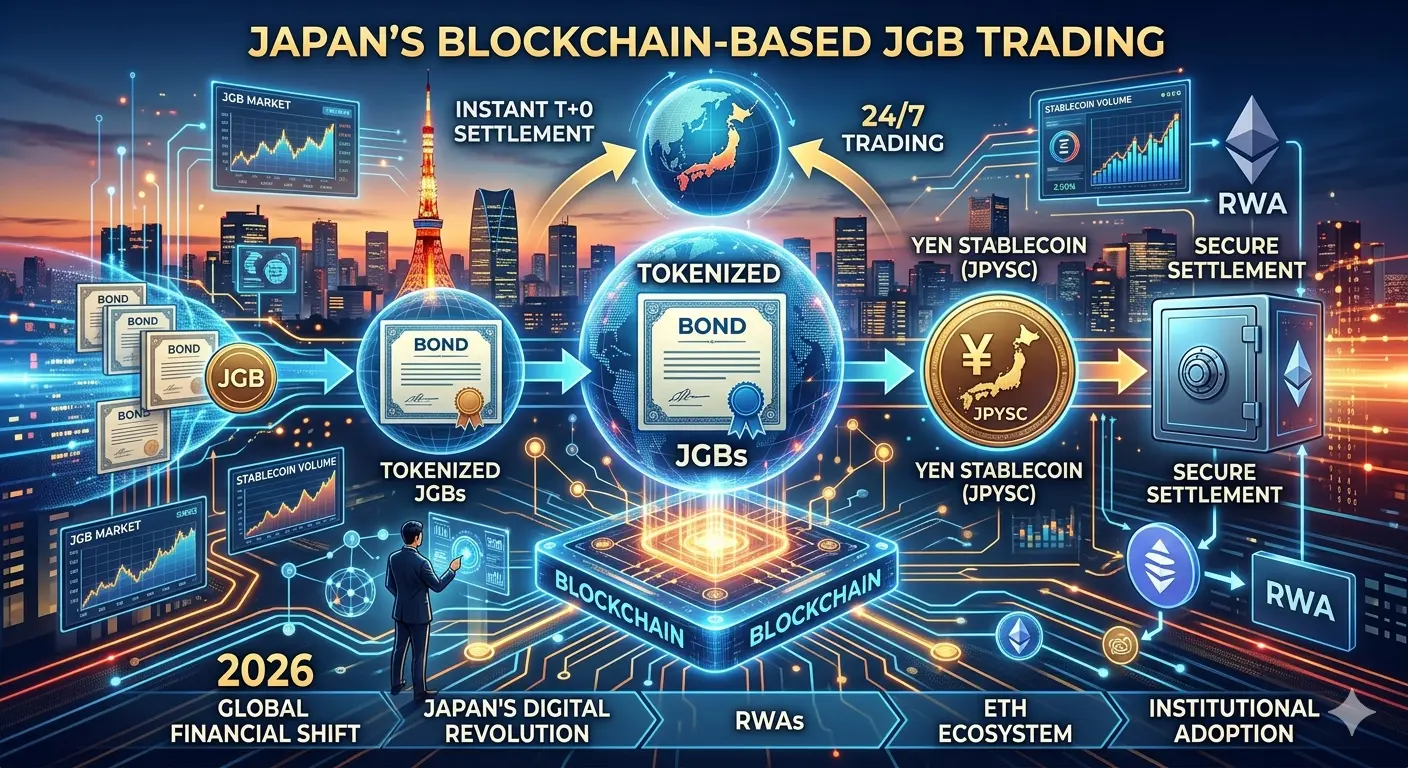
Japan is advancing one of the decade’s most important financial innovations by preparing to bring Japanese Government Bonds (JGBs) onto blockchain networks, with 24/7 trading infrastructure targeted as early as 2026. This institutional shift goes far beyond headlines — it could fundamentally reshape global capital markets, tokenized securities, Real World Assets, stablecoins, and settlement systems.
Japan manages one of the world’s largest government bond markets. Outstanding sovereign debt exceeds $7–9 trillion (with total public debt around 1,342 trillion yen or roughly $8.6–9 trillion in recent figures). This move places Japan at the forefront of the expanding Real World Asset sector.
What Japan Is Actually Doing
Major institutions including Mizuho Financial Group, Nomura Holdings, Japan Securities Clearing Corporation (JSCC), and partners like Digital Asset are actively piloting tokenized JGBs. The first phase centers on repo transactions — short-term secured funding using bonds as collateral.
The global repo market is enormous, with daily volumes reaching up to $4 trillion and outstanding figures often cited around $16 trillion. Japan represents a significant share (around 10% in some repo segments), making this transformation highly impactful.
Settlement evolution:
Traditional: T+1 or T+2 (1–2 business days delay)
Blockchain target: T+0 near-instant settlement
Expected gains: Faster capital recycling, substantially lower operational costs through automation, improved liquidity, reduced counterparty risk, and continuous global trading. Tokenized bonds will support 24/7 operations, moving beyond traditional banking hours.
Plans also include yen-denominated stablecoin settlements for on-chain efficiency.
Why This Is Significant for Crypto and Finance
This initiative delivers sovereign-level validation for blockchain in core financial infrastructure. It advances use cases long discussed in the industry: tokenized bonds, stocks, real estate, commodities, and payments.
The global tokenized treasury and bond sector has expanded rapidly. Tokenized RWAs reached approximately $19.3 billion by Q1 2026 (a 256.7% increase from $5.42 billion at the start of 2025). Tokenized U.S. Treasuries alone grew 225.5% in that period, adding about $9 billion and holding roughly 67% market share within RWAs. Other reports place total tokenized RWA value between $19–30 billion depending on methodology. Analysts project the sector could scale to hundreds of billions or trillions over the coming decade.
Yen Stablecoins: Emerging Opportunity
Using yen stablecoins for settlements could expand digital yen liquidity, speed up institutional adoption, and enhance cross-border efficiency.
Current stablecoin landscape (as of recent 2026 data):
USDT market cap: approximately $189–190 billion
USDC: around $79–80 billion
Total stablecoin market: over $300–315 billion
Yen-pegged stablecoins remain small currently (tens of millions), but Japan’s push could introduce a meaningful new institutional layer, boosting Asian liquidity and regulated digital asset demand.
24/7 Markets: Structural Transformation
Traditional bond markets operate within limited hours. Blockchain enables continuous trading, collateral management, and liquidity provision. Institutions stand to gain:
Higher capital efficiency with less idle capital
Round-the-clock funding and hedging
Reduced delays from settlement windows and intermediaries
This represents one of the most meaningful infrastructure upgrades in modern finance.
Cross-Chain Infrastructure and Key Players
SBI Holdings (with over $200 billion in assets under management) is collaborating with Chainlink on tokenized assets, stablecoins, cross-chain communication, and Proof of Reserve solutions. Institutions require seamless movement across blockchains without fragmentation, which boosts liquidity, accessibility, and participation.
Benefits for RWA Projects
RWA continues as one of the strongest sectors. Institutions seek yield-generating, government-backed, regulated, and transparent assets. Tokenized JGBs align perfectly.
Successful implementation could encourage other countries to follow, accelerating institutional on-chain adoption, tokenized finance, and DeFi integration.
Likely beneficiaries: Tokenization protocols, stablecoin platforms, Ethereum and Layer 2 ecosystems, infrastructure providers, and custody solutions.
Current Crypto Market Snapshot (early May 2026)
Bitcoin: Trading around $80,000–$81,000
Ethereum: Around $2,280–$2,310
The market is showing recovery signs supported by strengthening institutional developments. Japan’s initiative adds a powerful long-term positive signal, highlighting blockchain’s role as financial infrastructure rather than just speculation.
Positive potential effects include greater institutional confidence, increased capital flows into blockchain ecosystems, expanded stablecoin usage, growth in tokenized products, and broader regulated digital asset adoption.
Three Scenarios Analysts Are Discussing
Rapid Institutional Acceleration: Successful 2026 launch drives fast global adoption, sharp RWA expansion, and stronger investment in crypto infrastructure projects.
Gradual Implementation: Regulatory approvals, testing, and integration take time, leading to steady rather than explosive growth.
Global Competitive Race: Japan’s progress pressures financial hubs in Singapore, Hong Kong, Europe, the Middle East, and the United States to accelerate their own tokenization efforts.
Broader Future of Finance
Blockchain is increasingly merging with traditional finance as settlement, collateral, payment, and market infrastructure. This hybrid approach may define coming global markets — more continuous, efficient, and accessible.
Projections (e.g., from firms like BCG) suggest tokenized assets could reach $10–16 trillion by 2030, capturing a notable share of global financial activity.
Key Risks
Challenges include high reliability needs for sovereign-scale systems, smart contract security, regulatory timelines, integration complexity, cybersecurity, and possible liquidity fragmentation. Any disruption in large sovereign debt infrastructure demands careful management to maintain stability.
Final Outlook
Japan’s JGB tokenization initiative — targeting 24/7 trading, instant settlement, stablecoin integration, smart contract automation, and tokenized collateral by 2026 — stands as a landmark development in institutional blockchain adoption.
If implemented successfully, Japan could establish a global benchmark for sovereign tokenized finance. This opens an era where traditional markets and digital assets function together seamlessly, without time or geographic limits.
The long-term implications for liquidity, efficiency, innovation, and institutional participation are substantial. Market participants are closely watching RWA platforms, tokenization technologies, stablecoin ecosystems, and related infrastructure for opportunities in this evolving landscape.
This development reinforces blockchain’s deepening integration into global finance.
Japan is advancing one of the decade’s most important financial innovations by preparing to bring Japanese Government Bonds (JGBs) onto blockchain networks, with 24/7 trading infrastructure targeted as early as 2026. This institutional shift goes far beyond headlines — it could fundamentally reshape global capital markets, tokenized securities, Real World Assets, stablecoins, and settlement systems.
Japan manages one of the world’s largest government bond markets. Outstanding sovereign debt exceeds $7–9 trillion (with total public debt around 1,342 trillion yen or roughly $8.6–9 trillion in recent figures). This move places Japan at the forefront of the expanding Real World Asset sector.
What Japan Is Actually Doing
Major institutions including Mizuho Financial Group, Nomura Holdings, Japan Securities Clearing Corporation (JSCC), and partners like Digital Asset are actively piloting tokenized JGBs. The first phase centers on repo transactions — short-term secured funding using bonds as collateral.
The global repo market is enormous, with daily volumes reaching up to $4 trillion and outstanding figures often cited around $16 trillion. Japan represents a significant share (around 10% in some repo segments), making this transformation highly impactful.
Settlement evolution:
Traditional: T+1 or T+2 (1–2 business days delay)
Blockchain target: T+0 near-instant settlement
Expected gains: Faster capital recycling, substantially lower operational costs through automation, improved liquidity, reduced counterparty risk, and continuous global trading. Tokenized bonds will support 24/7 operations, moving beyond traditional banking hours.
Plans also include yen-denominated stablecoin settlements for on-chain efficiency.
Why This Is Significant for Crypto and Finance
This initiative delivers sovereign-level validation for blockchain in core financial infrastructure. It advances use cases long discussed in the industry: tokenized bonds, stocks, real estate, commodities, and payments.
The global tokenized treasury and bond sector has expanded rapidly. Tokenized RWAs reached approximately $19.3 billion by Q1 2026 (a 256.7% increase from $5.42 billion at the start of 2025). Tokenized U.S. Treasuries alone grew 225.5% in that period, adding about $9 billion and holding roughly 67% market share within RWAs. Other reports place total tokenized RWA value between $19–30 billion depending on methodology. Analysts project the sector could scale to hundreds of billions or trillions over the coming decade.
Yen Stablecoins: Emerging Opportunity
Using yen stablecoins for settlements could expand digital yen liquidity, speed up institutional adoption, and enhance cross-border efficiency.
Current stablecoin landscape (as of recent 2026 data):
USDT market cap: approximately $189–190 billion
USDC: around $79–80 billion
Total stablecoin market: over $300–315 billion
Yen-pegged stablecoins remain small currently (tens of millions), but Japan’s push could introduce a meaningful new institutional layer, boosting Asian liquidity and regulated digital asset demand.
24/7 Markets: Structural Transformation
Traditional bond markets operate within limited hours. Blockchain enables continuous trading, collateral management, and liquidity provision. Institutions stand to gain:
Higher capital efficiency with less idle capital
Round-the-clock funding and hedging
Reduced delays from settlement windows and intermediaries
This represents one of the most meaningful infrastructure upgrades in modern finance.
Cross-Chain Infrastructure and Key Players
SBI Holdings (with over $200 billion in assets under management) is collaborating with Chainlink on tokenized assets, stablecoins, cross-chain communication, and Proof of Reserve solutions. Institutions require seamless movement across blockchains without fragmentation, which boosts liquidity, accessibility, and participation.
Benefits for RWA Projects
RWA continues as one of the strongest sectors. Institutions seek yield-generating, government-backed, regulated, and transparent assets. Tokenized JGBs align perfectly.
Successful implementation could encourage other countries to follow, accelerating institutional on-chain adoption, tokenized finance, and DeFi integration.
Likely beneficiaries: Tokenization protocols, stablecoin platforms, Ethereum and Layer 2 ecosystems, infrastructure providers, and custody solutions.
Current Crypto Market Snapshot (early May 2026)
Bitcoin: Trading around $80,000–$81,000
Ethereum: Around $2,280–$2,310
The market is showing recovery signs supported by strengthening institutional developments. Japan’s initiative adds a powerful long-term positive signal, highlighting blockchain’s role as financial infrastructure rather than just speculation.
Positive potential effects include greater institutional confidence, increased capital flows into blockchain ecosystems, expanded stablecoin usage, growth in tokenized products, and broader regulated digital asset adoption.
Three Scenarios Analysts Are Discussing
Rapid Institutional Acceleration: Successful 2026 launch drives fast global adoption, sharp RWA expansion, and stronger investment in crypto infrastructure projects.
Gradual Implementation: Regulatory approvals, testing, and integration take time, leading to steady rather than explosive growth.
Global Competitive Race: Japan’s progress pressures financial hubs in Singapore, Hong Kong, Europe, the Middle East, and the United States to accelerate their own tokenization efforts.
Broader Future of Finance
Blockchain is increasingly merging with traditional finance as settlement, collateral, payment, and market infrastructure. This hybrid approach may define coming global markets — more continuous, efficient, and accessible.
Projections (e.g., from firms like BCG) suggest tokenized assets could reach $10–16 trillion by 2030, capturing a notable share of global financial activity.
Key Risks
Challenges include high reliability needs for sovereign-scale systems, smart contract security, regulatory timelines, integration complexity, cybersecurity, and possible liquidity fragmentation. Any disruption in large sovereign debt infrastructure demands careful management to maintain stability.
Final Outlook
Japan’s JGB tokenization initiative — targeting 24/7 trading, instant settlement, stablecoin integration, smart contract automation, and tokenized collateral by 2026 — stands as a landmark development in institutional blockchain adoption.
If implemented successfully, Japan could establish a global benchmark for sovereign tokenized finance. This opens an era where traditional markets and digital assets function together seamlessly, without time or geographic limits.
The long-term implications for liquidity, efficiency, innovation, and institutional participation are substantial. Market participants are closely watching RWA platforms, tokenization technologies, stablecoin ecosystems, and related infrastructure for opportunities in this evolving landscape.
This development reinforces blockchain’s deepening integration into global finance.