
#RWAMarketCapExceeds65Billion
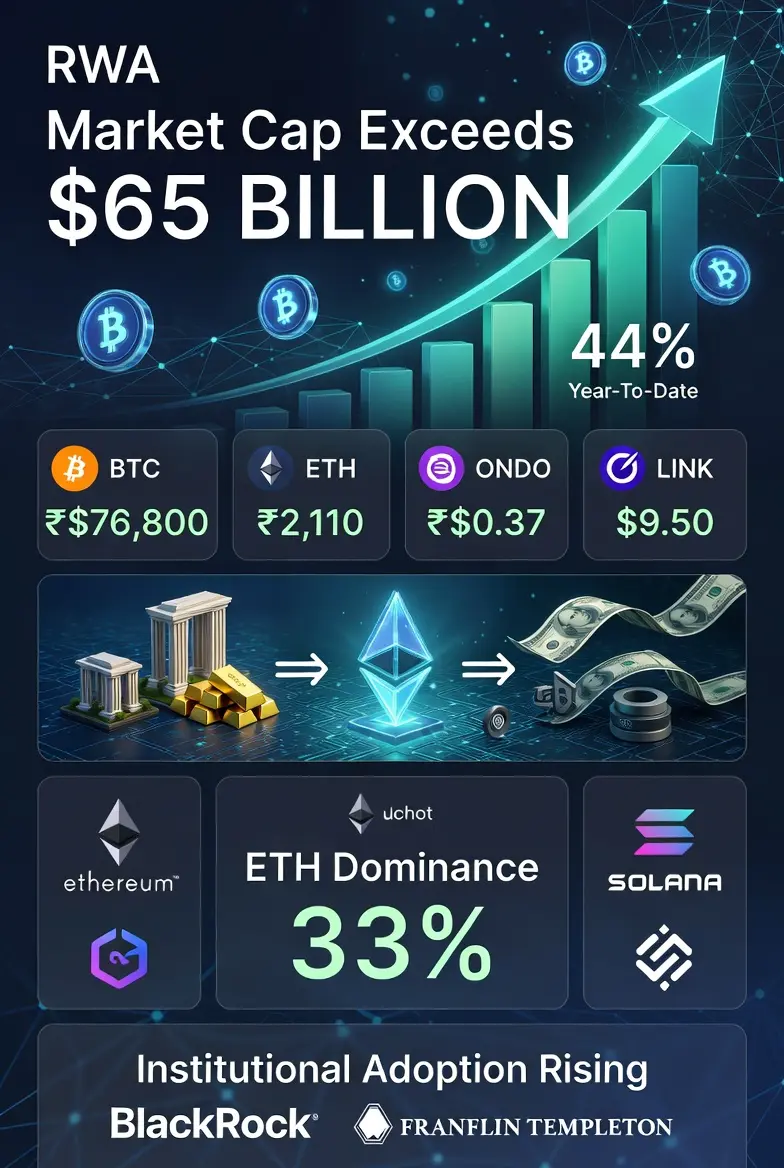
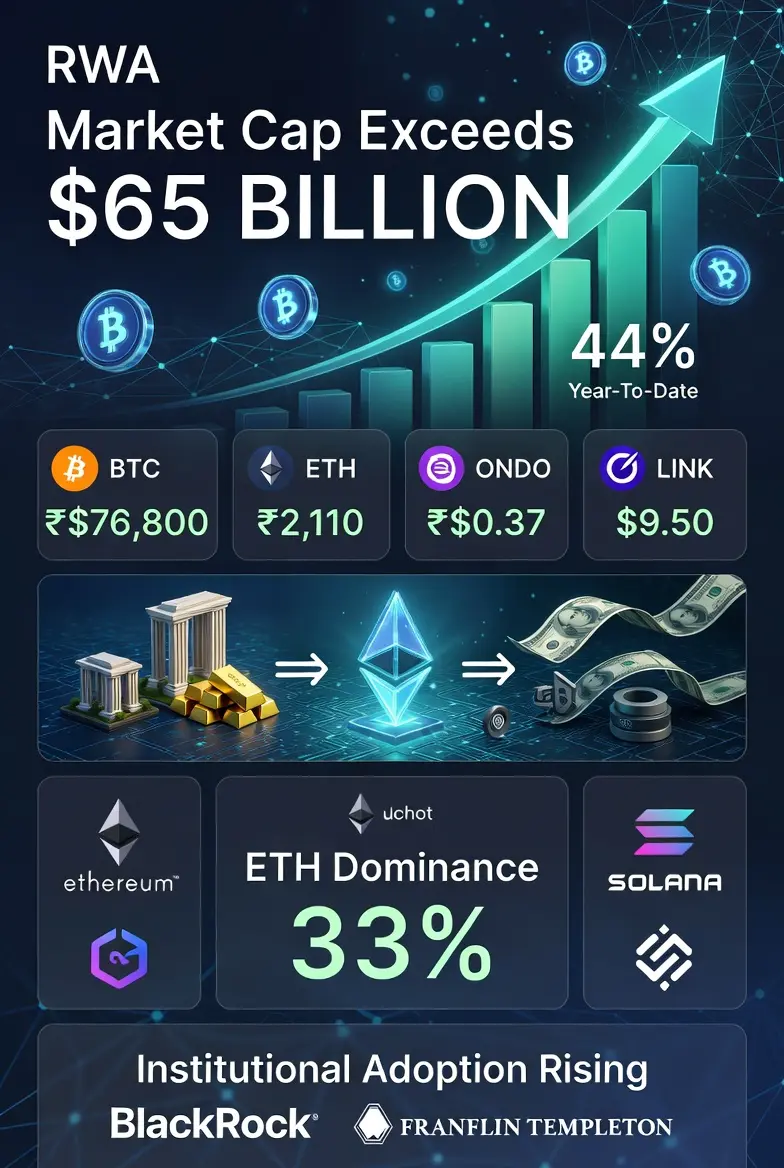
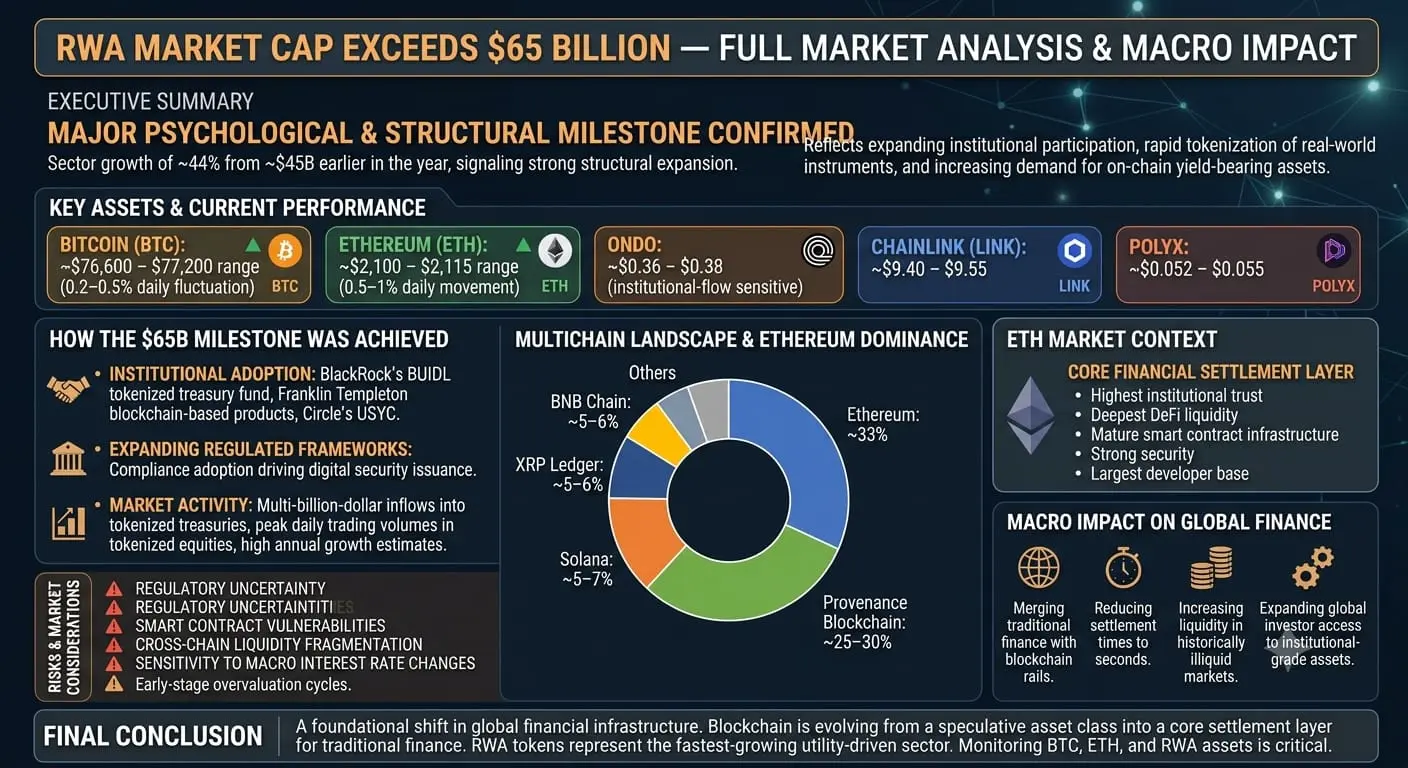
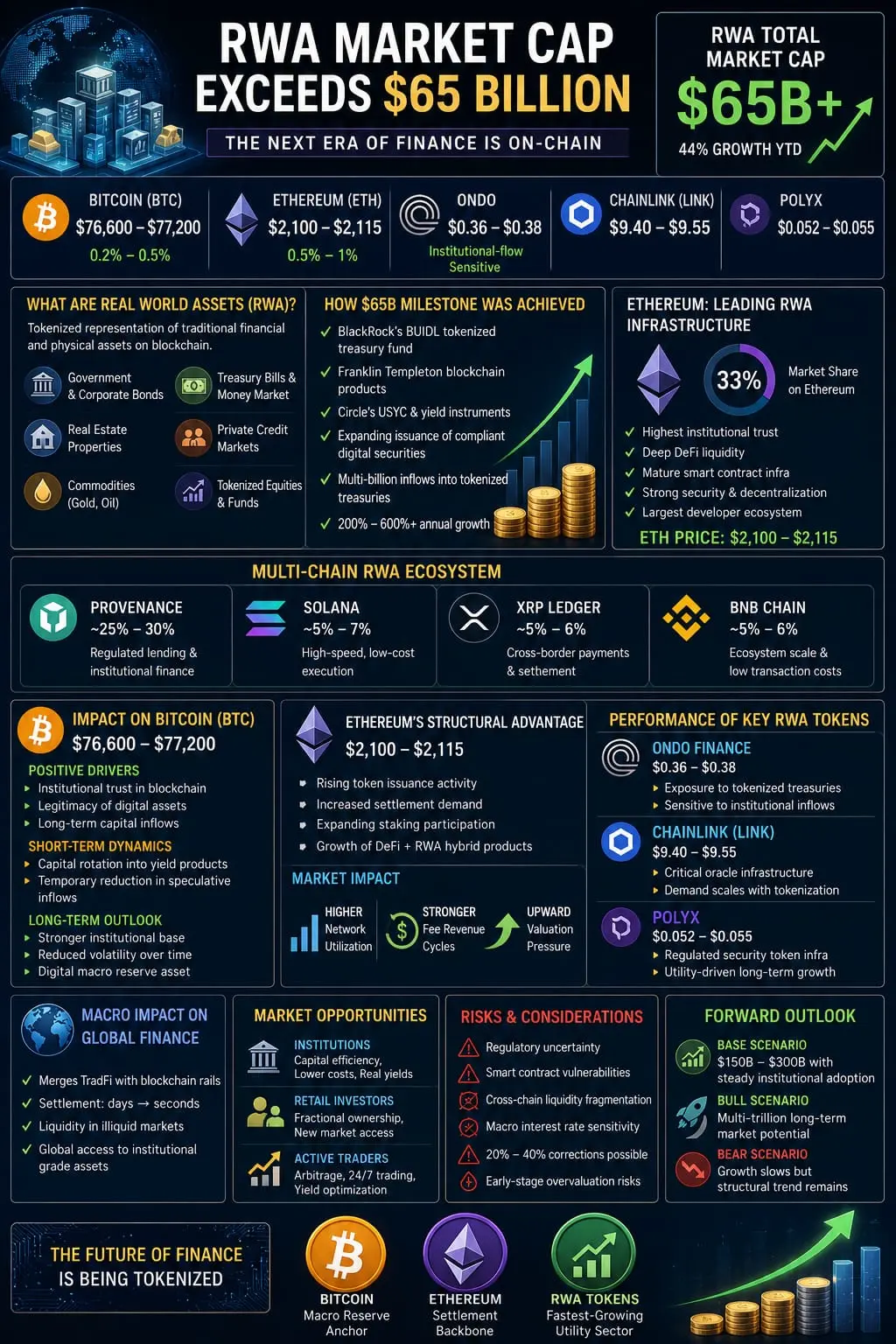
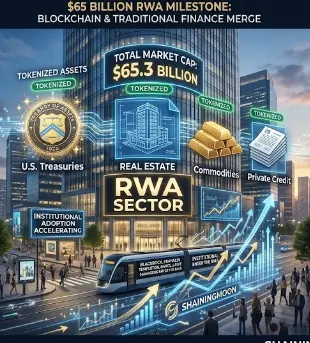
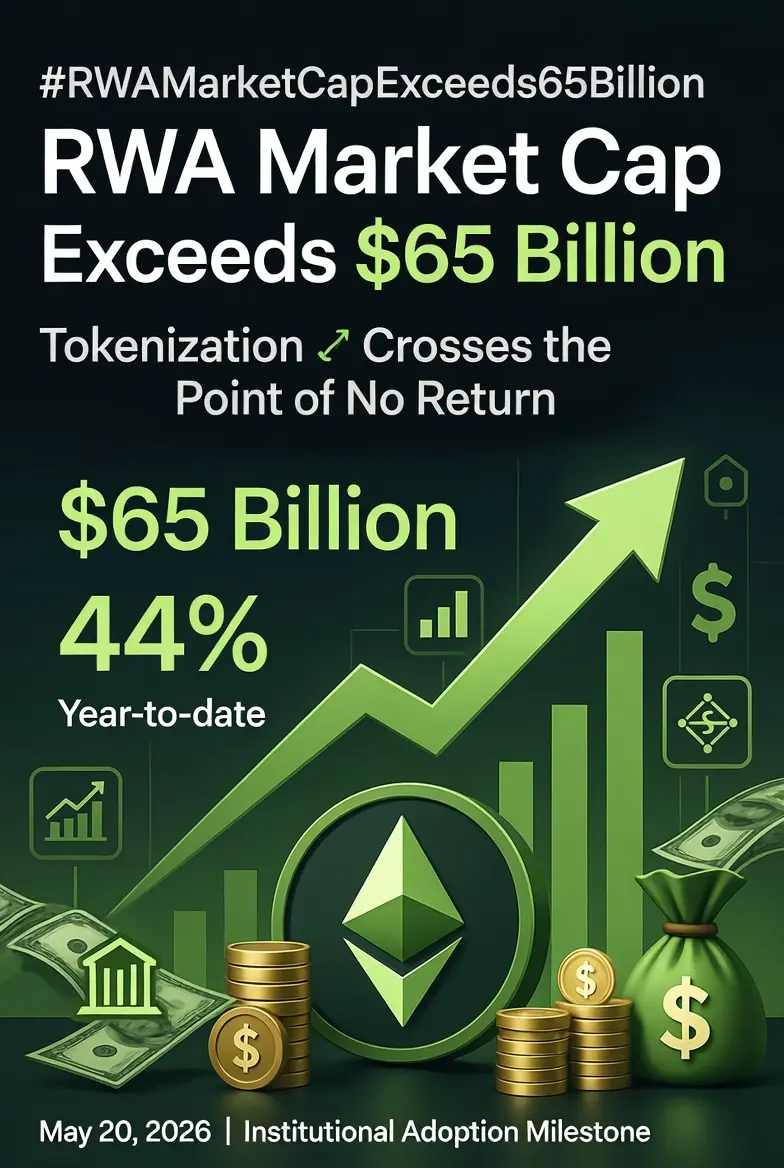
The Real World Assets (RWA) sector in crypto has officially crossed a major psychological and structural milestone, with total market capitalization exceeding $65 billion. This marks a significant acceleration in the integration of traditional finance with blockchain infrastructure and confirms rising institutional confidence in tokenized financial systems.
The development reflects expanding institutional participation, rapid tokenization of real-world instruments, and increasing demand for on-chain yield-bearing assets.
Current market conditions remain relatively stable with selective strength across major assets:
Bitcoin (BTC): ~$76,600 – $77,200 range (0.2–0.5% daily fluctuation)
Ethereum (ETH): ~$2,100 – $2,115 range (0.5–1% daily movement)
ONDO: ~$0.36 – $0.38 (institutional-flow sensitive)
Chainlink (LINK): ~$9.40 – $9.55
POLYX: ~$0.052 – $0.055
Overall, the RWA sector has grown
approximately 44% from ~$45B earlier in the
year, signaling strong structural expansion rather than speculative movement.
What Are Real World Assets (RWA)?
Real World Assets refer to physical or traditional financial instruments that are tokenized and represented on blockchain networks.
These include:
Government and corporate bonds
Treasury bills and money market instruments
Real estate properties
Commodities such as gold and oil
Private credit markets
Tokenized equities and investment funds
Core Value Proposition
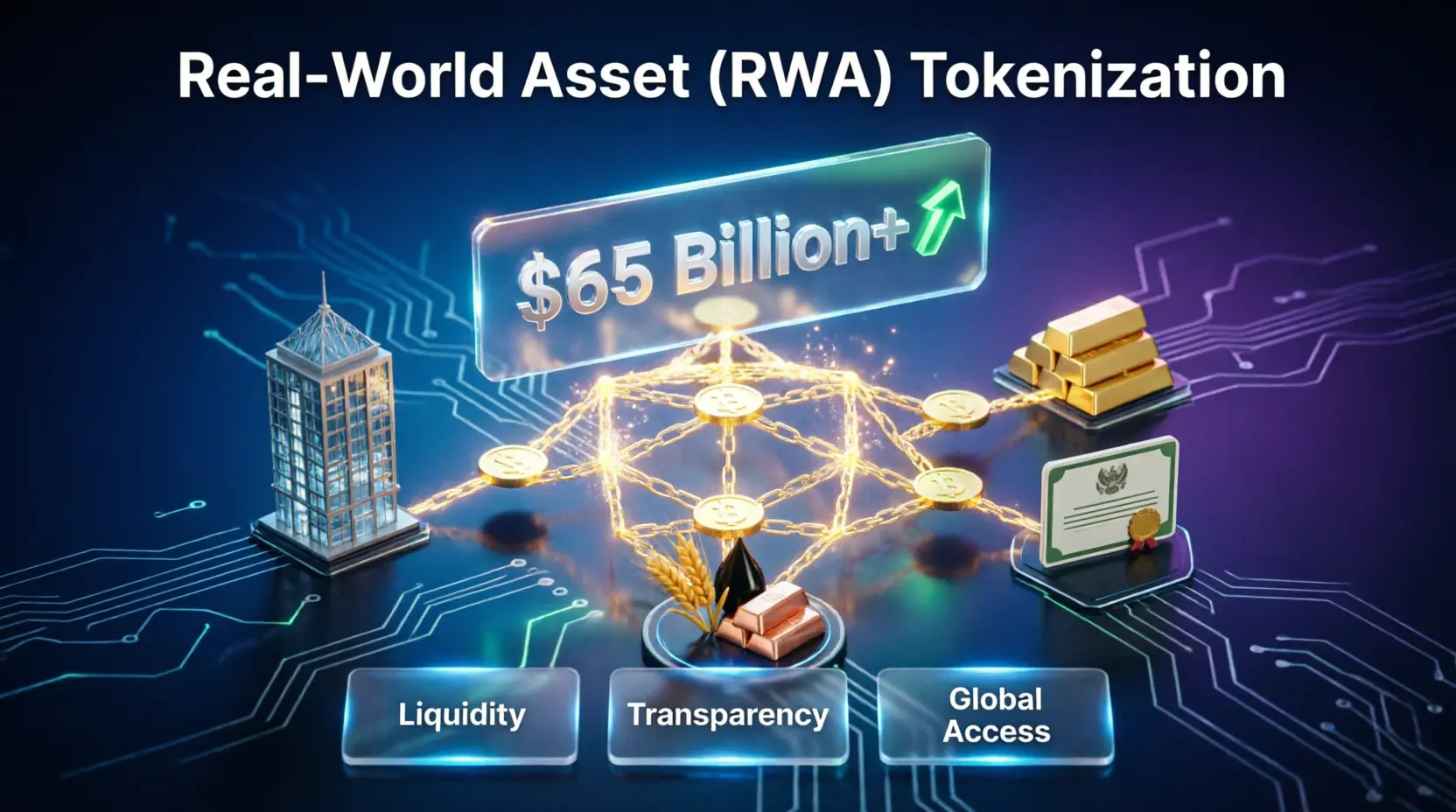
Tokenization converts traditionally illiquid assets into blockchain-based digital units, enabling:
Fractional ownership with lower entry barriers
Faster settlement (minutes instead of days)
Global accessibility without intermediaries
Transparent, immutable record-keeping
Improved liquidity in historically locked markets
This represents one of the most important structural upgrades in modern financial systems.
How the $65B Milestone Was Achieved
The rapid expansion of RWA markets has been driven by institutional adoption and regulated financial tokenization frameworks.
Key contributors include:
BlackRock’s BUIDL tokenized treasury fund
Franklin Templeton blockchain-based products
Circle’s USYC and similar yield instruments
Expanding issuance of compliant digital securities
Market activity highlights:
Multi-billion-dollar inflows into tokenized treasuries
Peak daily trading volumes reaching multi-billion levels in tokenized equities
Annual growth estimates ranging from 200% to 600%+ depending on classification
This confirms that RWA expansion is structurally driven by real capital allocation, not short-term speculation.
Ethereum’s Dominance in RWA Infrastructure
Ethereum remains the leading settlement layer for RWA activity with approximately 33% market share.
Key Strengths:
Highest institutional trust level
Deepest DeFi liquidity ecosystem
Mature smart contract infrastructure
Strong security and decentralization
Largest developer base in blockchain
ETH Market Context:
ETH Price: ~$2,100 – $2,115
Increased token issuance drives gas demand
Higher settlement activity strengthens fee generation
Network usage directly correlates with RWA expansion
Ethereum functions as the core financial settlement layer for tokenized markets.
Multi-Chain Competition Landscape
The RWA ecosystem is increasingly distributed across multiple blockchains:
Provenance Blockchain (~25–30%)
Strong in regulated lending and institutional finance.
Solana (~5–7%)
High-speed, low-cost execution for trading efficiency.
XRP Ledger (~5–6%)
Focused on cross-border payments and settlement systems.
BNB Chain (~5–6%)
Benefits from ecosystem scale and low transaction costs.
This balanced structure ensures no single chain dominates, promoting interoperability and innovation.
Impact on Bitcoin (BTC)
BTC Price: ~$76,600 – $77,200
RWA growth indirectly supports Bitcoin through macro-level adoption effects:
Positive Drivers:
Increased institutional trust in blockchain systems
Strengthened legitimacy of digital asset markets
Long-term capital inflows into crypto infrastructure
Short-Term Dynamics:
Capital rotation into yield-generating RWA products (4–8%+ annual yields in some cases)
Temporary reduction in speculative inflows into BTC
Long-Term Outlook:
Stronger institutional holding base
Reduced volatility over time
Reinforced role as digital macro reserve asset
Ethereum’s Structural Advantage
Ethereum is the primary direct beneficiary of RWA expansion.
Growth Drivers:
Rising token issuance activity
Increased settlement and transaction demand
Expanding staking participation
Growth of DeFi + RWA hybrid financial products
Market Impact:
Sustained expansion may lead to:
Higher network utilization
Stronger fee revenue cycles
Long-term price stability and upward valuation pressure around ~$2,100+
Performance of Key RWA Tokens
ONDO Finance
Price: ~$0.36 – $0.38
Strong exposure to tokenized treasury markets
Highly sensitive to institutional inflows
Potential for amplified volatility during adoption cycles
Chainlink (LINK)
Price: ~$9.40 – $9.55
Critical oracle infrastructure for RWA systems
Provides pricing, data feeds, and compliance verification
Demand scales directly with tokenization growth
POLYX
Price: ~$0.052 – $0.055
Focused on regulated security token infrastructure
Positioned for steady growth through compliance adoption
Long-term utility-driven expansion potential
Macro Impact on Global Finance
The RWA sector is reshaping global financial infrastructure by:
Merging traditional finance with blockchain rails
Reducing settlement times from days to seconds
Increasing liquidity in historically illiquid markets
Expanding global investor access to institutional-grade assets
Institutions are increasingly allocating capital to tokenized bonds, credit products, and yield-generating digital instruments.
Market Opportunities for Participants
Institutional Investors:
Improved capital efficiency
Lower operational costs
Access to diversified real yield products
Retail Investors:
Fractional ownership of real estate, bonds, and funds
Entry into previously restricted financial markets
Active Traders:
Cross-chain arbitrage opportunities
24/7 trading of tokenized assets
Yield optimization strategies across ecosystems
Decorrelation between crypto-native and traditional assets
Risks & Market Considerations
Despite strong growth, key risks remain:
Regulatory uncertainty across major jurisdictions
Smart contract vulnerabilities and protocol risks
Cross-chain liquidity fragmentation
Sensitivity to macro interest rate changes
Potential 20–40% corrections in overheated segments
Early-stage RWA markets may also face overvaluation cycles relative to real utility.
Forward Outlook
Base Scenario:
RWA market expands steadily toward $150B – $300B with continuous institutional adoption.
Bull Scenario:
Regulatory clarity and financial integration accelerate growth into a multi-trillion-dollar long-term market.
Bear Scenario:
Regulatory friction slows expansion but does not reverse structural adoption trend.
Final Conclusion
The crossing of the $65 billion RWA market cap milestone represents a foundational shift in global financial infrastructure.
Blockchain is evolving from a speculative asset class into a core settlement layer for traditional finance.
Bitcoin remains the macro reserve anchor
Ethereum acts as the primary settlement backbone
RWA tokens represent the fastest-growing utility-driven sector
As capital continues flowing into tokenized finance, monitoring BTC, ETH, and leading RWA assets will remain critical for understanding the next phase of digital market evolution.
The Real World Assets (RWA) sector in crypto has officially crossed a major psychological and structural milestone, with total market capitalization exceeding $65 billion. This marks a significant acceleration in the integration of traditional finance with blockchain infrastructure and confirms rising institutional confidence in tokenized financial systems.
The development reflects expanding institutional participation, rapid tokenization of real-world instruments, and increasing demand for on-chain yield-bearing assets.
Current market conditions remain relatively stable with selective strength across major assets:
Bitcoin (BTC): ~$76,600 – $77,200 range (0.2–0.5% daily fluctuation)
Ethereum (ETH): ~$2,100 – $2,115 range (0.5–1% daily movement)
ONDO: ~$0.36 – $0.38 (institutional-flow sensitive)
Chainlink (LINK): ~$9.40 – $9.55
POLYX: ~$0.052 – $0.055
Overall, the RWA sector has grown
approximately 44% from ~$45B earlier in the
year, signaling strong structural expansion rather than speculative movement.
What Are Real World Assets (RWA)?
Real World Assets refer to physical or traditional financial instruments that are tokenized and represented on blockchain networks.
These include:
Government and corporate bonds
Treasury bills and money market instruments
Real estate properties
Commodities such as gold and oil
Private credit markets
Tokenized equities and investment funds
Core Value Proposition
Tokenization converts traditionally illiquid assets into blockchain-based digital units, enabling:
Fractional ownership with lower entry barriers
Faster settlement (minutes instead of days)
Global accessibility without intermediaries
Transparent, immutable record-keeping
Improved liquidity in historically locked markets
This represents one of the most important structural upgrades in modern financial systems.
How the $65B Milestone Was Achieved
The rapid expansion of RWA markets has been driven by institutional adoption and regulated financial tokenization frameworks.
Key contributors include:
BlackRock’s BUIDL tokenized treasury fund
Franklin Templeton blockchain-based products
Circle’s USYC and similar yield instruments
Expanding issuance of compliant digital securities
Market activity highlights:
Multi-billion-dollar inflows into tokenized treasuries
Peak daily trading volumes reaching multi-billion levels in tokenized equities
Annual growth estimates ranging from 200% to 600%+ depending on classification
This confirms that RWA expansion is structurally driven by real capital allocation, not short-term speculation.
Ethereum’s Dominance in RWA Infrastructure
Ethereum remains the leading settlement layer for RWA activity with approximately 33% market share.
Key Strengths:
Highest institutional trust level
Deepest DeFi liquidity ecosystem
Mature smart contract infrastructure
Strong security and decentralization
Largest developer base in blockchain
ETH Market Context:
ETH Price: ~$2,100 – $2,115
Increased token issuance drives gas demand
Higher settlement activity strengthens fee generation
Network usage directly correlates with RWA expansion
Ethereum functions as the core financial settlement layer for tokenized markets.
Multi-Chain Competition Landscape
The RWA ecosystem is increasingly distributed across multiple blockchains:
Provenance Blockchain (~25–30%)
Strong in regulated lending and institutional finance.
Solana (~5–7%)
High-speed, low-cost execution for trading efficiency.
XRP Ledger (~5–6%)
Focused on cross-border payments and settlement systems.
BNB Chain (~5–6%)
Benefits from ecosystem scale and low transaction costs.
This balanced structure ensures no single chain dominates, promoting interoperability and innovation.
Impact on Bitcoin (BTC)
BTC Price: ~$76,600 – $77,200
RWA growth indirectly supports Bitcoin through macro-level adoption effects:
Positive Drivers:
Increased institutional trust in blockchain systems
Strengthened legitimacy of digital asset markets
Long-term capital inflows into crypto infrastructure
Short-Term Dynamics:
Capital rotation into yield-generating RWA products (4–8%+ annual yields in some cases)
Temporary reduction in speculative inflows into BTC
Long-Term Outlook:
Stronger institutional holding base
Reduced volatility over time
Reinforced role as digital macro reserve asset
Ethereum’s Structural Advantage
Ethereum is the primary direct beneficiary of RWA expansion.
Growth Drivers:
Rising token issuance activity
Increased settlement and transaction demand
Expanding staking participation
Growth of DeFi + RWA hybrid financial products
Market Impact:
Sustained expansion may lead to:
Higher network utilization
Stronger fee revenue cycles
Long-term price stability and upward valuation pressure around ~$2,100+
Performance of Key RWA Tokens
ONDO Finance
Price: ~$0.36 – $0.38
Strong exposure to tokenized treasury markets
Highly sensitive to institutional inflows
Potential for amplified volatility during adoption cycles
Chainlink (LINK)
Price: ~$9.40 – $9.55
Critical oracle infrastructure for RWA systems
Provides pricing, data feeds, and compliance verification
Demand scales directly with tokenization growth
POLYX
Price: ~$0.052 – $0.055
Focused on regulated security token infrastructure
Positioned for steady growth through compliance adoption
Long-term utility-driven expansion potential
Macro Impact on Global Finance
The RWA sector is reshaping global financial infrastructure by:
Merging traditional finance with blockchain rails
Reducing settlement times from days to seconds
Increasing liquidity in historically illiquid markets
Expanding global investor access to institutional-grade assets
Institutions are increasingly allocating capital to tokenized bonds, credit products, and yield-generating digital instruments.
Market Opportunities for Participants
Institutional Investors:
Improved capital efficiency
Lower operational costs
Access to diversified real yield products
Retail Investors:
Fractional ownership of real estate, bonds, and funds
Entry into previously restricted financial markets
Active Traders:
Cross-chain arbitrage opportunities
24/7 trading of tokenized assets
Yield optimization strategies across ecosystems
Decorrelation between crypto-native and traditional assets
Risks & Market Considerations
Despite strong growth, key risks remain:
Regulatory uncertainty across major jurisdictions
Smart contract vulnerabilities and protocol risks
Cross-chain liquidity fragmentation
Sensitivity to macro interest rate changes
Potential 20–40% corrections in overheated segments
Early-stage RWA markets may also face overvaluation cycles relative to real utility.
Forward Outlook
Base Scenario:
RWA market expands steadily toward $150B – $300B with continuous institutional adoption.
Bull Scenario:
Regulatory clarity and financial integration accelerate growth into a multi-trillion-dollar long-term market.
Bear Scenario:
Regulatory friction slows expansion but does not reverse structural adoption trend.
Final Conclusion
The crossing of the $65 billion RWA market cap milestone represents a foundational shift in global financial infrastructure.
Blockchain is evolving from a speculative asset class into a core settlement layer for traditional finance.
Bitcoin remains the macro reserve anchor
Ethereum acts as the primary settlement backbone
RWA tokens represent the fastest-growing utility-driven sector
As capital continues flowing into tokenized finance, monitoring BTC, ETH, and leading RWA assets will remain critical for understanding the next phase of digital market evolution.