#SpaceXTargets1.75TrillionIPO
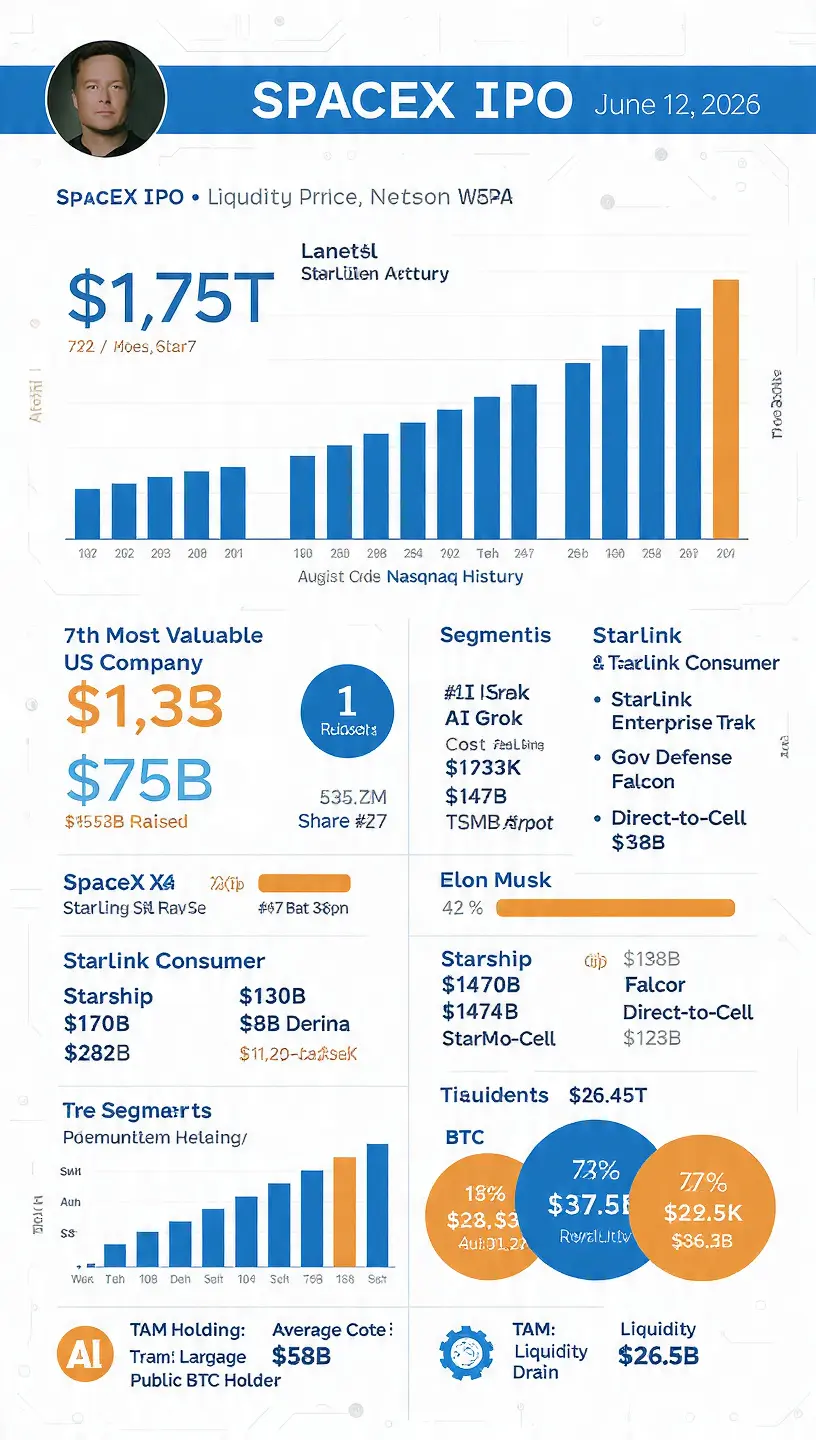
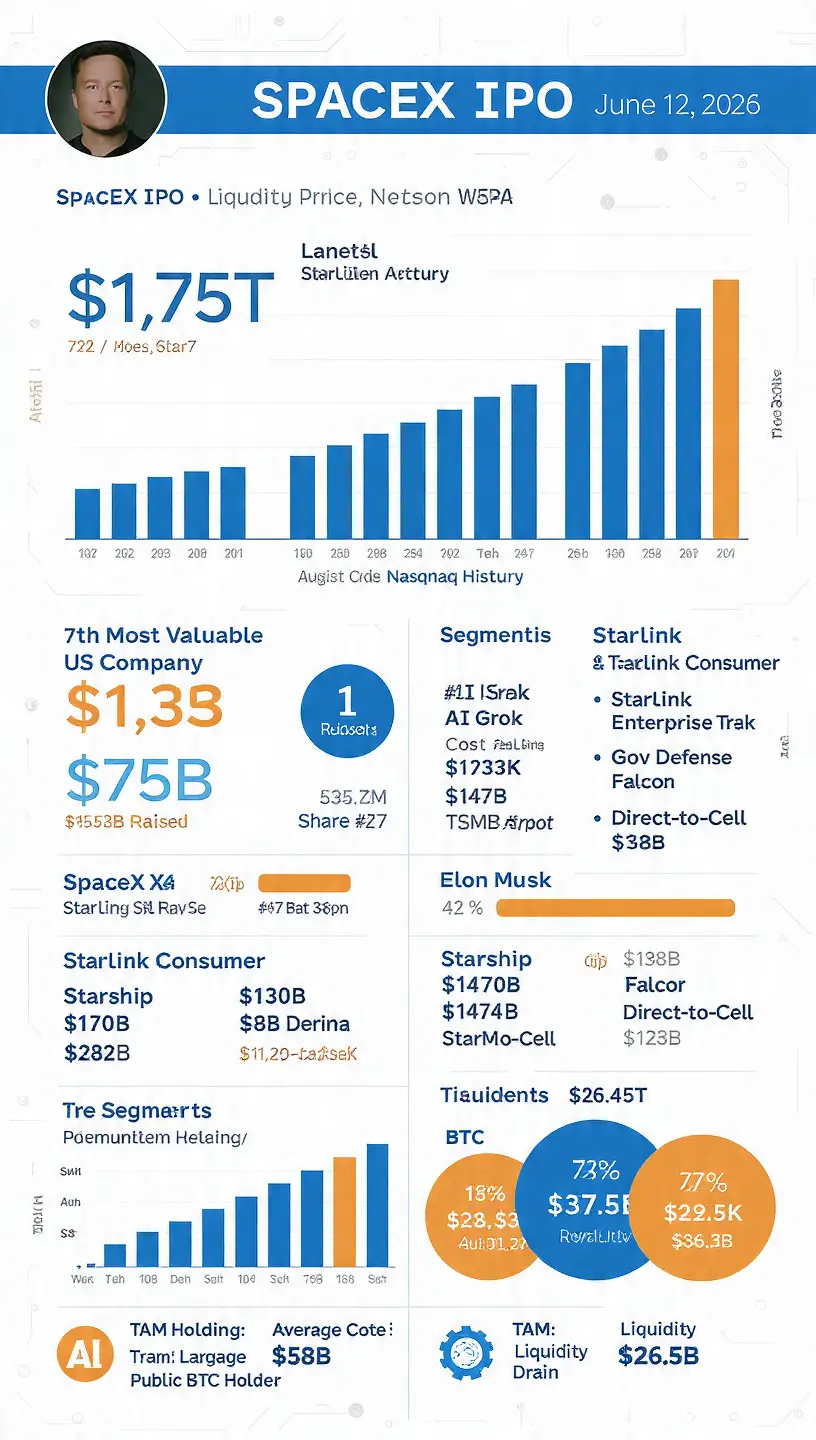
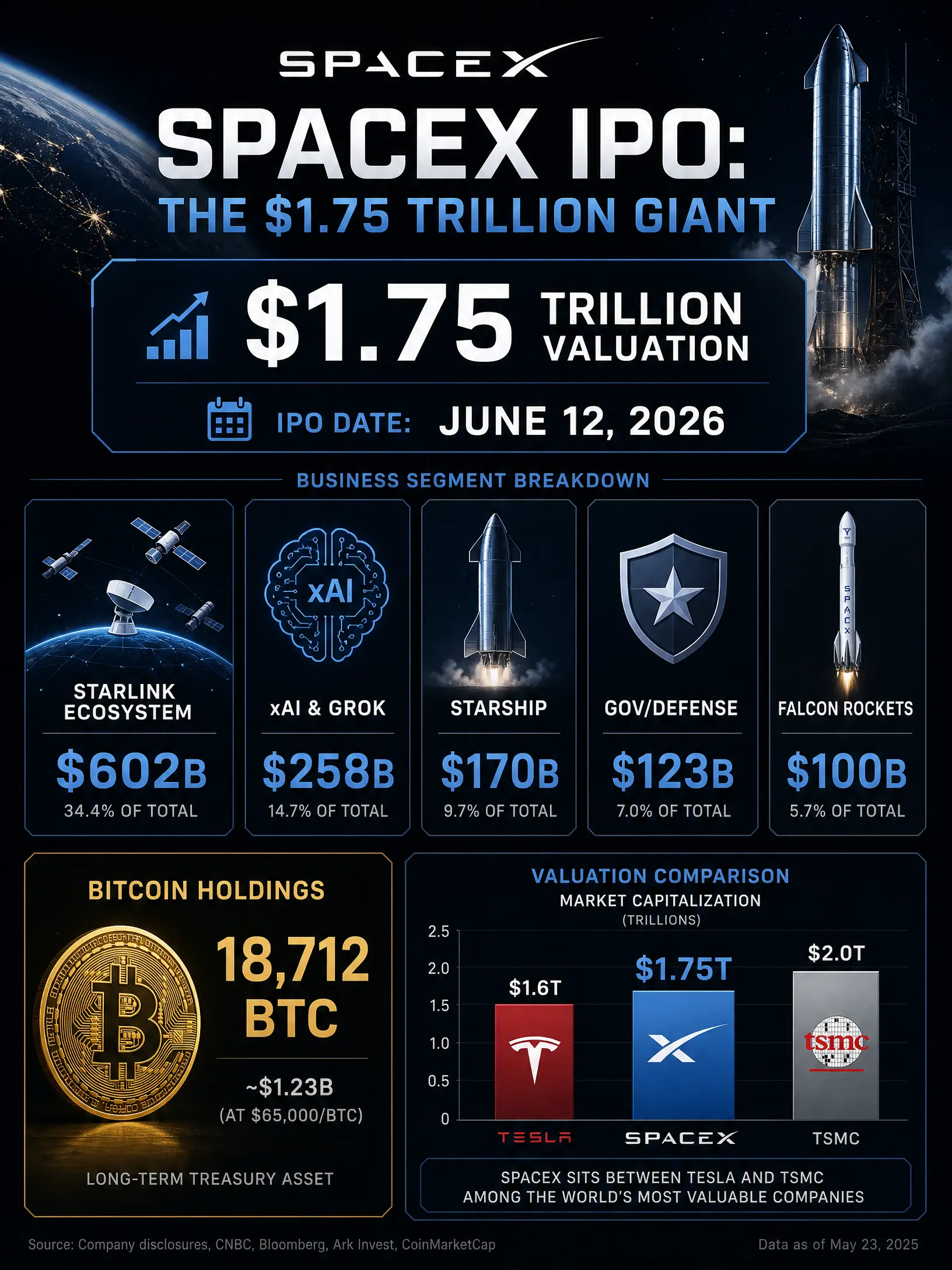
SpaceX is preparing to launch the largest initial public offering in history, targeting a valuation of $1.75 trillion with a fixed share price of $135. The company plans to raise $75 billion by selling approximately 555.6 million shares and is expected to begin trading on Nasdaq on June 12, 2026. This IPO would make SpaceX the seventh most valuable publicly traded company in the United States, surpassing Tesla's market capitalization of approximately $1.6 trillion and sitting just behind TSMC's roughly $2 trillion valuation. It would also eclipse the previous IPO record of $1.7 trillion set by Saudi Aramco seven years ago. Elon Musk, who already holds the title of the world's richest person, would very likely become a trillionaire as a result of this listing. He owns 42 percent of SpaceX's common stock and holds 350 million stock options, which together would be worth approximately $688 billion if the stock maintains its $135 offering price.
The valuation of $1.75 trillion reflects a complex sum-of-the-parts calculation across seven distinct business segments. Starlink Consumer Broadband is estimated at $380 billion, supported by approximately 9.2 million subscribers and trading at roughly 38 times revenue. The xAI and Grok division accounts for $258 billion, anchored by the $250 billion merger between xAI and SpaceX announced in early 2026. Starship Commercial Launch carries a $170 billion valuation as a pre-revenue option value representing the future potential of SpaceX's next-generation rocket system. Starlink Enterprise, Maritime, and Aviation services are valued at $147 billion, while Government and Defense contracts contribute $123 billion backed by a $22 billion contract backlog. The legacy Falcon 9 and Falcon Heavy launch operations are valued at $100 billion, representing 60 to 70 percent of global commercial launches. Finally, Starlink Direct-to-Cell is estimated at $75 billion, bolstered by $17 to $19 billion in EchoStar spectrum assets. The total addressable market that SpaceX describes in its S-1 filing reaches an astonishing $28.5 trillion, with AI representing $26.5 trillion of that figure. However, some analysts suggest that the $1.75 trillion price represents a 29 percent premium over the median forecasted fair value of SpaceX's combined businesses, raising questions about whether investors are overpaying for the Musk brand and the AI narrative layered onto what remains fundamentally a space and connectivity company.
One of the most striking revelations in the SpaceX S-1 filing is the disclosure of Bitcoin holdings. SpaceX disclosed that it holds 18,712 BTC as of March 31, 2026, acquired at an average purchase price of approximately $35,000 per coin, meaning the total acquisition cost was roughly $661 million. At current market prices around $70,000 per BTC, those holdings are now valued at approximately $1.29 to $1.45 billion, making SpaceX the seventh largest Bitcoin holder among publicly traded companies and surpassing Tesla's own treasury allocation. This Bitcoin reserve transforms the SpaceX IPO into something far more than a pure space industry investment. Every investor who buys SpaceX shares on Nasdaq will effectively be gaining indirect exposure to Bitcoin, creating a novel bridge between traditional equity markets and digital assets. The deliberate treasury strategy signals that SpaceX views Bitcoin not as a speculative side bet but as a long-term balance sheet asset, a philosophy consistent with Elon Musk's well documented influence on crypto markets through his public statements and Tesla's prior Bitcoin purchases and acceptance as payment for vehicles.
The impact of the SpaceX IPO on the cryptocurrency market, particularly Bitcoin, operates through several interconnected channels. The first and most immediate concern is liquidity drain. A $75 billion IPO requires investors to allocate enormous sums of capital to purchase SpaceX shares, and this capital must come from somewhere. In the current market environment, the pools of risk-on capital that flow into tech stocks, AI investments, and cryptocurrencies are largely shared. When a mega listing of this scale absorbs $75 billion, it directly competes with Bitcoin and other crypto assets for the same marginal investor dollar. Analysts at CoinDesk have warned that the combined IPO wave of 2026, including SpaceX, OpenAI, and Anthropic, could collectively draw more than $240 billion from the market by year end. This scale of capital absorption could compress the forward looking risk appetite that crypto markets depend on, particularly during periods when institutional flows are already fragile. Bitcoin is currently trading around $70,000, down nearly 50 percent from its all time high of $126,000 reached in October 2025, and already under pressure from spot ETF outflows and Strategy's first disclosed Bitcoin sale. The SpaceX IPO listing on June 12 adds another layer of selling pressure at a time when derivatives markets show open interest at 773,000 BTC with elevated funding rates despite weak spot demand, a dangerous divergence that often precedes deeper corrections.
The second impact channel operates through narrative and sentiment. Elon Musk's dual role as the CEO of both Tesla and SpaceX, combined with his outsized influence on crypto market sentiment through social media posts and public statements, means that the SpaceX IPO will dominate global financial headlines for weeks. During the roadshow period beginning June 8 and the early trading days after June 12, media attention will be intensely focused on Musk, his companies, and the valuation debate. This attention has historically been a double edged sword for Bitcoin. On one hand, the Bitcoin disclosure in SpaceX's filing validates the cryptocurrency as a legitimate treasury asset for one of the world's most ambitious technology companies, reinforcing the narrative that Bitcoin belongs on the balance sheets of major corporations alongside cash and short term investments. On the other hand, if the SpaceX IPO trades poorly in its initial days, the negative sentiment around Musk and his companies could spill over into crypto markets, given the strong correlation between Musk's public perception and Bitcoin price movements observed repeatedly since 2021. A failed or underperforming IPO debut would send a message that even the most hyped technology venture cannot sustain its valuation, and that message could reverberate across all risk assets including Bitcoin.
The third impact channel is structural and relates to the evolving competition between traditional equity markets and crypto markets for investor attention and capital allocation. The SpaceX IPO represents the arrival of a new category of publicly traded asset that blends space infrastructure, satellite connectivity, AI computing, and digital asset exposure into a single equity vehicle. For institutional investors who have been allocating to Bitcoin through ETFs and direct purchases, SpaceX offers an alternative that provides Bitcoin exposure indirectly while also delivering growth potential across multiple secular themes. This could redirect some institutional capital from pure Bitcoin allocations into SpaceX shares, particularly if the stock performs well in early trading and demonstrates that the Bitcoin treasury component is appreciated by the equity market. The Anthropic compute deal, which involves $1.25 billion per month through May 2029 for AI computing capacity at SpaceX's Colossus 1 data center in Memphis, Tennessee, further positions SpaceX as an AI infrastructure company, creating additional competition for the capital that has been flowing into AI themed crypto tokens and Bitcoin mining stocks that have pivoted toward AI computing narratives.
The fourth channel involves the Bitcoin holdings themselves. SpaceX holding 18,712 BTC on its balance sheet creates a unique dynamic. As a publicly traded company, SpaceX will be subject to quarterly reporting requirements, and any change in the value of its Bitcoin holdings will flow through its financial statements. If Bitcoin rises significantly after the IPO, SpaceX's treasury gains will boost its reported earnings and potentially drive its stock price higher, creating a positive feedback loop between Bitcoin appreciation and SpaceX equity value. Conversely, if Bitcoin continues to decline from current levels near $70,000, SpaceX could face treasury losses on its income statement, which might pressure its stock price and in turn reinforce negative Bitcoin sentiment through the Musk association. The fact that SpaceX acquired its Bitcoin at roughly $35,000 per coin means the company still holds substantial unrealized gains even at current prices, but a drop below $35,000 would push the holdings into unrealized loss territory, a scenario that would generate intense media coverage and potentially shake confidence in corporate Bitcoin adoption as a treasury strategy.
Beyond Bitcoin, the broader cryptocurrency market faces additional ripple effects from the SpaceX IPO. Altcoins and smaller crypto assets are even more sensitive to liquidity conditions than Bitcoin, because they trade in thinner markets with smaller buyer pools. When $75 billion is absorbed by a single IPO, the marginal capital that might otherwise flow into Ethereum, Solana, or emerging DeFi protocols is simply not available, and these assets tend to underperform during periods of equity market capital absorption. The crypto market has already experienced a roughly 7.5 percent decline over the past week as Bitcoin slid below $71,000, with analysts warning of potential further downside toward $50,000 support levels if ETF outflows and macro pressures persist. The SpaceX IPO timing, arriving during an already fragile crypto market environment, could amplify the existing downward momentum rather than provide a counterbalancing boost.
Looking at the bigger picture, the SpaceX IPO at $1.75 trillion represents a pivotal moment for the relationship between traditional capital markets and digital assets. It is simultaneously the largest capital raising event in financial history and the most prominent mainstream validation of Bitcoin as a corporate treasury asset. The net effect on Bitcoin and crypto will depend on how the IPO trades in its first weeks, whether the liquidity drain proves temporary or persistent, and whether the Bitcoin disclosure encourages other major companies to follow SpaceX's lead in allocating digital assets to their balance sheets. In the short term, the liquidity competition and sentiment risks suggest caution for crypto investors, as the IPO will absorb capital and attention that Bitcoin needs to recover from its current downtrend. In the longer term, however, the validation of Bitcoin by a $1.75 trillion company may prove to be one of the most significant adoption milestones in the history of digital assets, cementing Bitcoin's role not just as a speculative trading instrument but as a recognized component of corporate treasury management at the highest levels of global finance.#ShareYourUSStocksWinNvidia #DailyPolymarketHotspot @Gate_Square
SpaceX is preparing to launch the largest initial public offering in history, targeting a valuation of $1.75 trillion with a fixed share price of $135. The company plans to raise $75 billion by selling approximately 555.6 million shares and is expected to begin trading on Nasdaq on June 12, 2026. This IPO would make SpaceX the seventh most valuable publicly traded company in the United States, surpassing Tesla's market capitalization of approximately $1.6 trillion and sitting just behind TSMC's roughly $2 trillion valuation. It would also eclipse the previous IPO record of $1.7 trillion set by Saudi Aramco seven years ago. Elon Musk, who already holds the title of the world's richest person, would very likely become a trillionaire as a result of this listing. He owns 42 percent of SpaceX's common stock and holds 350 million stock options, which together would be worth approximately $688 billion if the stock maintains its $135 offering price.
The valuation of $1.75 trillion reflects a complex sum-of-the-parts calculation across seven distinct business segments. Starlink Consumer Broadband is estimated at $380 billion, supported by approximately 9.2 million subscribers and trading at roughly 38 times revenue. The xAI and Grok division accounts for $258 billion, anchored by the $250 billion merger between xAI and SpaceX announced in early 2026. Starship Commercial Launch carries a $170 billion valuation as a pre-revenue option value representing the future potential of SpaceX's next-generation rocket system. Starlink Enterprise, Maritime, and Aviation services are valued at $147 billion, while Government and Defense contracts contribute $123 billion backed by a $22 billion contract backlog. The legacy Falcon 9 and Falcon Heavy launch operations are valued at $100 billion, representing 60 to 70 percent of global commercial launches. Finally, Starlink Direct-to-Cell is estimated at $75 billion, bolstered by $17 to $19 billion in EchoStar spectrum assets. The total addressable market that SpaceX describes in its S-1 filing reaches an astonishing $28.5 trillion, with AI representing $26.5 trillion of that figure. However, some analysts suggest that the $1.75 trillion price represents a 29 percent premium over the median forecasted fair value of SpaceX's combined businesses, raising questions about whether investors are overpaying for the Musk brand and the AI narrative layered onto what remains fundamentally a space and connectivity company.
One of the most striking revelations in the SpaceX S-1 filing is the disclosure of Bitcoin holdings. SpaceX disclosed that it holds 18,712 BTC as of March 31, 2026, acquired at an average purchase price of approximately $35,000 per coin, meaning the total acquisition cost was roughly $661 million. At current market prices around $70,000 per BTC, those holdings are now valued at approximately $1.29 to $1.45 billion, making SpaceX the seventh largest Bitcoin holder among publicly traded companies and surpassing Tesla's own treasury allocation. This Bitcoin reserve transforms the SpaceX IPO into something far more than a pure space industry investment. Every investor who buys SpaceX shares on Nasdaq will effectively be gaining indirect exposure to Bitcoin, creating a novel bridge between traditional equity markets and digital assets. The deliberate treasury strategy signals that SpaceX views Bitcoin not as a speculative side bet but as a long-term balance sheet asset, a philosophy consistent with Elon Musk's well documented influence on crypto markets through his public statements and Tesla's prior Bitcoin purchases and acceptance as payment for vehicles.
The impact of the SpaceX IPO on the cryptocurrency market, particularly Bitcoin, operates through several interconnected channels. The first and most immediate concern is liquidity drain. A $75 billion IPO requires investors to allocate enormous sums of capital to purchase SpaceX shares, and this capital must come from somewhere. In the current market environment, the pools of risk-on capital that flow into tech stocks, AI investments, and cryptocurrencies are largely shared. When a mega listing of this scale absorbs $75 billion, it directly competes with Bitcoin and other crypto assets for the same marginal investor dollar. Analysts at CoinDesk have warned that the combined IPO wave of 2026, including SpaceX, OpenAI, and Anthropic, could collectively draw more than $240 billion from the market by year end. This scale of capital absorption could compress the forward looking risk appetite that crypto markets depend on, particularly during periods when institutional flows are already fragile. Bitcoin is currently trading around $70,000, down nearly 50 percent from its all time high of $126,000 reached in October 2025, and already under pressure from spot ETF outflows and Strategy's first disclosed Bitcoin sale. The SpaceX IPO listing on June 12 adds another layer of selling pressure at a time when derivatives markets show open interest at 773,000 BTC with elevated funding rates despite weak spot demand, a dangerous divergence that often precedes deeper corrections.
The second impact channel operates through narrative and sentiment. Elon Musk's dual role as the CEO of both Tesla and SpaceX, combined with his outsized influence on crypto market sentiment through social media posts and public statements, means that the SpaceX IPO will dominate global financial headlines for weeks. During the roadshow period beginning June 8 and the early trading days after June 12, media attention will be intensely focused on Musk, his companies, and the valuation debate. This attention has historically been a double edged sword for Bitcoin. On one hand, the Bitcoin disclosure in SpaceX's filing validates the cryptocurrency as a legitimate treasury asset for one of the world's most ambitious technology companies, reinforcing the narrative that Bitcoin belongs on the balance sheets of major corporations alongside cash and short term investments. On the other hand, if the SpaceX IPO trades poorly in its initial days, the negative sentiment around Musk and his companies could spill over into crypto markets, given the strong correlation between Musk's public perception and Bitcoin price movements observed repeatedly since 2021. A failed or underperforming IPO debut would send a message that even the most hyped technology venture cannot sustain its valuation, and that message could reverberate across all risk assets including Bitcoin.
The third impact channel is structural and relates to the evolving competition between traditional equity markets and crypto markets for investor attention and capital allocation. The SpaceX IPO represents the arrival of a new category of publicly traded asset that blends space infrastructure, satellite connectivity, AI computing, and digital asset exposure into a single equity vehicle. For institutional investors who have been allocating to Bitcoin through ETFs and direct purchases, SpaceX offers an alternative that provides Bitcoin exposure indirectly while also delivering growth potential across multiple secular themes. This could redirect some institutional capital from pure Bitcoin allocations into SpaceX shares, particularly if the stock performs well in early trading and demonstrates that the Bitcoin treasury component is appreciated by the equity market. The Anthropic compute deal, which involves $1.25 billion per month through May 2029 for AI computing capacity at SpaceX's Colossus 1 data center in Memphis, Tennessee, further positions SpaceX as an AI infrastructure company, creating additional competition for the capital that has been flowing into AI themed crypto tokens and Bitcoin mining stocks that have pivoted toward AI computing narratives.
The fourth channel involves the Bitcoin holdings themselves. SpaceX holding 18,712 BTC on its balance sheet creates a unique dynamic. As a publicly traded company, SpaceX will be subject to quarterly reporting requirements, and any change in the value of its Bitcoin holdings will flow through its financial statements. If Bitcoin rises significantly after the IPO, SpaceX's treasury gains will boost its reported earnings and potentially drive its stock price higher, creating a positive feedback loop between Bitcoin appreciation and SpaceX equity value. Conversely, if Bitcoin continues to decline from current levels near $70,000, SpaceX could face treasury losses on its income statement, which might pressure its stock price and in turn reinforce negative Bitcoin sentiment through the Musk association. The fact that SpaceX acquired its Bitcoin at roughly $35,000 per coin means the company still holds substantial unrealized gains even at current prices, but a drop below $35,000 would push the holdings into unrealized loss territory, a scenario that would generate intense media coverage and potentially shake confidence in corporate Bitcoin adoption as a treasury strategy.
Beyond Bitcoin, the broader cryptocurrency market faces additional ripple effects from the SpaceX IPO. Altcoins and smaller crypto assets are even more sensitive to liquidity conditions than Bitcoin, because they trade in thinner markets with smaller buyer pools. When $75 billion is absorbed by a single IPO, the marginal capital that might otherwise flow into Ethereum, Solana, or emerging DeFi protocols is simply not available, and these assets tend to underperform during periods of equity market capital absorption. The crypto market has already experienced a roughly 7.5 percent decline over the past week as Bitcoin slid below $71,000, with analysts warning of potential further downside toward $50,000 support levels if ETF outflows and macro pressures persist. The SpaceX IPO timing, arriving during an already fragile crypto market environment, could amplify the existing downward momentum rather than provide a counterbalancing boost.
Looking at the bigger picture, the SpaceX IPO at $1.75 trillion represents a pivotal moment for the relationship between traditional capital markets and digital assets. It is simultaneously the largest capital raising event in financial history and the most prominent mainstream validation of Bitcoin as a corporate treasury asset. The net effect on Bitcoin and crypto will depend on how the IPO trades in its first weeks, whether the liquidity drain proves temporary or persistent, and whether the Bitcoin disclosure encourages other major companies to follow SpaceX's lead in allocating digital assets to their balance sheets. In the short term, the liquidity competition and sentiment risks suggest caution for crypto investors, as the IPO will absorb capital and attention that Bitcoin needs to recover from its current downtrend. In the longer term, however, the validation of Bitcoin by a $1.75 trillion company may prove to be one of the most significant adoption milestones in the history of digital assets, cementing Bitcoin's role not just as a speculative trading instrument but as a recognized component of corporate treasury management at the highest levels of global finance.#ShareYourUSStocksWinNvidia #DailyPolymarketHotspot @Gate_Square