tanwarisb

vip
Age 0.2 Year
Peak Tier 0
No content yet
#PredictWorldCup🇺🇸vs🇵🇾
The FIFA World Cup 2026 continues with an exciting Group D encounter between the United States and Paraguay. As one of the tournament hosts, the USA will enjoy home support and familiar conditions, while Paraguay arrives determined to prove itself against one of the region’s strongest opponents. Both teams know that securing points in the opening stages can play a crucial role in qualification, making this fixture highly significant.
Match Overview
The United States enters the tournament with a talented squad capable of playing high-tempo football, pressing aggressi
HighAmbition
#PredictWorldCup🇺🇸vs🇵🇾
The FIFA World Cup 2026 continues with an exciting Group D encounter between the United States and Paraguay. As one of the tournament hosts, the USA will enjoy home support and familiar conditions, while Paraguay arrives determined to prove itself against one of the region’s strongest opponents. Both teams know that securing points in the opening stages can play a crucial role in qualification, making this fixture highly significant.
Match Overview
The United States enters the tournament with a talented squad capable of playing high-tempo football, pressing aggressively, and creating chances through quick transitions. Playing at home could provide an additional psychological advantage, as the crowd support may help the team maintain momentum during difficult moments.
Paraguay, meanwhile, has built its reputation on disciplined defending, physical battles in midfield, and organized tactical play. The team often focuses on limiting opponents’ opportunities before looking to strike on counterattacks or capitalize on set pieces. Their experience against strong South American competition prepares them well for high-pressure situations
Current Expectations and Market Sentiment
Prediction markets currently view this as a relatively balanced contest with a slight edge for the United States.
USA Win Probability: Approximately 49–50%
Draw Probability: Approximately 28–29%
Paraguay Win Probability: Approximately 23–24%
These figures suggest confidence in the United States but also acknowledge that Paraguay has realistic chances of earning points. The narrow difference between outcomes highlights how competitive this matchup could become.
United States Team Analysis
The American squad combines youth, speed, and technical quality across multiple positions. Players capable of carrying the ball forward and pressing high up the pitch make the USA dangerous in transition.
Key strengths include:
Fast attacking movement
Strong wing play
High pressing tactics
Home crowd advantage
Athletic midfield capable of covering large areas
However, occasional defensive lapses and inconsistency against organized opponents remain areas that require improvement. If the USA struggles to break Paraguay’s defensive shape early, frustration could become a factor.
Paraguay Team Analysis
Paraguay traditionally relies on defensive discipline and teamwork rather than individual brilliance. The team often prioritizes compact positioning and looks for opportunities through long balls, crosses, and set pieces.
Major strengths include:
Physical defending
Tactical organization
Counterattacking ability
Strong aerial presence
Experience in difficult competitive matches
Their biggest challenge may be generating enough attacking opportunities if forced to defend for extended periods against sustained American pressure.
Tactical Battle
The key tactical contest will likely revolve around possession versus defensive organization.
The United States may attempt to dominate possession, stretch the field, and create overloads on the wings. Paraguay could respond by sitting deeper, limiting space between defensive lines, and forcing the Americans into low-percentage crossing situations.
Midfield battles will be extremely important. Whichever team controls second balls and transitions could gain a decisive advantage.
Key Factors That Could Decide the Match
Home advantage for the United States
Paraguay’s disciplined defensive setup
Efficiency in front of goal
Performance during set pieces
Midfield control and ball recovery
Tactical adjustments after halftime
Individual moments of quality
Mental composure under pressure
Possible Score Scenarios
Several realistic outcomes stand out based on current form and tactical styles:
USA 1–0 Paraguay
USA 2–1 Paraguay
1–1 Draw
Paraguay 1–0 USA if they successfully frustrate the American attack
A low-scoring match appears more likely than an open, high-scoring encounter due to Paraguay’s defensive approach.
My Prediction
Based on available information, I believe the United States holds a slight advantage entering this fixture. Home support and attacking quality could prove enough to secure three points, although Paraguay possesses the discipline to make the match extremely competitive.
My projected result is a narrow 2–1 victory for the United States, but football remains unpredictable and alternative outcomes remain entirely possible.
Group Stage Importance
Opening matches often shape the momentum of an entire World Cup campaign. A victory would place either team in a stronger position for qualification, while even a single point could become valuable depending on other group results.
For the USA, starting with a win would boost confidence in front of home supporters. For Paraguay, avoiding defeat against the host nation could provide significant momentum heading into later fixtures.
Gate Prediction Market
Gate offers a dedicated World Cup prediction section where users can follow tournament schedules, standings, and prediction events in one place. After updating to the latest version of the Gate App, users can access match-related prediction opportunities and monitor changing market sentiment throughout the competition.
The platform also features the "Green Field Prophet, World Cup Prediction Carnival," covering every World Cup match with multiple participation options and promotional reward campaigns.
Before making any prediction, users should evaluate team news, tactical developments, injuries, and recent performances to form their own independent assessment.
Investment Mindset for Prediction Markets
Prediction markets should be approached with discipline and realistic expectations. Football outcomes depend on countless variables including injuries, referee decisions, tactical adjustments, and unexpected moments.
Rather than relying solely on public sentiment, participants may benefit from combining statistical analysis, historical performance, and current form before making decisions.
Final Thoughts
USA versus Paraguay promises to be one of the more interesting contests of the group stage. The Americans possess home advantage, attacking quality, and positive momentum, while Paraguay brings resilience, structure, and tournament experience that could make life difficult for any opponent.
Although current expectations lean slightly toward the United States, the relatively balanced probabilities show that no result should be considered certain. Fans can expect an intense tactical battle where patience, efficiency, and small moments may ultimately determine the winner.
Whether supporting the host nation or backing Paraguay’s determined challenge, this fixture should provide an entertaining showcase of World Cup football and could have lasting implications for Group D qualification.
@Gate_Square

repost-content-media
  • Reward
  • Comment
  • Repost
  • Share
#USPPIHits2.5YearHigh .
US PPI Hits 2.5-Year High: Market Impact Analysis on Bitcoin, Gold, and Trading Strategy
The United States Producer Price Index (PPI) has surged to its highest level in approximately 2.5 years, sending ripples through global financial markets. This development carries significant implications for investors across asset classes, from traditional equities and bonds to precious metals and cryptocurrencies.
Understanding the PPI Surge
The Producer Price Index measures the average change over time in the selling prices received by domestic producers for their output. When PP
HighAmbition
#USPPIHits2.5YearHigh .
​US PPI Hits 2.5-Year High: Market Impact Analysis on Bitcoin, Gold, and Trading Strategy
​The United States Producer Price Index (PPI) has surged to its highest level in approximately 2.5 years, sending ripples through global financial markets. This development carries significant implications for investors across asset classes, from traditional equities and bonds to precious metals and cryptocurrencies.
​Understanding the PPI Surge
​The Producer Price Index measures the average change over time in the selling prices received by domestic producers for their output. When PPI rises sharply, it indicates that production costs for businesses are increasing substantially. These elevated input costs typically translate into higher consumer prices down the line, creating inflationary pressure throughout the economy.
​The recent PPI reading represents the most significant increase in producer prices since early 2023, driven primarily by surging energy costs, logistics bottlenecks, and persistent supply chain friction.
Additional Market Context:
​US Producer input cost growth: approximately +3.8% YoY
​Energy component contribution: near 35% of total PPI increase
​Core goods inflation: trending above +2.9% YoY
​Global shipping cost volatility index: up roughly +12% quarter-on-quarter
​Liquidity & Macro Market Conditions
​Global liquidity conditions are tightening as central banks maintain restrictive monetary policy.
​Global M2 liquidity growth: slowing to approximately +1.5% YoY
​US dollar index (DXY): holding elevated near 105–107 range
​10-year Treasury yield: fluctuating around 4.1% – 4.5%
​Real yields: remaining positive at approximately 1.8% – 2.2%
​Tighter liquidity conditions generally reduce speculative appetite in risk assets such as equities and cryptocurrencies, increasing volatility across markets.
​Federal Reserve Policy Implications
​The elevated PPI reading has substantially altered market expectations regarding Federal Reserve monetary policy.
​Probability of near-term rate cuts: reduced to around 25% – 30%
​Expected policy rate range (2026): 4.75% – 5.25%
​Fed balance sheet runoff: continuing at $60B/month Treasury reduction pace
​Markets are increasingly pricing a “higher-for-longer” interest rate regime, which historically supports the US dollar while pressuring risk-on assets.
​Market Liquidity & Risk Sentiment Indicators
​Broader risk sentiment is shifting cautiously:
​Crypto total market capitalization: fluctuating near $2.2T – $2.4T
​24h spot trading volume: approximately $85B – $120B
​Derivatives open interest (crypto): near $32B – $38B
​Funding rates: mildly negative to neutral (-0.01% to +0.03%) indicating indecision
​Altcoin dominance: slightly declining toward 38% – 40% range
​Bitcoin dominance: strengthening near 52% – 54%
​Impact on Traditional Markets
​Equity markets are reacting with increased volatility as earnings expectations adjust to higher input costs.
​S&P 500 volatility index (VIX): rising toward 18 – 22 range
​Corporate earnings downgrade ratio: increasing to approximately 1.3 : 1 (downgrades vs upgrades)
​Profit margin compression estimate: -1.5% to -2.5% sector-wide impact
​Bond markets continue to price tighter conditions, with yield curve remaining partially inverted.
​Gold Market Analysis
​Gold remains caught between inflation support and interest rate pressure.
​2026 Trading Range: $4,000 – $5,500 per ounce
​2026 Record High (Late January): approximately $5,595 per ounce
​Current price momentum: consolidating near $4,000–$4,300 zone
​Gold ETF inflows: moderate at +1.2% monthly net inflow
​Physical demand (Asia): rising approximately +6% quarter-on-quarter
​Gold volatility index remains elevated, reflecting uncertainty around Fed policy direction.
​Bitcoin and Cryptocurrency Market Impact
​Bitcoin continues to react strongly to macroeconomic shifts and liquidity cycles.
​Current Price Action: trading around $62,000 – $63,000 (e.g., $62,967)
​2026 Highs: near $82,000 before correction phase
​Spot trading volume: averaging $28B – $35B daily
​ETF inflows (Bitcoin spot ETFs): approximately +$300M – $600M weekly net inflows
​Stablecoin supply: near $165B, indicating sidelined liquidity
​Market structure shows mixed sentiment with institutional accumulation coexisting alongside short-term profit-taking.
​Bitcoin Market Structure & Technical Depth
​Immediate Resistance: $65,000 – $67,000
​Key Support Level: $60,000
​Downside Liquidity Zones: $55,000 – $58,000
​Upside Liquidity Cluster: $70,000 – $75,000
​Additional technical indicators:
​RSI: neutral zone (45–55 range)
​MACD: flat momentum with weak bullish crossover attempts
​Liquidation clusters: concentrated near $61K and $66K levels
​Open interest skew: slightly short-biased after recent volatility spike
​Trading Strategy Considerations
​Bitcoin Strategy
​Current conditions suggest a liquidity-driven range market with sharp volatility spikes around macro data releases.
​Preferred approach: range trading between $60K–$67K
​Breakout trigger: sustained daily close above $67K
​Breakdown trigger: loss of $60K support with volume expansion
​Leverage recommendation: reduced exposure due to volatility expansion
​Market participation is increasingly event-driven, with CPI, PPI, and Fed commentary acting as primary catalysts.
​Gold Trading Strategy
​Accumulation zone: $4,000 – $4,200
​Breakout confirmation: above $4,500 with volume expansion
​Risk zone: breakdown below $4,000 psychological level
​Institutional positioning suggests gradual hedging against macro uncertainty rather than aggressive directional bets.
​Risk Management Essentials
​Portfolio volatility expectation: elevated (+20%–35% range expansion potential)
​Recommended max leverage: reduced to 2x – 5x range for active traders
​Correlation risk: increasing between equities and crypto under macro shocks
​Cash position strategy: maintaining 10%–25% liquidity buffer
​Long-Term Outlook
​If inflation remains persistent and liquidity tightens further, hard assets like Bitcoin and gold may experience structural support despite short-term pressure.
​Bullish long-term scenario: liquidity expansion returning in 2027
​Bearish medium-term scenario: prolonged restrictive policy into late 2026
​Base case: sideways macro-driven consolidation phase

​The US PPI reaching a 2.5-year high represents a major macroeconomic inflection point. It reinforces expectations of tighter monetary policy, weaker liquidity conditions, and increased cross-asset volatility.
Bitcoin and gold are both entering a phase where liquidity flows, ETF demand, and macro policy signals will dominate price action more than traditional technical structures alone.
Successful positioning in this environment requires:
​Strict risk control
​Liquidity awareness
​Adaptive trading strategies
​Macro-driven decision-making@Gate_Square
repost-content-media
  • Reward
  • Comment
  • Repost
  • Share
#GateLaunchesHongKongStockTrading
Gate has officially launched Hong Kong stock trading services, marking a significant milestone in the platform's evolution from a cryptocurrency exchange to a comprehensive multi-asset trading platform. This expansion follows the successful introduction of US stock trading and demonstrates Gate's commitment to providing diverse investment opportunities to its global user base.
The Hong Kong stock trading service became available on June 11, 2026, and represents a major step forward in Gate's mission to become a one-stop destination for all types of trading an
TENCENT1.53%
HSBC1.95%
XIAOMI1.55%
MEITUAN0.32%
AIA1.22%
HighAmbition
#GateLaunchesHongKongStockTrading
Gate has officially launched Hong Kong stock trading services, marking a significant milestone in the platform's evolution from a cryptocurrency exchange to a comprehensive multi-asset trading platform. This expansion follows the successful introduction of US stock trading and demonstrates Gate's commitment to providing diverse investment opportunities to its global user base.
The Hong Kong stock trading service became available on June 11, 2026, and represents a major step forward in Gate's mission to become a one-stop destination for all types of trading and investment activities. Users can now access over one thousand Hong Kong-listed stocks through the Gate platform, covering both the Main Board and the Growth Enterprise Market of the Hong Kong Stock Exchange. This extensive selection includes prominent companies such as Tencent Holdings, HSBC Holdings, CATL, China Mobile, Xiaomi, Meituan, BYD, Ping An Insurance, AIA Group, and Hong Kong Exchanges and Clearing.
To access the new Hong Kong stock trading feature, users need to update their Gate application to version 8.23.5 or above. The trading interface can be found by navigating to the TradFi section, selecting Stocks, and then choosing Hong Kong Stocks. One of the most convenient aspects of this service is that all trading is conducted using USDT, eliminating the need for traditional brokerage accounts or currency conversion to Hong Kong dollars. This approach makes Hong Kong stock investing accessible to cryptocurrency traders who may not have previously participated in traditional equity markets.
The trading features have been designed with user convenience in mind. The Hong Kong stock trading service shares a unified account system with the existing US stock trading platform, allowing seamless fund management and position tracking across both markets. Stock prices are displayed in Hong Kong dollars to provide accurate market representation, while the actual settlement occurs in USDT. Trading is available during regular Hong Kong market hours only, specifically from 01:30 to 04:00 UTC and 05:00 to 08:00 UTC, with a lunch break in between. The platform supports buy and sell execution, position management, order inquiry, and comprehensive asset management tools.
Gate has also introduced attractive promotional events to celebrate the launch of Hong Kong stock trading. The event period runs from June 11, 2026, to June 25, 2026, and offers users the opportunity to share over one hundred eighty-two thousand dollars worth of stock rewards from major companies including Tencent, Meituan, BYD, and Xiaomi. New users who complete their first Hong Kong stock trade can receive 0.2 Tencent shares, valued at approximately twelve USDT, with this offer limited to the first five thousand participants. Additionally, users who complete their first trade with a value of five hundred dollars or more have the chance to win one full Tencent share through a lucky draw.
The Value Investment Plan rewards users based on their average daily holding value, with opportunities to earn up to sixty Meituan shares for those maintaining holdings of ten thousand dollars or more. The Trading Challenge incentivizes active trading by offering up to eighty BYD shares for users achieving cumulative trading volumes of two million dollars or more. Furthermore, the Top Gainer Prediction event allows participants to predict which stock among Tencent, Xiaomi, Meituan, BYD, Alibaba, and SMIC will perform best, with correct predictors receiving Xiaomi shares as rewards.
Gate's expansion into Hong Kong stocks builds upon its established US stock trading service, which already supports over ten thousand US-listed stocks and exchange-traded funds. The US stock platform offers fractional trading from as little as 0.01 shares and covers major exchanges including the New York Stock Exchange, Nasdaq, NYSE Arca, NYSE American, and BATS. This existing infrastructure has provided Gate with valuable experience in equity trading, which has been leveraged to ensure a smooth launch for the Hong Kong stock service.
The platform also offers VIP benefits for active traders. Users with holdings of two thousand dollars or more can upgrade to VIP status, which provides exclusive trading fees as low as 0.023 percent and access to dedicated one-on-one account manager services. These benefits apply across both US and Hong Kong stock trading, providing additional value for active investors.
Gate's transformation from a cryptocurrency exchange to a multi-asset trading platform reflects the evolving needs of modern investors who seek diversified portfolios spanning multiple asset classes. By offering cryptocurrency trading, US stocks, and now Hong Kong stocks within a single platform, Gate provides users with unprecedented convenience and flexibility. This integration eliminates the need to maintain multiple accounts across different platforms, reducing complexity and improving capital efficiency for investors.
The Hong Kong stock market represents a particularly attractive addition to Gate's offerings due to its status as one of the world's leading financial centers. Hong Kong ranked as the world's top initial public offering venue in 2025, with companies raising a total of two hundred seventy-four point six billion Hong Kong dollars from one hundred six new listings. The market's strong performance has continued into 2026, making it an ideal time for Gate to introduce this service to its users.
Gate's commitment to security and transparency is evident in its operations. The platform utilizes zero-knowledge technology to ensure one hundred percent user-verifiable proof of reserves, demonstrating that user funds are fully backed. This approach has helped Gate maintain its position among the top ten exchanges globally based on liquidity and trading volume. The platform serves over seventeen million users worldwide and has consistently invested in expanding its service offerings to meet the diverse needs of its growing community.
The launch of Hong Kong stock trading represents more than just a new product offering; it signifies Gate's vision of creating a comprehensive financial ecosystem where users can seamlessly trade across different asset classes. Whether users are interested in Bitcoin and Ethereum, US technology stocks, or Hong Kong blue-chip companies, Gate now provides a unified platform to access all these opportunities.
For investors and traders, this expansion offers numerous advantages. The ability to trade Hong Kong stocks using USDT means that cryptocurrency holders can easily diversify into traditional equities without the friction of converting to fiat currencies or opening separate brokerage accounts. The unified account system ensures that funds can be efficiently allocated across different markets based on market conditions and investment opportunities.
Gate's strategic expansion into traditional finance markets while maintaining its cryptocurrency roots positions the platform uniquely in the financial services landscape. As the boundaries between traditional finance and digital assets continue to blur, Gate is well-positioned to serve as a bridge between these two worlds, offering users the best of both in a single, secure, and user-friendly platform.
The Hong Kong stock trading service is expected to grow and evolve based on market demand and user feedback. Gate has indicated that the asset list will expand over time, potentially adding more Hong Kong-listed securities as well as exploring opportunities in other regional markets. This commitment to continuous improvement and expansion reinforces Gate's position as a leading global exchange dedicated to providing comprehensive trading solutions for the modern investor.@Gate_Square
repost-content-media
  • Reward
  • Comment
  • Repost
  • Share
#BitmineAddsAnother25KEther
The cryptocurrency market has witnessed another significant development as BitMine Immersion Technologies continues its aggressive accumulation strategy. The company has recently added another 25,000 ETH to its already substantial treasury holdings, bringing its total Ethereum position to an impressive 5.54 million ETH tokens. This latest acquisition represents a major move in the ongoing institutional interest in Ethereum and has generated considerable attention across both traditional finance and digital asset markets.
Understanding BitMine's Ethereum Accumulatio
ETH0.78%
HighAmbition
#BitmineAddsAnother25KEther
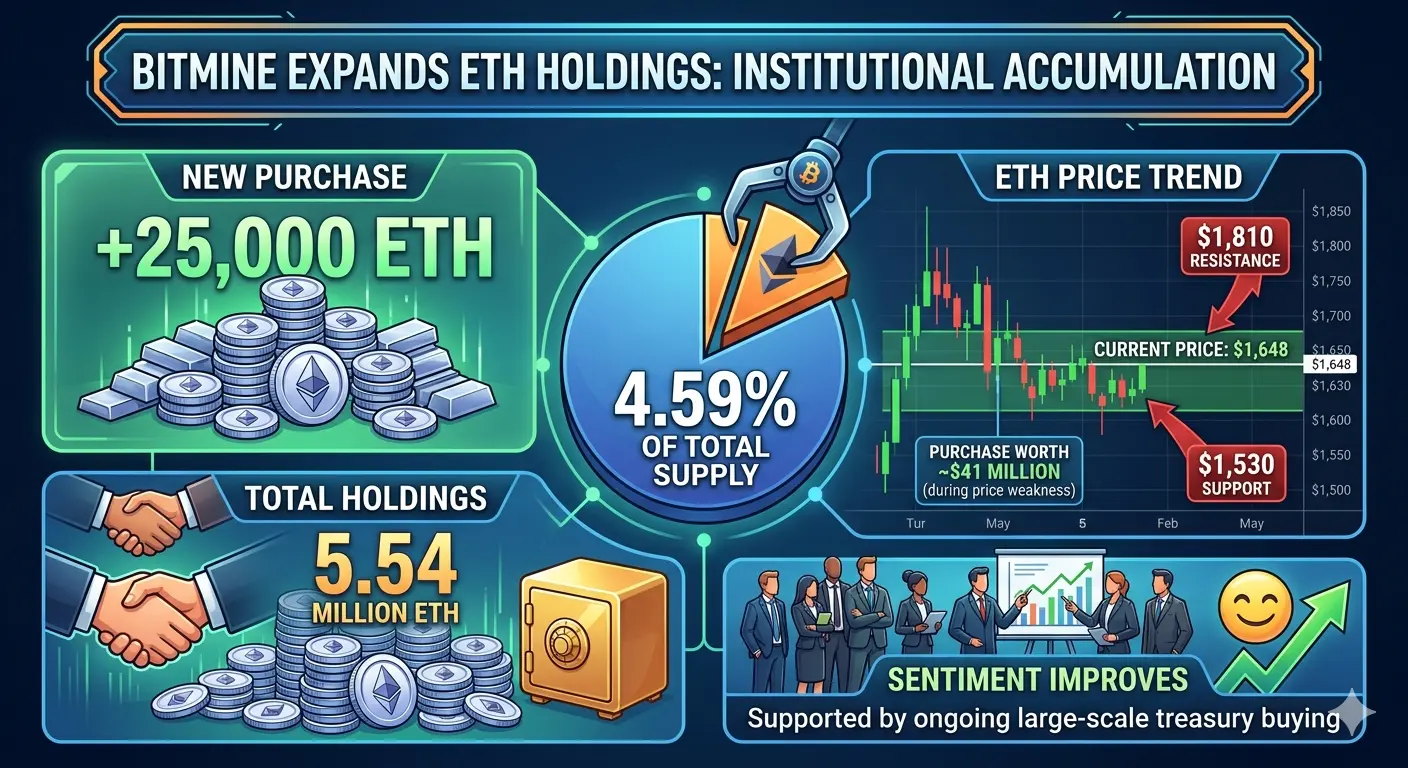
The cryptocurrency market has witnessed another significant development as BitMine Immersion Technologies continues its aggressive accumulation strategy. The company has recently added another 25,000 ETH to its already substantial treasury holdings, bringing its total Ethereum position to an impressive 5.54 million ETH tokens. This latest acquisition represents a major move in the ongoing institutional interest in Ethereum and has generated considerable attention across both traditional finance and digital asset markets.
Understanding BitMine's Ethereum Accumulation Strategy
BitMine has established itself as one of the largest Ethereum treasury-focused entities, consistently demonstrating confidence in the long-term prospects of the Ethereum network. The recent purchase of 25,000 ETH, valued at approximately $41 million at current market prices, follows a pattern of accumulation that has characterized the company’s strategy throughout 2026. Just days prior, BitMine purchased 126,971 ETH worth roughly $214 million, marking one of its largest weekly acquisitions of the year.
The company's total holdings now stand at 5.54 million ETH, representing approximately 4.59% of Ethereum's total circulating supply. This positions BitMine close to its stated target of reaching around 5% of total ETH supply. At current valuations, these holdings are worth approximately $9.3 billion, reflecting significant exposure to Ethereum’s price movements.
Purchase Price Analysis and Market Timing
BitMine has been executing its purchases during a period of price weakness in the Ethereum market. The company acquired its latest 25,000 ETH through transfers from major liquidity sources on June 10, 2026. Based on market data from that period, Ethereum was trading in the range of $1,630 to $1,690 per token, meaning the acquisition cost approximately $40.75 million to $42.25 million.
This accumulation strategy reflects a long-term investment approach, focusing on market cycles and fundamental outlook rather than short-term price movements. Company leadership has stated that the recent price pullback does not reflect changes in Ethereum’s underlying network development and adoption trends.
Impact on BitMine (BMNR) Stock Performance
BitMine’s stock, traded under the ticker BMNR on the NYSE, currently trades around $16.40 to $16.70 per share. The stock has experienced volatility in recent sessions, fluctuating between $15.35 and $16.56. BMNR is widely viewed as a market proxy for Ethereum exposure within traditional equity markets.
The company’s strategy has attracted strong investor attention, with BMNR showing sensitivity to Ethereum price movements. However, this also introduces higher volatility risk due to concentrated exposure to a single digital asset class.
BitMine has also explored capital-raising strategies such as preferred equity instruments to support future Ethereum acquisitions while aiming to balance investor returns and long-term exposure.
Impact on Ethereum Market Dynamics
BitMine’s accumulation activity contributes to consistent demand in the Ethereum market, particularly during periods of price weakness. Large-scale holdings by institutional entities can influence overall market liquidity and sentiment.
Second, such activity reflects growing institutional interest in Ethereum as a digital asset with long-term utility across decentralized finance, infrastructure, and tokenized applications.
Third, significant holdings reduce available circulating supply in open markets, which can influence liquidity conditions and price responsiveness during periods of increased demand or volatility.
Current Ethereum Price and Technical Analysis
As of June 12, 2026, Ethereum is trading at approximately $1,648 per ETH, still below its previous peak levels but showing stabilization from recent lows.
From a technical perspective, Ethereum is currently trading near key support zones around $1,645 to $1,700. The 200-day moving average near $1,663 is acting as an important reference level for market participants.
Key Support and Resistance Levels
Immediate support is found at the $1,645 to $1,663 range, aligned with recent consolidation and moving averages. A break below this zone could lead toward the $1,530 level, which has historically attracted strong buying interest.
The broader support zone is located near $1,750, where market participants are closely monitoring price behavior for signs of strength or weakness.
On the resistance side, immediate levels are observed between $1,790 and $1,810. A breakout above this area could open movement toward $1,950 to $2,000. The $2,088 level remains a key long-term resistance point, followed by the $2,200–$2,300 range.
Market Sentiment and Investor Confidence
BitMine’s continued accumulation has contributed to improved sentiment around Ethereum, even amid broader market uncertainty. Large institutional participation is often interpreted as a sign of long-term confidence in the asset’s ecosystem and future adoption.
Community discussions have increasingly highlighted institutional activity as a key factor supporting market stability during volatile conditions.
Ethereum Price Forecast and Trading Strategy
Looking ahead, Ethereum presents a mixed outlook influenced by both macroeconomic and network-specific factors. Short-term expectations suggest a trading range near $1,645 to $1,700, while longer-term projections vary widely depending on market conditions and adoption trends.
The bullish outlook is supported by continued ecosystem development, increasing institutional participation, and ongoing network upgrades. The bearish outlook reflects macroeconomic uncertainty, regulatory developments, and broader risk-asset pressure.
Traders are advised to monitor key support and resistance levels closely, as price action remains sensitive to both technical and macroeconomic signals.
BitMine's Future Plans and Strategic Outlook
BitMine is expected to continue its long-term accumulation strategy while exploring funding mechanisms such as equity issuance to support future purchases. The company also maintains diversified investments and liquidity reserves to support operations and manage market volatility.
Conclusion
BitMine’s acquisition of another 25,000 ETH highlights continued institutional interest in Ethereum and reinforces its role as a major digital asset within treasury strategies. While market conditions remain volatile, long-term accumulation trends continue to shape sentiment across the ecosystem.
Investors are advised to focus on key technical levels and broader market conditions, as price direction will ultimately depend on liquidity, adoption, and macroeconomic factors.
@Gate_Square
repost-content-media
  • Reward
  • Comment
  • Repost
  • Share
#BitmineAddsAnother25KEther
The cryptocurrency market has witnessed another significant development as BitMine Immersion Technologies continues its aggressive accumulation strategy. The company has recently added another 25,000 ETH to its already substantial treasury holdings, bringing its total Ethereum position to an impressive 5.54 million ETH tokens. This latest acquisition represents a major move in the ongoing institutional interest in Ethereum and has generated considerable attention across both traditional finance and digital asset markets.
Understanding BitMine's Ethereum Accumulatio
ETH0.78%
HighAmbition
#BitmineAddsAnother25KEther
The cryptocurrency market has witnessed another significant development as BitMine Immersion Technologies continues its aggressive accumulation strategy. The company has recently added another 25,000 ETH to its already substantial treasury holdings, bringing its total Ethereum position to an impressive 5.54 million ETH tokens. This latest acquisition represents a major move in the ongoing institutional interest in Ethereum and has generated considerable attention across both traditional finance and digital asset markets.
Understanding BitMine's Ethereum Accumulation Strategy
BitMine has established itself as one of the largest Ethereum treasury-focused entities, consistently demonstrating confidence in the long-term prospects of the Ethereum network. The recent purchase of 25,000 ETH, valued at approximately $41 million at current market prices, follows a pattern of accumulation that has characterized the company’s strategy throughout 2026. Just days prior, BitMine purchased 126,971 ETH worth roughly $214 million, marking one of its largest weekly acquisitions of the year.
The company's total holdings now stand at 5.54 million ETH, representing approximately 4.59% of Ethereum's total circulating supply. This positions BitMine close to its stated target of reaching around 5% of total ETH supply. At current valuations, these holdings are worth approximately $9.3 billion, reflecting significant exposure to Ethereum’s price movements.
Purchase Price Analysis and Market Timing
BitMine has been executing its purchases during a period of price weakness in the Ethereum market. The company acquired its latest 25,000 ETH through transfers from major liquidity sources on June 10, 2026. Based on market data from that period, Ethereum was trading in the range of $1,630 to $1,690 per token, meaning the acquisition cost approximately $40.75 million to $42.25 million.
This accumulation strategy reflects a long-term investment approach, focusing on market cycles and fundamental outlook rather than short-term price movements. Company leadership has stated that the recent price pullback does not reflect changes in Ethereum’s underlying network development and adoption trends.
Impact on BitMine (BMNR) Stock Performance
BitMine’s stock, traded under the ticker BMNR on the NYSE, currently trades around $16.40 to $16.70 per share. The stock has experienced volatility in recent sessions, fluctuating between $15.35 and $16.56. BMNR is widely viewed as a market proxy for Ethereum exposure within traditional equity markets.
The company’s strategy has attracted strong investor attention, with BMNR showing sensitivity to Ethereum price movements. However, this also introduces higher volatility risk due to concentrated exposure to a single digital asset class.
BitMine has also explored capital-raising strategies such as preferred equity instruments to support future Ethereum acquisitions while aiming to balance investor returns and long-term exposure.
Impact on Ethereum Market Dynamics
BitMine’s accumulation activity contributes to consistent demand in the Ethereum market, particularly during periods of price weakness. Large-scale holdings by institutional entities can influence overall market liquidity and sentiment.
Second, such activity reflects growing institutional interest in Ethereum as a digital asset with long-term utility across decentralized finance, infrastructure, and tokenized applications.
Third, significant holdings reduce available circulating supply in open markets, which can influence liquidity conditions and price responsiveness during periods of increased demand or volatility.
Current Ethereum Price and Technical Analysis
As of June 12, 2026, Ethereum is trading at approximately $1,648 per ETH, still below its previous peak levels but showing stabilization from recent lows.
From a technical perspective, Ethereum is currently trading near key support zones around $1,645 to $1,700. The 200-day moving average near $1,663 is acting as an important reference level for market participants.
Key Support and Resistance Levels
Immediate support is found at the $1,645 to $1,663 range, aligned with recent consolidation and moving averages. A break below this zone could lead toward the $1,530 level, which has historically attracted strong buying interest.
The broader support zone is located near $1,750, where market participants are closely monitoring price behavior for signs of strength or weakness.
On the resistance side, immediate levels are observed between $1,790 and $1,810. A breakout above this area could open movement toward $1,950 to $2,000. The $2,088 level remains a key long-term resistance point, followed by the $2,200–$2,300 range.
Market Sentiment and Investor Confidence
BitMine’s continued accumulation has contributed to improved sentiment around Ethereum, even amid broader market uncertainty. Large institutional participation is often interpreted as a sign of long-term confidence in the asset’s ecosystem and future adoption.
Community discussions have increasingly highlighted institutional activity as a key factor supporting market stability during volatile conditions.
Ethereum Price Forecast and Trading Strategy
Looking ahead, Ethereum presents a mixed outlook influenced by both macroeconomic and network-specific factors. Short-term expectations suggest a trading range near $1,645 to $1,700, while longer-term projections vary widely depending on market conditions and adoption trends.
The bullish outlook is supported by continued ecosystem development, increasing institutional participation, and ongoing network upgrades. The bearish outlook reflects macroeconomic uncertainty, regulatory developments, and broader risk-asset pressure.
Traders are advised to monitor key support and resistance levels closely, as price action remains sensitive to both technical and macroeconomic signals.
BitMine's Future Plans and Strategic Outlook
BitMine is expected to continue its long-term accumulation strategy while exploring funding mechanisms such as equity issuance to support future purchases. The company also maintains diversified investments and liquidity reserves to support operations and manage market volatility.
Conclusion
BitMine’s acquisition of another 25,000 ETH highlights continued institutional interest in Ethereum and reinforces its role as a major digital asset within treasury strategies. While market conditions remain volatile, long-term accumulation trends continue to shape sentiment across the ecosystem.
Investors are advised to focus on key technical levels and broader market conditions, as price direction will ultimately depend on liquidity, adoption, and macroeconomic factors.
@Gate_Square
repost-content-media
  • Reward
  • Comment
  • Repost
  • Share
#SpotSilverUp10PercentForTheWeek
Spot silver has demonstrated remarkable strength this week with a substantial ten percent surge that has captured the attention of investors and traders across global markets. Currently trading at approximately 67 dollars per ounce, this precious metal has shown exceptional bullish momentum driven by a convergence of multiple fundamental and technical factors. The sharp upward movement represents one of the most significant weekly gains in recent months, signaling a potential shift in market sentiment and positioning silver as a standout performer among precio
HighAmbition
#SpotSilverUp10PercentForTheWeek
Spot silver has demonstrated remarkable strength this week with a substantial ten percent surge that has captured the attention of investors and traders across global markets. Currently trading at approximately 67 dollars per ounce, this precious metal has shown exceptional bullish momentum driven by a convergence of multiple fundamental and technical factors. The sharp upward movement represents one of the most significant weekly gains in recent months, signaling a potential shift in market sentiment and positioning silver as a standout performer among precious metals.
The primary catalyst behind this sudden surge stems from escalating geopolitical tensions, particularly the ongoing conflicts and trade disputes that have heightened safe-haven demand. When uncertainty grips global markets, investors traditionally flock toward precious metals as stores of value, and silver has benefited tremendously from this risk-off sentiment. Additionally, the weakening United States dollar has provided substantial tailwinds for silver prices, as a softer dollar makes the metal more affordable for international buyers and enhances its appeal as an alternative currency hedge.
Industrial demand represents another crucial driver propelling silver prices higher. The metal plays an indispensable role in manufacturing sectors, particularly in electronics, solar panels, electric vehicles, and various high-tech applications. As the global economy continues its transition toward green energy and sustainable technologies, silver consumption has accelerated significantly. The photovoltaic industry alone consumes substantial quantities of silver for solar cell production, and this demand stream shows no signs of abating as countries worldwide expand their renewable energy infrastructure.
Supply constraints have further exacerbated the bullish price action. Mining production has faced numerous challenges including environmental regulations, operational difficulties, and resource depletion at existing mines. The Silver Institute has projected that the market will remain in significant deficit for the third consecutive year, with industrial demand reaching record levels while supply struggles to keep pace. This structural imbalance between supply and demand creates a favorable environment for sustained price appreciation.
From a technical perspective, silver has successfully breached several key resistance levels during this rally. The breakthrough above the 70 dollars psychological barrier marked a significant milestone, although the current retracement to 67 dollars suggests some profit-taking activity. The 50-day moving average sits at approximately 67.72 dollars, which now serves as immediate support that bulls must defend to maintain the uptrend structure. A sustained hold above this level would confirm the bullish bias and open the door for further gains.
Looking ahead, the resistance landscape becomes more challenging. The immediate upside target rests at 72 dollars to 72.60 dollars, which represents a prior support zone now acting as a cap. Beyond that, the 200-day moving average at 76.07 dollars represents the next major hurdle. A wider retracement band extending from 74.63 dollars to 83.61 dollars from the earlier all-time highs provides additional context for any recovery attempts. These levels will likely attract selling pressure from traders looking to capitalize on the recent gains, making them important markers for momentum assessment.
Support levels warrant careful attention for risk management purposes. The 67.72 dollars 50-day moving average provides the first line of defense. A break below this threshold could trigger deeper corrections toward the 61 dollars to 60.83 dollars major support cluster, which would represent a more substantial pullback but still within the context of a broader bullish structure. A further decline with conviction could eventually open the path toward the December breakout level near 59.34 dollars.
Institutional forecasts for silver remain constructive despite recent volatility. Analysts from major financial institutions including Bank of America, JPMorgan, and UBS have projected year-end targets ranging from 80 dollars to 106 dollars per ounce, with more optimistic scenarios extending to 135 dollars. These projections reflect expectations of continued industrial demand growth, persistent supply deficits, and ongoing macroeconomic uncertainty that supports precious metals allocation.
For traders navigating this market, several strategic approaches merit consideration. Trend-following strategies remain appropriate given the strong bullish momentum, with entry points on pullbacks to key support levels offering favorable risk-reward profiles. Position sizing should account for silver's inherent volatility, which typically exceeds that of gold due to the metal's smaller market size and dual role as both precious and industrial metal. Stop-loss orders placed below the 50-day moving average or the 61 dollars support cluster would help protect capital while allowing sufficient room for normal price fluctuations.
Investors should monitor several key variables that will likely influence silver's trajectory in the coming weeks and months. Federal Reserve policy decisions and interest rate expectations remain paramount, as higher rates increase the opportunity cost of holding non-yielding assets like silver. Inflation data releases will also impact sentiment, with higher inflation generally supporting precious metals as inflation hedges. Additionally, developments in the renewable energy sector and electric vehicle adoption will drive industrial demand expectations.
The market impact of this silver surge extends beyond the metal itself. Mining companies have experienced significant share price appreciation, with silver-focused producers outperforming broader equity indices. Exchange-traded funds tracking silver have seen substantial inflows as institutional and retail investors increase allocations. The gold-silver ratio, currently around 63 to 1, remains historically elevated and suggests potential for silver to outperform gold in the coming quarters if the ratio normalizes toward historical averages around 50 to 1.
In conclusion, silver's 10 percent weekly surge reflects a confluence of supportive factors including geopolitical uncertainty, robust industrial demand, supply constraints, and favorable technical positioning. While short-term volatility should be expected as the market digests recent gains and contends with resistance levels, the medium to long-term outlook remains constructive. Traders and investors should maintain disciplined risk management while remaining alert to opportunities presented by pullbacks to key support zones. The path forward will depend heavily on macroeconomic developments, central bank policies, and the continued evolution of industrial demand drivers, but the structural supply-demand imbalance provides a solid foundation for sustained price appreciation potential.@Gate_Square
repost-content-media
  • Reward
  • Comment
  • Repost
  • Share
#SpaceXIPOAttractsOver250BillionInOrders
The SpaceX IPO has become one of the most discussed financial events in modern market history, driven by extraordinary investor demand, high liquidity inflows, and aggressive price discovery expectations across both institutional and retail segments.
SpaceX (SpaceX) is transitioning from a private aerospace leader into a publicly traded mega-cap candidate, with its IPO marking a structural shift in how space infrastructure is valued in global capital markets.
🔹 Massive Demand Surge & Order Book Expansion
Early market estimates suggest that total deman
SPCX7.45%
BTC1.20%
HighAmbition
#SpaceXIPOAttractsOver250BillionInOrders
The SpaceX IPO has become one of the most discussed financial events in modern market history, driven by extraordinary investor demand, high liquidity inflows, and aggressive price discovery expectations across both institutional and retail segments.
SpaceX (SpaceX) is transitioning from a private aerospace leader into a publicly traded mega-cap candidate, with its IPO marking a structural shift in how space infrastructure is valued in global capital markets.
🔹 Massive Demand Surge & Order Book Expansion
Early market estimates suggest that total demand for the IPO has reached $200B – $300B equivalent range, depending on allocation assumptions and derivative exposure.
📊 Demand Breakdown (Estimated Market Structure)
Institutional investors: 55% – 65% share of total demand
Sovereign wealth funds: 10% – 15%
Hedge funds & macro funds: 15% – 20%
Retail + derivatives exposure: $80B – $120B equivalent
This creates an estimated oversubscription ratio of 3.5x – 4.2x, one of the highest in large-cap IPO history.
🔹 IPO Pricing Structure & Valuation Metrics
💰 Core IPO Metrics (Estimated)
IPO Price Range: $130 – $140 per share
Mid valuation reference: ~$1.6T – $1.8T market cap
Total shares issued: ~555M shares
Potential greenshoe option: +10% – 15% supply expansion
📈 Fully diluted valuation scenarios:
Conservative case: $1.5T
Base case: $1.7T
High demand scenario: $1.85T+
This places SpaceX among the top-tier global mega-cap technology and infrastructure entities if sustained post-listing.
🔹 Liquidity Inflow & Trading Volume Expectations
IPO events of this magnitude typically generate extreme liquidity spikes during initial trading sessions.
📊 Estimated Day-1 Trading Metrics:
Expected trading volume: $35B – $70B equivalent
Volatility range: ±12% to ±25% intraday swings
Opening gap expectation: +8% to +20% above IPO price range
Order book imbalance: Buy-side dominance 1.8x – 2.5x sell pressure
High liquidity concentration is expected due to institutional repositioning and hedge fund hedging activity around derivatives exposure.
🔹 Price Discovery & Market Range Scenarios
Early derivatives pricing and pre-market speculation indicate multiple potential trading zones:
📊 Projected Price Ranges:
Opening range: $145 – $170
Short-term equilibrium: $155 – $185
High momentum breakout scenario: $190 – $210
Correction scenario support zones: $120 – $135
These ranges reflect uncertainty in fair valuation during the initial discovery phase.
🔹 Volatility Structure & Market Behavior
IPO volatility is expected to remain elevated due to:
Heavy institutional rebalancing
Retail speculative inflows
Algorithmic trading participation
Limited initial float supply
📉 Volatility Indicators:
Expected implied volatility: 45% – 70%
Short-term beta behavior: 2.0x – 3.5x compared to market index
Liquidity shock sensitivity: high during first 3–5 trading sessions
🔹 Strategic Business Drivers Supporting Valuation
Investor enthusiasm is strongly linked to SpaceX’s multi-layer business model:
🚀 Rocket launch services (Falcon & Starship systems)
🛰️ Starlink global satellite internet network
🏛️ Government and defense contracts backlog (multi-billion dollar scale)
🤖 AI + data infrastructure integration potential
🌍 Global connectivity expansion roadmap
These revenue streams create a hybrid model of infrastructure + technology + data services.
🔹 Crypto Market & Digital Asset Correlation
Some institutional reports highlight indirect exposure of SpaceX to digital assets historically, including bitcoin reserves, which strengthens its narrative connection with alternative asset markets.
Market impact implications:
Increased correlation between tech IPO sentiment and crypto risk appetite
Potential liquidity rotation from crypto → equities during IPO phase
Short-term volatility spillover across digital asset markets
This creates a cross-market sentiment bridge between traditional finance and crypto ecosystems.
🔹 Gate.io & Pre-IPO Market Access Layer
Gate.io (Gate.io) and similar platforms have introduced pre-IPO exposure instruments that track valuation movements before and after listing.
Key structural features:
Tokenized exposure to IPO valuation movement
Pre-market speculative liquidity access
No direct equity ownership structure
High leverage-like volatility profile
Estimated activity metrics:
Subscription volume: $20M – $50M+ equivalent range
Active participation growth: rapid expansion from retail Asia markets
Liquidity turnover: high frequency trading behavior post-allocation
🔹 Institutional Sentiment & Risk Matrix
📊 Positive drivers:
Strong execution history
Expanding global infrastructure demand
High-margin satellite internet scaling potential
Defense + government contract stability
Extreme valuation sensitivity
Regulatory uncertainty in space + telecom sectors
Capital expenditure intensity (Starship program)
Revenue timing mismatch vs long-term vision
🔹 Market Impact Across Sectors
A successful IPO performance may impact:
Aerospace & defense stocks (valuation rerating)
Satellite communication companies (competitive pressure)
AI infrastructure narratives (cross-sector capital inflows)
ETF and index rebalancing strategies
Crypto markets via sentiment correlation channels
The SpaceX IPO represents a high-liquidity, high-volatility, institutionally driven market event with strong speculative and long-term structural interest.
While demand metrics and liquidity estimates suggest aggressive market participation, the final outcome will depend on:
Real-time price discovery
Institutional profit-taking behavior
Macro liquidity conditions
Retail sentiment stability
Space infrastructure is transitioning into a mainstream capital market theme — and SpaceX sits at the center of this structural shift.
@Gate_Square
repost-content-media
  • Reward
  • 1
  • Repost
  • Share
ybaser:
To The Moon 🌕
#PredictWorldCup🇺🇸vs🇵🇾
World Cup 2026 Prediction: USA vs Paraguay - A Battle for Group D Supremacy
The 2026 FIFA World Cup has officially kicked off, and one of the most anticipated opening matches features the United States taking on Paraguay at SoFi Stadium in Los Angeles. As a host nation, the United States carries the weight of expectations from millions of fans, while Paraguay returns to the World Cup stage after a 16-year absence, hungry to make their mark on the tournament once again.
Match Overview and Context
This Group D encounter represents a critical opening fixture for both t
HighAmbition
#PredictWorldCup🇺🇸vs🇵🇾
World Cup 2026 Prediction: USA vs Paraguay - A Battle for Group D Supremacy
The 2026 FIFA World Cup has officially kicked off, and one of the most anticipated opening matches features the United States taking on Paraguay at SoFi Stadium in Los Angeles. As a host nation, the United States carries the weight of expectations from millions of fans, while Paraguay returns to the World Cup stage after a 16-year absence, hungry to make their mark on the tournament once again.
Match Overview and Context
This Group D encounter represents a critical opening fixture for both teams. The United States enters the tournament under the guidance of head coach Mauricio Pochettino, who has been working to instill a more aggressive, high-pressing style of play. The team comes into this match with mixed recent form, having suffered heavy defeats to Belgium and Portugal in March but bouncing back with a 3-2 victory over Senegal in late May. Paraguay, meanwhile, has shown resilience under coach Gustavo Alfaro, with the team demonstrating a disciplined defensive approach that has served them well in CONMEBOL qualifying.
The historical context adds another layer of intrigue to this matchup. These two teams have faced each other multiple times in international competition, including a memorable Round of 16 clash at the 1998 FIFA World Cup. The United States has historically had the upper hand in recent encounters, keeping clean sheets in back-to-back victories over Paraguay, with four of the last five meetings finishing with a single-goal margin.
Polymarket Prediction Analysis
According to current Polymarket odds, this match is being priced as a relatively close contest. The United States holds a slight edge with approximately 49.5% to 50.5% probability of victory, while a draw sits around 28.5% to 29%, and a Paraguay win is valued at roughly 23% to 24%. These odds reflect the competitive nature of this fixture, acknowledging that while the USA has home advantage and superior individual talent, Paraguay's organized defensive structure and South American pedigree make them a dangerous opponent.
The narrow spread between a United States victory and a draw or Paraguay result indicates that prediction market participants view this as an evenly matched group stage contest where form, set-piece execution, and early tournament momentum will likely determine the outcome. The total goals line of 2.5 suggests expectations of a relatively tight, tactical affair rather than an open, high-scoring game.
Key Factors to Consider
Several critical elements will influence the outcome of this match. First, the home advantage for the United States cannot be understated. Playing in front of a capacity crowd at SoFi Stadium, with the energy and support of American fans, provides a significant psychological boost. The familiarity with conditions, time zones, and the reduced travel burden all work in favor of the host nation.
Second, the tactical battle between Pochettino and Alfaro will be fascinating. Pochettino has emphasized a possession-based, high-pressing approach that relies on the technical quality of players like Christian Pulisic, Weston McKennie, and Gio Reyna. If the United States can impose this style and deny Paraguay the chance to settle into their defensive shape, the attacking quality should eventually tell. However, Paraguay's ability to remain compact, frustrate opponents, and capitalize on counter-attacking opportunities presents a genuine threat.
Third, the mental aspect of opening a World Cup on home soil brings both opportunity and pressure. The United States must balance the desire to put on a show for the home crowd with the pragmatic need to secure points. Paraguay, as the underdog, can play with less pressure and may benefit from any early American nerves.
Team Analysis and Key Players
For the United States, Christian Pulisic remains the focal point of the attack. The AC Milan forward brings creativity, dribbling ability, and a eye for goal that makes him the most dangerous player in the squad. Weston McKennie provides energy and box-to-box presence in midfield, while Folarin Balogun offers a mobile, technical option at striker. The defensive partnership of Chris Richards and Miles Robinson will need to be alert to Paraguay's physical presence from set pieces.
Paraguay's strength lies in their collective organization and defensive discipline. They have mastered the art of defending under Alfaro, and this momentum carries them into the World Cup. While they may lack the star power of their opponents, their cohesion and tactical awareness make them difficult to break down. Their ability to remain competitive against technically superior sides was demonstrated during qualifying, where they showed they could grind out results even when not at their best.
My Prediction
After careful analysis of the available data, current form, and the specific dynamics of this matchup, my prediction is a **United States victory by a score of 2-1**. While Paraguay's defensive organization will make this a challenging contest, the quality of the American attack, combined with home advantage and the tactical acumen of Pochettino, should prove decisive.
The United States has the attacking weapons to break down Paraguay's defensive block, particularly through the individual brilliance of Pulisic and the movement of Balogun. However, Paraguay's threat from set pieces and their ability to capitalize on transitions means the USA will need to remain focused throughout the 90 minutes. I anticipate the Americans taking an early lead, Paraguay equalizing through a set piece or counter-attack, and the USA finding a winner in the second half as fitness and depth tell.
Trading Strategy on Gate Prediction Market
For those participating in the Gate World Cup prediction campaign, this match presents an interesting trading opportunity. Given the odds pricing this as a close contest, there may be value in taking a position on the United States, particularly if you can find favorable entry points. The key questions to consider are:
Question 1: What is your predicted outcome for the USA vs Paraguay match, and what is your confidence level in this prediction?
My predicted outcome is a United States victory with medium-high confidence. While Paraguay's defensive capabilities and the unpredictable nature of opening World Cup matches introduce uncertainty, the combination of home advantage, superior individual talent, and tactical flexibility gives the USA the edge. I would rate my confidence at 70%, acknowledging that a draw or Paraguay victory remains a realistic possibility.
Question 2: What factors do you believe will most significantly influence the outcome of this match?
The three most significant factors are home advantage and crowd support, tactical execution and the ability to impose playing style, and mental composure under World Cup pressure. The United States must leverage the energy of the home crowd while maintaining tactical discipline. Their ability to break down Paraguay's defensive block early will be crucial, as will their defensive concentration to prevent conceding from set pieces or counter-attacks.
Question 3: What is your recommended trading strategy for this prediction market event?
My recommended strategy is to take a moderate position on the United States victory, sized appropriately for your risk tolerance. Given the relatively even odds, there is value in backing the host nation, particularly if you believe the market is slightly undervaluing the home advantage factor. Consider scaling into the position if early market movements create better entry points, and be prepared to hold through potential volatility as the match unfolds. For risk management, avoid overexposure given the unpredictable nature of opening World Cup fixtures, and consider hedging with a smaller position on the draw if the odds become more attractive closer to kickoff.
The USA vs Paraguay match represents an exciting opening to the 2026 World Cup for both teams. For the United States, it is an opportunity to lay down a marker and build momentum on home soil. For Paraguay, it is a chance to announce their return to the world stage with a statement result. While my analysis favors the United States, the beauty of football lies in its unpredictability, and this match has all the ingredients for a compelling contest that could go either way. May the best team win, and may your predictions prove profitable.
repost-content-media
  • Reward
  • Comment
  • Repost
  • Share
#MyGateTradeStory
The Victory Tax: How a $26 Loss Taught Me More Than Any Win Ever Could
Here is the uncomfortable truth nobody tells you: sometimes the market takes your money in ways that make no sense. Not because your analysis was wrong. Not because you overleveraged. But because the system itself becomes the executioner, and you are left staring at a zero balance wondering what just happened.
This is the story of how I paid the Victory Tax in reverse. Not from a win that inflated my ego, but from a loss so bizarre it rewired everything I thought I knew about risk.
The Setup: June 2026
H-
Original content no longer visible
  • Reward
  • Comment
  • Repost
  • Share
#RWAMarketCapExceeds65Billion
Current Market Overview: The Historic $65B+ Breakthrough
The Real World Assets (RWA) sector in crypto has officially entered a new financial era in May 2026 after crossing the $65 billion market capitalization milestone, which is widely considered one of the most important structural transitions in modern digital finance. This is not a short-term rally or a speculative spike, but a long-term transformation where traditional financial instruments are gradually being rebuilt on blockchain infrastructure.
What makes this milestone so important is not just the numbe
HighAmbition
#RWAMarketCapExceeds65Billion
Current Market Overview: The Historic $65B+ Breakthrough
The Real World Assets (RWA) sector in crypto has officially entered a new financial era in May 2026 after crossing the $65 billion market capitalization milestone, which is widely considered one of the most important structural transitions in modern digital finance. This is not a short-term rally or a speculative spike, but a long-term transformation where traditional financial instruments are gradually being rebuilt on blockchain infrastructure.
What makes this milestone so important is not just the number itself, but the speed and consistency of growth behind it. The sector has expanded from approximately $5.8B in early 2023, to around $15.2B by the end of 2024, then to nearly $45B by the end of 2025, and now reaching $65B+ in mid-2026. This type of growth reflects a compounding institutional adoption curve rather than retail-driven speculation.
At a broader structural level, analysts estimate that the total real-world asset exposure represented on-chain—including stablecoin liquidity layers, tokenized funds, and indirect financial instruments—has already crossed $300B+ in combined value representation, making RWA one of the fastest-growing intersections between traditional finance and blockchain technology.
This expansion confirms a powerful reality: RWA is no longer a narrative or experimental concept. It is becoming a fully functional financial infrastructure layer that sits between global capital markets and decentralized systems.
Deep Understanding: What Exactly Are Real World Assets (RWA)?
Real World Assets refer to physical, financial, and legally enforceable instruments from traditional markets that are converted into blockchain-based digital tokens through a process known as tokenization.
In simple financial terms, tokenization means converting ownership rights or cash flow rights of real assets into programmable digital units that can move freely across blockchain networks.
These assets include:
Real estate properties and land ownership structures
Gold, silver, and commodity reserves
Government bonds, treasury bills, and corporate debt instruments
Private credit portfolios and lending agreements
Equity shares, index exposure, and fund-based products
Carbon credits, invoices, and supply chain receivables
The transformation is not just technological—it is structural. It changes how ownership is recorded, how value is transferred, and how financial exposure is accessed globally.
How RWA Tokenization Actually Works in Practice
The RWA ecosystem operates through a deeply layered financial architecture that connects traditional finance with blockchain systems.
First, a real-world asset is legally structured under a compliant framework. Then ownership rights or cash-flow rights are divided into digital tokens. These tokens are issued on blockchain networks, where they can be transferred, traded, or used as collateral.
The key mechanisms include:
Fractional ownership allows large-scale assets such as real estate or private credit pools to be divided into small accessible units, making previously inaccessible markets available to global investors.
24/7 trading infrastructure removes traditional market hour limitations, enabling continuous liquidity flow across global time zones.
Instant settlement reduces dependency on slow banking rails and enables near real-time clearing of transactions.
Transparency layers provided by blockchain systems allow verifiable ownership tracking, reducing counterparty uncertainty.
DeFi integration enables tokenized assets to be used in lending protocols, liquidity pools, and structured yield systems.
This combination creates a financial environment where traditional assets become programmable, liquid, and globally accessible.
Institutional Adoption: The Real Engine Behind Growth
One of the most critical forces behind the rapid expansion of the RWA sector is the entry of global institutional capital. Unlike earlier crypto cycles driven mainly by retail speculation, the current RWA growth is driven by regulated financial institutions, asset managers, and banking networks.
Major institutions actively participating include:
BlackRock, which has pioneered tokenized Treasury products and is leading institutional-scale experiments in blockchain-based fund issuance.
Franklin Templeton, which has expanded tokenized money market funds and is actively distributing regulated on-chain investment products.
JPMorgan Chase, which has developed blockchain settlement systems and collateral mobility infrastructure through its Onyx platform.
Goldman Sachs, which is exploring tokenized bonds, structured credit instruments, and digital asset market integration.
Fidelity Investments, which is building digital asset custody and tokenization infrastructure for institutional clients.
The presence of these institutions signals a fundamental shift: blockchain is no longer competing with traditional finance—it is becoming part of it.
Blockchain Market Structure Supporting RWA Growth
The RWA ecosystem is not dominated by a single chain, but rather a multi-chain financial architecture where different networks serve different institutional roles.
Ethereum remains the dominant settlement layer with approximately 33%+ market share, largely due to its deep DeFi integration and institutional-grade security assumptions.
Provenance Blockchain holds a significant share due to its focus on mortgage-backed securities and structured credit products.
XRP Ledger, and Solana collectively support trading, settlement, and high-speed execution layers depending on institutional requirements.
This multi-chain structure reflects a realistic financial system design rather than a single-ecosystem monopoly.
Key Asset Classes Driving RWA Expansion
The growth of RWA is heavily concentrated in several high-value asset categories.
Private credit remains the largest segment, representing a major portion of total RWA value. This includes tokenized loans, structured debt, and syndicated lending markets that were previously accessible only to institutional investors.
Tokenized U.S. Treasuries represent another major growth engine, offering stable yield exposure through blockchain-based fund structures.
Real estate tokenization is expanding as legal frameworks mature, allowing fractional ownership of high-value properties.
Commodity tokenization, especially gold-backed assets, provides a stable store-of-value layer within the blockchain ecosystem.
Emerging categories such as carbon credits, intellectual property rights, and supply chain receivables are gradually expanding the boundaries of what can be tokenized.
Market Growth Dynamics and Long-Term Projections
The RWA sector is currently experiencing exponential growth rather than linear expansion. Over the past two years, the market has grown by more than 200%–300%, driven primarily by institutional inflows and infrastructure maturity.
Short-term projections suggest continued expansion toward $100B+ by the end of 2026, while long-term estimates from financial research institutions project the sector could reach anywhere between $2 trillion to $30 trillion by 2030, depending on adoption rates.
Considering that global real-world asset markets exceed approximately $800 trillion in total value, even a small percentage shift toward tokenization represents massive capital inflows into blockchain systems.
Collateral Mobility: The Most Powerful Innovation
One of the most transformative concepts within RWA is collateral mobility.
In traditional finance, assets often lose productivity when used as collateral because they must be locked, sold, or transferred into restricted systems.
In tokenized systems, the same asset can remain yield-generating while simultaneously being used as collateral for borrowing or liquidity access.
This creates a dual-layer financial system where capital efficiency increases significantly, and liquidity becomes continuously active rather than static.
Global Impact and Emerging Market Opportunities
In emerging regions such as South Asia and other developing economies, RWA introduces access to global financial instruments that were previously difficult to reach.
Investors can gain exposure to USD-based yield products, fractional real estate investments, and global credit markets without traditional banking limitations.
At the same time, cross-border settlement becomes faster and more efficient, reducing friction in international capital flows.
However, regulatory frameworks remain uneven, and compliance structures vary significantly across jurisdictions, making governance a key factor in adoption.
Key Risks and Structural Challenges
Despite strong momentum, the RWA sector still faces several structural risks.
Regulatory uncertainty remains one of the most important challenges, as global frameworks are still evolving.
Liquidity fragmentation across different chains can reduce market efficiency.
Custody, compliance, and legal enforceability require continued institutional-grade development.
Smart contract vulnerabilities also remain a technical risk factor that must be addressed through audits and insurance mechanisms.
Future Outlook: The Next Financial Evolution (2026–2030)
The future of RWA is expected to move toward full-scale integration of global financial systems into blockchain infrastructure.
We are likely to see tokenized real estate markets operating at institutional scale, AI-powered financial structuring systems, automated yield distribution mechanisms, and fully interoperable global settlement networks.
As adoption increases, RWA will likely become one of the largest and most important financial sectors in the world, reshaping how ownership, liquidity, and capital flow operate globally.
Final Conclusion: A Structural Shift in Global Finance
The crossing of the $65B RWA milestone represents a fundamental transformation rather than a temporary market trend.
Financial systems are evolving from slow, fragmented, institution-heavy structures into programmable, liquid, and globally accessible networks powered by blockchain infrastructure.
RWA is effectively bridging the gap between traditional finance and decentralized systems, creating a unified financial layer where real-world value and digital liquidity coexist.
The long-term implication is clear: this is not a cycle, but a deep structural evolution that will continue shaping global markets for decades to come.
repost-content-media
  • Reward
  • Comment
  • Repost
  • Share
#GateSquarePizzaDay
🍕 The Most Expensive Meal in Human History
On May 22, 2010, a moment occurred in digital history that nobody fully understood at the time, yet it later became one of the most iconic financial stories ever recorded in human civilization, when a programmer named Laszlo Hanyecz posted on the BitcoinTalk forum offering 10,000 BTC in exchange for two large Papa John’s pizzas, simply to test whether Bitcoin could function as real money in the physical world.
At that time, Bitcoin had almost no recognized market value, no institutional adoption, and almost zero liquidity in tr
BTC1.20%
HighAmbition
#GateSquarePizzaDay
🍕 The Most Expensive Meal in Human History
On May 22, 2010, a moment occurred in digital history that nobody fully understood at the time, yet it later became one of the most iconic financial stories ever recorded in human civilization, when a programmer named Laszlo Hanyecz posted on the BitcoinTalk forum offering 10,000 BTC in exchange for two large Papa John’s pizzas, simply to test whether Bitcoin could function as real money in the physical world.
At that time, Bitcoin had almost no recognized market value, no institutional adoption, and almost zero liquidity in traditional financial terms, meaning those 10,000 BTC were worth approximately $41 only, and the transaction was completed without hesitation, marking the first real-world commercial Bitcoin purchase in history, which later became known globally as “Bitcoin Pizza Day,” symbolizing the beginning of practical cryptocurrency utility beyond theory and experimentation.
Fast Forward to May 2026, the entire meaning of that transaction has transformed beyond imagination, as Bitcoin now trades at approximately $76,880 per BTC, making those same 10,000 BTC worth around $768,800,000+ (over 768 million USD), turning a simple pizza purchase into what is widely recognized as the most expensive meal ever consumed in human history.
And if we expand the full historical context, Laszlo reportedly spent over 80,000 BTC on pizza-related transactions during 2010, which at today’s valuation exceeds $6 billion USD, creating a legendary example of early adoption, technological experimentation, and long-term opportunity cost that continues to be discussed across global financial communities.
This story is not just about pizza, and it is not just about Bitcoin value appreciation; it represents a complete transformation in how digital assets evolve from experimental concepts into trillion-dollar macroeconomic instruments that now influence global finance, institutional investment strategies, ETF markets, sovereign adoption trends, and corporate treasury management systems.
The key lessons from Bitcoin Pizza Day remain extremely powerful even today:
Early adoption matters more than short-term understanding, because technologies that appear meaningless at inception often become foundational pillars of global systems in the future, and those who recognize value before mass awareness often experience exponential outcomes that redefine financial history.
Volatility is not a flaw but a feature of emerging assets, because Bitcoin’s journey from $0.004 per BTC to nearly $77,000 per BTC demonstrates extreme price discovery phases driven by adoption cycles, liquidity expansion, macroeconomic conditions, and global trust evolution.
Utility is the true driver of long-term value, because Bitcoin transitioned from a simple peer-to-peer experiment into a global settlement asset, store of value, ETF-backed instrument, and even a treasury reserve asset for corporations and institutions worldwide.
And most importantly, never underestimate future technological evolution, because what seems insignificant or speculative today can become a core pillar of tomorrow’s financial architecture when adoption, infrastructure, and global recognition align.
Today Bitcoin is no longer just a digital experiment; it has become a global macro asset class integrated into ETFs, institutional portfolios, cross-border payment systems, and even geopolitical financial strategies, while continuing to evolve alongside blockchain innovation, Layer-2 scaling solutions, and increasing real-world integration.
To the entire Gate Square community, this day is more than just a celebration; it is a reflection of how far the crypto ecosystem has come, and a reminder of how early belief, conviction, and patience can transform outcomes on a global scale.
Happy Bitcoin Pizza Day 🍕
Happy Gate Square Community Celebration 🔥
repost-content-media
  • Reward
  • Comment
  • Repost
  • Share
#Polymarket每日热点
📢 Gate Square | Polymarket Prediction Discussion — SpaceX IPO Timing (SPCX)
The latest Polymarket event under #PolymarketDailyHotTopic is centered around one of the most historic and highly anticipated financial events in modern markets, the potential SpaceX Initial Public Offering, reportedly targeting a massive valuation range of $1.75 trillion to $2 trillion, with the expected Nasdaq ticker “SPCX” and a highly debated earliest listing window around June 12, 2026, depending on SEC approval, market conditions, and final IPO structuring decisions.
According to current market
HighAmbition
#Polymarket每日热点
📢 Gate Square | Polymarket Prediction Discussion — SpaceX IPO Timing (SPCX)
The latest Polymarket event under #PolymarketDailyHotTopic is centered around one of the most historic and highly anticipated financial events in modern markets, the potential SpaceX Initial Public Offering, reportedly targeting a massive valuation range of $1.75 trillion to $2 trillion, with the expected Nasdaq ticker “SPCX” and a highly debated earliest listing window around June 12, 2026, depending on SEC approval, market conditions, and final IPO structuring decisions.
According to current market reports and investor sentiment, SpaceX is accelerating its IPO roadmap as institutional demand continues to strengthen, driven by explosive growth in Starlink satellite internet adoption, rising global defense contracts, expanding NASA partnerships, and long-term expectations around Starship commercialization, all of which are contributing to extremely aggressive forward valuation models that position SpaceX as one of the most valuable potential public listings in history.
📊 Event Core Details
Event: SpaceX IPO Timing Prediction
Expected Ticker: SPCX
Valuation Range: $1.75T – $2T
Expected Capital Raise: $75B – $80B
Earliest Possible Window: Around June 12, 2026
Exchange: Nasdaq
Main Drivers: Institutional demand, liquidity conditions, SEC approval process, macro market stability
📈 Market Interpretation and Key Growth Drivers The market excitement around this IPO is being driven by multiple powerful long-term narratives including Starlink’s rapid global expansion into millions of users, continuous revenue scaling from satellite broadband services, increasing government and military contracts, and long-term expectations that Starship will drastically reduce orbital launch costs while enabling large-scale space infrastructure development, deep space missions, and global connectivity expansion.
Investor sentiment remains highly divided, where bullish participants view SpaceX as a generational infrastructure asset comparable to the largest technological revolutions in history, while cautious analysts highlight that a $2 trillion valuation requires extremely high execution consistency over decades, making the IPO heavily dependent on future performance rather than current fundamentals.
📉 IPO Timing Probability Analysis From a structural market perspective, the most likely timing scenarios are:
Aggressive Scenario: Mid June 2026 (June 12–June 20) if SEC approval, roadshow, and pricing align smoothly
Moderate Scenario: July – September 2026 if valuation negotiations or market volatility delay execution
Delayed Scenario: Late 2026 or beyond if macro conditions weaken or regulatory review extends
Historically, mega-IPOs depend more on institutional book-building strength, liquidity conditions, and pricing stability rather than internal readiness alone, which makes timing uncertain despite strong public speculation.
💡 Personal View and Market Analysis In my opinion, the June 12, 2026 date is a highly symbolic and aggressive target that reflects strong market optimism, however the more realistic expectation is that SpaceX may prioritize valuation stability and institutional pricing strength, which could shift the listing slightly into late June or even Q3 2026 if volatility increases.
However, if institutional demand remains extremely strong and oversubscription levels are high, then an early June listing remains a realistic scenario, especially under favorable macro liquidity conditions and successful SEC progression.
🚀 Final Outlook The SpaceX IPO is not just a market listing event, it represents a structural transformation in global capital markets where space infrastructure, satellite internet, AI integration, and deep space logistics are converging into a single trillion-dollar ecosystem, reshaping how investors value next-generation technology companies at a global scale.
As anticipation builds, traders and investors are closely monitoring every regulatory update, liquidity shift, and institutional signal, making this one of the most important prediction events of 2026 across both traditional finance and emerging digital markets.
📌 Join the discussion, share your prediction, and submit your trading view using #PolymarketDailyHotTopic — market sentiment may play a key role in shaping the final IPO timeline outcome.
repost-content-media
  • Reward
  • Comment
  • Repost
  • Share
#BitMineAdds71KEther
The #BitMineAdds71KEther event has become one of the strongest institutional Ethereum accumulation developments of the current crypto market cycle where BitMine Immersion Technologies (BMNR), under the leadership of Wall Street strategist Tom Lee, expanded its Ethereum treasury reserves through a massive acquisition of more than 71,000 ETH within a single week, creating a powerful signal that large financial entities are increasingly treating Ethereum as a strategic infrastructure asset instead of only a speculative cryptocurrency.
This development reflects a much larger
HighAmbition
#BitMineAdds71KEther
The #BitMineAdds71KEther event has become one of the strongest institutional Ethereum accumulation developments of the current crypto market cycle where BitMine Immersion Technologies (BMNR), under the leadership of Wall Street strategist Tom Lee, expanded its Ethereum treasury reserves through a massive acquisition of more than 71,000 ETH within a single week, creating a powerful signal that large financial entities are increasingly treating Ethereum as a strategic infrastructure asset instead of only a speculative cryptocurrency.
This development reflects a much larger transformation taking place across global financial markets where blockchain infrastructure, staking systems, decentralized finance, tokenized assets, and AI-integrated financial ecosystems are gradually becoming integrated into traditional institutional finance structures, positioning Ethereum at the center of the future digital settlement economy.
Ethereum is increasingly being viewed as: • A global settlement layer for tokenized assets and institutional transactions.
• A yield-generating blockchain infrastructure through staking participation.
• A core decentralized finance ecosystem supporting liquidity and smart contracts.
• A long-term institutional reserve asset accumulated by treasury-focused companies.
As institutional treasury firms continue removing ETH from exchanges and shifting holdings into staking infrastructure, Ethereum’s market structure is evolving toward a long-duration supply compression model where liquid market supply gradually becomes tighter over time.
BitMine Immersion Technologies — Institutional Ethereum Treasury Expansion
BitMine Immersion Technologies has rapidly emerged as one of the strongest institutional Ethereum treasury companies globally, supported by major digital asset investors and capital allocators connected with firms such as ARK-linked exposure, Founders Fund, Pantera Capital, Galaxy Digital, DCG, and several crypto-focused institutional groups increasing long-term Ethereum participation.
The company’s strategy revolves around an aggressive accumulation framework often referred to as the “Alchemy of 5%” model where BitMine aims to control nearly 5% of Ethereum’s total circulating supply over the long term.
With Ethereum circulating supply estimated near 120 million ETH, this target implies accumulation exceeding 6 million ETH over time, positioning BitMine among the dominant institutional entities influencing Ethereum liquidity, staking participation, and long-term valuation behavior.
71K ETH Acquisition — Institutional Market Impact
The recent acquisition of approximately 71,000–71,500 ETH valued between $150 million and $170 million represents one of the fastest accumulation phases completed by BitMine during the current cycle.
Following this expansion: • Total ETH treasury holdings advanced toward nearly 5 million ETH.
• Institutional ownership moved beyond 4% of Ethereum circulating supply.
• Treasury accumulation speed increased significantly.
• Staking participation expanded further.
• Exchange-based liquid ETH supply continued tightening.
This aggressive accumulation behavior creates direct pressure on Ethereum’s available liquidity because a large portion of purchased ETH does not return to active trading circulation and instead becomes locked inside treasury reserves and validator infrastructure.
As institutional participants continue staking large quantities of ETH while reducing exchange supply availability, even moderate market demand increases can trigger stronger upward price expansion because thinner supply conditions create more sensitive market reactions.
Ethereum Current Market Structure and Price Environment
Ethereum is currently trading near $2,127 while volatility remains elevated due to institutional accumulation, ETF participation, staking growth, and macro liquidity positioning.
Current Trading Price: $2,127 represents the active institutional accumulation region where treasury firms continue expanding exposure while markets remain positioned between consolidation and potential breakout conditions.
Short-Term Consolidation Range: $1,950 – $2,450 remains the primary active trading range where buyers and sellers continue competing for directional control while institutional accumulation gradually absorbs available exchange liquidity.
Primary Support Zone: $2,000 remains one of the most important structural support levels because institutional buyers continue defending this region during temporary market weakness.
Secondary Support Region: $1,920 – $1,850 acts as a deeper demand area where long-term investors may continue accumulating additional ETH exposure during volatility phases.
Major Defensive Support: $1,700 – $1,750 represents a broader macro support region where long-duration treasury participants may aggressively increase accumulation if deeper corrections appear.
Immediate Resistance Zone: $2,300 – $2,450 remains the first major resistance barrier where traders continue monitoring breakout confirmation signals.
Intermediate Breakout Region: $2,600 – $2,800 represents a critical momentum expansion area where a confirmed breakout could trigger stronger institutional and ETF-driven buying activity.
Bullish Expansion Targets: $3,000 – $3,500 could become achievable if ETF inflows strengthen while institutional treasury accumulation continues reducing available market supply.
Mid-Cycle Institutional Targets: $4,000 – $5,500 represent broader expansion projections supported by continued staking growth, declining exchange reserves, and accelerating institutional participation.
Strong Bullish Supply Compression Scenario: $6,000 – $8,500 could emerge if Ethereum experiences a full institutional supply squeeze phase driven by aggressive treasury accumulation and expanding ETF demand.
Extended Macro Expansion Scenario: $10,000+ remains possible within a long-duration macro cycle if Ethereum becomes a dominant infrastructure layer for tokenized financial systems and institutional blockchain settlements.
MAVAN Validator Network — Institutional Staking Infrastructure
BitMine’s Ethereum strategy is heavily supported by the MAVAN (Made in America Validator Network) ecosystem, which functions as a large-scale validator and staking infrastructure designed to convert treasury-held ETH into yield-generating assets.
Estimated operational metrics include: • More than 3.3 million ETH actively staked.
• Estimated staking valuation exceeding $7.7 billion.
• Staking participation ratio near 67%.
• Estimated annual staking yield between 2.8% and 3.2%.
• Potential yearly revenue generation ranging between $220 million and $330 million.
This structure creates a powerful treasury reinforcement system where Ethereum holdings continuously generate yield while simultaneously remaining locked inside staking infrastructure instead of re-entering exchange circulation.
Institutional Supply Compression and Liquidity Reduction
Ethereum markets are increasingly experiencing institutional supply compression where treasury companies, ETF-related structures, validators, and staking entities continue removing ETH from active exchange liquidity.
Major institutional accumulation drivers include: • Treasury reserve expansion strategies.
• ETF-related Ethereum exposure growth.
• Institutional validator participation.
• Long-duration staking lock mechanisms.
• Declining exchange reserve balances.
As liquid exchange supply continues decreasing while institutional demand expands, Ethereum’s price elasticity may strengthen significantly because thinner liquidity conditions often create larger directional market movements during accumulation phases.
Ethereum Price Forecast Scenarios
Conservative Institutional Scenario: $2,000 – $3,200 remains achievable if institutional accumulation continues gradually while ETF participation grows at a moderate pace.
Balanced Expansion Scenario: $3,500 – $5,500 becomes increasingly realistic if treasury firms continue aggressive accumulation while validator participation expands steadily.
Strong Bullish Institutional Scenario: $6,000 – $8,500 could develop if Ethereum experiences a large-scale supply compression phase supported by staking growth, ETF inflows, and improved global liquidity conditions.
Extreme Institutional Expansion Scenario: $10,000+ may emerge over longer macro cycles if Ethereum evolves into a dominant settlement infrastructure for tokenized traditional financial assets.
Ethereum Trading Strategy Outlook
Accumulation Strategy
The $2,000 – $2,200 region continues functioning as a strategic long-term accumulation area where institutional entities are gradually expanding exposure ahead of possible future supply shortages created by staking lockups and treasury reserve growth.
Breakout Strategy
A confirmed breakout above $2,600 – $2,800 could trigger accelerated momentum expansion toward: $3,200
$3,500
$4,000
$4,500
Such a breakout scenario would likely require strong ETF inflows, expanding institutional accumulation, and continued reduction in available exchange supply.
Risk Management Strategy
Key downside monitoring zones currently remain: $1,950
$1,850
$1,700
Although temporary volatility remains possible during global liquidity tightening phases, long-term institutional adoption trends continue supporting Ethereum’s broader structural positioning.
Final Outlook — Ethereum’s Institutional Evolution
The #BitMineAdds71KEther development represents far more than a treasury acquisition because it highlights Ethereum’s accelerating transformation into a globally institutionalized yield-generating financial infrastructure asset supported by treasury firms, validators, ETF systems, staking participation, and blockchain-based settlement expansion.
With Ethereum currently trading near $2,127, markets appear positioned near a major structural inflection point where institutional treasury expansion, staking growth, ETF participation, and declining exchange supply could shape the direction of Ethereum’s next multi-year cycle.
If institutional accumulation continues accelerating while staking infrastructure locks additional ETH away from exchanges, Ethereum could potentially experience a powerful long-duration supply compression phase capable of driving expansion toward: $5,000
$6,500
$8,500
$10,000+
BitMine’s aggressive treasury strategy demonstrates growing institutional conviction that Ethereum is increasingly becoming one of the foundational digital settlement infrastructures of the future global financial system.
repost-content-media
  • Reward
  • Comment
  • Repost
  • Share
#CLARITYActPassesSenateCommittee
The CLARITY Act, recently advanced through the U.S. Senate Banking Committee with a bipartisan 15–9 vote, marks a historic shift in U.S. digital asset regulation. While the development is fundamentally bullish for long-term crypto adoption, Bitcoin experienced a short-term correction due to profit-taking, macro uncertainty, and “sell the news” dynamics.
Bitcoin is currently trading on Gate.io around $77,600–$78,400, after recently testing highs near $81,000–$82,000, reflecting a controlled consolidation phase rather than structural weakness.
CLARITY Act Overvi
BTC1.17%
HighAmbition
#CLARITYActPassesSenateCommittee
The CLARITY Act, recently advanced through the U.S. Senate Banking Committee with a bipartisan 15–9 vote, marks a historic shift in U.S. digital asset regulation. While the development is fundamentally bullish for long-term crypto adoption, Bitcoin experienced a short-term correction due to profit-taking, macro uncertainty, and “sell the news” dynamics.
Bitcoin is currently trading on Gate.io around $77,600–$78,400, after recently testing highs near $81,000–$82,000, reflecting a controlled consolidation phase rather than structural weakness.
CLARITY Act Overview
The CLARITY Act (Digital Asset Market Clarity Act) is designed to establish a full legal framework for crypto markets in the United States, removing long-standing ambiguity that has restricted institutional participation.
Key Features:
Classification of digital assets into securities and commodities
Defined jurisdiction split between CFTC (commodities) and SEC (securities)
Regulatory licensing framework for crypto exchanges
Stablecoin issuance and reserve requirements
Custody, auditing, and reporting standards for institutions
Legal recognition of compliant blockchain-based financial systems
Market Support & Opposition:
Supporters: Coinbase, Circle, Ripple, a16z, and policy-aligned regulators
Opponents: 일부 banking groups and labor organizations concerned about systemic risk and consumer protection
This creates a foundational regulatory bridge between traditional finance and digital asset ecosystems.
Market Reaction: Why Bitcoin Dropped Despite Positive News
1. Sell the News Dynamics
Bitcoin had already priced in regulatory optimism:
Rally phase pushed price toward $81K–$82K resistance zone
News confirmation triggered profit realization
Short-term correction followed toward $77K–$78K range
This is a standard behavior in mature financial markets.
2. Resistance Zone Pressure
Strong sell orders concentrated near $80K psychological level
Short-term traders exited leveraged positions
Liquidity pockets triggered rapid downside wicks
3. Macro Environment Influence
Rising U.S. Treasury yields increased opportunity cost of holding risk assets
Dollar strength created additional pressure on crypto liquidity
Equity market softness contributed to correlated risk-off sentiment
4. Liquidation Cascade
Over-leveraged long positions were flushed out
Futures market imbalance amplified downward momentum
Spot markets stabilized after leverage reset
5. Regulatory Timeline Uncertainty
Even with Senate progress:
Full Senate vote still pending
House approval required
Final presidential signing uncertain
Markets continuously discount time risk, not just outcome.
Bitcoin Price Structure & Market Behavior
Current Range Dynamics
Support Zone: $75,500 – $76,800
Mid Range: $77,000 – $79,000
Resistance: $80,500 – $82,500
Bitcoin is currently consolidating inside a broad high-volatility range after a strong multi-week rally.
Scenario-Based Outlook
Bullish Scenario:
Break above $82,500 resistance
Potential move toward $85K–$88K
Extended momentum could push toward $90K+
Neutral Scenario:
Range-bound movement between $76K–$81K
Market digestion of regulatory headlines
Bearish Scenario:
Breakdown below $75K support
Possible retest of $72K–$70K liquidity zone
Institutional Adoption Catalyst
Regulatory Clarity Unlocks Capital Flows
The Act significantly reduces legal uncertainty, enabling:
Pension funds to evaluate Bitcoin exposure
Insurance portfolios to consider allocation
Corporate treasuries to revisit balance sheet diversification
Previously, regulatory ambiguity was the biggest barrier—not volatility.
Banking System Integration
Traditional finance integration accelerates through:
Federally compliant custody solutions
Bitcoin-backed lending systems
Institutional clearing and settlement infrastructure
This reduces friction between fiat and crypto ecosystems.
Market Structure Evolution
Bitcoin is transitioning into a hybrid asset class:
Structural Improvements:
Increased institutional participation stabilizes liquidity
ETF-driven flows reduce retail-driven volatility spikes
Stronger correlation with macro liquidity cycles
Identity Shift:
Bitcoin evolves further into:
A macro hedge asset
A regulated commodity instrument
A global liquidity-sensitive digital reserve asset
Volatility Analysis
Short-Term Volatility (High)
Volatility remains elevated due to:
Legislative milestones
Macro liquidity shifts
Leverage-driven derivatives positioning
Price swings between $77K–$82K reflect this instability.
Medium-Term Stabilization
As regulatory clarity improves:
Tail-risk events decline
Institutional models normalize Bitcoin exposure
Liquidity depth increases significantly
This leads to smoother price discovery over time.
Structural Volatility Outlook
Baseline volatility decreases gradually
Event-driven spikes remain possible
Institutional flows reduce random micro volatility
Bitcoin becomes less chaotic but not low-volatility.
Institutional Strategy Response
Phase 1: Legal & Compliance Evaluation
Institutions begin reassessing:
Custody providers
Exchange compliance status
Internal allocation mandates
This phase is slow but foundational.
Phase 2: Gradual Allocation Deployment
Likely capital flows into:
Bitcoin ETFs
Direct custody solutions
Hedge fund exposure increases
Corporate treasury pilot allocations
Early adopters lead the transition.
Phase 3: Infrastructure Expansion
Demand increases for:
Regulated prime brokers
Institutional lending platforms
Settlement networks
Derivatives clearing systems
This creates long-term ecosystem expansion.
Risk Framework Evolution
Institutional models now adjust:
Lower regulatory risk premium
Improved risk-adjusted returns for Bitcoin
Enhanced portfolio diversification models
However, full-scale adoption remains gradual due to governance cycles.
Market Sentiment Outlook
Short-Term Sentiment:
Neutral to slightly volatile
Driven by news digestion and liquidity shifts
Mid-Term Sentiment:
Bullish structural bias
Institutional accumulation expected on dips
Long-Term Sentiment:
Strongly positive if legislation fully passes
Bitcoin increasingly seen as institutional-grade macro asset
Conclusion
The CLARITY Act represents a structural turning point for Bitcoin and the broader crypto ecosystem. While short-term price action reflects profit-taking and uncertainty, the long-term implications are decisively constructive.
Bitcoin’s movement from $82K highs to the $77K–$78K consolidation zone reflects healthy market digestion rather than trend reversal.
Over time, the Act is expected to:
Expand institutional participation
Reduce regulatory uncertainty
Strengthen infrastructure development
Improve market efficiency and liquidity depth
Bitcoin is transitioning from a speculative asset into a globally integrated financial instrument, with increasing stability, deeper liquidity, and stronger institutional participation shaping its next phase of growth.
repost-content-media
  • Reward
  • Comment
  • Repost
  • Share
#GateSquareMayTradingShare
Bitcoin (BTC) Market Analysis
Bitcoin is currently trading near $77,895 after facing strong rejection from the $81,000 resistance zone. The market has entered a volatile consolidation phase, but the broader structure remains constructive as institutional participation and ETF-driven demand continue to support long-term momentum.
Recent price action reflects a liquidity reset and leverage reduction phase, which often occurs during strong bullish cycles. Despite short-term pressure, Bitcoin continues to hold key structural support levels, indicating that overall mark
BTC1.20%
HighAmbition
#GateSquareMayTradingShare
Bitcoin (BTC) Market Analysis
Bitcoin is currently trading near $77,895 after facing strong rejection from the $81,000 resistance zone. The market has entered a volatile consolidation phase, but the broader structure remains constructive as institutional participation and ETF-driven demand continue to support long-term momentum.
Recent price action reflects a liquidity reset and leverage reduction phase, which often occurs during strong bullish cycles. Despite short-term pressure, Bitcoin continues to hold key structural support levels, indicating that overall market conditions remain stable.
Market Structure & Key Levels
Bitcoin is currently defending the $77,600 support zone, with traders closely watching $76,000 as the most important short-term support level.
Support Levels: $77,600 → $76,000 → $74,500
Resistance Levels: $79,200 → $81,200 → $84,000 → $85,000
A breakout above $79,200 could restore bullish momentum and open the path toward higher resistance zones. However, a breakdown below $76,000 may extend corrective pressure toward lower support areas.
Technical Overview
Technical indicators suggest a market in temporary compression:
RSI near oversold territory (~29) on lower timeframes suggests potential recovery conditions
Price is trading near lower volatility bands, indicating possible exhaustion of selling pressure
ADX above 50 reflects strong trend potential, meaning volatility expansion may follow soon
Overall, the structure suggests short-term consolidation within a broader bullish trend.
Market Fundamentals
Bitcoin’s market capitalization remains near $1.585 trillion, supported by steadily decreasing exchange supply and increasing long-term holdings.
Key drivers include:
Continued institutional accumulation through ETFs
Corporate treasury holdings remaining strong
Sovereign and fund-level exposure increasing gradually
Reduced circulating liquidity on exchanges
Large institutional participants continue adjusting exposure, reflecting long-term positioning rather than exit behavior.
Derivatives & Market Positioning
The derivatives market shows a significant reduction in excessive leverage, improving overall stability.
Open interest remains elevated but more balanced
Funding conditions are relatively neutral
Excessive leveraged positioning has been reduced after recent volatility
This type of reset often leads to healthier price action in the medium term.
Sentiment & Macro Environment
Market sentiment remains cautiously positive, with social indicators showing steady optimism without extreme euphoria.
Macro factors continue to influence price movement:
Elevated global interest rates
Strong US dollar conditions
Inflation expectations and economic data releases
Geopolitical uncertainty supporting alternative store-of-value demand
Despite short-term pressure, Bitcoin continues to gain attention as a digital macro asset within global financial systems.
Risk Outlook
Key risks to monitor:
Breakdown below $76,000 support zone
Increased macroeconomic volatility
Sudden liquidity shifts in derivatives markets
At the same time, structural support remains
strong due to:
Institutional accumulation
ETF inflows
Long-term supply reduction trend
Trading Strategy Overview
Accumulation Zone:
$76,000 – $77,600 range for gradual positioning with risk control
Breakout Scenario:
Above $79,200 → bullish continuation toward $81,200 and higher levels
Risk Management:
Avoid over-leveraged positions during volatility
Focus on confirmed support/resistance reactions
Final Summary
Bitcoin remains in a healthy consolidation phase after a strong volatility event, with price stabilizing above critical support levels. While short-term uncertainty persists, the broader market structure continues to favor a long-term bullish outlook driven by institutional adoption, ETF demand, and supply tightening.
The coming sessions will be important for confirming whether Bitcoin continues its upward expansion or remains within a consolidation range.
repost-content-media
  • Reward
  • Comment
  • Repost
  • Share
#DailyPolymarketHotspot
Ethereum (ETH) Market Analysis + Polymarket Sentiment Report (May 2026)
Ethereum (ETH) is currently trading near $2,176, and the market is sitting at a critical equilibrium zone where both bullish accumulation and short-term corrective pressure are competing. On Polymarket, ETH-related prediction markets are actively pricing macro liquidity conditions, ETF flows, network growth, and Bitcoin correlation dynamics.
This phase reflects a balanced but highly reactive market structure, where sentiment can shift quickly based on macro news or crypto-specific developments.
E
ETH0.78%
BTC1.20%
HighAmbition
#DailyPolymarketHotspot
Ethereum (ETH) Market Analysis + Polymarket Sentiment Report (May 2026)
Ethereum (ETH) is currently trading near $2,176, and the market is sitting at a critical equilibrium zone where both bullish accumulation and short-term corrective pressure are competing. On Polymarket, ETH-related prediction markets are actively pricing macro liquidity conditions, ETF flows, network growth, and Bitcoin correlation dynamics.
This phase reflects a balanced but highly reactive market structure, where sentiment can shift quickly based on macro news or crypto-specific developments.
ETH Current Market Position ($2,176 Zone)
Ethereum is currently trading in a mid-range consolidation structure after a strong multi-phase volatility cycle.
Key technical price zones:
Immediate support: $2,050 – $2,100
Major support: $1,900 – $1,850
Immediate resistance: $2,250 – $2,300
Strong breakout resistance: $2,400 – $2,600
Extended bullish expansion zone: $2,800 – $3,200
Market interpretation: ETH is not in a breakdown phase, but in a liquidity accumulation range where both sides are waiting for confirmation.
Polymarket ETH Sentiment Structure
Polymarket traders are currently pricing Ethereum across three major dimensions:
1. ETH Price Direction Markets
ETH price prediction contracts are focused on medium-term movement expectations:
Current probability distribution (market-implied sentiment):
Sideways consolidation (range-bound): 45%–55%
Bullish breakout scenario: 30%–40%
Bearish correction continuation: 15%–25%
Interpretation: Market is leaning slightly bullish, but not aggressively positioned.
2. ETF Flow & Institutional Demand Markets
One of the strongest drivers of ETH sentiment is institutional ETF exposure.
Current Polymarket pricing:
Continued ETH ETF inflows: 60%–70% probability
Neutral inflow/outflow balance: 20%–30%
Sustained outflow pressure: 10%–20%
Insight: ETH is increasingly behaving like a macro ETF-linked digital asset, where traditional finance flows directly influence price direction.
3. Ethereum Network Growth & Adoption Bets
Ethereum’s long-term value is heavily tied to ecosystem expansion.
Market expectations:
Layer-2 adoption growth continuation: 70%–85%
Stable network upgrade performance: 80%+
DeFi ecosystem expansion phase: 50%–65%
High gas fee pressure return risk: 25%–35%
Interpretation: Traders view Ethereum as a technology infrastructure asset, not just a speculative token.
ETH Volatility Behavior on Polymarket
Ethereum-related prediction markets show moderate-to-high volatility sensitivity compared to Bitcoin.
Typical reaction ranges:
Normal news flow → 3%–7% odds movement
ETF or macro updates → 8%–15% movement
Major crypto market shocks → 15%–25%+ repricing
Key triggers:
Bitcoin directional movement
US macroeconomic data (inflation, interest rates)
ETF inflow/outflow reports
Layer-2 ecosystem developments
ETH behaves as a beta-sensitive macro asset with tech-driven catalysts.
Macro Environment Impact on ETH
Ethereum pricing is strongly influenced by global liquidity conditions.
Key macro drivers:
US interest rate expectations
Dollar liquidity cycles
Risk-on vs risk-off sentiment shifts
Institutional portfolio rebalancing
Market behavior:
Liquidity expansion → ETH outperforms
Liquidity tightening → ETH underperforms BTC
Uncertainty phases → ETH trades in consolidation range
Market Sentiment Overview
Current ETH sentiment on Polymarket is:
Mild bullish bias: ~55%
⚪ Neutral positioning: ~30%
Bearish hedge positioning: ~15%
Interpretation: There is no extreme fear or euphoria — the market is in a controlled accumulation mindset.
Risk Factors Being Priced
Polymarket traders are actively monitoring several downside risks:
Bitcoin dominance increase (ETH underperformance risk)
ETF inflow slowdown
Macro tightening conditions (higher yields / stronger dollar)
Layer-2 fragmentation concerns
DeFi liquidity stagnation
Key concern: ETH upside depends heavily on liquidity expansion + institutional continuation flow.
Forward Outlook — Next ETH Phase Scenarios
Base Case (Most Likely):
Sideways range between $2,050 – $2,400
Gradual accumulation phase
Controlled volatility expansion
Bullish Scenario:
Break above $2,400 resistance
Expansion toward $2,800 – $3,200 zone
ETF inflows accelerate + Bitcoin support stable
Bearish Scenario:
Breakdown below $2,050
Retest $1,900 – $1,850 zone
Macro tightening + BTC weakness drag effect
Final Summary
Ethereum at $2,176 is currently in a balanced but highly sensitive market phase, where neither bulls nor bears have full control.
On Polymarket, ETH is being priced as:
A macro liquidity asset
A technology infrastructure network
A Bitcoin-correlated but independently driven market
Core takeaway:
ETH is not trending aggressively — it is building structure for its next major expansion move.
Simple market logic:
Liquidity = direction
ETF flows = momentum
Bitcoin = correlation anchor
Ecosystem growth = long-term valuation driver
repost-content-media
  • Reward
  • Comment
  • Repost
  • Share
#BitcoinVShapedReversalBack
Bitcoin V-Shaped Reversal Analysis
What is a V-Shaped Reversal?
A V-shaped reversal is one of the most powerful technical chart structures in financial markets. It occurs when an asset experiences a sharp and fast decline, followed by an equally sharp and aggressive recovery, forming a clear “V” shape on the price chart.
This pattern typically indicates:
Strong demand absorption at lower price levels
Aggressive buying from institutional and smart money participants
Short squeeze and forced liquidation of bearish positions
Rapid sentiment shift from fear to opportu
BTC1.20%
HighAmbition
#BitcoinVShapedReversalBack
Bitcoin V-Shaped Reversal Analysis
What is a V-Shaped Reversal?
A V-shaped reversal is one of the most powerful technical chart structures in financial markets. It occurs when an asset experiences a sharp and fast decline, followed by an equally sharp and aggressive recovery, forming a clear “V” shape on the price chart.
This pattern typically indicates:
Strong demand absorption at lower price levels
Aggressive buying from institutional and smart money participants
Short squeeze and forced liquidation of bearish positions
Rapid sentiment shift from fear to opportunistic accumulation
Unlike other reversal patterns, a V-shape shows very little consolidation at the bottom, meaning buyers step in immediately without allowing extended sideways movement.
In Bitcoin’s case, this structure is currently being closely monitored as market volatility increases.
Current Bitcoin Market Context (May 2026)
Bitcoin is currently trading near $78,034, reflecting a consolidation phase after recent volatility.
Price Action Overview:
Current Price: $78,034.62
24h Change: -1.32%
24h High: $79,188.7
24h Low: $77,656.7
Market Cap: $1.54 Trillion
The market is currently stabilizing after sharp swings between $77,000 and $79,000, indicating active liquidity battles between buyers and sellers.
Technical Indicators (7-Day Multi-Timeframe View)
Daily (1D) Timeframe:
Moving Averages: Bullish alignment
RSI: Neutral zone (balanced momentum)
ADX: 34.12 (moderate trend strength)
Interpretation: Long-term structure remains supportive despite short-term volatility.
4-Hour Timeframe:
MA Alignment: Bearish pressure present
CCI: -105.6 (oversold conditions)
Williams %R: -88.8 (deep oversold zone)
Interpretation: Short-term market is technically oversold, suggesting potential relief bounce conditions.
Hourly Timeframe:
MA Alignment: Neutral
ADX: 50.3 (strong directional movement)
CCI: -144.6 (extreme oversold reading)
Interpretation: Market is in a high-volatility compression phase, often seen before strong directional moves.
Key Discussion Points on Bitcoin’s V-Shaped Recovery
1. Critical Resistance Levels
Bitcoin’s recovery structure is currently being tested against major resistance zones.
Key Levels:
$70,000 → Psychological confirmation zone
$74,000 → Major resistance / previous support flip
$77,500 – $79,200 → Current consolidation band
$81,000 – $85,000 → Next macro resistance cluster
Interpretation:
$70K acts as structural confirmation level
$74K is the main breakout barrier for V-shape validation
Above $79K, momentum expansion becomes significantly stronger
Failure to hold below $70,000 would weaken the V-shaped recovery structure.
2. Macro Factors Influencing the Pattern
Several macroeconomic conditions are shaping Bitcoin’s current structure:
Global inflation concerns linked to energy prices
Middle East geopolitical tensions increasing safe-haven demand
Federal Reserve policy uncertainty ahead of key meetings
Exchange reserves declining to multi-year lows
Institutional accumulation continuing during dips
Interpretation: Macro conditions are creating a mixed environment of risk pressure and long-term accumulation support.
3. Community Sentiment and Trader Psychology
Market participants are actively debating whether Bitcoin is forming a true V-shaped recovery or a temporary bounce.
Current sentiment themes:
Dip buyers accumulating between $70,000 – $75,000
Aggressive traders expecting continuation toward $81,000+
Bearish traders waiting for rejection at $74,000 resistance
Common trader view:
“Buy the dip until invalidation”
“Breakout above $74K confirms trend continuation”
“Failure below $70K signals deeper correction risk”
Interpretation: Sentiment is split but leaning cautiously bullish.
4. Risk Factors and Market Uncertainty
Despite bullish V-shape expectations, risks remain active:
Federal Reserve maintaining restrictive policy stance
Inflation spikes reducing liquidity appetite
Resistance rejection near $74,000–$75,000 zone
Liquidity traps creating fake breakout structures
Higher timeframe bearish divergence signals
Key Risk Scenario: If Bitcoin fails to reclaim $74,000, the move may turn into a liquidity grab instead of a full reversal.
5. Trading Strategy Outlook (Next Market Plan)
Bullish Scenario Strategy:
If Bitcoin holds above $70,000 and breaks $74,000:
Momentum target: $77,000 → $81,000 → $85,000
Strong breakout above $81K may open expansion toward new cycle highs
Traders may consider trend-following entries after confirmation
Bearish Scenario Strategy:
If Bitcoin fails to hold $70,000:
First downside target: $68,000
Extended correction zone: $65,000 – $66,000
Deep invalidation level: below $65,000
Interpretation: This would invalidate the clean V-shaped structure.
Accumulation Strategy (Smart Money Approach):
Gradual buying between $70K – $74K zone
Avoid heavy leverage during volatility spikes
Scale positions instead of full exposure
Wait for breakout confirmation above resistance zones
6. Volume and Confirmation Logic
A true V-shaped reversal requires:
Declining volume during the drop
Rising volume during recovery
Strong breakout above resistance
No prolonged consolidation at the bottom
Interpretation: Volume behavior is the final confirmation factor for validating the pattern.
Summary
Bitcoin is currently showing early-stage characteristics of a V-shaped recovery structure, with price stabilizing around $78,000 after sharp volatility between $77,000–$79,000.
The structure is still not fully confirmed, but key conditions are developing:
Strong support near $70,000
Major resistance at $74,000
Expansion potential above $81,000 – $85,000
Final Market Logic:
Above $74K → bullish continuation likely
Below $70K → recovery structure weakens
Between range → consolidation and volatility
Bitcoin is currently in a decision zone, where the next breakout will determine whether this becomes a full V-shaped reversal or a prolonged consolidation phase.
repost-content-media
  • Reward
  • Comment
  • Repost
  • Share
#TrumpVisitsChina
The official visit of U.S. President to China from May 13–15, 2026, became one of the most important financial and geopolitical events of the year as global investors, crypto traders, institutions, hedge funds, and commodity markets closely monitored the meetings between Trump and Chinese President in Beijing. Financial markets entered the summit with very high expectations because traders believed the discussions could improve trade relations, stabilize global markets, increase energy cooperation, and reduce tensions between the world’s two biggest economies.
The summit h
BTC1.17%
XAUUSD0.18%
HighAmbition
#TrumpVisitsChina
The official visit of U.S. President to China from May 13–15, 2026, became one of the most important financial and geopolitical events of the year as global investors, crypto traders, institutions, hedge funds, and commodity markets closely monitored the meetings between Trump and Chinese President in Beijing. Financial markets entered the summit with very high expectations because traders believed the discussions could improve trade relations, stabilize global markets, increase energy cooperation, and reduce tensions between the world’s two biggest economies.
The summit happened during a difficult economic environment where inflation remained high, interest rates stayed elevated, oil markets faced supply risks because of Middle East tensions, and global investors were already worried about volatility linked to the Strait of Hormuz and slowing economic growth across major economies.
Before the summit started, investors aggressively entered Bitcoin, technology stocks, oil futures, and commodity markets because expectations were rising that Trump and Xi could announce stronger trade agreements, technology cooperation, and expanded economic partnerships. However, after the meetings ended without major breakthrough agreements, markets quickly shifted toward profit-taking and defensive positioning, creating strong volatility across cryptocurrencies, commodities, and global equities.
Bitcoin (BTC) Market Reaction and Crypto Volatility
Bitcoin became one of the most closely watched assets during the Trump–China summit because traders expected that better diplomatic relations between the United States and China could indirectly support institutional crypto adoption and improve global market confidence.
Before the summit, Bitcoin traded between approximately $80,500 and $82,300 while bullish traders targeted higher resistance zones near $84,000, $85,500, and $88,000 if positive announcements emerged from Beijing. Optimism increased after reports confirmed that several major technology executives joined Trump’s delegation, which investors viewed as a positive sign for future technology cooperation and AI-related infrastructure growth.
During the summit, Bitcoin initially remained stable around $81,000, but volatility expanded quickly as traders waited for official announcements related to trade policy and technology agreements. After the summit concluded without meaningful crypto-related developments, sentiment weakened and Bitcoin declined toward the $77,200–$79,300 range before stabilizing near $78,900.
The correction triggered heavy liquidations across leveraged futures markets, with approximately $550 million–$620 million worth of long positions removed within a short period. Traders described the movement as a classic “buy the rumor, sell the news” reaction where expectations became too optimistic before the event and were later reset after the final outcomes disappointed markets.
Despite short-term weakness, analysts believe Bitcoin’s broader long-term structure remains stable because ETF inflows, institutional accumulation, and long-term adoption trends continue supporting the market. Many traders now expect Bitcoin to fluctuate between $75,000 and $85,000 in the near term, while a breakout above $88,000 could reopen momentum toward $90,000 and higher levels if global tensions ease.
Oil Market Reaction and Energy Developments
The oil market experienced major volatility throughout the Trump–China meetings because investors remained concerned about Middle East tensions and supply risks connected to the Strait of Hormuz, which handles a significant portion of global oil transportation.
Before the summit, Brent crude traded between $106 and $108.50 per barrel, while WTI crude fluctuated near $104.80–$107.20 per barrel because geopolitical uncertainty and supply concerns continued supporting elevated prices.
During the summit, oil prices briefly moved lower toward $106 per barrel because traders expected diplomatic progress that could calm global tensions. However, sentiment changed after Trump announced that China plans to increase purchases of U.S. crude oil from Texas, Louisiana, and Alaska.
The announcement created a bullish reaction in energy markets, pushing Brent crude toward $109–$110 per barrel while WTI approached $108.50 per barrel during intraday trading. Investors interpreted the development as a possible revival of U.S.–China energy cooperation after years of trade restrictions and tariff disputes.
Even after prices stabilized, oil remained highly volatile between $101 and $110 per barrel, while analysts warned that any escalation involving Iran or disruptions around the Strait of Hormuz could quickly push Brent crude toward $115 or higher levels.
Gold Market Performance and Safe-Haven Demand
Gold remained one of the strongest safe-haven assets during the summit because investors continued searching for protection against inflation uncertainty, geopolitical risks, and market volatility.
Before the meetings, gold traded between $4,680 and $4,720 per ounce as Middle East tensions and inflation concerns supported strong demand. During the summit, gold prices remained relatively stable near $4,690–$4,715 per ounce, while futures contracts traded close to $4,725 per ounce.
Inflation data showed U.S. CPI remaining near 3.8%–4.0%, while producer prices continued rising, creating uncertainty for financial markets and limiting stronger upside momentum in gold.
Federal Reserve policy expectations also influenced gold prices because persistent inflation reduced the possibility of rapid interest rate cuts, keeping pressure on non-yielding assets. However, analysts still believe gold could remain structurally strong above $4,600, while a move above $4,750–$4,800 could open the path toward the psychological $5,000 level if geopolitical tensions intensify further.
Global Stock Market Reaction
Global stock markets reacted negatively after the Trump–China summit because investors expected larger breakthroughs in trade agreements and technology cooperation. Once those expectations failed to materialize, institutional investors reduced exposure to high-risk sectors.
The Dow Jones declined approximately 0.80%–0.95%, the S&P 500 fell around 0.90%–1.10%, and the Nasdaq dropped nearly 1.20%–1.60% as technology and semiconductor companies faced renewed uncertainty regarding exports and future China-related business growth.
Total market capitalization losses exceeded approximately $1.1 trillion during the post-summit selloff, showing how strongly investors repositioned after the event outcomes disappointed financial markets.
Final Market Outlook
Following the Trump–China summit, global financial markets entered a new phase of volatility where investors remain highly sensitive to geopolitical developments, inflation data, energy security risks, and central bank policy decisions. Bitcoin continues trading inside a macro-driven environment, oil remains reactive to Middle East developments, gold continues acting as a safe-haven asset, and global equities remain vulnerable to disappointment surrounding trade and technology negotiations.
The summit demonstrated that financial markets are increasingly influenced by expectations, liquidity conditions, and geopolitical narratives, meaning future diplomatic meetings between the United States and China will likely continue creating major volatility across cryptocurrencies, commodities, and stock markets.
repost-content-media
  • Reward
  • Comment
  • Repost
  • Share
#JaneStreetReducesBitcoinETFHoldings
Jane Street’s Bitcoin ETF Holdings Reduction:
Global financial markets and cryptocurrency traders closely analyzed the latest SEC 13F filings from after the company significantly reduced its exposure to several major Bitcoin-related investment products during Q1 2026. The filings revealed large reductions in positions connected to spot Bitcoin ETFs and crypto-linked equities, creating immediate discussion across institutional trading desks, hedge funds, crypto exchanges, and social media platforms.
The biggest reductions included exposure to Bitcoin ETF
HighAmbition
#JaneStreetReducesBitcoinETFHoldings
Jane Street’s Bitcoin ETF Holdings Reduction:
Global financial markets and cryptocurrency traders closely analyzed the latest SEC 13F filings from after the company significantly reduced its exposure to several major Bitcoin-related investment products during Q1 2026. The filings revealed large reductions in positions connected to spot Bitcoin ETFs and crypto-linked equities, creating immediate discussion across institutional trading desks, hedge funds, crypto exchanges, and social media platforms.
The biggest reductions included exposure to Bitcoin ETF products, Fidelity Bitcoin funds, and Strategy stock holdings. At the same time, Jane Street increased exposure toward Ethereum ETFs and crypto-related equity investments, which quickly triggered speculation regarding institutional sentiment toward Bitcoin and the broader digital asset market.
Despite the strong headlines, many analysts explained that the situation is more complex than a simple bearish signal because Jane Street primarily operates as a market-making and liquidity-providing firm rather than a traditional long-term investment institution. Understanding the difference between directional investing and market-making activity became extremely important after the filings were released.
Breakdown of Jane Street’s Bitcoin ETF Reductions
According to the latest regulatory filings, Jane Street significantly reduced exposure across several major Bitcoin-linked products during Q1 2026.
The company reduced its holdings in iShares Bitcoin Trust (IBIT) by approximately 71%, lowering the position from nearly 20 million shares to approximately 5.9 million shares. Even after the reduction, the remaining position was still valued near $225 million based on market prices during the reporting period.
Jane Street also reduced exposure to Fidelity’s FBTC Bitcoin ETF by roughly 60%, decreasing holdings toward approximately 2 million shares with a remaining market value near $115 million.
Another major reduction involved stock holdings, where Jane Street reportedly lowered exposure by approximately 78%, reducing the stake from nearly 968,000 shares to around 210,000 shares during the quarter.
These portfolio adjustments immediately created bearish discussion across crypto markets because many traders interpreted the filings as a sign that large institutions were reducing confidence in Bitcoin near the $80,000–$82,000 price region.
However, deeper analysis showed that the situation was far more strategic and technical than social media reactions initially suggested.
Ethereum Rotation and Portfolio Reallocation
While reducing Bitcoin-linked exposure, Jane Street simultaneously increased investments across Ethereum ETFs and crypto-related equities, suggesting a tactical portfolio rotation rather than a complete exit from digital assets.
The company reportedly added approximately $82 million into Ethereum ETF products while significantly increasing exposure to iShares Ethereum Trust (ETHA) and Fidelity Ethereum Fund (FETH).
At the same time, Jane Street aggressively increased holdings in , boosting exposure from approximately 17,000 shares to nearly 1.5 million shares. The market value of that position expanded from roughly $380,000 to nearly $28 million during the reporting period.
This rotation created an important narrative across financial markets because it suggested that institutional capital was not abandoning crypto exposure entirely but was instead reallocating toward different segments of the digital asset ecosystem.
Many analysts believe Ethereum benefited from rising institutional interest connected to staking infrastructure, tokenization growth, decentralized finance development, and expanding blockchain utility across financial markets.
Why 13F Filings Can Be Misleading
One of the most important aspects of this story involves understanding how 13F filings work and why they often fail to show the complete institutional picture.
Jane Street operates primarily as a market maker and liquidity provider. Unlike traditional long-term investors, market makers continuously rebalance positions, hedge exposure, and exploit price inefficiencies across multiple markets simultaneously.
SEC 13F filings only display long equity positions held at the end of a quarter. The filings do not reveal:
• Short positions
• Futures hedges
• Options exposure
• Delta-neutral trades
• Arbitrage strategies
• Temporary liquidity positions
Because of this limitation, the reported reduction in Bitcoin ETF exposure may not represent a true bearish position on Bitcoin itself.
For example, market makers often buy spot ETFs while simultaneously shorting Bitcoin futures contracts to capture spreads between markets. The 13F filing only shows the ETF holdings side of the strategy while hiding the hedging structure operating behind the scenes.
This means Jane Street’s actual net exposure to Bitcoin could remain partially neutral even after the reported reductions.
Several institutional analysts explained that the filings likely reflected:
• Portfolio rebalancing
• Risk management adjustments
• Capital efficiency optimization
• Tactical exposure rotation
• Hedging modifications during volatile conditions
rather than a direct prediction that Bitcoin prices would collapse.
Bitcoin Price Reaction and Market Sentiment
Despite the dramatic headlines, Bitcoin showed relatively strong resilience after the filings became public.
During the reporting period, Bitcoin continued trading above the major psychological support range between $78,000 and $80,000 while maintaining broader macro bullish structure conditions. Spot Bitcoin prices fluctuated between approximately $79,500 and $82,500 during several sessions following the news release.
Short-term volatility increased because social media traders interpreted the filings as institutional bearishness, leading to temporary selling pressure and increased liquidation activity across leveraged futures positions.
However, broader ETF market data continued showing strong institutional participation.
Analysts highlighted that spot Bitcoin ETFs still recorded approximately $2.4 billion–$2.5 billion in net inflows during April 2026, demonstrating that institutional demand across the broader market remained strong despite Jane Street’s internal adjustments.
This divergence became extremely important because it showed that one firm’s portfolio rebalancing should not automatically be viewed as a complete institutional market trend.
Some traders even argued that reducing concentrated ETF exposure could create healthier long-term price action by lowering excessive leverage and reducing dependency on a small number of dominant institutional positions.
Institutional Market Structure and Crypto Maturity
The situation surrounding Jane Street also highlighted how cryptocurrency markets continue evolving toward more mature institutional structures.
In traditional financial markets, large market-making firms constantly rebalance positions across equities, derivatives, commodities, and foreign exchange products. These adjustments rarely create panic because institutional investors understand that liquidity providers continuously optimize exposure according to volatility, spreads, and market conditions.
However, crypto markets still remain highly sensitive to institutional headlines because digital assets operate within a more emotionally reactive trading environment.
The outsized reaction to Jane Street’s filings demonstrated how quickly crypto sentiment can shift based on regulatory documents and institutional activity, even when the underlying market impact remains relatively limited.
At the same time, growing participation from firms such as , Fidelity, and other institutional asset managers continues strengthening the legitimacy and structural depth of the cryptocurrency ecosystem.
Bitcoin Trading Strategy and Market Outlook
From a trading perspective, Bitcoin continues operating inside a broad macro consolidation structure where institutional flows, ETF demand, and macroeconomic conditions remain the primary drivers of momentum.
Traders currently view the $75,000–$77,000 region as a major support zone where institutional buyers could aggressively defend price structure if volatility increases further. Holding above this range may allow Bitcoin to stabilize and attempt another movement toward the $84,000–$86,000 resistance area.
If Bitcoin successfully breaks above $88,000 with strong volume and ETF inflows, momentum could expand toward the psychological $90,000 and $95,000 resistance levels during the coming months.
However, if macroeconomic conditions weaken significantly or institutional selling pressure accelerates across broader markets, Bitcoin could revisit deeper support levels near $72,000–$74,000 before rebuilding momentum again.
Trading Strategy Plans
• Conservative traders may wait for confirmation above $84,000 before entering larger swing positions.
• Short-term traders may focus on volatility ranges between $78,000 and $82,000 while maintaining disciplined stop-loss management.
• Long-term investors continue monitoring ETF inflows, Federal Reserve policy direction, and institutional accumulation trends rather than reacting emotionally to individual 13F filings.
• Risk management remains extremely important because crypto markets continue experiencing rapid sentiment-driven movements during institutional news cycles.
Final Market Outlook
Jane Street’s Bitcoin ETF reductions created major headlines across crypto markets, but deeper analysis suggests the situation reflects sophisticated institutional portfolio management rather than a complete loss of confidence in Bitcoin itself.
The simultaneous increase in Ethereum ETF exposure and crypto-equity investments indicates that institutional capital continues flowing into the broader digital asset ecosystem, even while portfolio allocations shift between sectors.
Bitcoin remains structurally supported by institutional adoption, ETF demand, long-term accumulation trends, and growing integration with traditional financial markets. While short-term volatility surrounding institutional filings will likely continue influencing sentiment, broader market conditions still suggest that cryptocurrencies remain an increasingly important part of the global financial system.
The overall market reaction demonstrated once again that modern crypto markets are heavily driven by expectations, narratives, institutional positioning, and liquidity conditions, meaning future regulatory filings and institutional portfolio adjustments will likely continue generating strong volatility across Bitcoin and the broader digital asset sector.
repost-content-media
  • Reward
  • Comment
  • Repost
  • Share
#TradFi交易分享挑战
#TradFi交易分享挑战
#Australian Dollar (AUDUSD)
AUDUSD is currently trading near 0.71455, maintaining a structurally bullish but highly sensitive condition within global TradFi forex markets. The pair continues to reflect the ongoing interaction between United States monetary policy expectations and Australia’s commodity-driven economic framework. Market participants including banks, hedge funds, and CFD traders are closely monitoring this pair due to its strong responsiveness to macroeconomic data, liquidity shifts, and global risk sentiment changes.
The broader 2026 macro environme
AUDUSD-0.07%
HighAmbition
#TradFi交易分享挑战
#TradFi交易分享挑战
#Australian Dollar (AUDUSD)
AUDUSD is currently trading near 0.71455, maintaining a structurally bullish but highly sensitive condition within global TradFi forex markets. The pair continues to reflect the ongoing interaction between United States monetary policy expectations and Australia’s commodity-driven economic framework. Market participants including banks, hedge funds, and CFD traders are closely monitoring this pair due to its strong responsiveness to macroeconomic data, liquidity shifts, and global risk sentiment changes.
The broader 2026 macro environment remains mixed. Inflation levels in major economies are still relatively elevated, central banks are maintaining cautious policy stances, and global growth is uneven across regions. In this environment, AUDUSD is acting as a key sentiment indicator, reacting quickly to changes in investor confidence and liquidity expectations.
At current levels, price is holding above the critical psychological zone near 0.71000, while buyers are attempting to maintain upward structure toward higher resistance regions. However, volatility remains elevated, meaning both continuation and corrective scenarios must be considered.
Understanding AUDUSD in Simple TradFi Terms
AUDUSD shows how many US dollars are required to purchase one Australian dollar.
• If AUDUSD rises → Australian dollar strengthens
• If AUDUSD falls → US dollar strengthens
The Australian dollar is a risk-linked commodity currency, meaning it tends to perform well when global growth improves and commodity demand increases.
The US dollar acts as a global safe-haven currency, strengthening during uncertainty, tighter financial conditions, or risk-off sentiment.
This structural contrast makes AUDUSD highly reactive compared to many other forex pairs.
Current Market Structure
AUDUSD is trading near 0.71455 and showing recovery from previous consolidation phases, forming a controlled bullish structure.
Key Resistance Zones
• 0.71800 – short-term resistance
• 0.72250 – breakout trigger zone
• 0.73000 – institutional resistance area
• 0.74200 – expansion target zone
• 0.75000 – psychological extension
A sustained break above 0.72250 may trigger stronger upside momentum.
Key Support Zones
• 0.71000 – immediate support
• 0.70800 – structure defense zone
• 0.70000 – major psychological level
• 0.69200 – deeper correction area
• 0.68450 – long-term structural support
Maintaining price above 0.70000 remains essential for bullish continuity.
Fundamental Drivers Behind AUDUSD
1. United States Dollar Factors
The US dollar remains influenced by Federal Reserve policy and macro data.
Key conditions: • Interest rates remain elevated
• Inflation still moderately persistent
• Treasury yields relatively strong
• Labor market showing mixed signals
This keeps USD supported but sensitive to any policy shift expectations.
2. Australian Dollar Factors
AUD is driven by global trade and commodity cycles.
Supporting elements: • Strong iron ore and gold exports
• Energy exports remain stable
• China demand expectations improving
• Risk sentiment stabilization
• Relatively steady policy stance
Australia’s export dependence makes AUD highly sensitive to global growth conditions.
3. China Impact
China remains the most important external driver for AUD.
• Strong China activity → AUD strength
• Weak China activity → AUD pressure
Current expectations of gradual industrial stabilization are supporting AUD bias.
4. Global Risk Sentiment
AUDUSD reacts strongly to risk conditions.
• Risk-on → AUD strengthens
• Risk-off → USD strengthens
This makes the pair highly volatile during global uncertainty phases.
Technical Structure Overview
AUDUSD remains in a controlled bullish phase with moderate momentum strength.
Trend conditions: • Short-term: Bullish
• Medium-term: Bullish
• Long-term: Neutral to bullish
Momentum indicators: • RSI: Balanced strength, not overbought
• MACD: Positive but stable
• Moving averages: Gradual bullish alignment
• Volatility: Medium-high
Market is trending upward but still vulnerable to pullbacks.
Institutional Sentiment
Bullish Positioning
Large participants expect: • Break above 0.72250
• Expansion toward 0.73000–0.74200
• Gradual USD weakness cycle
• Commodity-driven AUD support
They view current structure as accumulation.
Bearish Positioning
Cautious participants highlight: • Strong USD yield support
• Resistance pressure near 0.72250–0.73000
• Global uncertainty risk
• Potential profit-taking zones
Temporary corrections remain possible.
Advanced Trading Strategies
1. Buy-on-Dip Strategy
• Entry: 0.70800 – 0.71000
• Stop-loss: Below 0.70000
• Target 1: 0.72250
• Target 2: 0.73000
• Target 3: 0.74200
Best suited for trend continuation environments.
2. Breakout Strategy
• Buy above 0.72250 with confirmation
• Targets: 0.73000 → 0.74200 → 0.75000
• Stop-loss: Below breakout zone
High reward but requires strong confirmation.
3. Range Strategy
• Sell: 0.72200–0.73000
• Buy: 0.70800–0.71000
• Focus: Intraday movements
Works best during consolidation phases.
4. Swing Strategy
• Hold 3–10 days
• Follow macroeconomic events
• Focus CPI, NFP, China data
• Avoid overtrading during volatility spikes
Risk Considerations
Key risks include: • US inflation surprises
• Federal Reserve policy shifts
• China slowdown risks
• Commodity price declines
• Sudden USD strength spikes
• Geopolitical shocks
• Global liquidity tightening
Recommended approach: • Low leverage usage
• Strict stop-loss discipline
• Avoid emotional entries
• Do not chase breakouts
Market Outlook Scenarios
Bullish Scenario
If risk sentiment improves: • 0.72250 breakout
• 0.73000 expansion
• 0.74200–0.75000 continuation
Neutral Scenario
• Range: 0.70000 – 0.72250
• Accumulation phase
• Await macro catalyst
Bearish Scenario
If USD strengthens: • Drop toward 0.70000
• Possible 0.69200 test
• Extended correction toward 0.68450
Final Outlook
AUDUSD remains in a macro-supported bullish structure with controlled volatility. The market is currently in a decision zone where breakout confirmation is required for further upside continuation.
Key levels to monitor: • 0.71000 – support base
• 0.72250 – breakout trigger
• 0.73000 – resistance cluster
• 0.74200 – expansion zone
Overall, AUDUSD continues to offer strong opportunities for both swing and intraday traders, provided risk management and macro awareness remain the primary focus.
repost-content-media
  • Reward
  • Comment
  • Repost
  • Share
  • Pinned