Users interested in WARD typically want to understand how Warden Protocol sustains its AI Agent network and the specific role of WARD within the Intent execution framework. Traditional public chain tokens usually handle Gas and governance only, but WARD also takes on Solver network collaboration and automated execution incentives.
WARD's mechanics generally involve governance voting, network security, Intent execution rewards, and ecosystem operations. This topic breaks down into four layers: the AI Agent network, the Intent architecture, Solver incentives, and multi-chain execution mechanisms.
What Role Does WARD Play in Warden Protocol?
WARD's primary purpose is to sustain governance and execution collaboration within the Warden Protocol Intent network. It functions more like a protocol-layer infrastructure token than a typical application token.
First, WARD participates in Warden Protocol's on-chain governance. Then, it incentivizes the Solver network to execute Intent tasks. Additionally, WARD contributes to network security and ecosystem collaboration.
Structurally, WARD's main functions include:
- Network governance
- Solver incentives
- Security collaboration
- Ecosystem operations
This design means WARD is not just a medium of exchange—it plays a critical role in maintaining the long-term, stable operation of the AI Agent automated execution network.
How Is WARD Used for Network Governance and Security?
WARD supports the Warden Protocol through its governance system and network security mechanisms. Governance within Warden Protocol centers on coordinating the Solver network, managing ecosystem upgrades, and adjusting protocol parameters.
First, WARD holders can submit governance proposals. The community then uses WARD to vote on-chain. Based on those results, Warden Protocol implements protocol updates.
| Governance Module |
WARD Role |
| Proposal System |
Community governance |
| Voting Mechanism |
Protocol upgrades |
| Network Security |
Collaborative validation |
| Ecosystem Coordination |
Parameter adjustments |
Official sources indicate that WARD also plays a role in network security and validation, meaning it goes beyond a simple governance token.
How Does WARD Support the AI Agent Network?
WARD participates in the incentive collaboration that powers the AI Agent automated execution network. AI Agents need an on-chain execution layer, and Warden Protocol delivers that through its Solver network.
First, an AI Agent submits an Intent request. The Solver network then identifies the optimal execution path. Finally, Warden Protocol rewards Solvers with WARD for completing the task.
This mechanism allows AI Agents to automatically handle cross-chain interactions and on-chain operations, sparing users from manually executing complex transactions. Unlike traditional wallet setups, Warden Protocol is built around Intent-driven execution.
How Does WARD Participate in On-Chain Execution Incentives?
A key function of WARD is incentivizing the Solver network to process on-chain Intent executions. Solvers act as automated execution nodes in Warden Protocol, so a continuous incentive structure is essential.
First, a user submits an Intent request. The Solver network then selects the best execution route. The Solver processes the on-chain transactions and any cross-chain operations. Finally, some Solver nodes receive WARD as an execution reward.
Unlike traditional blockchain validators, Solvers in Warden Protocol focus on automated task execution. As a result, WARD's incentive design leans toward on-chain collaboration and Intent processing.
How Does WARD Differ From Traditional Public Chain Tokens?
Traditional public chain tokens mostly cover Gas fees and on-chain governance, whereas WARD is built for the Intent network and AI Agent collaboration.
Structurally, traditional blockchains support transaction validation, while Warden Protocol emphasizes goal-directed execution. WARD must enable AI Agents, Solvers, and multi-chain automated systems to work together seamlessly.
| Type |
Core Function |
| Traditional Public Chain Token |
Gas and governance |
| WARD |
Intent execution and AI collaboration |
This distinction means WARD is more of an automated execution network infrastructure token than a standard on-chain transaction token.
How Is WARD's Total Supply and Economic Model Designed?
According to official documentation, WARD has a total supply of 1 billion tokens. Its economic model is built around the community ecosystem, network security, core contributors, and long-term protocol operations.
WARD's token distribution is as follows:
| Allocation |
Percentage |
Main Purpose |
| Community & Ecosystem |
35% |
Network incentives and ecosystem expansion |
| Core Contributors |
20% |
Long-term development and protocol maintenance |
| Foundation & Protocol |
20% |
Governance and network operations |
| Investors |
20% |
Ecosystem funding support |
| Liquidity & Market |
5% |
Market liquidity and trading support |
Official documentation notes that part of WARD's allocation uses a long-term unlocking structure to reduce pressure from short-term concentrated releases. Solver network and ecosystem incentives will continue to run based on long-term Intent execution demand.
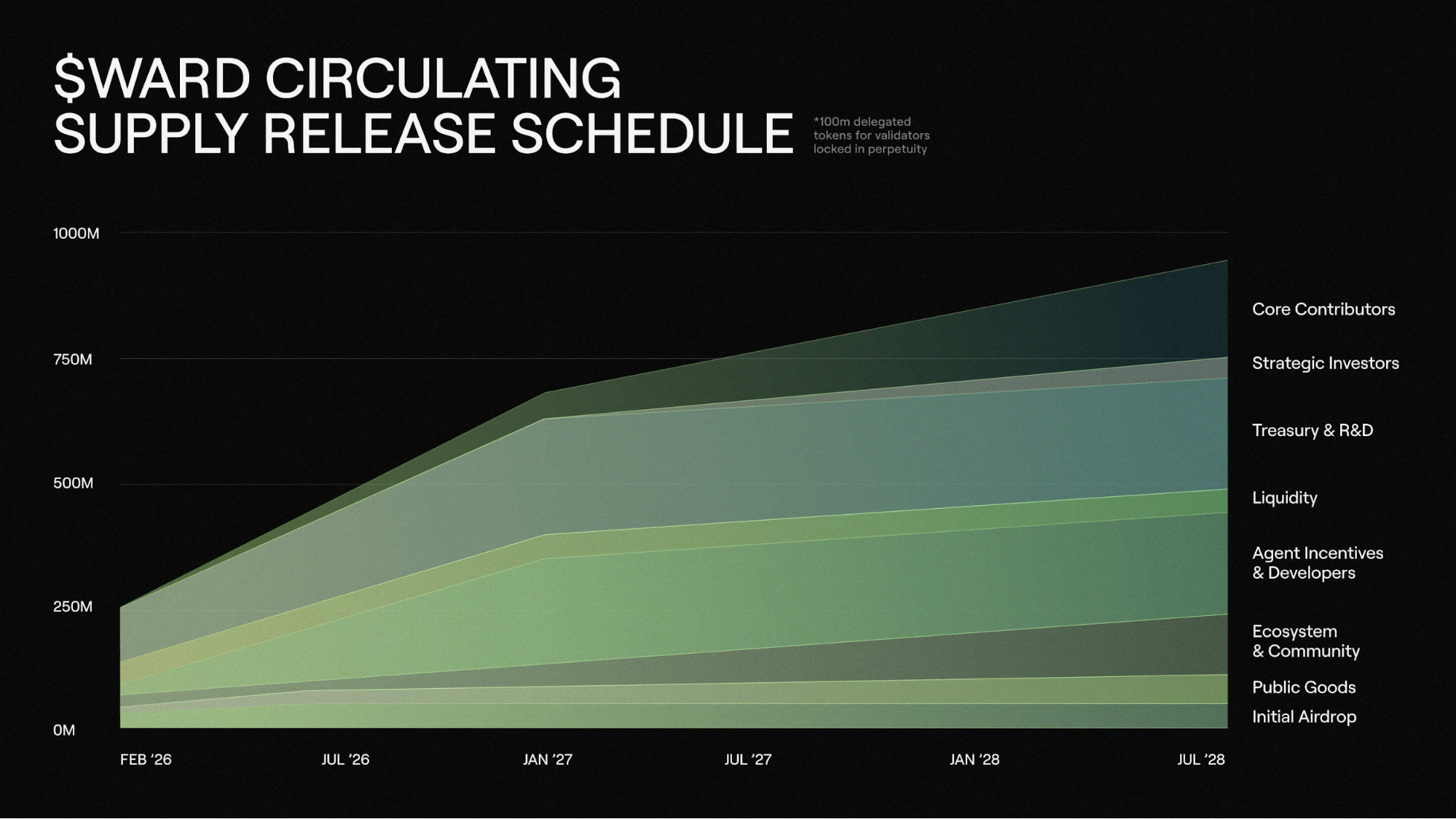
Structurally, WARD is designed for a protocol-layer long-term operational model rather than a short-term liquidity model. Its value derives primarily from sustained demand for the Warden Protocol Intent network.
What Limitations Does WARD's Token Model Face?
Intent networks require significant execution collaboration, so WARD's utility is tied to the size of the Solver network and overall ecosystem activity. AI Agent automated execution also depends on stable on-chain demand.
If Warden Protocol lacks sufficient application integration, network demand for WARD could decline. Insufficient Intent execution volume would also reduce the effectiveness of Solver incentives.
Multi-chain collaboration involves complex verification processes, so Warden Protocol must continuously improve execution efficiency and security. AI Agent automation also introduces permission control and error execution risks.
Summary
WARD is the core protocol-layer token of Warden Protocol, handling governance, Solver incentives, network security, and AI Agent execution collaboration.
Compared to traditional public chain tokens, WARD emphasizes Intent execution and automated network coordination. Warden Protocol leverages WARD to support the Solver network, multi-chain interactions, and the long-term health of the AI Agent automated execution ecosystem.
FAQ
What is the role of WARD?
WARD is primarily used for Warden Protocol network governance, Solver incentives, network security, and AI Agent automated execution collaboration.
What is the total supply of WARD?
Official documents state that the total supply of WARD is 1 billion tokens, allocated for the community ecosystem, protocol operations, and network incentives.
How does WARD support the AI Agent network?
WARD incentivizes the Solver network to execute Intent requests, enabling AI Agents to automatically handle on-chain tasks and cross-chain interactions.
How is WARD different from traditional public chain tokens?
Traditional public chain tokens mainly cover Gas and governance, whereas WARD focuses on Intent execution, Solver collaboration, and the AI Agent automation network.
Why does the Solver network need WARD?
The Solver network needs WARD as execution incentives to continuously process on-chain Intent requests and automated tasks.
How does WARD participate in governance?
WARD holders can vote on-chain and submit governance proposals to influence Warden Protocol upgrades and ecosystem coordination.







