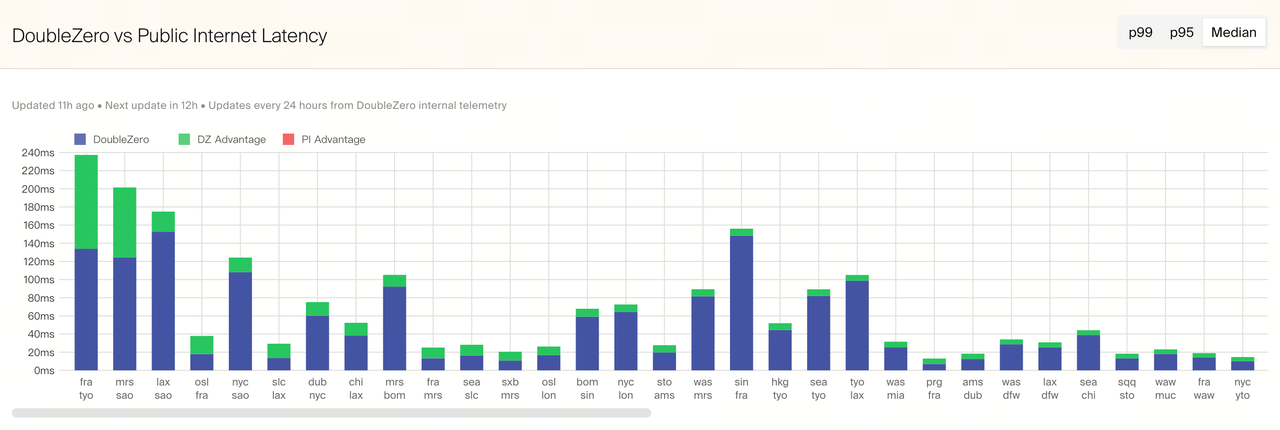
As blockchain networks continue to scale, communication efficiency between nodes has become a growing performance bottleneck. The limitations of the public internet in latency, congestion, and security make it difficult for validators to exchange data fast enough to support high-frequency trading and real-time applications, especially in scenarios like DeFi and blockchain gaming.
Against this backdrop, DoubleZero leverages a DePIN model to integrate global private fiber resources, creating a high-performance communication network independent of the public internet. As a foundational infrastructure layer, it optimizes data transmission paths through task scheduling and verification mechanisms. This positions it as a key player in the DePIN space and supports the expansion of Web3 applications at scale.
The Importance of Decentralized Task Scheduling and Verification
In decentralized networks, efficiently allocating resources while ensuring trustworthy execution is a core design challenge. Task scheduling determines how data flows between nodes, while verification mechanisms ensure that data is neither tampered with nor falsified during transmission and processing.
DoubleZero uses a decentralized scheduling system to dynamically assign tasks based on node performance, avoiding single points of failure common in centralized systems. At the same time, on-chain verification continuously audits node behavior in real time, preventing cheating and inefficiencies. This combination of scheduling and verification is key to achieving both low latency and high reliability.
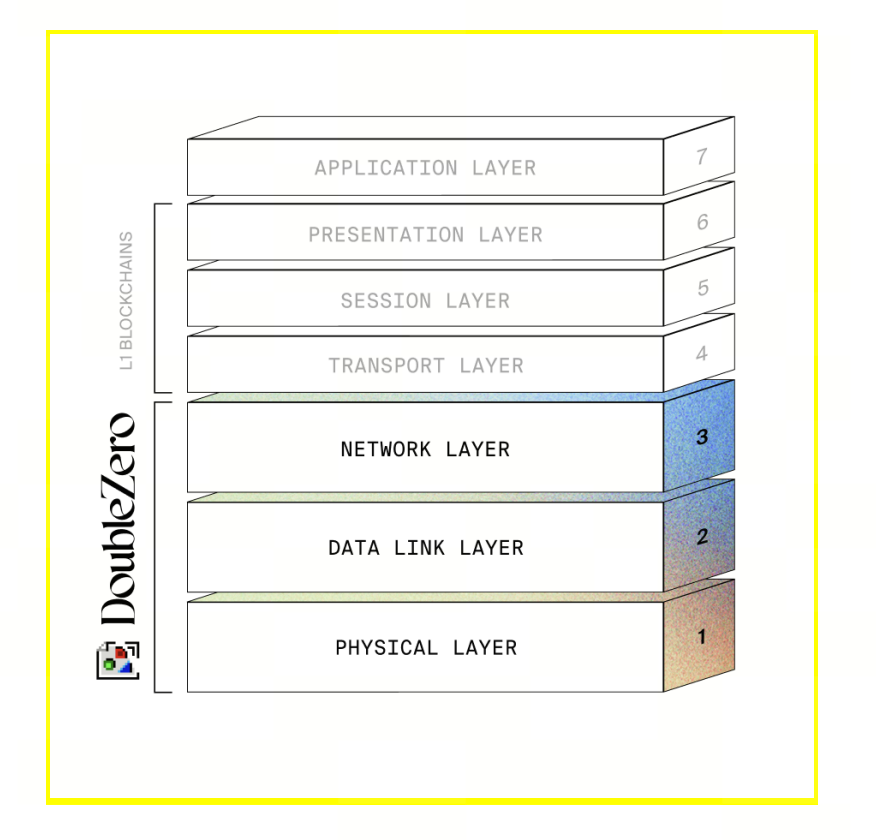
DoubleZero’s Position in the Stack
DoubleZero focuses on the infrastructure layer of DePIN networks, with a core goal of optimizing data transmission rather than computation itself. Unlike GPU rendering or compute-focused networks, it prioritizes communication efficiency, improving overall system performance through edge filtering and dedicated bandwidth.
This positioning makes it a foundational accelerator for blockchain networks, particularly suited for consensus optimization, real-time data synchronization, and high-frequency interaction scenarios. It holds unique value within the DePIN ecosystem.
Who Are the Core Participants in the DoubleZero Network?
The DoubleZero network is composed of multiple roles, each responsible for different functions and coordinated through token-based incentives.
Bandwidth providers deploy dedicated hardware and supply fiber links, forming the backbone of network transmission capacity. Compute contributors run software to handle monitoring and data feedback. Validator nodes connect to the network to enhance blockchain consensus efficiency, while developers integrate network services via APIs for specific applications.
Together, these roles form a distributed collaborative system that enables continuous scaling while maintaining high performance.
A Detailed Look at DoubleZero’s Task Scheduling Mechanism
DoubleZero’s task scheduling is driven by on-chain smart contracts and implemented through multiple layers of software components. The system first converts on-chain data into routing rules via a controller, after which daemon processes manage network tunnels and data transmission paths.
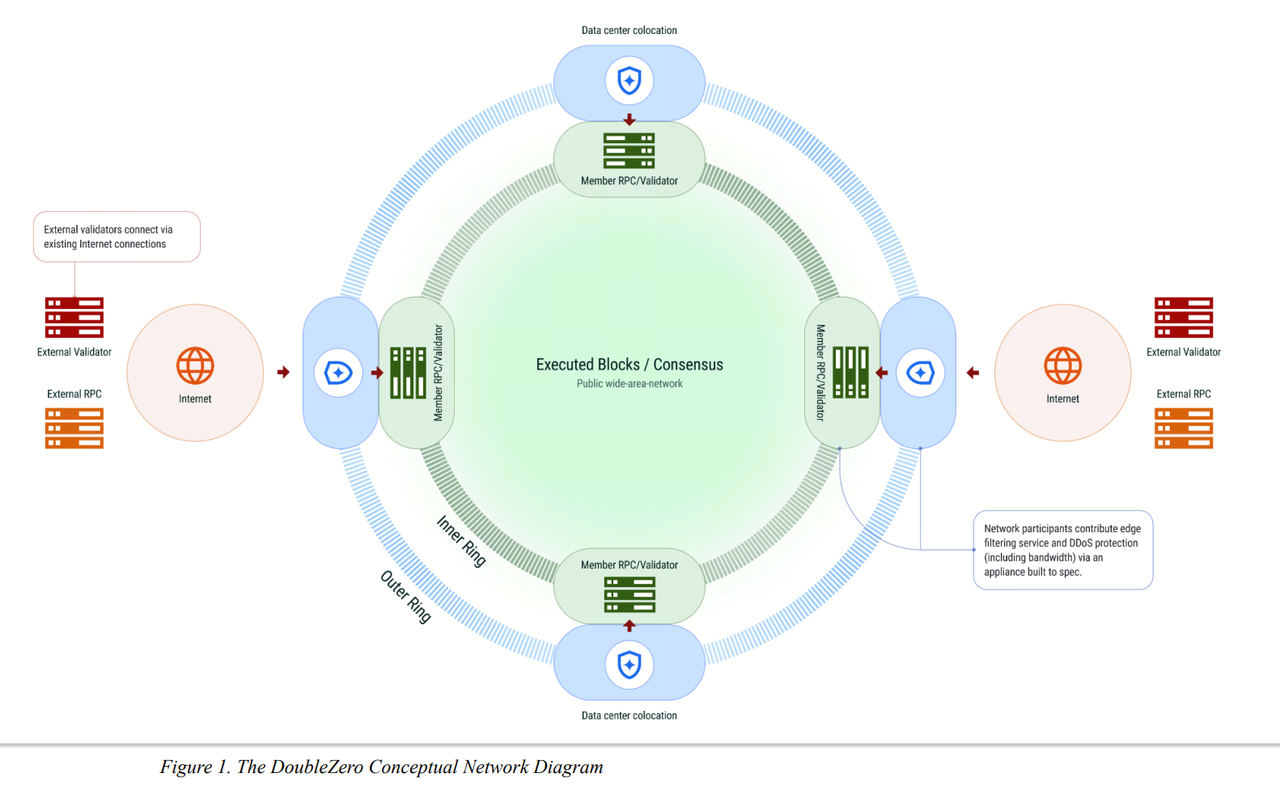 Image source: DoubleZero Whitepaper
During execution, the scheduling system dynamically selects optimal paths based on real-time network conditions, prioritizing links with higher performance and lower latency. At the same time, it evaluates node contributions, for example using marginal contribution models, to ensure fair and efficient resource allocation.
This approach allows the network to continuously optimize routing in complex environments, improving overall performance over time.
The Task Execution Flow in DoubleZero
The operation of DoubleZero can be broken down into several stages. First, users or systems submit data transmission or communication tasks. The data then enters the network’s ingress layer, where FPGA hardware filters it and verifies signatures to ensure validity.
Next, the verified data is transmitted through the inner-ring dedicated fiber network, reaching the target node via the most efficient route. After processing at consensus nodes, performance data is fed back to the on-chain system for settlement and further optimization.
This process forms a closed loop, allowing tasks to be executed efficiently while continuously improving network performance.
DoubleZero’s Computation Verification Mechanism
DoubleZero combines hardware and on-chain logic to provide multi-layered security. At the ingress layer, FPGA hardware filters duplicate data, detects malicious traffic, and verifies signatures, ensuring data integrity at the source.
On-chain, smart contracts continuously monitor node performance metrics such as latency and throughput. If a link fails to meet required standards, the system automatically reduces its weight or isolates it, maintaining overall network stability and reliability.
This hybrid model, combining hardware and smart contracts, strikes a balance between security and efficiency.
Incentive and Penalty Mechanisms in DoubleZero
To maintain high network performance, DoubleZero introduces a performance-based incentive system. Rewards are directly tied to the quality of service provided, with low-latency and highly stable links earning higher returns.
From an economic perspective, user fees translate into token demand, while mechanisms such as token burning or locking may enhance value. Meanwhile, nodes are required to stake tokens to guarantee service reliability.
Nodes that underperform or behave abnormally are penalized through reduced rewards, slashed stakes, or removal from participation, ensuring overall network quality.
How DoubleZero’s Core Mechanisms Work Together
DoubleZero’s high performance comes from the coordination of multiple layers of mechanisms. The dual-ring architecture separates filtering from transmission, ensuring both security and efficiency. Task scheduling dynamically optimizes routing, improving resource utilization. Verification mechanisms ensure data and behavior integrity, while incentives motivate participants to continuously improve performance.
Together, these components form a closed loop that links resource contribution, task scheduling, execution, validation, and reward distribution. This continuous feedback cycle steadily enhances network efficiency. According to available data, the system can improve blockchain communication and consensus efficiency by approximately 77 percent.
Conclusion
By deeply integrating hardware, software, and on-chain mechanisms, DoubleZero builds an efficient and trustworthy decentralized communication network. Its core strength lies in optimizing data transmission paths through task scheduling and verification, overcoming the limitations of the public internet.
As Web3 applications increasingly demand low latency and high throughput, DoubleZero is well positioned to become critical infrastructure, providing stronger performance support for blockchain networks.
FAQs
How does DoubleZero work?
It operates through a complete process that includes task scheduling, data filtering, fiber transmission, result verification, and reward settlement.
What are DoubleZero’s core technologies?
Dual-ring architecture, FPGA-based filtering, and on-chain verification mechanisms.
Why is decentralized scheduling necessary?
It prevents single points of failure and improves the efficiency of resource allocation.
How does DoubleZero ensure data security?
Through a combination of hardware-level filtering and on-chain smart contract verification.
Primarily from its low latency, under 10ms, and significantly improved communication efficiency.