Summary
In April 2025, the Trump administration announced the launch of a “reciprocal tariff” policy, imposing a uniform 10% “minimum benchmark tariff” on global trade partners, which triggered severe fluctuations in global risk assets.
● Bitcoin, as the main public chain adopting the PoW (Proof of Work) mechanism, relies on physical mining machines for mining. These mining machines are not on the list of tariff exemptions in the United States, which puts significant cost pressure on mining companies.
● The decline in the mining machine manufacturers has been most noticeable in the past month, primarily due to the impact of tariff policies on both the supply and demand sides of mining machine manufacturing.
● The self-operated mining farms are mainly influenced by the supply side, and the business process of selling Bitcoin to cryptocurrency exchanges is less affected by tariff policies.
● Cloud mining farms are relatively less affected by tariff policies, as the essence of cloud mining is to pass on the cost of purchasing mining machines to customers through computing power service fees. Therefore, the erosion of platform profits is significantly less than that of traditional mining models.
●Although the tariff policy has hit Bitcoin mining in the United States, Bitcoin spot ETF funds represented by BlackRock’s IBIT and Bitcoin-holding companies represented by MicroStrategy still hold the pricing power of Bitcoin.
● The price of Bitcoin is no longer the only indicator; policy trends, geopolitical security, energy scheduling, and manufacturing stability are the true keys to survival in mining.
Keywords: Gate Research, tariffs, Bitcoin, Bitcoin mining
Preface
On April 2, the Trump administration announced the launch of a “reciprocal tariff” policy, imposing a 10% “minimum baseline tariff” on global trade partners and adding “personalized” high tariffs on countries with significant trade deficits. This policy triggered severe fluctuations in global risk assets, with the S&P 500 and Nasdaq both experiencing their largest single-day declines since March 2020; the cryptocurrency sector also saw a significant decrease in assets. Following Trump’s announcement of the tariff policy, China announced retaliatory tariffs of 84% on the U.S., while the European Union imposed a 25% tariff on $21 billion worth of U.S. goods, resulting in a total market value loss of over $1 trillion in the global stock market within a week.
On April 9, the tariff policy reversed, with Trump announcing a 90-day suspension of tariffs on 75 countries excluding China, while the EU simultaneously suspended tariffs and began negotiations with the US. On the same day, the S&P 500 rose by 9.51%, the Nasdaq increased by 12.02%, Bitcoin’s price rebounded by 8.19% to $82,500, and Ethereum’s price recovered to $1,650.
In the numerous tracks of crypto assets, Bitcoin mining has become one of the on-chain economic modules most directly affected by tariff policies due to its strong reliance on hardware, wide global supply chain span, and high capital intensity. The global trade friction caused by U.S. reciprocal tariffs poses multiple impacts on the crypto mining industry. Since most Bitcoin mining machines are manufactured in China, the U.S.-China trade war will raise the import costs of mining machines, with China’s export tax rate to the U.S. rising to 145%, which will compress North American mining expansion plans; the depreciation of the RMB exacerbates the dollar debt pressure on Chinese mining companies, combined with fluctuations in electricity and energy prices, leading to a continuous rise in operating costs. At the same time, the volatility of coin prices also affects miner income, with Bitcoin’s price retracting from $82,500 before the tariff announcement to below $75,000.
At the macro level, the Fed’s stagflation fears and risk aversion were superimposed, high 10-year Treasury yields dampened risk appetite, financing conditions tightened, and miners’ stock prices fell in tandem with the technology sector. In the context of geopolitical tensions, the global mining layout is facing restructuring, and enterprises may accelerate the transfer to tariff-friendly regions such as Southeast Asia and the Middle East. In the short term, policy uncertainty will continue to amplify the risk of Bitcoin mining, and the industry may enter a new round of reshuffle.
1. Bitcoin mining is facing a direct impact from tariff policies, with most related companies’ stock prices falling more than the NASDAQ 100 index.
Bitcoin, as the main public chain adopting the PoW (Proof of Work) mechanism, is also the highest market value cryptocurrency, widely regarded as “digital gold.” Since the PoW mechanism relies on physical mining machines for mining, and mining machines and their upstream key components such as semiconductors are not on the tariff exemption list, related mining enterprises therefore face significant cost pressure. The upstream impact brought by tariff policies may indirectly affect the medium to long-term trend of Bitcoin prices through cost transmission mechanisms.
The main ecology of Bitcoin mining includes mining machines, self-operated mining farms, and cloud computing power mining farms. Mining machinery companies include Bitmain, Canaan Technology (NASDAQ: CAN), Bitmicro, Ebang International (NASDAQ: EBON), etc. Several of the company’s main factories are located in Chinese mainland. Among them, Bitmain occupies a major share of the mining machine market (its market share is more than 70% disclosed in the 2018 prospectus).
Self-operated mining companies include Marathon Digital ( NASDAQ: MARA ), Riot Platform ( NASDAQ: RIOT ), Cleanspark ( NASDAQ: CLSK ), and many others. The self-operated mining companies listed on NASDAQ are headquartered in the United States, but their mining sites are distributed across multiple countries including the United States, UAE, and Paraguay. Marathon owns the largest mining site in the world, with a total hash rate exceeding 54EH/s, accounting for about 6% of the current total network hash rate.
Major companies in the cloud mining industry include Antpool, Bitdeer(NASDAQ: BTDR), BitFufu(NASDAQ:BFBF), Ecos, and others. Unlike self-operated mining farms, cloud mining farms sell the computing power required for mining to individual or institutional clients, thereby partially transferring the risk of Bitcoin price fluctuations to the clients. The platform itself focuses on site selection, construction, and daily operations of the mining farms. Bitdeer has a portion of self-operated mining farms and a portion of cloud mining business. BitFufu only has cloud mining business.
Affected by Trump’s tariff policy, the stock prices of companies related to Bitcoin mining have declined, with losses exceeding the NASDAQ 100 index. Using Yahoo’s yfinance database, the author has gathered the closing prices of 8 Bitcoin mining-related companies over the past month, along with the NASDAQ 100 index as a reference standard. On April 2, when Trump announced the tariff policy, the stock prices of Bitcoin mining-related companies all dropped significantly, while on April 9, after Trump announced a 90-day delay in implementing the tariff policy, the stock prices of Bitcoin mining-related companies showed a noticeable rebound.
After standardization, since the announcement of the tariff policy on April 2, mining machines have been the most significantly declining sector in Bitcoin mining, with Canaan Creative down over 17% and Ebang International down over 11%. Next is the self-operated mining farm sector, with Core Scientific leading the decline, falling over 10% in the past month; Marathon has only dropped 0.8%, the lowest in this sector. Finally, cloud computing mining farms are less affected, with BitFufu only down 5.9%. The NASDAQ100 index, used as a benchmark, has fallen by 2.2%.
Table 1: Performance of Bitcoin Mining Companies vs. Nasdaq 100 Index (NDX) Over the Past Month

2. Analysis of the Impact of Tariff Policies on Various Segments of Bitcoin Mining
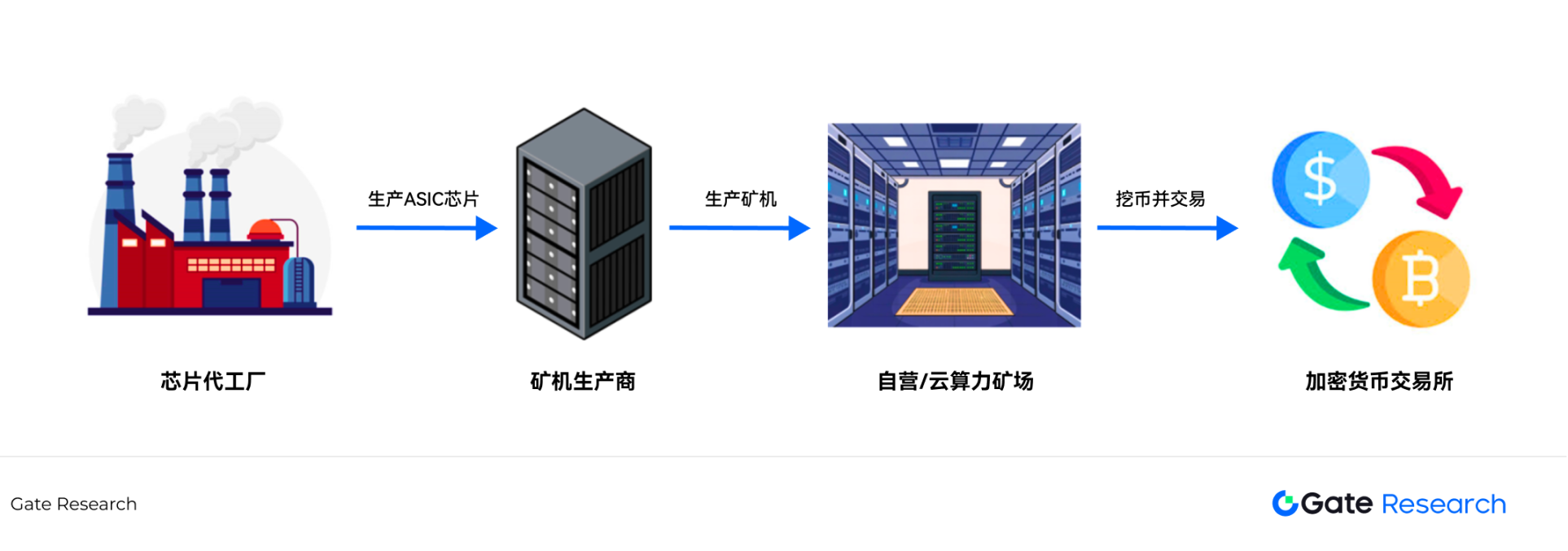
After Trump announced the tariff policy, companies related to Bitcoin mining experienced varying degrees of decline. However, as mentioned above, the stock price performance of different sub-sectors also showed a certain degree of differentiation. The core reason for this is that various links in the Bitcoin mining supply chain are affected by tariffs of different levels.
Figure 1: Core Supply Chain of Bitcoin Mining
2.1 Mining Machine Manufacturers
From the stock price performance, the decline of mining machine manufacturers in the past month has been the most significant, primarily due to the impact of tariff policies on both the supply and demand sides of mining machine manufacturing. The upstream of mining machine production includes foundries such as TSMC, Samsung, and SMIC. Mining machine companies first independently complete the IC design of ASIC chips, then deliver the blueprints to foundries for wafer fabrication. Once the wafer fabrication is successful, the foundries will mass-produce the ASIC chips, and the mining machine companies will receive the chips and package them into mining machines.
TSMC has a 64.9% market share in the chip foundry sector[1], and the Trump administration has asked TSMC to build factories in the United States or face tariffs of more than 100% on it[2]. Foundries such as SMIC, Hua Hong Semiconductor, and Samsung are also under high tariff pressure from the United States. Foundries have only two options: paying tariffs and reducing orders from the United States, either of which will cause the foundry’s profits to fall. This part of the pressure may be transferred to downstream mining machine manufacturers, making producers pay higher prices to improve the gross margin of foundry orders.
From the demand side, due to the registration locations of companies like Bitmain, Canaan Creative, and Bitmicro being in China, American mining farms such as Marathon, Riot, and Cleanspark have to bear high tariffs when purchasing mining machines, resulting in higher costs. Therefore, in the short term, there will be a noticeable shrinkage in mining machine orders. Taking Bitmain’s flagship model Antminer S21 Pro and Canaan Creative’s flagship model Avalon A15 Pro as examples. Before the tariff policy is implemented, without considering operating costs, assuming the electricity cost is $0.043/KWH (Cleanspark’s electricity cost in 2024)【3】, with the total network hashrate at 850EH/s【4】, and the depreciation period of mining machines being 30 months【5】, currently the cost of mining one Bitcoin with the S21 Pro is $68,367, while the cost with the A15 Pro is $75,801.
Table 2: Mainstream Mining Machine Parameters for Bitcoin Mining

Mining cost = Total cost / Cumulative amount of coins mined
Once the tariff policy is implemented, in an optimistic scenario, the selling price of exported mining machines will increase by 30% from the original basis, making the cost for mining 1 Bitcoin with the S21 Pro $80,105, and with the A15 Pro $88,717. In a pessimistic scenario, if the selling price of exported mining machines increases by 70% from the original basis, the cost for mining 1 Bitcoin with the S21 Pro will be $95,756, and with the A15 Pro $105,938.
Table 3: Mining Costs of Mining Machines Under Different Tariff Scenarios
![The impact of tariff policies on Bitcoin mining: An in-depth analysis of cost and supply chain disruptions])https://img.gateio.im/social/moments-b4122c46720e1ec56e3453712feea0c6(
The above price does not take into account the complex operating costs of the mining site, which include site rental costs and personnel costs. If these costs are included, the cost of mining will further increase. A significant increase in tariffs will impose higher mining costs on the mining sites, and a weakening on the demand side will also have a considerable impact on upstream mining machine manufacturers.
From a long-term perspective, mining machine manufacturers may prioritize capacity layout in regions with favorable tariff policies. By implementing a global capacity allocation strategy, they can effectively avoid potential tariff policy risks and achieve supply chain cost optimization.
)# 2.2 Self-operated mining farm
Compared to mining machine manufacturers being squeezed by both supply and demand sides, self-operated mining farms are mainly affected by the supply side. The business process of selling Bitcoin to cryptocurrency exchanges is less influenced by tariff policies. Bitcoin prices are affected by tariff policies and policies that deter capital from uncertainty, leading to a short-term capital outflow and a significant drop in Bitcoin. However, self-operated mining farms represented by Marathon, with sufficient cash flow, tend to adopt a coin hoarding strategy instead of immediately selling Bitcoin on exchanges after mining. Similar to MicroStrategy’s strategy of borrowing to buy coins, Marathon has issued convertible bonds multiple times to directly purchase Bitcoin. Therefore, large mining farms are relatively less affected by the drop in Bitcoin prices.
For small mining operations with tight cash flow, the decline in Bitcoin prices has a particularly significant impact on their stock prices. Due to limited funds, these mining operations often cannot hold onto the Bitcoin they mine for the long term and must sell it immediately after mining to maintain operational capital. During market downturns, this “mine and sell” strategy can exacerbate selling pressure in the market, further affecting Bitcoin price trends. As shown in the figure below, Cipher and Hive held 1,034 and 2,201 Bitcoins respectively in March 2025, down 40% and 3% year-on-year; while Marathon and Riot held 47,531 and 19,223 Bitcoins respectively in March 2025, up 173% and 126% year-on-year.
Table 4: Changes in the number of coins held by self-operated mining companies (from January 2024 to March 2025)
![The Impact of Tariff Policies on Bitcoin Mining: An In-Depth Analysis of Costs and Supply Chain Disruptions]###https://img.gateio.im/social/moments-cf94c2da2a0be7a72af4971bf22e3a36(
In the past month, the stock price fluctuations of small and medium-sized self-operated mining farms Cipher and Hive Digital have been -7.1% and -5.5%, respectively, with the decline in stock prices significantly exceeding that of large mining farms like Marathon that adhere to a coin hoarding strategy.
However, in the long term, the depreciation cycle for mining equipment is typically 2.5 to 3 years, which means that self-operated mines need to make ongoing capital expenditures (CAPEX) to purchase new mining rigs to replace older equipment. Although different mining companies use different statistical calibers when disclosing computing power data (such as monthly average computing power, power-on computing power, month-end computing power, etc.), it is difficult to directly compare computing power indicators between different companies. From January 2024 to March 2025, the computing power data disclosed by mainstream listed mining companies shows that their computing power growth rate generally exceeds 70%. The core driver of the continuous growth of computing power lies in “relative competitiveness”: in the context of the continuous increase in computing power of the whole network, if the computing power of the mining farm itself does not increase, the amount of bitcoin it can mine will continue to decline. Bitcoin mining is a dynamic game, and the expansion of computing power is like sailing against the current, and if you don’t advance, you will retreat.
In this context, if the tax policy for mining machinery is officially implemented, the cost pressure on upstream mining machine manufacturers will inevitably be passed on to downstream mining farms, further pushing up the marginal production costs in the industry and posing challenges to the profitability of medium-sized mining farms.
)# 2.3 Cloud Computing Power Mining Farm
Cloud mining farms are essentially a rental model, with upstream being the mining machine manufacturers and downstream being individual and institutional clients. Cloud mining farms do not hold or sell coins; instead, they package computing power for 30 days, 60 days, or 90 days to sell to clients, who will choose to hoard or sell coins based on their own judgment. Therefore, cloud mining farms primarily earn service fees paid by clients and do not directly bear the profits or losses resulting from Bitcoin price fluctuations.
The core competitiveness of cloud computing power mining farms lies in reducing leasing, electricity and labor costs through site optimization, while maintaining a high degree of flexibility in computing power deployment to cope with market fluctuations - the need to quickly expand mining machines and sites to meet customer needs in a bull market, and the need to streamline operations and convert redundant computing power to self-mining in a bear market, this dynamic balance ability directly determines the company’s market competitiveness.
The revenue of cloud computing power companies is mainly driven by the computing power of the whole network, and when the computing power of the whole network rises, it proves that most miners are still optimistic about the price of Bitcoin in the future, or more customers choose to buy cloud computing power; When the computing power of the whole network decreases, it means that miners are not optimistic about the trend of Bitcoin price, and the part of the cloud computing power in the computing power of the whole network will also decrease. The data in the figure below shows that after Trump announced the tariff policy on April 2, Bitcoin’s average daily computing power even hit a record high on April 5, exceeding 1 ZH/s for the first time. 【12】
Figure 2: Bitcoin Network Hash Rate Changes (January 2025 to April 2025)
![The impact of cost and supply chain disturbances, a deep dive into the tariff policies affecting Bitcoin mining]###https://img.gateio.im/social/moments-cd8a5d398c280b5518fbefdcfd191b6d(
From the perspective of costs, although the price of mining machines is under upward pressure due to the transmission of tariff policies, the leasing business model of cloud computing power mining farms inherently possesses a risk buffering mechanism—essentially, it passes on the cost of purchasing mining machines to customers through computing power service fees, and some customers directly share the hardware investment through mining machine hosting agreements, making the erosion of platform profits by the premium of mining machines significantly weaker than in traditional mining models. This characteristic of cost transfer and sharing makes cloud computing power mining farms a field less impacted by the tariff policies of the Trump administration.
) 3. The reshaping of the Bitcoin mining landscape and its impact on Bitcoin prices
The recent imposition of tariffs by the United States on Bitcoin mining equipment imported from China and other countries has significantly increased the operational costs for U.S. miners. This creates greater potential opportunities for non-U.S. companies to enter the Bitcoin mining industry, as they can procure Chinese-made mining machines from other countries at a lower cost, thus gaining a cost advantage. Although U.S. mining facilities can mitigate some of the tariff impacts by establishing operational bases overseas, it is undeniable that these tariff policies have increased the operational costs and policy risks for domestic mining operations.
According to the above deduction, the daily Bitcoin output is 450 coins, and the mining of Bitcoin will become more decentralized, with the influence of American mining companies such as Marathon, Riot, and Cleanspark possibly declining. Due to the past stockpiling strategies adopted by large mining companies like Marathon, and the unclear holding attitudes of enterprises from other countries potentially entering the mining industry towards Bitcoin, they may choose a “mine-sell” strategy (immediately withdrawing and selling Bitcoin after mining it on exchanges). From this perspective, high tariff policies are generally bearish for Bitcoin price trends. Some mining farms leaving the United States also contradicts what Trump once proposed - ensuring that all remaining Bitcoins achieve “Made in America”.
However, in the long term, the core logic of Bitcoin underwent a fundamental change in 2024. Bitcoin spot ETF funds represented by BlackRock’s IBIT, and Bitcoin-holding companies represented by MicroStrategy still hold the pricing power of Bitcoin. As of April 2025, IBIT holds 570,983 Bitcoins【13】, and MicroStrategy holds 528,185 Bitcoins【14】. The Bitcoin holdings of both continue to increase as a percentage of the total circulating supply of Bitcoin【15】, and their purchasing power is sufficient to absorb the daily production of newly minted Bitcoins.
Table 5: MicroStrategy and IBIT’s Bitcoin Holdings and Proportions
![The impact of cost and supply chain disruptions, a deep dive into the effects of tariff policies on Bitcoin mining]###https://img.gateio.im/social/moments-fad5c041a97646861c236e0b18173097(
) Summary
The Trump administration’s promotion of a “reciprocal tariff” policy poses a dual challenge to the Bitcoin mining industry in terms of upstream costs and geopolitical layout. Mining machine manufacturers are under the most pressure due to constraints on the supply chain and reduced demand, while self-operated mines face the dual squeeze of rising costs and increased capital expenditures. In contrast, cloud computing mines have relative buffering capability due to the “risk transfer” mechanism. Overall, the pace of mining expansion in North America may be limited, with global computing power further dispersing towards low-tariff regions such as Southeast Asia and the Middle East, potentially leading to a temporary decline in the voice of U.S. mining companies within the Bitcoin ecosystem.
Mining enterprises often invest heavily, have long cycles, and possess weak risk resistance; the Bitcoin network itself cannot actively adjust these risks, as its mechanism is “open, fair, and competitive,” rather than “defensive, adaptive, and regulatory.” This creates a structural contradiction: the most decentralized asset globally has an industrial chain that is one of the most easily influenced by centralized policy interventions. Therefore, mining participants must reevaluate the importance of policy. The price of Bitcoin is no longer the only indicator; policy trends, geopolitical security, energy dispatch, and manufacturing stability are the true keys to survival in mining.
In the short term, the rising cost of mining combined with some miners’ “mining, withdrawing, and selling” behavior may constitute marginal bearish pressure on Bitcoin prices. However, in the medium to long term, institutional forces represented by BlackRock’s IBIT and MicroStrategy have become the dominant power in the market, and their sustained buying ability is expected to hedge supply pressure and stabilize market structure. Bitcoin mining is currently at a critical period of policy reshaping and structural transition, and global investors need to closely monitor the policy evolution and the rebalancing of the industrial chain brought about by computing power migration.
Data Source
- Patent PC,
2.Reuters,
- Cleanspark,
4.Bitinfocharts,
5.CoinShares Research,
-
Bitmain,
-
Canaan,
-
Marathon Digital,
-
Riot Platform,
-
Cipher,
-
Hive Digital
-
Bitinforcharts,#3m
-
iShares,
-
Bitbo,
-
Financial M Square Bitcoin Mining Core Supply Chain


