Key Points:* U.S. court reinstates Trump’s tariffs during appeal process.
- Economic uncertainties and trade implications arise.
- Legal challenges continue amid political controversy.
The U.S. Court of Appeals temporarily reinstated Trump’s “Liberation Day” tariffs on June 2, 2025, while legal challenges continue over their legality.
This pause in the ruling affects economic stability, prompting concerns over U.S. trade policy responsiveness to individual decisions instead of structured regulations.
Court Reinstates Tariffs Amidst Ongoing Legal Disputes
The U.S. Court of Appeals reinstated President Trump’s tariffs, counteracting a prior decision that blocked them. Originally halted by the CIT, the tariffs are back in place as legal proceedings progress.
The continuation of tariffs affects economic conditions, as concerns over higher consumer costs and potential job losses arise. Analysts argue this could slow growth in certain sectors.
A spokesperson from the U.S. Court of Appeals for the Federal Circuit noted, “This administrative stay will remain in effect until further notice while this court considers the motions papers.”
Statements from political figures highlight the ongoing debate. The Trump administration criticized the initial ruling, calling it “politicized.” The U.S. Supreme Court’s potential involvement remains uncertain.
Economic Effects and Market Response Amid Tariff Reimplementation
Did you know? Prior to this event, the U.S. Court of International Trade set a precedent by blocking tariffs imposed under national emergency claims, marking a pivotal legal stance on economic powers.
As of June 2, 2025, Bitcoin (BTC) stands at $105,539.25, with a market cap of $2.10 trillion. Despite a 0.96% rise in 24 hours, its 7-day performance declined by 3.15%, indicating market fluctuations. Data sourced from CoinMarketCap.
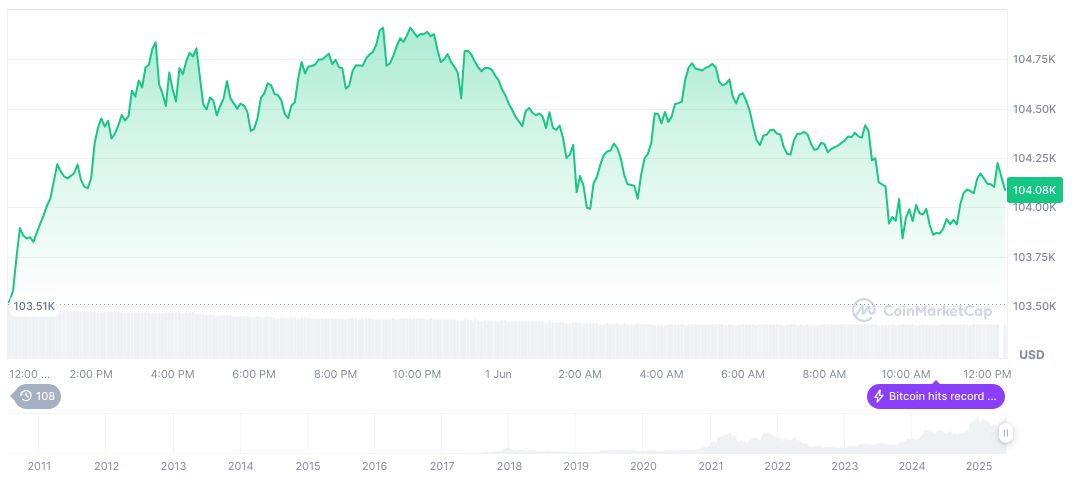 Bitcoin(BTC), daily chart, screenshot on CoinMarketCap at 00:22 UTC on June 2, 2025. Source: CoinMarketCap
The Coincu research team suggests that Trump’s tariffs might influence global trade strategies. Historical data reveals increased market volatility during tariff disputes, stressing the need for durable policies to stabilize economic activities.
Bitcoin(BTC), daily chart, screenshot on CoinMarketCap at 00:22 UTC on June 2, 2025. Source: CoinMarketCap
The Coincu research team suggests that Trump’s tariffs might influence global trade strategies. Historical data reveals increased market volatility during tariff disputes, stressing the need for durable policies to stabilize economic activities.
Disclaimer: The information on this page may come from third parties and does not represent the views or opinions of Gate. The content displayed on this page is for reference only and does not constitute any financial, investment, or legal advice. Gate does not guarantee the accuracy or completeness of the information and shall not be liable for any losses arising from the use of this information. Virtual asset investments carry high risks and are subject to significant price volatility. You may lose all of your invested principal. Please fully understand the relevant risks and make prudent decisions based on your own financial situation and risk tolerance. For details, please refer to
Disclaimer.


