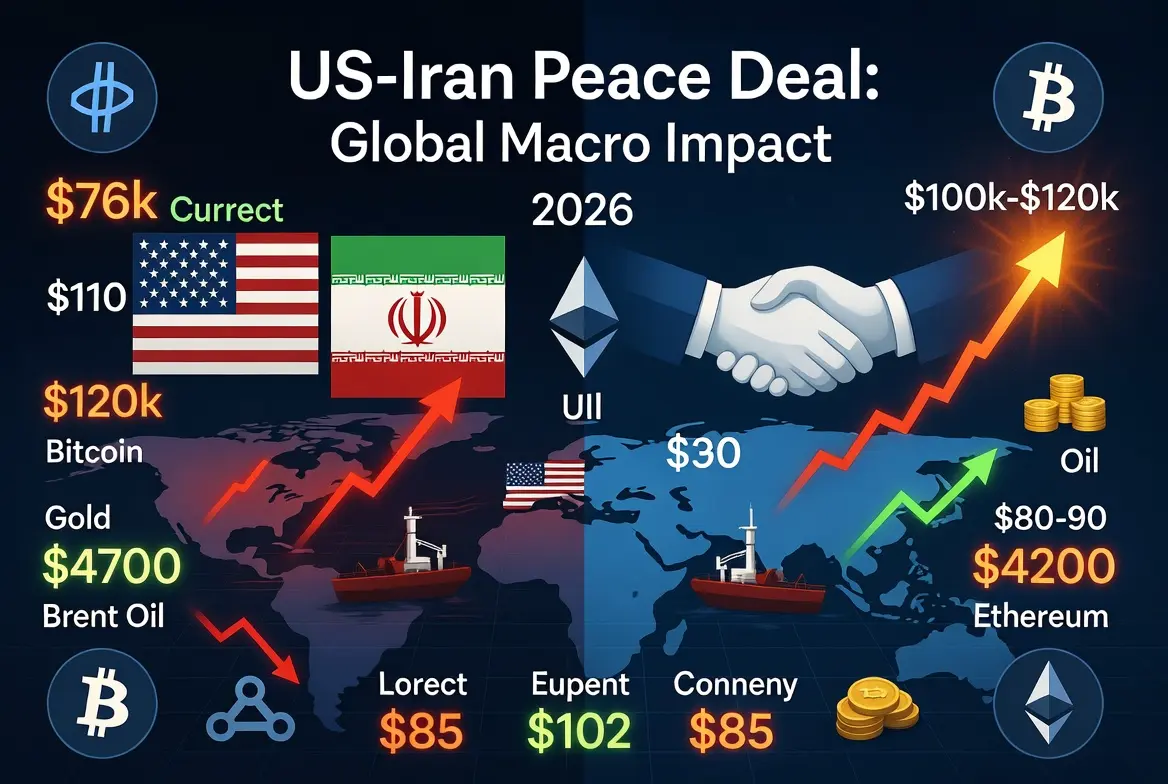
#USIranDraftDeal
The proposed US-Iran draft agreement has become the most important geopolitical and macroeconomic development of 2026 because it directly affects global oil supply, inflation trends, Federal Reserve policy expectations, safe-haven demand, shipping logistics, crypto market liquidity, and overall investor sentiment across nearly every major financial market. Since the military conflict erupted on February 28, 2026 following coordinated US and Israeli strikes on Iran, markets have experienced extreme volatility driven by fears surrounding the closure of the Strait of Hormuz, the narrow but critically important waterway responsible for nearly 20% of global oil transportation. The conflict transformed energy markets almost overnight, created severe inflation pressure worldwide, disrupted global shipping routes, triggered supply-chain instability, and forced traders to rapidly reposition across commodities, equities, currencies, and digital assets.
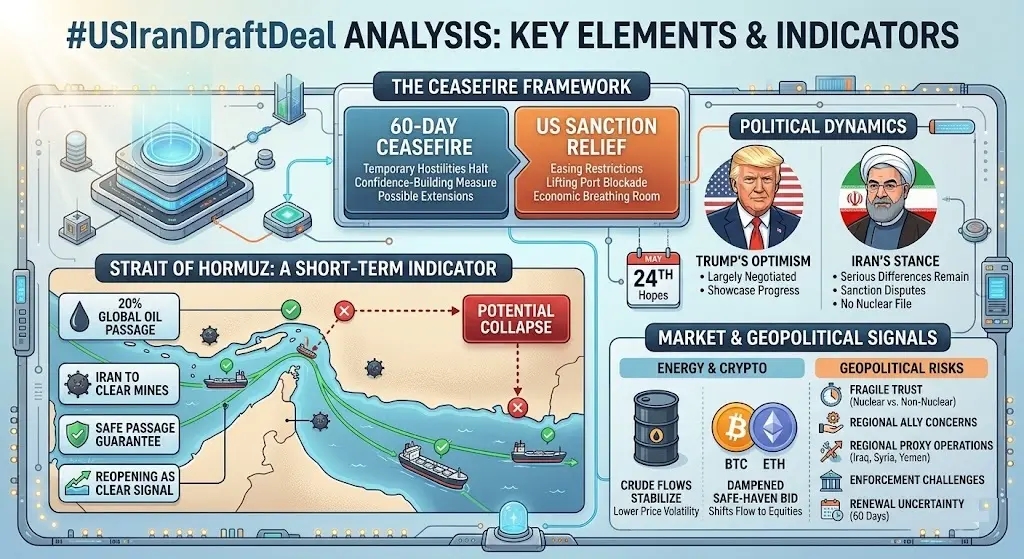
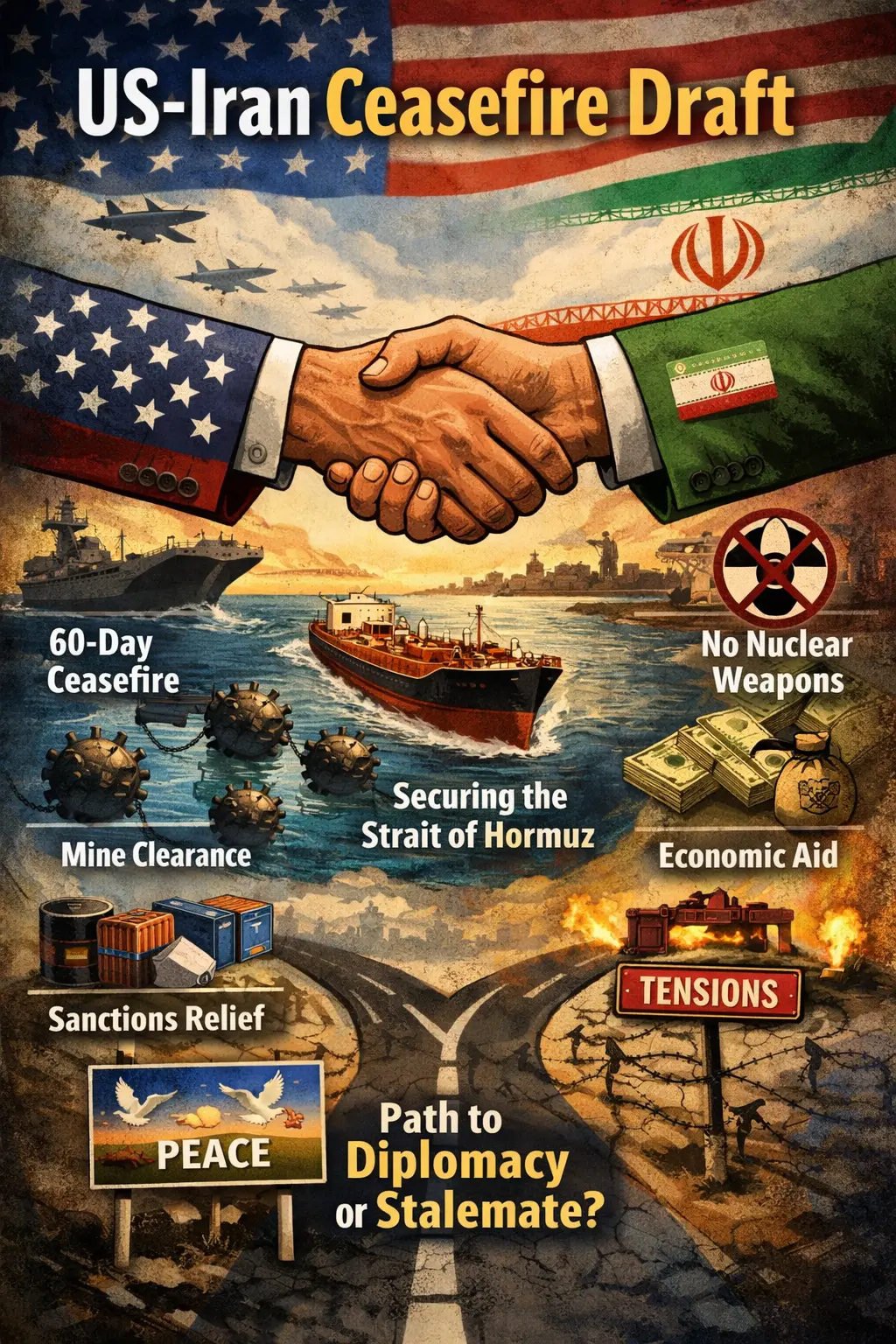
The draft framework now being negotiated reportedly contains several highly significant provisions capable of changing the direction of global markets for the remainder of 2026 and potentially beyond. The agreement proposes an immediate and unconditional ceasefire across land, air, and naval operations while simultaneously restoring commercial navigation through the Persian Gulf, the Strait of Hormuz, and the Sea of Oman under an internationally monitored arrangement. Another major component involves the gradual lifting of US sanctions on Iran in exchange for nuclear compliance measures and limitations related to enriched uranium reserves. Reports additionally suggest that billions of $ in frozen Iranian funds may be released as part of the broader normalization process, while negotiations toward a final comprehensive agreement would continue during a temporary 60-day stabilization period. However, despite the optimistic headlines, disagreements remain extremely serious because Iranian officials reportedly reject parts of the US interpretation regarding long-term control of the Strait of Hormuz, creating uncertainty over how quickly shipping activity and oil exports can realistically normalize.
The importance of this deal becomes clearer when examining the scale of economic disruption caused by the conflict itself. After tensions escalated, Iran progressively tightened restrictions on commercial shipping through the Strait of Hormuz while the United States responded with pressure targeting Iranian trade routes and exports. The result was one of the largest energy supply shocks in modern financial history. Diesel and jet fuel prices surged above $200 per barrel during the peak of the crisis while shipping insurance costs exploded and global freight rates accelerated sharply higher. US inflation jumped from 2.4% year-over-year in February to 3.4% in March largely because of soaring fuel costs, while consumer sentiment weakened significantly across major economies. The International Energy Agency warned that oil markets could enter a severe supply “red zone” by July-August if shipping restrictions continued during peak summer demand, meaning the proposed deal rapidly became the single largest macro catalyst influencing every major asset class.
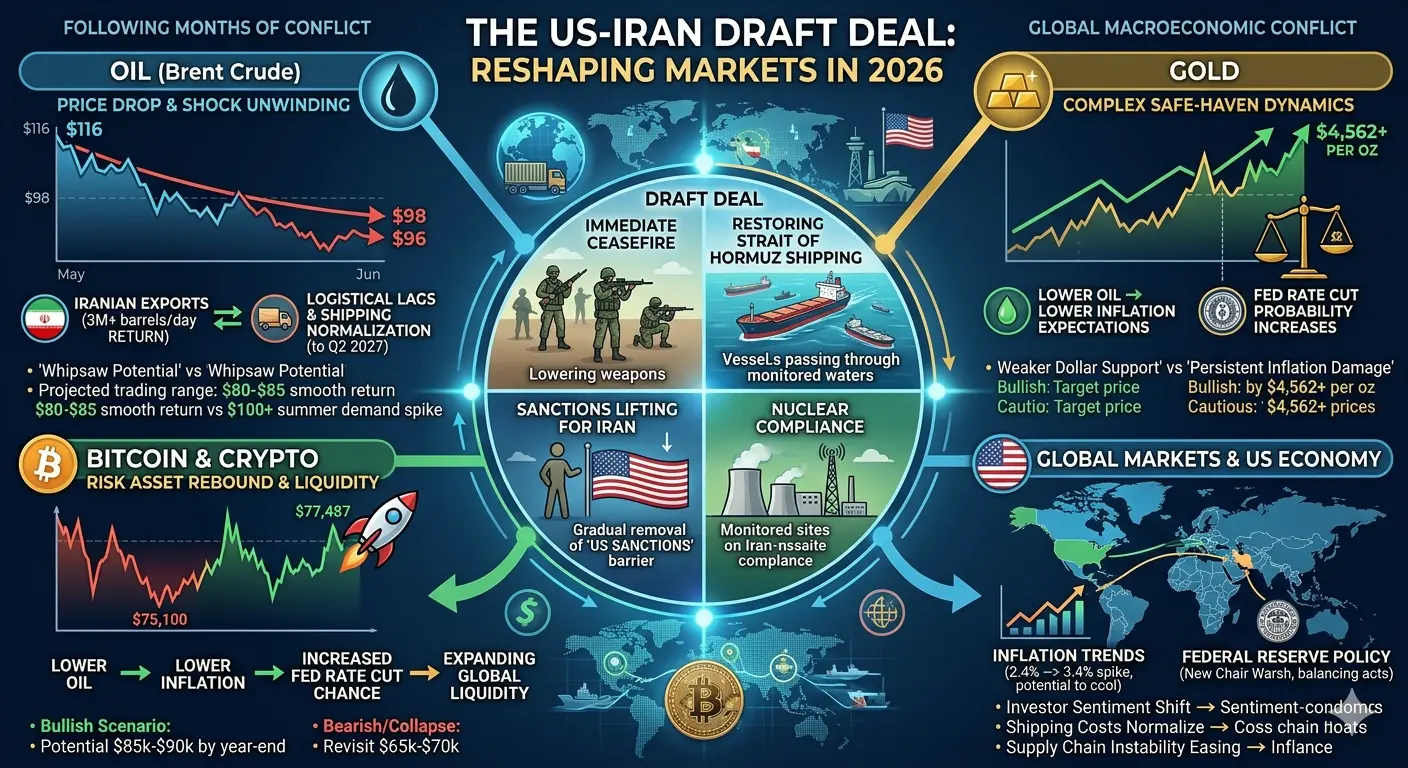
Oil markets reacted immediately and violently to the improving diplomatic tone because traders instantly began pricing in the possibility of restored Iranian exports and partial normalization of global supply conditions. Brent crude fell more than 4.5% toward approximately $98.80 per barrel while WTI crude plunged toward $90.62, marking a single-day decline exceeding 6%. Brent later stabilized around $96.14, but these levels remain dramatically below the wartime highs seen earlier in the conflict. On May 1, Brent crude traded near $116.10 per barrel while prices around April 7 hovered near $107.13, demonstrating how aggressively geopolitical premiums have started unwinding. Markets are now increasingly pricing in the possibility that Iranian exports of approximately 3 to 3.5 million barrels per day could eventually return to global circulation if sanctions are eased and shipping channels reopen, creating substantial supply pressure after months of severe scarcity fears.
However, the oil story remains far more complicated than the market’s initial reaction suggests because physical supply restoration may take significantly longer than financial traders currently expect. ADNOC warned that full normalization of shipping flows through the Strait of Hormuz may not occur until Q1 or Q2 of 2027 even if hostilities end immediately, highlighting the massive disconnect between paper market pricing and real-world logistical recovery. Damaged infrastructure, elevated insurance costs, naval security concerns, trapped vessels, and delayed transportation systems all mean that actual barrel movement cannot instantly recover simply because a draft agreement exists. This creates the possibility of a major whipsaw scenario where oil initially crashes on optimistic headlines before rebounding sharply once traders realize that physical supply constraints remain severe for many months. Some analysts now expect Brent crude to decline toward $80-$85 if Iranian supply returns smoothly, while others believe prices could rebound above $100 again if summer demand intensifies before logistical normalization occurs.
Gold markets responded in a far more complex manner because the deal simultaneously reduced immediate geopolitical panic while weakening the US dollar through lower inflation expectations. Spot gold climbed roughly 1.18% toward approximately $4,562 per ounce while some trading sessions briefly pushed prices closer to $4,586 despite easing war fears. Under normal conditions, lower geopolitical risk reduces safe-haven demand for gold, but traders instead focused on the broader macroeconomic implications of falling oil prices and potential Federal Reserve policy shifts. The dominant market logic became increasingly clear: lower oil prices may reduce inflation pressure, softer inflation could increase the probability of future Federal Reserve rate cuts, lower rates could weaken the US dollar, and a weaker dollar generally supports higher gold prices even if the geopolitical premium fades.
Still, the bullish gold thesis remains deeply contested because inflation damage from months of elevated energy costs has already spread across the broader economy. Consumer inflation expectations remain elevated while prediction markets continue assigning relatively low probability to aggressive Federal Reserve easing during 2026. New Federal Reserve Chair Kevin Warsh inherited one of the most difficult macroeconomic environments in years because lower oil prices may help future inflation trends but cannot immediately reverse the structural damage already caused by the energy crisis. As a result, gold traders remain divided between bullish forecasts targeting $4,800-$5,000 in the medium term and more cautious outlooks expecting temporary pullbacks toward $4,200-$4,300 if geopolitical fear fades faster than dollar weakness develops. Longer-term bullish projections above $5,500-$6,000 remain tied heavily to eventual monetary easing, fiscal instability, and persistent global currency weakness.
Bitcoin and the broader crypto market reacted with equally dramatic volatility because digital assets remain highly sensitive to liquidity expectations, macroeconomic risk sentiment, and Federal Reserve policy outlooks. BTC initially dropped roughly 4% during peak war fears, sliding toward approximately $75,100 before reversing sharply higher after reports emerged that negotiations were progressing toward a possible settlement framework. Bitcoin later rebounded toward approximately $77,487 as traders aggressively repositioned into risk assets while simultaneously increasing expectations for eventual monetary easing if oil prices continue declining. The bullish crypto narrative currently dominating markets follows a straightforward macro chain reaction: lower oil prices reduce inflation pressure, reduced inflation pressure improves rate-cut probabilities, easier monetary policy increases global liquidity, and expanding liquidity conditions historically support Bitcoin and altcoin rallies.
Under the most optimistic scenario where the agreement becomes fully operational, shipping activity through the Strait of Hormuz gradually normalizes, Brent crude stabilizes near $80-$85, inflation softens during late summer, and the Federal Reserve pivots toward rate reductions by September or October, Bitcoin could realistically challenge the $85,000-$90,000 region before the end of 2026. Some cycle-based analysts continue projecting upside targets between $120,000 and $150,000 under highly favorable macroeconomic conditions supported by institutional demand and expanding liquidity conditions. However, downside risks remain extremely important because markets already price in relatively high probabilities of eventual diplomatic resolution. If negotiations collapse, military escalation resumes, oil prices surge back above $110-$120, and the Federal Reserve maintains a hawkish stance because inflation remains stubbornly elevated, Bitcoin could revisit the $65,000-$70,000 institutional accumulation zone while higher-beta altcoins such as ETH, SOL, and XRP could experience even sharper downside volatility.
The broader market environment therefore remains trapped between headline optimism and execution uncertainty. Traders generally agree that the draft agreement has the potential to remove the largest macroeconomic threat facing global markets in 2026, but skepticism surrounding implementation speed, shipping normalization, sanction removal, and long-term geopolitical stability remains extremely high. Iran and the United States continue disagreeing on several major details involving strategic authority over the Strait of Hormuz while logistical experts repeatedly warn that restoring normal energy flows could take many months regardless of diplomatic breakthroughs. Because of this uncertainty, every diplomatic headline, Federal Reserve statement, shipping update, inventory report, or energy-market development now has the ability to move oil, gold, Bitcoin, and broader financial markets by massive percentages within hours.
For traders and investors, the most important variables to monitor going forward include formal confirmation of the agreement, real-time shipping activity through the Strait of Hormuz, actual Iranian export recovery, summer oil inventory data, inflation trends, and Federal Reserve guidance regarding interest rates. The US-Iran draft deal has already pushed oil down more than 6% in a single session, driven gold toward record territory above $4,500, and reignited bullish momentum across Bitcoin and crypto markets. But the ultimate direction of markets will depend not only on diplomatic signatures and optimistic headlines but also on whether physical supply chains recover fast enough, inflation cools meaningfully, and central-bank policy eventually shifts toward easier financial conditions. Until those developments become clearer, traders should expect extremely high volatility across oil, gold, crypto, and global risk assets throughout the remainder of 2026.@Gate_Square @Gate广场_Official #StockTradingChallengeUpTo17000U #TradeCFDWinGold
The proposed US-Iran draft agreement has become the most important geopolitical and macroeconomic development of 2026 because it directly affects global oil supply, inflation trends, Federal Reserve policy expectations, safe-haven demand, shipping logistics, crypto market liquidity, and overall investor sentiment across nearly every major financial market. Since the military conflict erupted on February 28, 2026 following coordinated US and Israeli strikes on Iran, markets have experienced extreme volatility driven by fears surrounding the closure of the Strait of Hormuz, the narrow but critically important waterway responsible for nearly 20% of global oil transportation. The conflict transformed energy markets almost overnight, created severe inflation pressure worldwide, disrupted global shipping routes, triggered supply-chain instability, and forced traders to rapidly reposition across commodities, equities, currencies, and digital assets.
The draft framework now being negotiated reportedly contains several highly significant provisions capable of changing the direction of global markets for the remainder of 2026 and potentially beyond. The agreement proposes an immediate and unconditional ceasefire across land, air, and naval operations while simultaneously restoring commercial navigation through the Persian Gulf, the Strait of Hormuz, and the Sea of Oman under an internationally monitored arrangement. Another major component involves the gradual lifting of US sanctions on Iran in exchange for nuclear compliance measures and limitations related to enriched uranium reserves. Reports additionally suggest that billions of $ in frozen Iranian funds may be released as part of the broader normalization process, while negotiations toward a final comprehensive agreement would continue during a temporary 60-day stabilization period. However, despite the optimistic headlines, disagreements remain extremely serious because Iranian officials reportedly reject parts of the US interpretation regarding long-term control of the Strait of Hormuz, creating uncertainty over how quickly shipping activity and oil exports can realistically normalize.
The importance of this deal becomes clearer when examining the scale of economic disruption caused by the conflict itself. After tensions escalated, Iran progressively tightened restrictions on commercial shipping through the Strait of Hormuz while the United States responded with pressure targeting Iranian trade routes and exports. The result was one of the largest energy supply shocks in modern financial history. Diesel and jet fuel prices surged above $200 per barrel during the peak of the crisis while shipping insurance costs exploded and global freight rates accelerated sharply higher. US inflation jumped from 2.4% year-over-year in February to 3.4% in March largely because of soaring fuel costs, while consumer sentiment weakened significantly across major economies. The International Energy Agency warned that oil markets could enter a severe supply “red zone” by July-August if shipping restrictions continued during peak summer demand, meaning the proposed deal rapidly became the single largest macro catalyst influencing every major asset class.
Oil markets reacted immediately and violently to the improving diplomatic tone because traders instantly began pricing in the possibility of restored Iranian exports and partial normalization of global supply conditions. Brent crude fell more than 4.5% toward approximately $98.80 per barrel while WTI crude plunged toward $90.62, marking a single-day decline exceeding 6%. Brent later stabilized around $96.14, but these levels remain dramatically below the wartime highs seen earlier in the conflict. On May 1, Brent crude traded near $116.10 per barrel while prices around April 7 hovered near $107.13, demonstrating how aggressively geopolitical premiums have started unwinding. Markets are now increasingly pricing in the possibility that Iranian exports of approximately 3 to 3.5 million barrels per day could eventually return to global circulation if sanctions are eased and shipping channels reopen, creating substantial supply pressure after months of severe scarcity fears.
However, the oil story remains far more complicated than the market’s initial reaction suggests because physical supply restoration may take significantly longer than financial traders currently expect. ADNOC warned that full normalization of shipping flows through the Strait of Hormuz may not occur until Q1 or Q2 of 2027 even if hostilities end immediately, highlighting the massive disconnect between paper market pricing and real-world logistical recovery. Damaged infrastructure, elevated insurance costs, naval security concerns, trapped vessels, and delayed transportation systems all mean that actual barrel movement cannot instantly recover simply because a draft agreement exists. This creates the possibility of a major whipsaw scenario where oil initially crashes on optimistic headlines before rebounding sharply once traders realize that physical supply constraints remain severe for many months. Some analysts now expect Brent crude to decline toward $80-$85 if Iranian supply returns smoothly, while others believe prices could rebound above $100 again if summer demand intensifies before logistical normalization occurs.
Gold markets responded in a far more complex manner because the deal simultaneously reduced immediate geopolitical panic while weakening the US dollar through lower inflation expectations. Spot gold climbed roughly 1.18% toward approximately $4,562 per ounce while some trading sessions briefly pushed prices closer to $4,586 despite easing war fears. Under normal conditions, lower geopolitical risk reduces safe-haven demand for gold, but traders instead focused on the broader macroeconomic implications of falling oil prices and potential Federal Reserve policy shifts. The dominant market logic became increasingly clear: lower oil prices may reduce inflation pressure, softer inflation could increase the probability of future Federal Reserve rate cuts, lower rates could weaken the US dollar, and a weaker dollar generally supports higher gold prices even if the geopolitical premium fades.
Still, the bullish gold thesis remains deeply contested because inflation damage from months of elevated energy costs has already spread across the broader economy. Consumer inflation expectations remain elevated while prediction markets continue assigning relatively low probability to aggressive Federal Reserve easing during 2026. New Federal Reserve Chair Kevin Warsh inherited one of the most difficult macroeconomic environments in years because lower oil prices may help future inflation trends but cannot immediately reverse the structural damage already caused by the energy crisis. As a result, gold traders remain divided between bullish forecasts targeting $4,800-$5,000 in the medium term and more cautious outlooks expecting temporary pullbacks toward $4,200-$4,300 if geopolitical fear fades faster than dollar weakness develops. Longer-term bullish projections above $5,500-$6,000 remain tied heavily to eventual monetary easing, fiscal instability, and persistent global currency weakness.
Bitcoin and the broader crypto market reacted with equally dramatic volatility because digital assets remain highly sensitive to liquidity expectations, macroeconomic risk sentiment, and Federal Reserve policy outlooks. BTC initially dropped roughly 4% during peak war fears, sliding toward approximately $75,100 before reversing sharply higher after reports emerged that negotiations were progressing toward a possible settlement framework. Bitcoin later rebounded toward approximately $77,487 as traders aggressively repositioned into risk assets while simultaneously increasing expectations for eventual monetary easing if oil prices continue declining. The bullish crypto narrative currently dominating markets follows a straightforward macro chain reaction: lower oil prices reduce inflation pressure, reduced inflation pressure improves rate-cut probabilities, easier monetary policy increases global liquidity, and expanding liquidity conditions historically support Bitcoin and altcoin rallies.
Under the most optimistic scenario where the agreement becomes fully operational, shipping activity through the Strait of Hormuz gradually normalizes, Brent crude stabilizes near $80-$85, inflation softens during late summer, and the Federal Reserve pivots toward rate reductions by September or October, Bitcoin could realistically challenge the $85,000-$90,000 region before the end of 2026. Some cycle-based analysts continue projecting upside targets between $120,000 and $150,000 under highly favorable macroeconomic conditions supported by institutional demand and expanding liquidity conditions. However, downside risks remain extremely important because markets already price in relatively high probabilities of eventual diplomatic resolution. If negotiations collapse, military escalation resumes, oil prices surge back above $110-$120, and the Federal Reserve maintains a hawkish stance because inflation remains stubbornly elevated, Bitcoin could revisit the $65,000-$70,000 institutional accumulation zone while higher-beta altcoins such as ETH, SOL, and XRP could experience even sharper downside volatility.
The broader market environment therefore remains trapped between headline optimism and execution uncertainty. Traders generally agree that the draft agreement has the potential to remove the largest macroeconomic threat facing global markets in 2026, but skepticism surrounding implementation speed, shipping normalization, sanction removal, and long-term geopolitical stability remains extremely high. Iran and the United States continue disagreeing on several major details involving strategic authority over the Strait of Hormuz while logistical experts repeatedly warn that restoring normal energy flows could take many months regardless of diplomatic breakthroughs. Because of this uncertainty, every diplomatic headline, Federal Reserve statement, shipping update, inventory report, or energy-market development now has the ability to move oil, gold, Bitcoin, and broader financial markets by massive percentages within hours.
For traders and investors, the most important variables to monitor going forward include formal confirmation of the agreement, real-time shipping activity through the Strait of Hormuz, actual Iranian export recovery, summer oil inventory data, inflation trends, and Federal Reserve guidance regarding interest rates. The US-Iran draft deal has already pushed oil down more than 6% in a single session, driven gold toward record territory above $4,500, and reignited bullish momentum across Bitcoin and crypto markets. But the ultimate direction of markets will depend not only on diplomatic signatures and optimistic headlines but also on whether physical supply chains recover fast enough, inflation cools meaningfully, and central-bank policy eventually shifts toward easier financial conditions. Until those developments become clearer, traders should expect extremely high volatility across oil, gold, crypto, and global risk assets throughout the remainder of 2026.@Gate_Square @Gate广场_Official #StockTradingChallengeUpTo17000U #TradeCFDWinGold