#USIranNegotiationGame
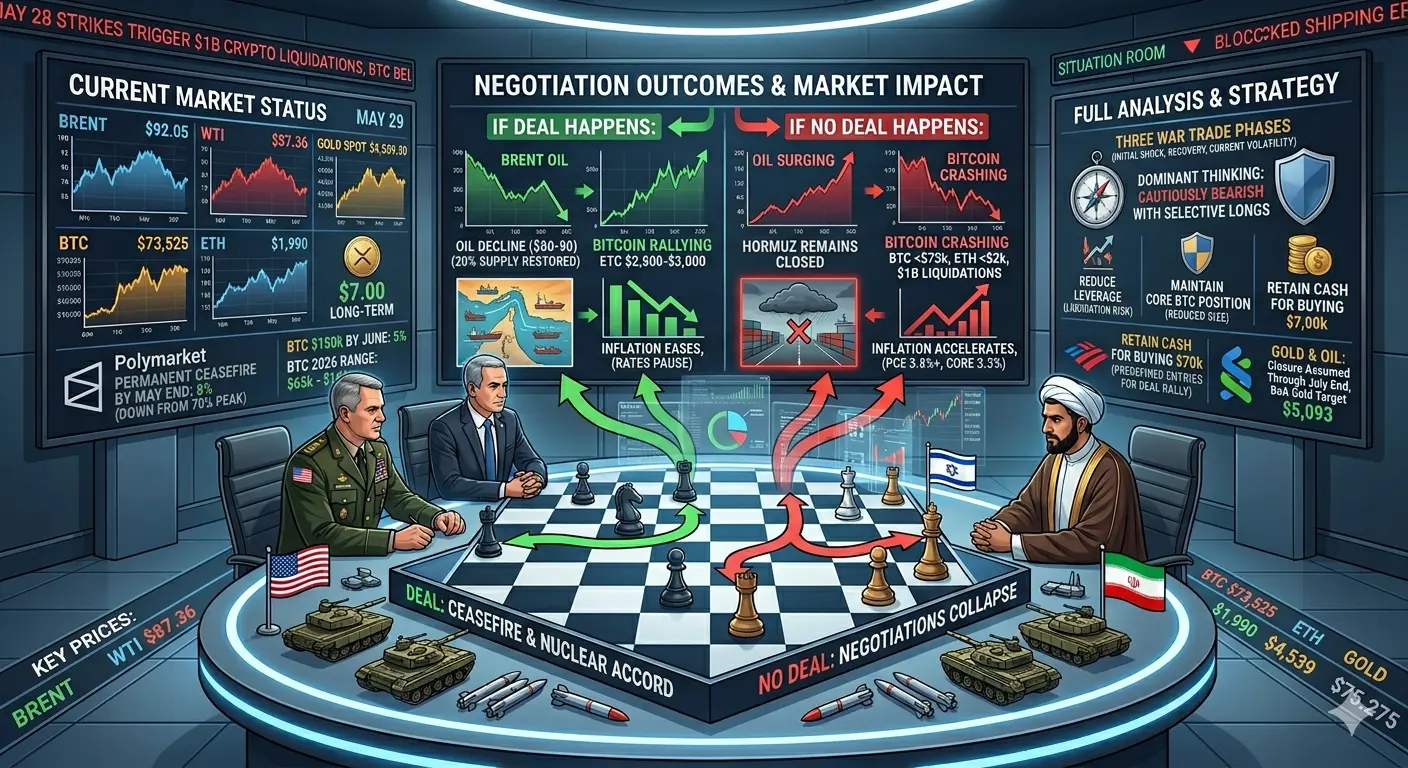
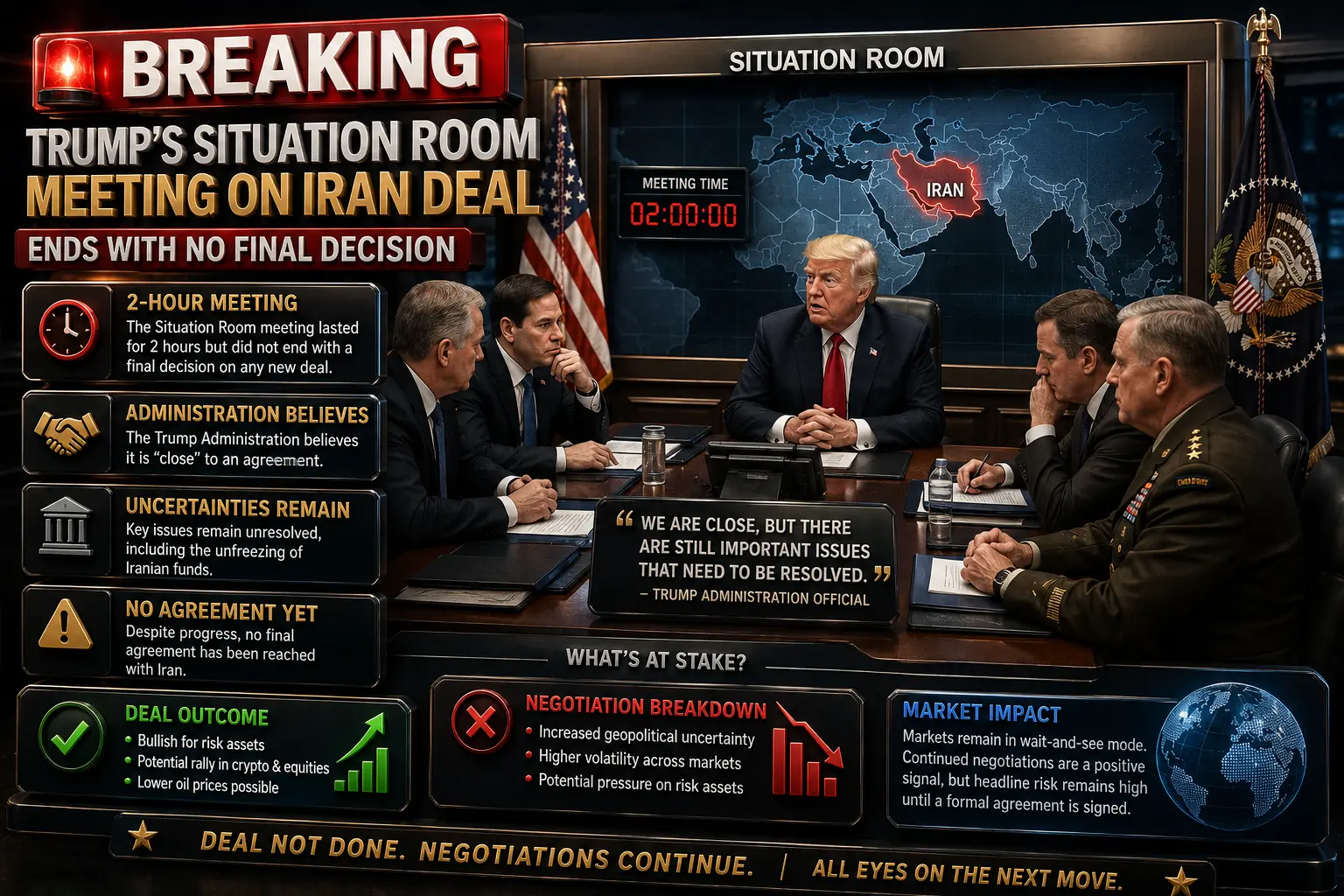
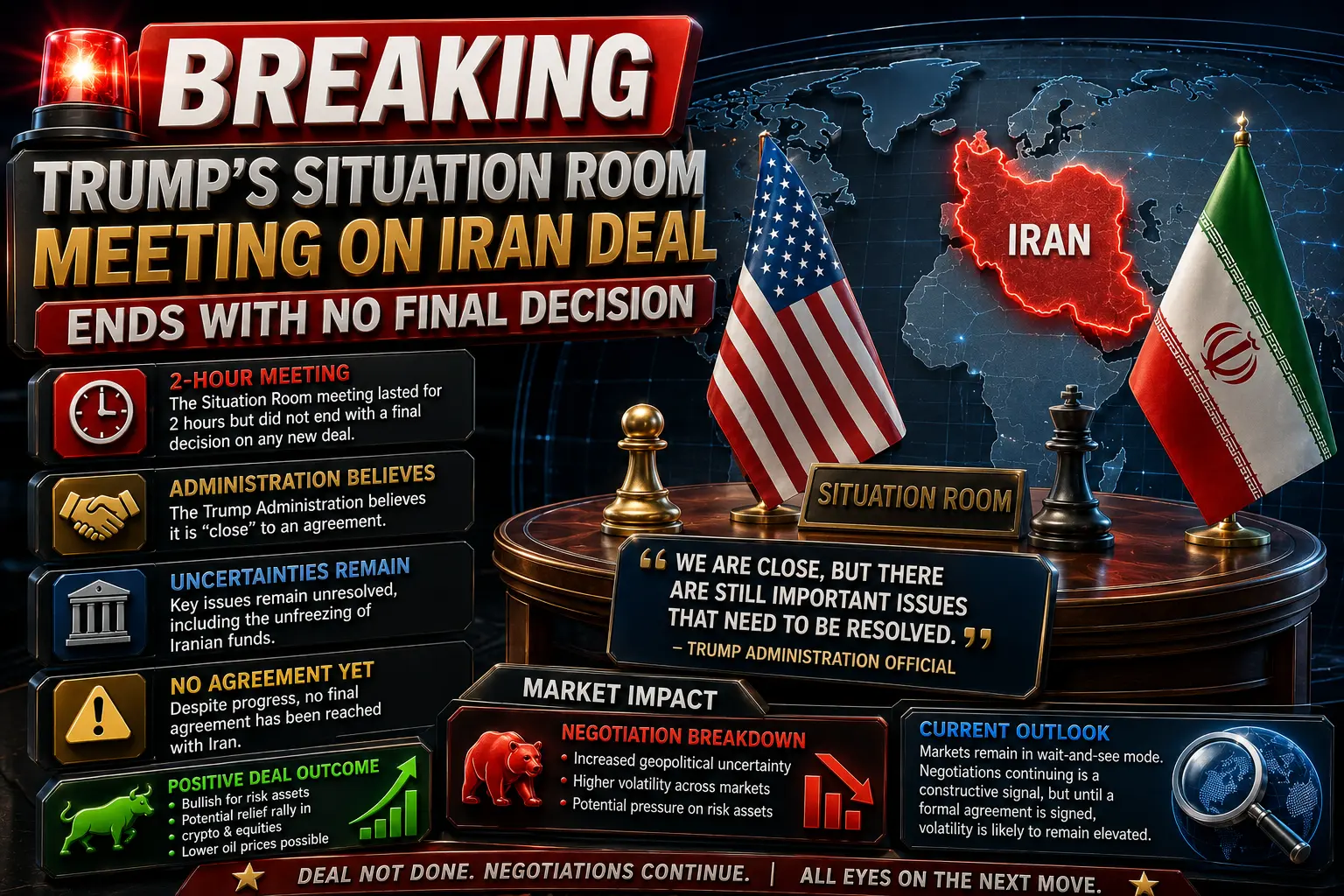
The US and Iran have been in conflict since February 28 2026 when the US and Israel struck Iranian targets. After three months of fighting a breakthrough may be near. On May 28 negotiators reached a tentative agreement to extend the ceasefire by 60 days and start talks on Iran nuclear program including reopening the Strait of Hormuz which carries one-fifth of global seaborne oil. However the deal is not finalized. Trump stated on May 29 he is holding a Situation Room meeting with advisers for a final determination. He asserted Iran is negotiating on fumes and November midterms will not rush him. Polymarket odds for permanent ceasefire by end of May dropped to 8 percent after renewed strikes on May 28 down from 70 percent peak. The deal awaits presidential approval and nothing is guaranteed until Trump signs off. Even if ceasefire extension is approved a permanent ceasefire and full nuclear deal remain separate distant milestones. The extension buys diplomacy time while a nuclear deal requires sustained negotiations on enrichment limits sanctions relief and verification. A permanent ceasefire is not assured and a nuclear deal is further from certainty.
If the Nuclear Deal Does Not Happen
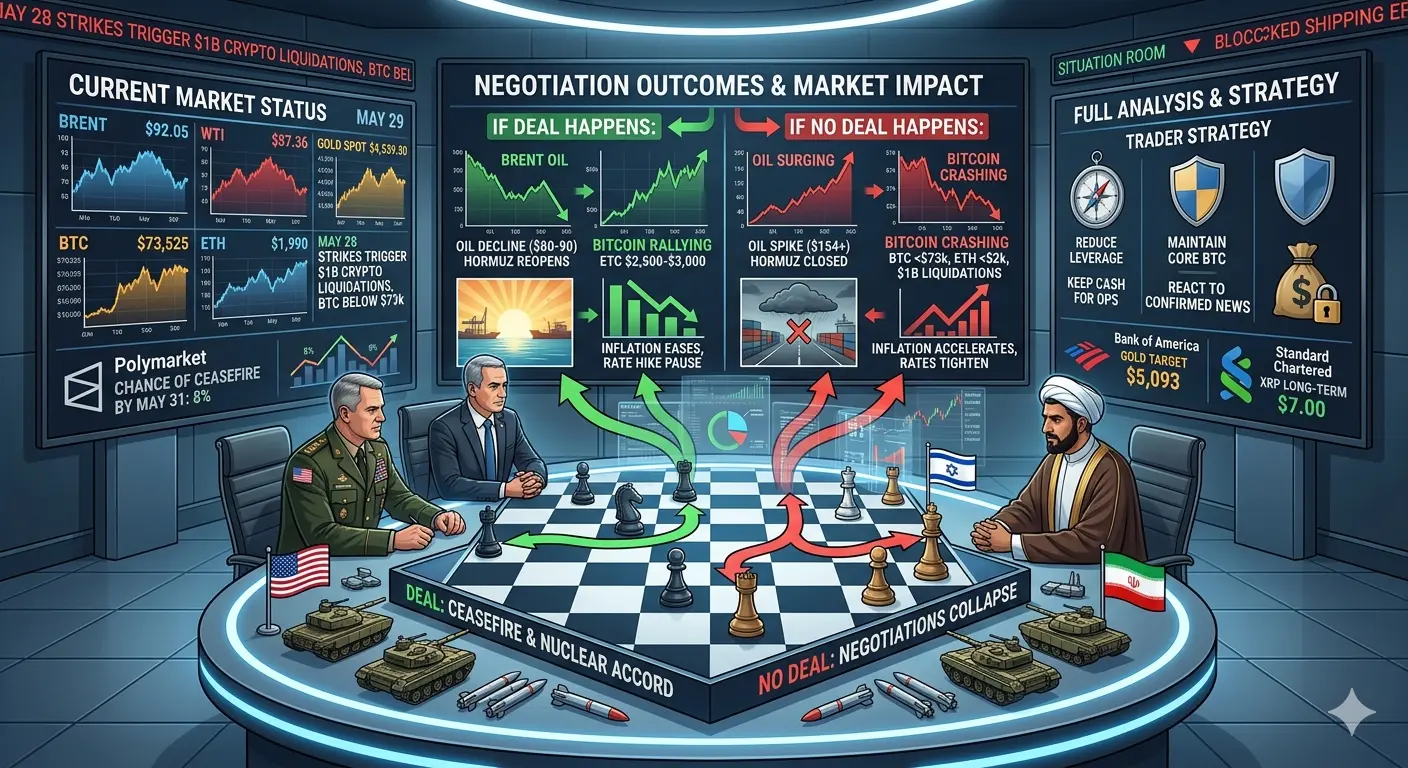
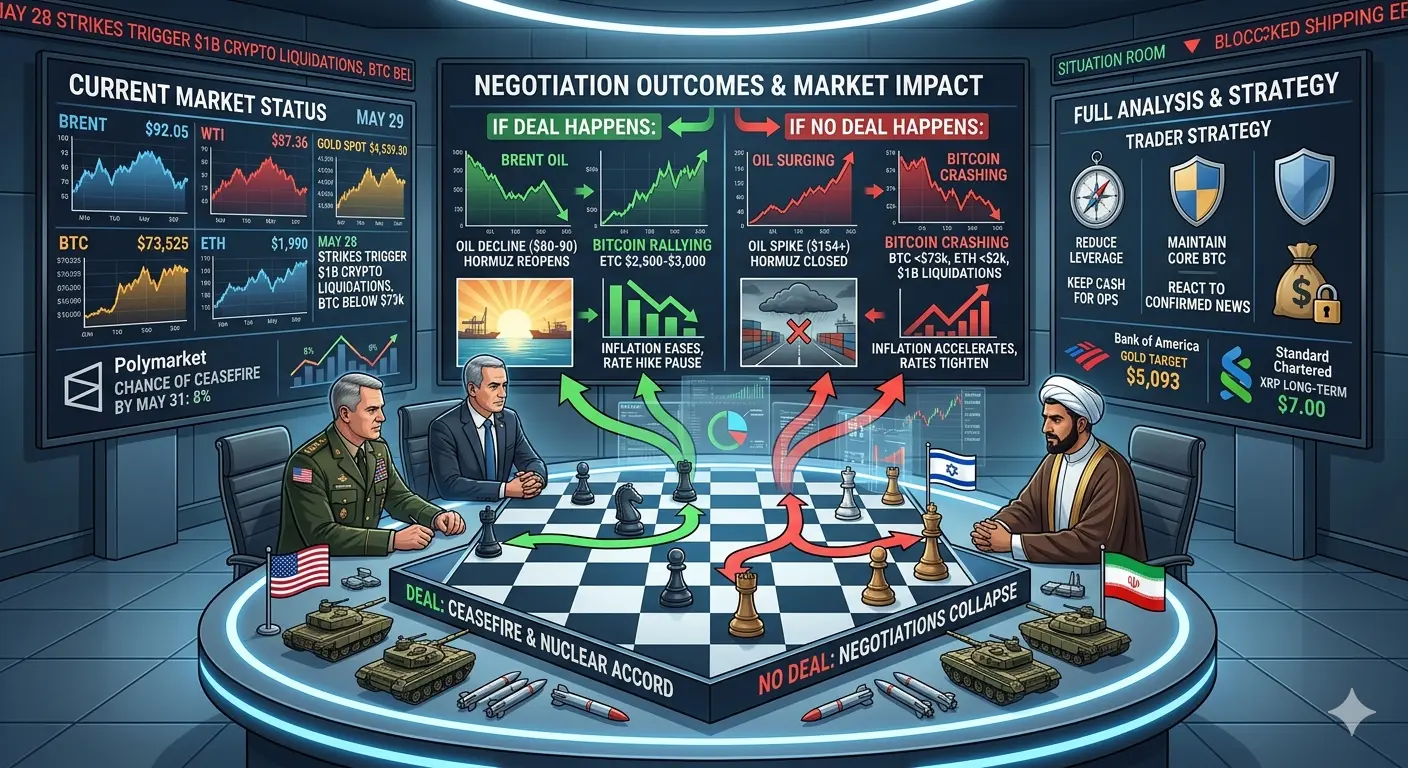
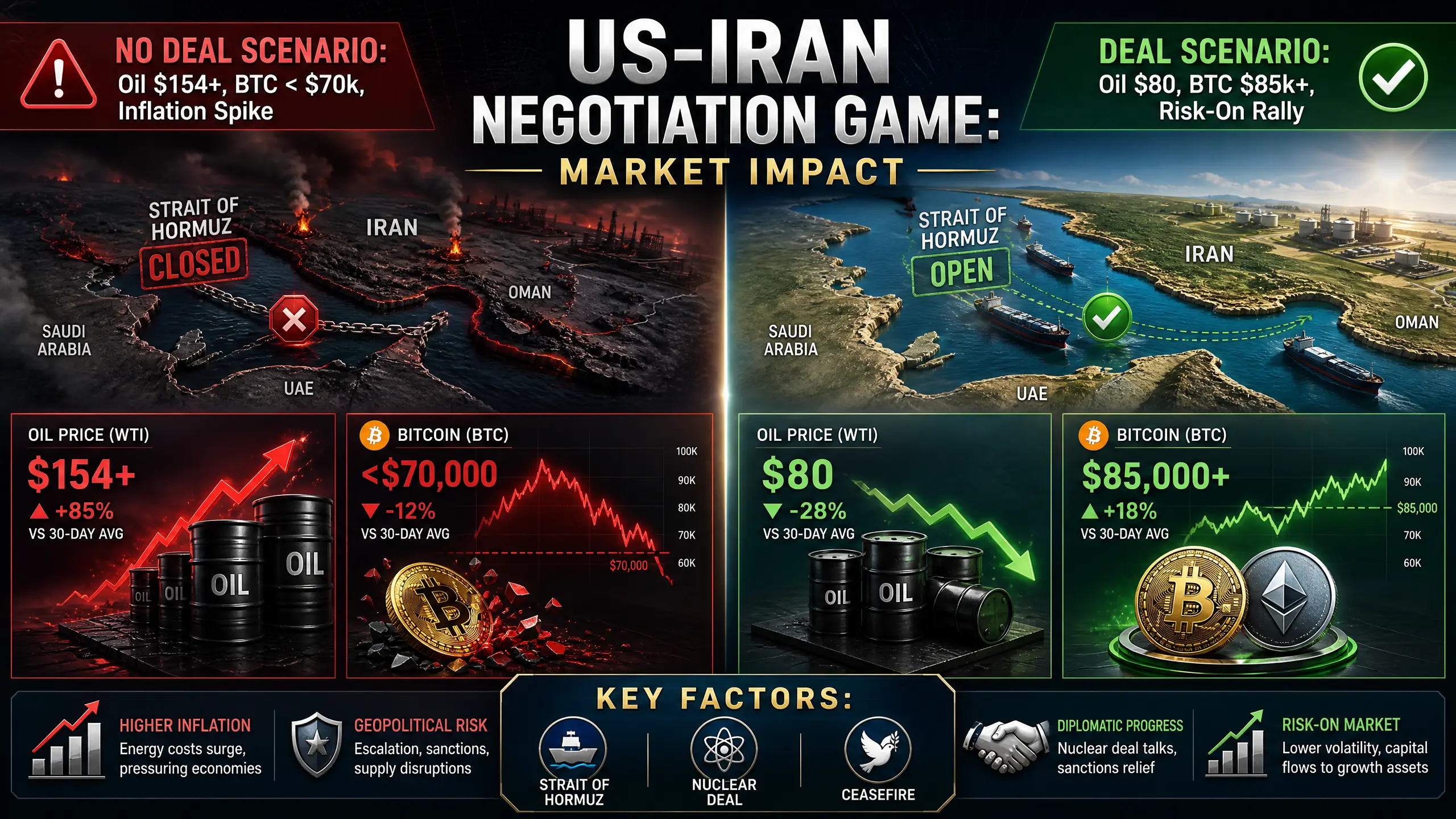
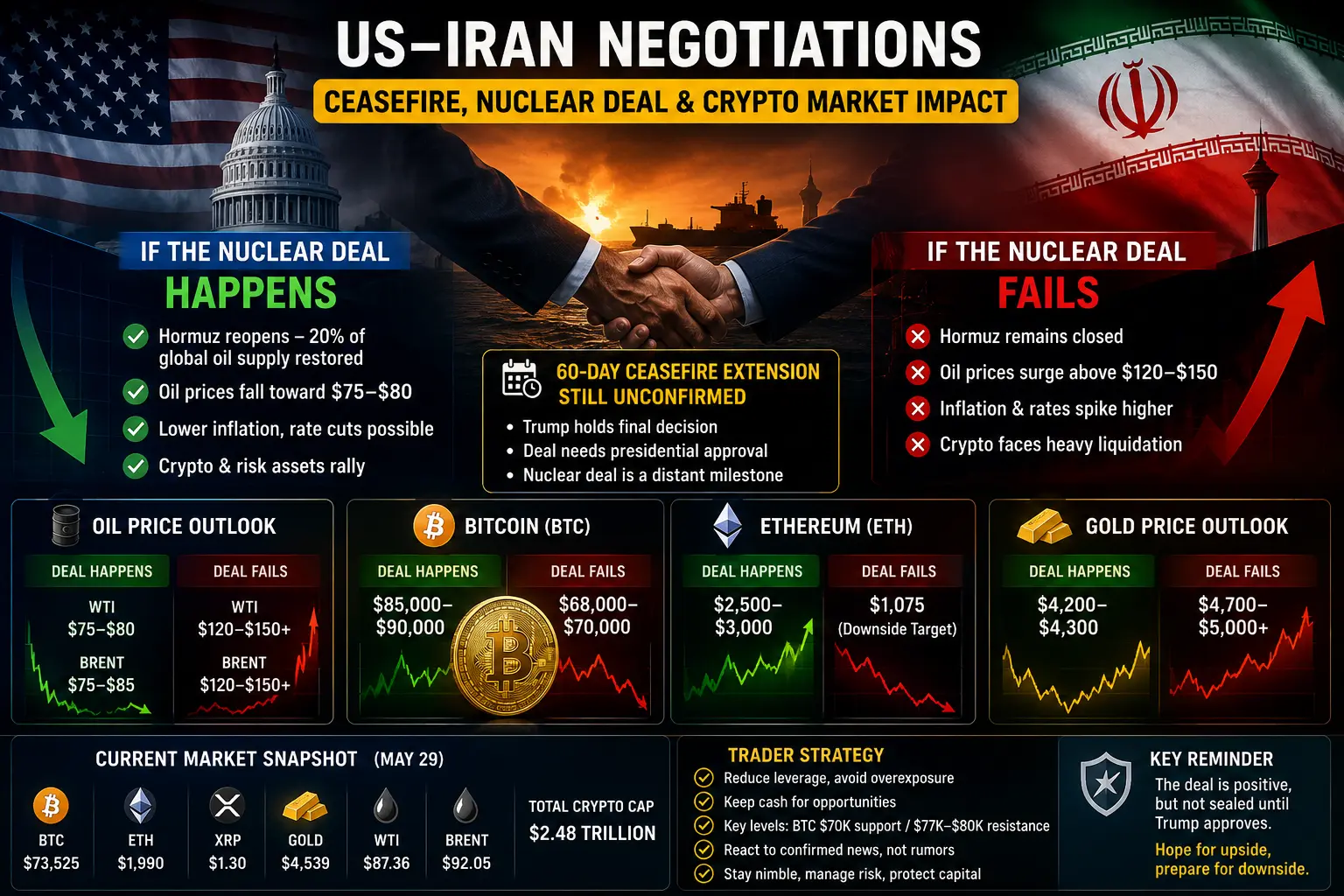
If negotiations collapse consequences would be severe across every asset class. Oil would surge as Hormuz remains effectively closed. The IEA called this the largest supply disruption in oil market history. Analysts project oil approaching $154 per barrel under sustained 12-week closure. Brent near $92.05 on May 29 would spike above $100 and challenge $120 to $130. WTI near $87.36 could rebound above $100 rapidly. US gasoline already above $4 per gallon and $1.50 above pre-war levels would climb further. PCE data on May 28 showed 3.8 percent year-over-year jump fastest since 2021 and core index 3.3 percent. A failed deal would exacerbate inflation forcing central banks to tighten policy. BTC dropped below $73,000 on May 28 touching $72,912 lowest since April 13 after renewed strikes triggered nearly $1 billion in crypto liquidations in 24 hours with longs 93 percent of wipeout. Ethereum plunged below $2,000 testing $1,967 with analysts projecting downside near $1,075. Bitcoin could face further selling as risk appetite collapses but BTC paradoxically added 25 percent since February strikes outperforming traditional havens. TradingView noted Bitcoin is winning the 2026 Middle East war trade. Short-term BTC downside targets include $68,000 to $70,000. Gold initially rallies as safe haven but higher rates weigh. Gold futures settled $4,389.70 on May 28 two-month low before rebounding to $4,539.30. Bank of America year-end target $5,093. In no-deal gold could spike $4,700 to $5,000 but sustained high rates cap gains.
If the Nuclear Deal Happens
If a nuclear deal is negotiated market impact would be transformative and positive for risk assets. Oil falls substantially as Hormuz reopens restoring 20 percent of global supply. Brent dropped over 4.5 percent to $98.80 on May 24 when optimism emerged and further declines toward $80 are possible. Reuters note energy flows face slow recovery and assume Strait closed until July end. Oil forecasts increased three times since war began representing 40 percent increases from February estimates of $63.85 Brent and $60.38 WTI. Normalization takes months so oil may not return to pre-war levels immediately. WTI could drop toward $75 to $80. Lower oil reduces inflation significantly. Gasoline could decline $1 or more per gallon allowing central banks to pause rate hikes bullish for crypto. Bitcoin rallies reclaiming $80,000 quickly and pushing toward $85,000 to $90,000. Prediction markets give BTC 5 percent chance of $150,000 by June but 2026 range spans $65,000 to $145,000. Ethereum benefits reclaiming $2,500 to $3,000. XRP around $1.30 targets $7.00 long-term per Standard Chartered. Gold faces downward pressure initially as safe-haven demand diminishes and dollar strengthens. UBS notes global debt and fiscal deficits elevate hard assets long-term. Gold may dip $4,200 to $4,300 but bullish case intact. Silver at $75.275 follows gold dip but benefits from industrial demand recovery.
Current Market and June Stability
Markets are caught in volatile tug-of-war between deal optimism and conflict escalation. Bitcoin approximately $73,525 on May 29 down from $77,280 on May 26. Seven-day decline roughly 6.3 percent. Ethereum broke below $2,000 testing $1,967 with downside target $1,075. Total crypto cap near $2.48 trillion with negligible momentum and ETF outflows. Spot Bitcoin ETFs recorded $229 million net outflows on May 28. Gold spot rebounded to $4,539.30 up 0.97 percent after tumbling to $4,389.70. WTI near $87.36 and Brent near $92.05 both down sharply for May. Oil jumped over 2 percent on May 28 after Iran retaliated against US airbase. Nearly $1 billion leveraged crypto positions liquidated on May 28 largest event of year dominated by longs at 93 percent. June unlikely to bring full stabilization regardless of deal outcome. Even if Trump approves 60-day extension negotiations consume weeks keeping uncertainty alive through June into July. Reuters assumes Strait closed until July end meaning oil disruptions persist. Central banks leaning hawkish with new Fed Chair Warsh facing surging gasoline prices. Higher rates weigh on crypto through June. If ceasefire holds and talks progress BTC stabilizes $75,000 to $82,000. If talks stall BTC tests $68,000 to $70,000. Stabilization may only emerge late June or early July if deal framework becomes concrete and Hormuz reopening timeline clears.
Full Analysis and Trader Strategy
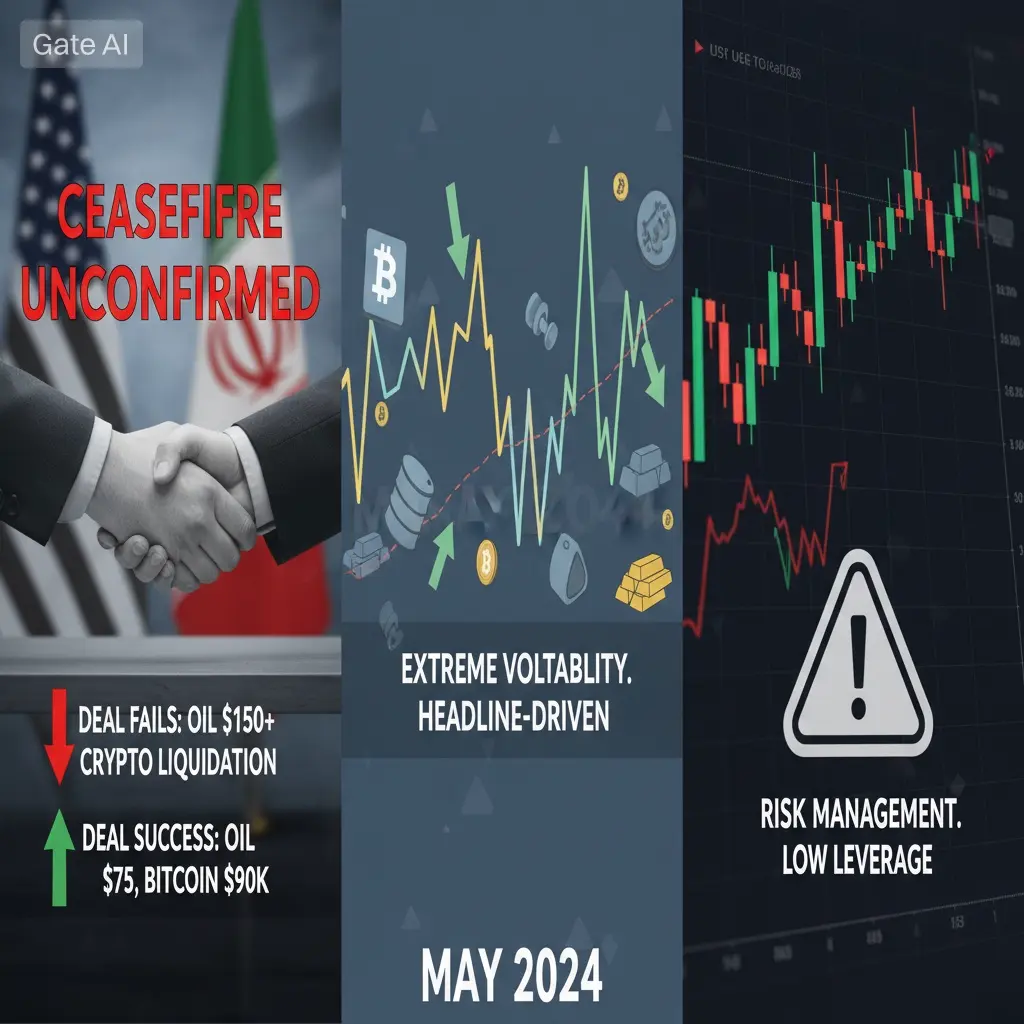
The conflict beginning February 28 2026 profoundly reshaped crypto. Before war Bitcoin traded above $80,000 and hit all-time high $126,080 in late 2025. BTC paradoxically rallied 25 percent from pre-strike levels before May downturn. Gold dropped over 10 percent since conflict because war inflation pushes rates higher weighing on non-yielding gold. Bitcoin attracted flows as fiat debasement hedge. Three phases occurred: initial shock late February with BTC dropping and oil surging past $100, recovery March through mid-May with BTC climbing toward $80,000 and gold peaking above $4,600, and current volatility mid-May through late-May with ceasefire hopes and strikes alternating. May 28 strikes triggered $1 billion liquidations sending BTC below $73,000 and ETH below $2,000. May 29 deal news lifted gold to $4,539 and pushed Brent below $93. Key prices: Bitcoin $73,525, Ethereum $1,990, XRP $1.30, gold $4,539, silver $75.275, WTI $87.36, Brent $92.05, crypto cap $2.48 trillion. Oil peaked $103 plus earlier. Bank of America gold target $5,093. BTC 2026 range $65,000 to $145,000. ETH bearish target $1,075. Brent forecasts hiked three times roughly 40 percent from pre-war estimates. Traders operate in headline-driven environment where every signal moves markets 3 to 5 percent per session. Dominant thinking cautiously bearish with selective longs. Many caught in May 28 liquidation. BTC support $70,000 to $72,000 deeper floor $68,000. Resistance $77,000 to $80,000 deal breakout pushes toward $85,000 to $90,000. ETH battleground $1,960 to $2,000 extreme downside $1,075. Reduce leverage given liquidation risk. Maintain core BTC reduced size keep cash for buying at $70,000 predefined entries for deal rally. Gold swings $4,200 to $4,700 but Bank of America $5,093 suggests long-term upside. Oil remains $85 to $95 WTI and $90 to $100 Brent through June as closure assumed through July. Stay nimble size small react to confirmed developments not rumors. Deal positive but not sealed until Trump approves. Balance hope for upside with fear of another billion-dollar liquidation. Neither fully bullish nor bearish but prepared for both with disciplined limits and clear exit plans.@Gate_Square @Gate广场_Official
The US and Iran have been in conflict since February 28 2026 when the US and Israel struck Iranian targets. After three months of fighting a breakthrough may be near. On May 28 negotiators reached a tentative agreement to extend the ceasefire by 60 days and start talks on Iran nuclear program including reopening the Strait of Hormuz which carries one-fifth of global seaborne oil. However the deal is not finalized. Trump stated on May 29 he is holding a Situation Room meeting with advisers for a final determination. He asserted Iran is negotiating on fumes and November midterms will not rush him. Polymarket odds for permanent ceasefire by end of May dropped to 8 percent after renewed strikes on May 28 down from 70 percent peak. The deal awaits presidential approval and nothing is guaranteed until Trump signs off. Even if ceasefire extension is approved a permanent ceasefire and full nuclear deal remain separate distant milestones. The extension buys diplomacy time while a nuclear deal requires sustained negotiations on enrichment limits sanctions relief and verification. A permanent ceasefire is not assured and a nuclear deal is further from certainty.
If the Nuclear Deal Does Not Happen
If negotiations collapse consequences would be severe across every asset class. Oil would surge as Hormuz remains effectively closed. The IEA called this the largest supply disruption in oil market history. Analysts project oil approaching $154 per barrel under sustained 12-week closure. Brent near $92.05 on May 29 would spike above $100 and challenge $120 to $130. WTI near $87.36 could rebound above $100 rapidly. US gasoline already above $4 per gallon and $1.50 above pre-war levels would climb further. PCE data on May 28 showed 3.8 percent year-over-year jump fastest since 2021 and core index 3.3 percent. A failed deal would exacerbate inflation forcing central banks to tighten policy. BTC dropped below $73,000 on May 28 touching $72,912 lowest since April 13 after renewed strikes triggered nearly $1 billion in crypto liquidations in 24 hours with longs 93 percent of wipeout. Ethereum plunged below $2,000 testing $1,967 with analysts projecting downside near $1,075. Bitcoin could face further selling as risk appetite collapses but BTC paradoxically added 25 percent since February strikes outperforming traditional havens. TradingView noted Bitcoin is winning the 2026 Middle East war trade. Short-term BTC downside targets include $68,000 to $70,000. Gold initially rallies as safe haven but higher rates weigh. Gold futures settled $4,389.70 on May 28 two-month low before rebounding to $4,539.30. Bank of America year-end target $5,093. In no-deal gold could spike $4,700 to $5,000 but sustained high rates cap gains.
If the Nuclear Deal Happens
If a nuclear deal is negotiated market impact would be transformative and positive for risk assets. Oil falls substantially as Hormuz reopens restoring 20 percent of global supply. Brent dropped over 4.5 percent to $98.80 on May 24 when optimism emerged and further declines toward $80 are possible. Reuters note energy flows face slow recovery and assume Strait closed until July end. Oil forecasts increased three times since war began representing 40 percent increases from February estimates of $63.85 Brent and $60.38 WTI. Normalization takes months so oil may not return to pre-war levels immediately. WTI could drop toward $75 to $80. Lower oil reduces inflation significantly. Gasoline could decline $1 or more per gallon allowing central banks to pause rate hikes bullish for crypto. Bitcoin rallies reclaiming $80,000 quickly and pushing toward $85,000 to $90,000. Prediction markets give BTC 5 percent chance of $150,000 by June but 2026 range spans $65,000 to $145,000. Ethereum benefits reclaiming $2,500 to $3,000. XRP around $1.30 targets $7.00 long-term per Standard Chartered. Gold faces downward pressure initially as safe-haven demand diminishes and dollar strengthens. UBS notes global debt and fiscal deficits elevate hard assets long-term. Gold may dip $4,200 to $4,300 but bullish case intact. Silver at $75.275 follows gold dip but benefits from industrial demand recovery.
Current Market and June Stability
Markets are caught in volatile tug-of-war between deal optimism and conflict escalation. Bitcoin approximately $73,525 on May 29 down from $77,280 on May 26. Seven-day decline roughly 6.3 percent. Ethereum broke below $2,000 testing $1,967 with downside target $1,075. Total crypto cap near $2.48 trillion with negligible momentum and ETF outflows. Spot Bitcoin ETFs recorded $229 million net outflows on May 28. Gold spot rebounded to $4,539.30 up 0.97 percent after tumbling to $4,389.70. WTI near $87.36 and Brent near $92.05 both down sharply for May. Oil jumped over 2 percent on May 28 after Iran retaliated against US airbase. Nearly $1 billion leveraged crypto positions liquidated on May 28 largest event of year dominated by longs at 93 percent. June unlikely to bring full stabilization regardless of deal outcome. Even if Trump approves 60-day extension negotiations consume weeks keeping uncertainty alive through June into July. Reuters assumes Strait closed until July end meaning oil disruptions persist. Central banks leaning hawkish with new Fed Chair Warsh facing surging gasoline prices. Higher rates weigh on crypto through June. If ceasefire holds and talks progress BTC stabilizes $75,000 to $82,000. If talks stall BTC tests $68,000 to $70,000. Stabilization may only emerge late June or early July if deal framework becomes concrete and Hormuz reopening timeline clears.
Full Analysis and Trader Strategy
The conflict beginning February 28 2026 profoundly reshaped crypto. Before war Bitcoin traded above $80,000 and hit all-time high $126,080 in late 2025. BTC paradoxically rallied 25 percent from pre-strike levels before May downturn. Gold dropped over 10 percent since conflict because war inflation pushes rates higher weighing on non-yielding gold. Bitcoin attracted flows as fiat debasement hedge. Three phases occurred: initial shock late February with BTC dropping and oil surging past $100, recovery March through mid-May with BTC climbing toward $80,000 and gold peaking above $4,600, and current volatility mid-May through late-May with ceasefire hopes and strikes alternating. May 28 strikes triggered $1 billion liquidations sending BTC below $73,000 and ETH below $2,000. May 29 deal news lifted gold to $4,539 and pushed Brent below $93. Key prices: Bitcoin $73,525, Ethereum $1,990, XRP $1.30, gold $4,539, silver $75.275, WTI $87.36, Brent $92.05, crypto cap $2.48 trillion. Oil peaked $103 plus earlier. Bank of America gold target $5,093. BTC 2026 range $65,000 to $145,000. ETH bearish target $1,075. Brent forecasts hiked three times roughly 40 percent from pre-war estimates. Traders operate in headline-driven environment where every signal moves markets 3 to 5 percent per session. Dominant thinking cautiously bearish with selective longs. Many caught in May 28 liquidation. BTC support $70,000 to $72,000 deeper floor $68,000. Resistance $77,000 to $80,000 deal breakout pushes toward $85,000 to $90,000. ETH battleground $1,960 to $2,000 extreme downside $1,075. Reduce leverage given liquidation risk. Maintain core BTC reduced size keep cash for buying at $70,000 predefined entries for deal rally. Gold swings $4,200 to $4,700 but Bank of America $5,093 suggests long-term upside. Oil remains $85 to $95 WTI and $90 to $100 Brent through June as closure assumed through July. Stay nimble size small react to confirmed developments not rumors. Deal positive but not sealed until Trump approves. Balance hope for upside with fear of another billion-dollar liquidation. Neither fully bullish nor bearish but prepared for both with disciplined limits and clear exit plans.@Gate_Square @Gate广场_Official