ALEXKHAN

vip
Age 1.6 Year
Peak Tier 0
No content yet
#WCTCTradingKingPK
WCTC S8 Trading Strategy Expansion
Most traders reach a certain level where they understand basic concepts like support and resistance, trendlines, and simple indicators, but they still struggle to achieve consistency because they fail to understand that in the current market environment, execution quality matters far more than knowledge, and the real difference between profitable traders and struggling traders is not what they know but how patiently and accurately they apply it in live conditions where emotions, volatility, and uncertainty are constantly testing their dec
HighAmbition
#WCTCTradingKingPK
WCTC S8 Trading Strategy Expansion
Most traders reach a certain level where they understand basic concepts like support and resistance, trendlines, and simple indicators, but they still struggle to achieve consistency because they fail to understand that in the current market environment, execution quality matters far more than knowledge, and the real difference between profitable traders and struggling traders is not what they know but how patiently and accurately they apply it in live conditions where emotions, volatility, and uncertainty are constantly testing their decisions.
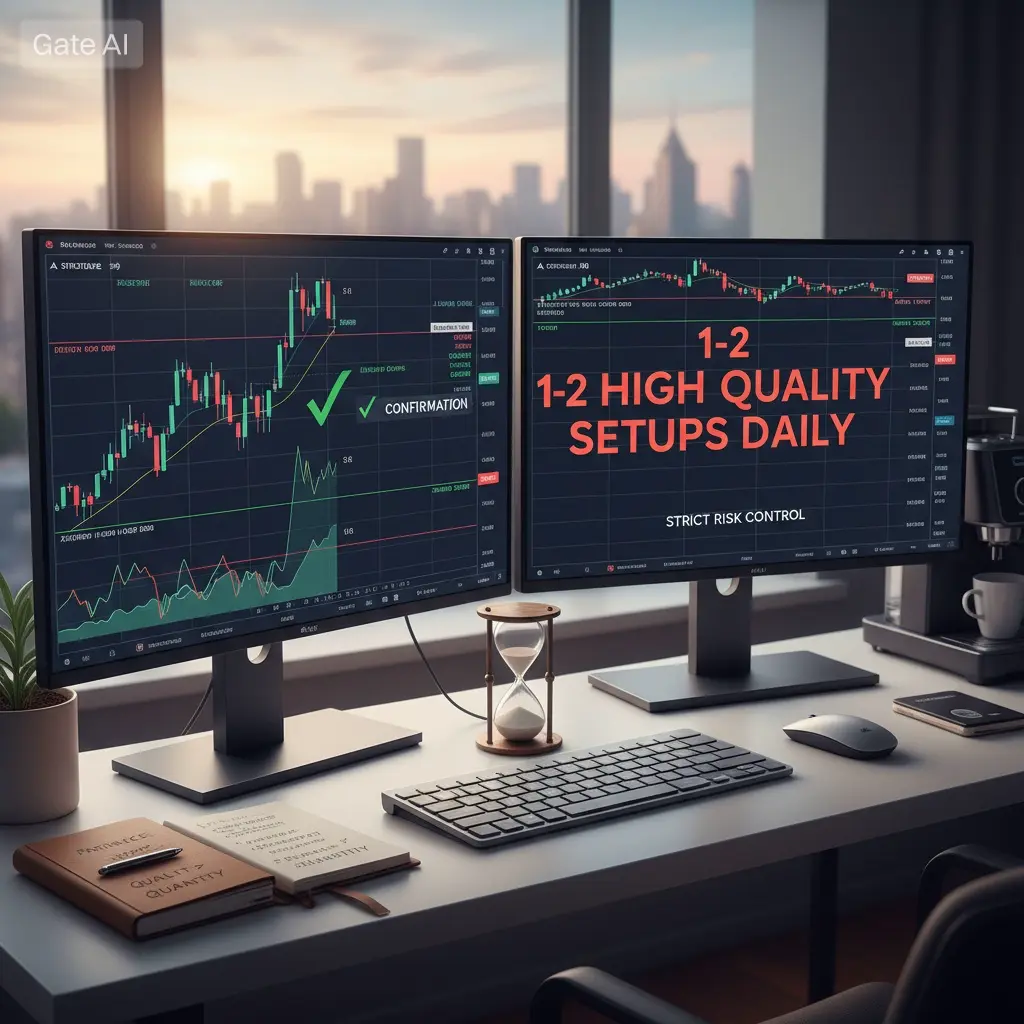
Entry confirmation is one of the most ignored yet powerful aspects of trading, because many traders believe that once price reaches a key level such as support or resistance, it is enough to take a position, whereas in reality, that approach turns trading into guessing, and a more refined method is to wait for clear confirmation signals such as strong rejection wicks indicating liquidity grab, a shift in lower timeframe structure showing a potential reversal, or a sudden increase in volume at a critical zone, because these factors collectively increase the probability that the level will actually hold rather than break.
Another major improvement in trading accuracy comes from multi-timeframe analysis, where instead of relying on a single chart, a trader aligns higher timeframe direction with mid timeframe structure and then refines entries on lower timeframes, because when the daily or four-hour trend supports the direction, the one-hour chart provides structural clarity, and the five to fifteen minute chart offers precise entry timing, the trade becomes significantly stronger, whereas ignoring this alignment often leads to confusion and conflicting signals.
Timing also plays a critical role, yet it is often underestimated, because markets behave very differently depending on the session, and high liquidity periods such as the London and New York opens tend to produce cleaner and more decisive moves, while low volume hours often result in slow, choppy, and deceptive price action that traps impatient traders, so focusing on the right timing alone can dramatically improve both win rate and confidence.
When it comes to breakout trading, the common mistake most traders make is entering immediately when price breaks a level, assuming momentum will continue, but in many cases, these breakouts are designed to trap traders and capture liquidity, so a more disciplined approach is to wait for the breakout to occur, observe whether price can hold above or below the level, and then enter on a confirmed retest, because this reduces false entries and aligns the trade with stronger market intent.
Risk-to-reward ratio is another fundamental pillar that separates professional thinking from amateur behavior, because instead of focusing only on how often they win, experienced traders focus on how much they gain when they are right compared to how much they lose when they are wrong, ensuring that even with a moderate win rate, a minimum of one-to-two or ideally one-to-three risk-to-reward ratio allows overall profitability to remain positive over time.
Position sizing is a subtle but powerful tool that many traders ignore, as they tend to risk the same amount on every trade regardless of setup quality, whereas a smarter approach is to adjust position size based on confidence, reducing exposure in uncertain conditions and slightly increasing it when multiple confluences align, which helps in maintaining balance between aggression and protection.
There are also phases in the market where the best decision is to reduce activity, because when price becomes highly unpredictable or lacks clear direction, switching into a capital preservation mode by lowering risk, reducing frequency, and even staying out of trades entirely can protect both capital and mental clarity, as not trading during bad conditions is often more profitable than forcing trades.
Journaling is one of the most overlooked habits among traders, yet it is one of the most effective ways to improve, because by consistently reviewing entries, exits, reasoning, and emotional state, a trader begins to identify repeating mistakes and patterns in behavior, which over time leads to better decision-making and stronger discipline.
At the same time, over-complicating strategies by adding too many indicators or constantly changing systems creates confusion rather than clarity, so maintaining a simple framework based on structure, liquidity, and confirmation allows for better focus and faster decision-making without unnecessary noise.
Many traders continue to struggle because they repeatedly make the same advanced mistakes such as entering without confirmation, trading during every session regardless of conditions, ignoring macroeconomic influences, risking too much on single positions, and frequently switching strategies after short-term losses, which prevents them from building consistency.
A refined execution model requires a clear step-by-step process where the trader first identifies the overall market structure, then marks key liquidity zones, patiently waits for price to approach those areas, looks for confirmation signals before entering, manages risk carefully during the trade, and exits based on predefined plans rather than emotional reactions, because this structured approach removes randomness from decision-making.
One of the most important mindset shifts that transforms trading performance is moving away from the need to predict whether a trade will win and instead focusing on whether the trade meets all the conditions of a tested system, because this removes emotional pressure and allows the trader to operate with discipline and confidence regardless of individual outcomes.
In the end, the reality of this market is that basic knowledge is widely available and easily understood by most participants, but disciplined execution, patience, and emotional control remain rare, and traders who focus on these core principles rather than constantly searching for new tools or shortcuts are the ones who gradually achieve consistency and long-term profitability.
👉 #WCTC交易王PK
Serious traders should share their approach, because real growth comes from exchanging structured ideas rather than chasing random signals.#GateSquareMayTradingShare #CreatorCarnival #ContentMining
repost-content-media
  • Reward
  • 1
  • Repost
  • Share
HighAmbition:
Just charge forward 👊
##FedHoldsRateButDividesDeepen
Final Combined Macro Breakdown
The Federal Reserve’s decision on April 29, 2026 to hold interest rates steady at 3.50%–3.75% while producing the most divided FOMC vote since 1992 (reported 8–4 split with strong dissents) has created one of the most uncertain macro environments in recent cycles. Although headline policy remains unchanged, internal fragmentation between hawkish members, dovish voices, and a cautious majority signals deep disagreement on the future path of monetary policy, generating a “policy uncertainty premium” that markets must continuously p
BTC0.98%
HighAmbition
##FedHoldsRateButDividesDeepen
Final Combined Macro Breakdown
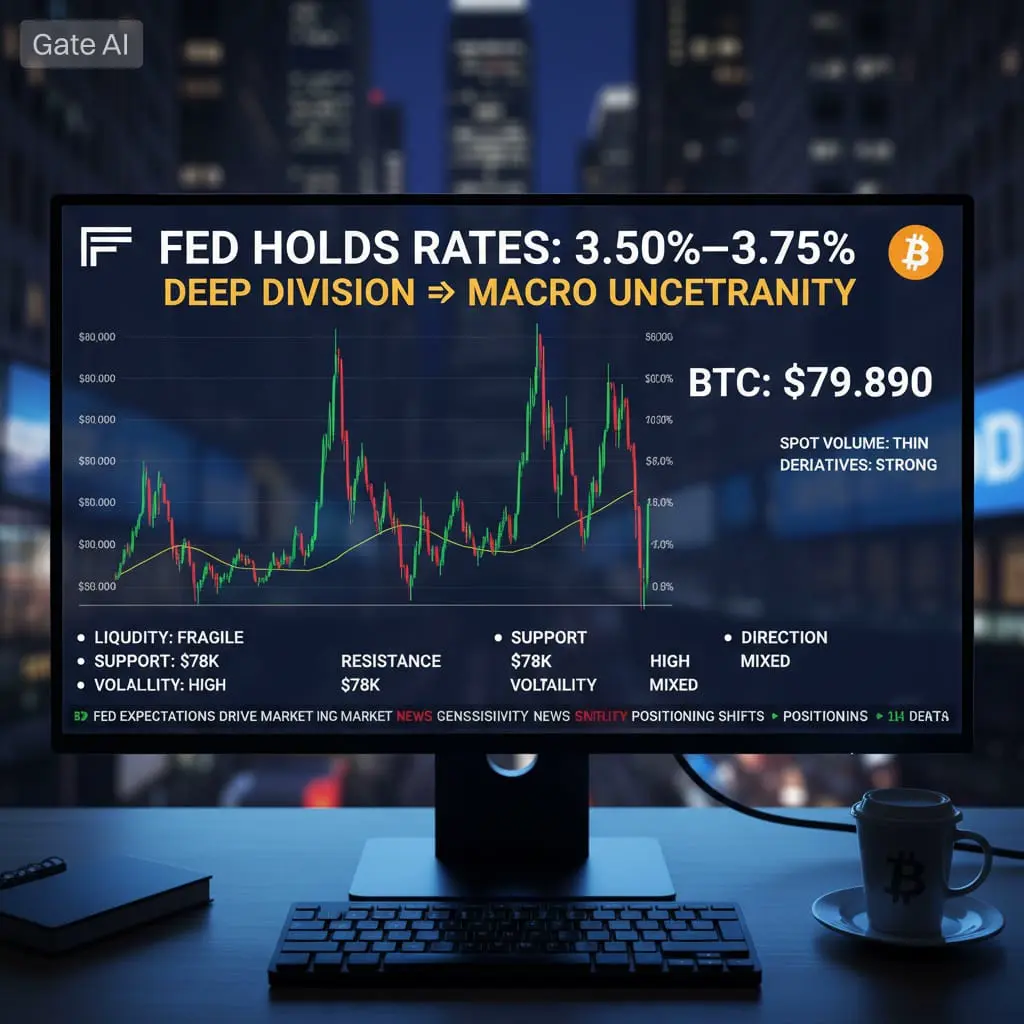
The Federal Reserve’s decision on April 29, 2026 to hold interest rates steady at 3.50%–3.75% while producing the most divided FOMC vote since 1992 (reported 8–4 split with strong dissents) has created one of the most uncertain macro environments in recent cycles. Although headline policy remains unchanged, internal fragmentation between hawkish members, dovish voices, and a cautious majority signals deep disagreement on the future path of monetary policy, generating a “policy uncertainty premium” that markets must continuously price in.
This uncertainty is critical for Bitcoin because it directly affects global liquidity expectations, dollar strength, and risk appetite. Bitcoin is no longer reacting only to crypto-specific developments but is increasingly functioning as a macro liquidity-sensitive asset where Federal Reserve communication, Treasury yields, and inflation expectations dominate short-term price behavior.
As of now, Bitcoin is trading around the $79,800 to $80,300 range after briefly touching $80,500–$80,700, showing a 24-hour gain of approximately +1.5% to +2.5%, while recovering roughly +14% to +18% from earlier consolidation below $70K. This confirms a shift from recovery phase into a macro-sensitive consolidation zone above the critical $80K level.
However, this move is occurring under very thin liquidity conditions, with spot volumes falling below $8–10 billion daily on major exchanges, one of the lowest participation levels since late 2023. This makes the market highly sensitive to institutional flows, macro headlines, and derivatives-driven positioning.
At the same time, derivatives markets are dominating price discovery, with rising open interest, fluctuating funding rates, and heavy options positioning. Institutions are not primarily accumulating spot BTC but are hedging macro uncertainty, creating a layered structure where gamma hedging and liquidation flows amplify price movements.
Recent breakout activity above $80K was driven by concentrated bursts of taker buy volume, where billions in notional exposure were executed in short timeframes, showing event-driven institutional participation rather than steady organic demand. This confirms that Fed expectations are now directly shaping Bitcoin’s intraday volatility.
From a liquidity perspective, Bitcoin is in a critical equilibrium zone between $78,000 and $80,500. The $80,000 level has become a psychological pivot, $78,000–$79,000 acts as strong support, and $82,000–$85,000 remains the next major liquidity cluster where profit-taking and hedging pressure is expected.
If momentum continues and macro conditions stabilize or turn dovish, Bitcoin could extend toward $88,000–$90,000, with potential upside toward $95,000–$100,000+ in a liquidity expansion scenario. However, if uncertainty persists or sentiment weakens, price could revisit $76,500–$77,000 or deeper zones near $70,000–$68,000.
Although nominal rates remain unchanged, real financial conditions are effectively tightening due to persistent inflation (~3.3%), labor market softness (~4.3% unemployment), and geopolitical energy pressures. This means liquidity is less supportive than the headline rate suggests, directly impacting risk assets like Bitcoin.
The Fed’s internal division increases uncertainty about future policy direction, forcing markets to price multiple scenarios simultaneously: delayed cuts, prolonged higher-for-longer policy, or future easing if economic weakness intensifies. This scenario complexity increases volatility while reducing directional conviction among institutional investors.
The bullish interpretation is that holding rates avoids immediate liquidity contraction while increasing the probability of future easing, which supports Bitcoin as a hedge against monetary instability and fiat debasement.
The bearish interpretation is that policy uncertainty delays capital deployment, leading institutions to reduce spot accumulation and rely more on hedging strategies, resulting in sideways consolidation and sharp correction risk during macro shocks.
Globally, this uncertainty impacts equities, commodities, and emerging markets, but Bitcoin often acts as both a risk asset and alternative store of value, depending on liquidity conditions and dollar sentiment.
From a derivatives structure perspective, rising open interest and unstable funding rates indicate frequent repositioning rather than long-term conviction. Options gamma exposure further increases the probability of sharp, fast moves in both directions when key levels break or fail.
Technically, Bitcoin remains supported above $78,000, but sustained continuation above $80,000 is required for a move toward $82,000–$85,000, while failure could trigger liquidity-driven pullbacks.
In conclusion, the current phase represents a macro-embedded Bitcoin market where Federal Reserve divergence, liquidity uncertainty, and institutional hedging flows dominate price action. The market is not trending cleanly but constantly recalibrating between competing macro narratives, making volatility, liquidity awareness, and patience the key drivers of performance in this environment.#GateSquareMayTradingShare #CreatorCarnival #ContentMining
repost-content-media
  • Reward
  • 1
  • Repost
  • Share
HighAmbition:
Just charge forward 👊
#DeFiLossesTop600MInApril
DeFi Losses Top $600M in April
April became one of the most damaging months in DeFi history, recording 28 separate exploits totaling $635.2M, the highest monthly incident count ever seen in decentralized finance. Unlike previous cycles dominated by small smart contract bugs, this phase showed a structural evolution where attacks shifted toward infrastructure-level manipulation, cross-chain exploits, and social engineering campaigns, creating systemic rather than isolated damage across the ecosystem.
A major portion of losses was driven by extreme single-event failu
DRIFT-2.16%
RHEA2.13%
AAVE2.39%
HighAmbition
#DeFiLossesTop600MInApril
DeFi Losses Top $600M in April
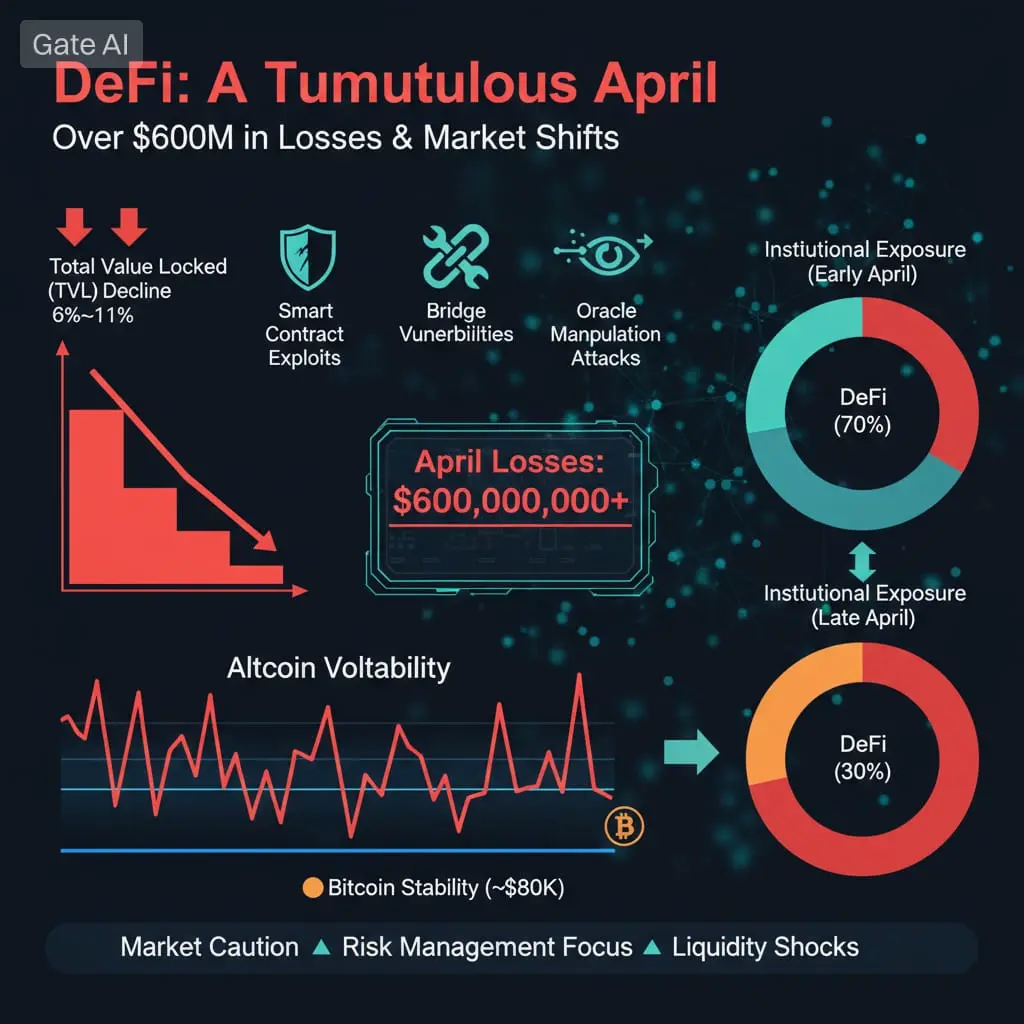
April became one of the most damaging months in DeFi history, recording 28 separate exploits totaling $635.2M, the highest monthly incident count ever seen in decentralized finance. Unlike previous cycles dominated by small smart contract bugs, this phase showed a structural evolution where attacks shifted toward infrastructure-level manipulation, cross-chain exploits, and social engineering campaigns, creating systemic rather than isolated damage across the ecosystem.
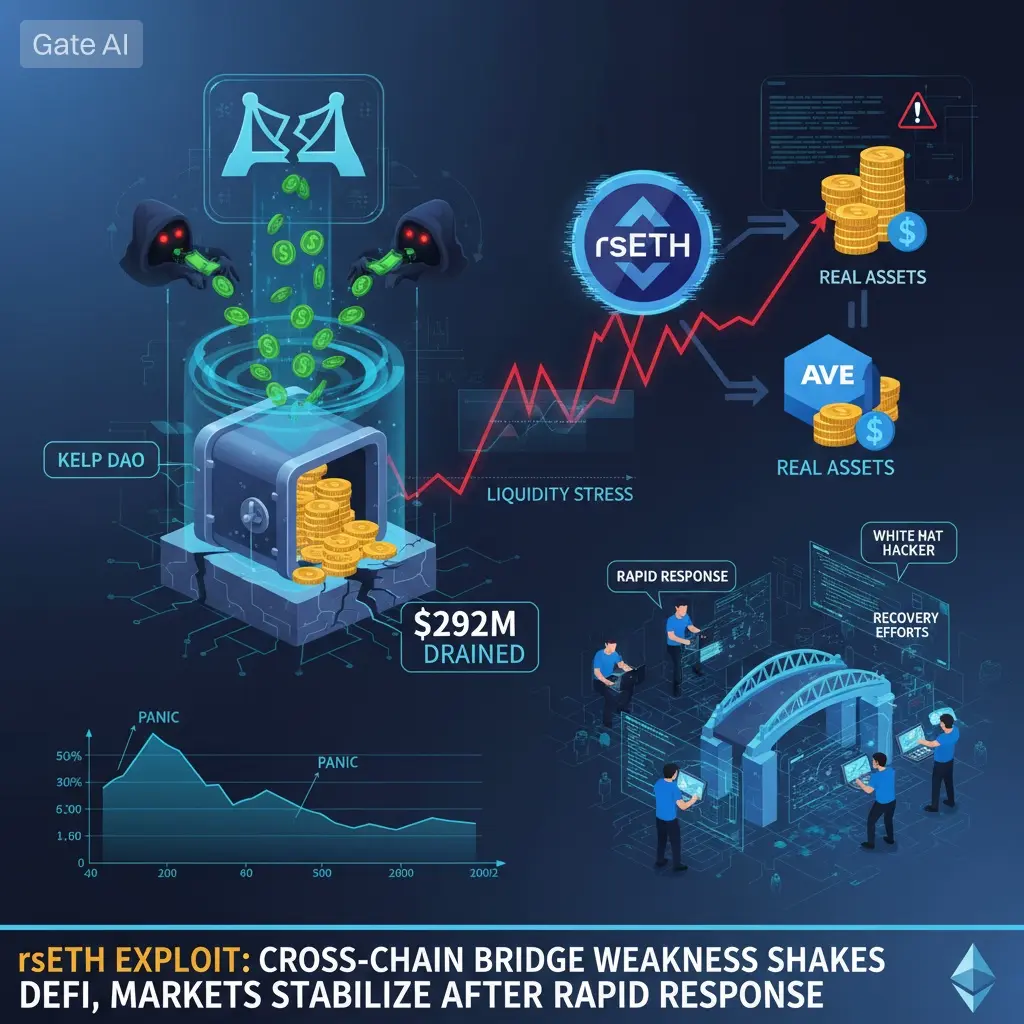
A major portion of losses was driven by extreme single-event failures, including Drift Protocol losing $285M through a 12-minute drain linked to long-term social engineering and zero-timelock admin takeover, and KelpDAO losing $293M via forged cross-chain messages exploiting LayerZero verifier weaknesses and poisoned RPC infrastructure. Alongside these, more than 20 additional incidents affected protocols like Rhea Finance ($18.4M), Grinex ($15M), Wasabi ($5.5M), and Aftermath ($1.14M), showing that vulnerability was widespread across multiple layers of DeFi.
One of the most critical macro impacts was the $13.2B DeFi TVL wipeout within 48 hours, with Aave alone losing approximately $8.45B in deposits, triggering forced liquidity exits and cascading risk reduction across lending markets. During peak stress, $355M in liquidations occurred within a single hour, highlighting how quickly DeFi leverage can unwind in fragile conditions.
Investigations linked approximately $577M (around 91% of April losses) to the Lazarus Group, marking a major escalation in state-linked cyber activity. This also pushed DPRK-attributed cumulative crypto theft estimates to around $6.75B, reinforcing concerns that DeFi is now a geopolitical attack surface, not just a financial experiment.
The nature of attacks has fundamentally changed. Instead of simple coding bugs, the dominant threat vector is now multi-layer infrastructure manipulation, oracle poisoning, flash loan coordination, and social engineering campaigns targeting governance and admin access, meaning attackers are behaving more like structured financial actors than random hackers.
This shift has also triggered a defensive response from the ecosystem. A “DeFi United” rescue coalition began forming with over $300M in emergency recovery capital, including Aave DAO committing 25,000 ETH, while institutions like Standard Chartered described the event as an “antifragile moment,” suggesting that stress is forcing long-term structural strengthening despite short-term damage.
Market impact was immediate and severe. AAVE traded in the $90–$95 range under extreme volatility, while Ethereum and Solana experienced sharp intraday drawdowns linked to liquidity withdrawal and risk-off sentiment. The broader ecosystem saw DeFi TVL contract by 6%–11% month-over-month, while high-risk chains experienced up to 15% liquidity exits, especially in synthetic stablecoin and yield farming protocols.
This liquidity shock was amplified by a cascading mechanism: exploit drains liquidity → LP withdrawals accelerate → stablecoin peg pressure increases → borrowing positions liquidate → collateral prices fall → cross-protocol contagion spreads. This is why relatively small initial exploits often resulted in $50M–$100M+ total ecosystem damage.
In parallel, crypto market conditions were already unstable. Bitcoin fluctuated between $68,000 and $80,000 (+14%–18% recovery range), Ethereum moved between $2,200 and $2,360 (+4%–6%), and altcoins experienced -8% to -25% drawdowns, especially in DeFi-linked tokens. This meant that exploit-driven shocks hit an already fragile liquidity environment.
Institutionally, reactions were defensive but strategic. Capital rotated away from unaudited DeFi protocols into BTC and ETH ETF exposure, custody-secured products, and regulated yield strategies, while hedge desks increased protection against smart contract risk. This reinforced Bitcoin’s role as a macro hedge asset compared to DeFi’s high-risk yield environment.
Several structural reasons explain why April was particularly severe: AI-driven exploit scanning tools improved attacker efficiency, rapid unaudited protocol deployment increased attack surface, yield farming incentives encouraged leverage, and fragmented liquidity across Ethereum, Arbitrum, BSC, and Solana made cross-chain exploitation easier. Additionally, outdated oracle systems and weak bridge validation frameworks remained common failure points.
On a strategic level, the ecosystem is now transitioning toward stronger security frameworks including AI-based auditing systems, real-time exploit detection, cross-chain insurance layers, decentralized oracle strengthening, and institutional-grade compliance infrastructure. If implemented successfully, analysts expect 30%–50% reduction in future exploit losses, though short-term volatility remains elevated.
Trader sentiment also shifted sharply. Retail participation in DeFi farming declined due to increased fear of smart contract risk, while opportunistic traders focused on volatility-driven short-term strategies and rotated into BTC/ETH exposure during panic events.
In conclusion, the $600M+ DeFi losses in April represent not just a wave of hacks but a structural stress test of decentralized finance, where infrastructure weaknesses, evolving attack sophistication, and fragile liquidity conditions collided simultaneously. While DeFi is not collapsing, it is clearly undergoing a forced evolution under pressure, and until security and liquidity systems mature, the sector will remain highly volatile, exploit-sensitive, and capital defensive — where preservation matters more than yield.
repost-content-media
  • Reward
  • 1
  • Repost
  • Share
HighAmbition:
Just charge forward 👊
#DailyPolymarketHotspot
BTC $80K+ $90K+ $100K+ Probability Outlook
Bitcoin is currently trading in the $79,800–$80,300 region, and the market structure has clearly shifted into a Polymarket-style probability pricing system, where price is no longer behaving like a simple trend or technical setup. Instead, it is constantly repricing the likelihood of different future outcomes based on liquidity conditions, macro expectations, ETF inflows, derivatives positioning, and institutional sentiment.
In this environment, $80K, $90K, and $100K are not just price targets — they are competing probability
BTC0.98%
HighAmbition
#DailyPolymarketHotspot
BTC $80K+ $90K+ $100K+ Probability Outlook
Bitcoin is currently trading in the $79,800–$80,300 region, and the market structure has clearly shifted into a Polymarket-style probability pricing system, where price is no longer behaving like a simple trend or technical setup. Instead, it is constantly repricing the likelihood of different future outcomes based on liquidity conditions, macro expectations, ETF inflows, derivatives positioning, and institutional sentiment.
In this environment, $80K, $90K, and $100K are not just price targets — they are competing probability outcomes that are continuously updated in real time, similar to prediction market hotspots where capital flows determine which scenario is becoming more likely.
At the $80K level, Bitcoin has formed a base equilibrium zone, where the market is balancing between buyers and sellers. This level is no longer acting as resistance but as a liquidity-supported foundation. The probability of BTC holding above $80K in the short term is currently around 70%–80%, supported by ETF inflows, institutional accumulation, and relatively thin spot supply. However, downside risk toward $78K–$77K still exists with a 20%–30% probability, especially if macro liquidity tightens or forced deleveraging occurs.
Moving higher, the $90K zone represents a momentum expansion probability layer, where continuation depends on clearing liquidity clusters around $82K–$85K. Once that zone is broken and held, probability of reaching $90K increases significantly. Current estimates place this at 45%–60% medium-term probability, with potential expansion toward 65%+ if ETF demand remains strong and macro conditions stay supportive. This zone is also expected to produce sharp reactions, consolidation phases, and profit-taking volatility.
The $100K level is a macro-cycle probability event, not just a technical target. It depends on global liquidity expansion, Fed policy direction, ETF accumulation trends, and Bitcoin’s growing role as a macro hedge asset. The probability of BTC reaching $100K currently sits around 25%–40%, but can rise toward 50%+ in a strong liquidity expansion scenario. This is the lowest probability but highest impact outcome in the current structure.
From a liquidity perspective, the market is highly sensitive because spot volume remains relatively thin while derivatives and ETF flows dominate price discovery. This means even small capital shifts can rapidly reprice probabilities between $80K, $90K, and $100K scenarios. Rising open interest and unstable funding rates confirm that positioning is reactive, not stable.
Volatility behaves differently across these zones:
• $80K = stability + consolidation probability zone
• $82K–$85K = breakout acceleration zone
• $90K = reaction + profit-taking cluster
• $100K = macro-driven exponential repricing zone
Institutionally, Bitcoin is increasingly treated as a macro hedge rather than a speculative asset, while retail traders often react emotionally to these probability shifts, amplifying volatility.
In conclusion, Bitcoin is no longer just moving in trends — it is functioning like a live Polymarket-style probability engine, where price is the output of constantly shifting expectations between $80K stability, $90K momentum expansion, and $100K macro breakout scenarios.
👉 The next major move will depend on which probability gains dominance first in this live hotspot structure.#GateSquareMayTradingShare #CreatorCarnival #ContentMining
repost-content-media
  • Reward
  • 1
  • Repost
  • Share
HighAmbition:
Just charge forward 👊
#BitcoinETFOptionLimitQuadruples
The quadrupling of Bitcoin ETF option limits represents a major structural change in Bitcoin’s financial market evolution, as it significantly impacts how institutional capital interacts with BTC, how liquidity is formed, and how price discovery functions in a system increasingly driven by regulated derivatives instead of only spot trading. This reflects a shift from a retail-focused speculative asset toward a more institutional and globally integrated financial instrument where ETFs, options, hedging activity, and macro positioning collectively influence mark
BTC0.98%
HighAmbition
#BitcoinETFOptionLimitQuadruples
The quadrupling of Bitcoin ETF option limits represents a major structural change in Bitcoin’s financial market evolution, as it significantly impacts how institutional capital interacts with BTC, how liquidity is formed, and how price discovery functions in a system increasingly driven by regulated derivatives instead of only spot trading. This reflects a shift from a retail-focused speculative asset toward a more institutional and globally integrated financial instrument where ETFs, options, hedging activity, and macro positioning collectively influence market direction.
When Bitcoin ETF options were introduced in late 2024, position limits were set at around 25,000 contracts to maintain controlled risk exposure. However, institutional demand for Bitcoin exposure through regulated products grew much faster than expected. Hedge funds, asset managers, and market makers increasingly adopted ETF options as a preferred method for exposure and risk management, which created constraints under the original limits.
Due to this rising demand, limits were later increased to 250,000 contracts, and the market is now moving toward a potential expansion near 1 million contracts. This reflects a significant increase in institutional participation capacity and shows that Bitcoin is being integrated into the same category as major traditional ETFs, where large-scale derivatives activity is standard.
This expansion directly affects Bitcoin price behavior, especially around the $80,000 level. At this stage, BTC is influenced not only by spot buying and selling but also by ETF flows, options positioning, volatility expectations, and macro sentiment. As a result, price movement is increasingly shaped by derivatives-driven liquidity rather than only retail participation.
Currently, Bitcoin trades in the $79,800 to $80,500 range, with daily fluctuations of around +1.5% to +2.5%. The $80,000 level has evolved into a structural equilibrium zone, acting as both support and a liquidity pivot where institutional activity is concentrated.
One key effect of expanding ETF option limits is the growth in open interest capacity in derivatives markets. Larger positions increase liquidity depth but also raise volatility potential, as market makers must continuously hedge exposure. These hedging flows directly influence spot Bitcoin price, making derivatives markets an active driver of price discovery.
This creates a feedback loop where price changes affect hedging activity, hedging impacts liquidity, and liquidity further influences price behavior. As a result, Bitcoin behaves less like a simple supply-demand asset and more like a dynamic system influenced by positioning and volatility expectations.
From a liquidity perspective, spot trading volume remains moderate, while derivatives and ETF-related flows dominate market activity. This makes Bitcoin more sensitive to changes in positioning and macro conditions.
Key liquidity zones include:
$78,000–$79,000 as short-term support
$80,000–$80,500 as equilibrium range
$82,000–$85,000 as resistance and liquidity expansion zone
$88,000–$90,000 as extended continuation targets
The bullish side of ETF option expansion is improved market efficiency, deeper liquidity, and stronger institutional participation. It enables advanced strategies such as hedging, volatility trading, and arbitrage, strengthening Bitcoin’s integration into global financial systems.
However, it also increases short-term volatility because larger derivative positions require continuous hedging adjustments, which can create sharper price movements and faster reversals.
Major exchanges have gradually aligned Bitcoin ETF options with traditional ETF frameworks, marking a key step in institutional acceptance of Bitcoin as a regulated asset class.
In conclusion, the expansion of Bitcoin ETF option limits is a major milestone in market structure evolution. It strengthens institutional involvement and liquidity but also increases complexity in price behavior. Bitcoin’s movement around $80,000 is now shaped by the interaction of ETF flows, derivatives positioning, and macro liquidity conditions rather than only spot market demand.
repost-content-media
  • Reward
  • 1
  • Repost
  • Share
HighAmbition:
Just charge forward 👊
#TapAndPayWithGateCard
The Tap and Pay feature with Gate Card represents a major evolution in the real-world use of cryptocurrency, because it directly connects digital assets with everyday spending in a simple, fast, and practical way. Instead of crypto being limited to trading, investing, or holding, this system transforms it into a usable payment method that works in real-world environments just like traditional debit or credit cards. This shift is important because true adoption of crypto depends not only on price growth or market activity, but on how easily people can actually use it in
BTC0.98%
HighAmbition
#TapAndPayWithGateCard
The Tap and Pay feature with Gate Card represents a major evolution in the real-world use of cryptocurrency, because it directly connects digital assets with everyday spending in a simple, fast, and practical way. Instead of crypto being limited to trading, investing, or holding, this system transforms it into a usable payment method that works in real-world environments just like traditional debit or credit cards. This shift is important because true adoption of crypto depends not only on price growth or market activity, but on how easily people can actually use it in daily life.
At its core, Gate Card acts as a bridge between crypto wallets and global payment networks. Users can store supported assets such as Bitcoin, stablecoins, or other cryptocurrencies in their account, and then spend them instantly at any NFC-enabled payment terminal. When a transaction is made, the system automatically converts the required crypto amount into fiat currency at the exact moment of payment. This removes the need for manual conversion, exchange transfers, or complicated steps before spending, making the entire process smooth and user-friendly.
One of the strongest advantages of this system is instant real-world usability. In traditional crypto usage, users often need to transfer funds to an exchange, convert them, and then withdraw fiat before spending. This creates delays and friction. Tap and Pay removes all of that, allowing users to simply tap their card and complete payment within seconds. This makes crypto usable in real-life situations such as shopping malls, restaurants, transport systems, online purchases, and international travel.
Another important benefit is simplicity for mainstream users. Many people avoid crypto not because of lack of interest, but because of complexity. Wallet management, blockchain confirmations, gas fees, and exchange processes can feel overwhelming. Gate Card simplifies this experience completely. Users do not need technical knowledge of blockchain systems; they only need to understand how to load funds and use a card. This dramatically lowers the barrier to entry for everyday adoption.
From a global usability perspective, Tap and Pay creates strong advantages for international transactions. Users can spend crypto across different countries without worrying about currency exchange rates, banking restrictions, or cross-border delays. This is especially useful for travelers, freelancers, and remote workers who deal with multiple currencies. It effectively turns crypto into a borderless spending tool, which aligns with the original vision of decentralized finance.
Security is another key pillar of the system. Gate Card transactions typically include multiple layers of protection such as encryption, identity verification, real-time fraud detection, and spending limits. Users retain full control over their assets while still enjoying fast payment experiences. In many cases, funds are only converted at the moment of transaction, reducing unnecessary exposure and improving financial safety.
From a market perspective, Tap and Pay features like this do not directly cause short-term price movements, but they strengthen long-term adoption narratives. The more crypto is used for real-world payments, the stronger its utility becomes beyond speculation. This helps shift perception from crypto as a trading asset to crypto as functional money. Over time, this kind of utility can support ecosystem growth and broader acceptance among both retail users and institutions.
Another important dimension is spending control and transparency. Users can track transactions in real time, set limits, and manage which assets are used for payments. This gives a higher level of financial flexibility compared to traditional banking systems, where spending structures are often rigid and less customizable. Crypto-based cards introduce a more dynamic and user-controlled financial experience.
The Tap and Pay system also plays a role in the evolution of Web3 payments. As blockchain infrastructure develops, financial systems are gradually moving toward more integrated and decentralized models. Gate Card represents a practical step in this direction by linking blockchain-based value storage with real-world spending networks. This helps bridge the gap between digital finance and physical commerce.
From a behavioral perspective, this feature changes how users interact with crypto. Instead of focusing only on price charts or trading strategies, users begin to treat crypto as actual money that can be spent in daily life. This psychological shift is extremely important for adoption, because mass usage depends on perception as much as technology. When people can easily use crypto for everyday needs, it becomes normalized in society.
Economically, widespread adoption of crypto payment cards could improve global payment efficiency. Cross-border transactions become faster, currency conversion friction is reduced, and financial inclusion improves in regions with limited banking access. While traditional banking systems still dominate global finance, crypto payment solutions introduce competition that can push innovation and efficiency across the entire industry.
However, challenges still exist. One major issue is price volatility when non-stable assets like Bitcoin are used for payments. Sudden market changes can affect spending value, which is why many systems rely on stablecoins for daily transactions. Regulatory differences across countries also create complexity in adoption, as financial rules for crypto payments are still evolving globally.
Despite these challenges, the overall direction remains strongly positive. As infrastructure improves and regulations become clearer, crypto payment systems like Tap and Pay are expected to grow significantly. Gate Card is part of this broader transformation, helping bridge the gap between digital assets and real-world usability in a practical and scalable way.
In conclusion, Tap and Pay with Gate Card is not just a payment feature, but a step toward making cryptocurrency fully functional in everyday life. It simplifies usage, improves global accessibility, enhances financial flexibility, and supports the long-term vision of crypto as a real-world financial system. While challenges remain, the reduction in friction between digital assets and real-world spending marks a major milestone in the journey toward mainstream crypto adoption.
repost-content-media
  • Reward
  • 1
  • Repost
  • Share
HighAmbition:
Just charge forward 👊
#OilBreaks110
Oil Breaks $110 Scenario
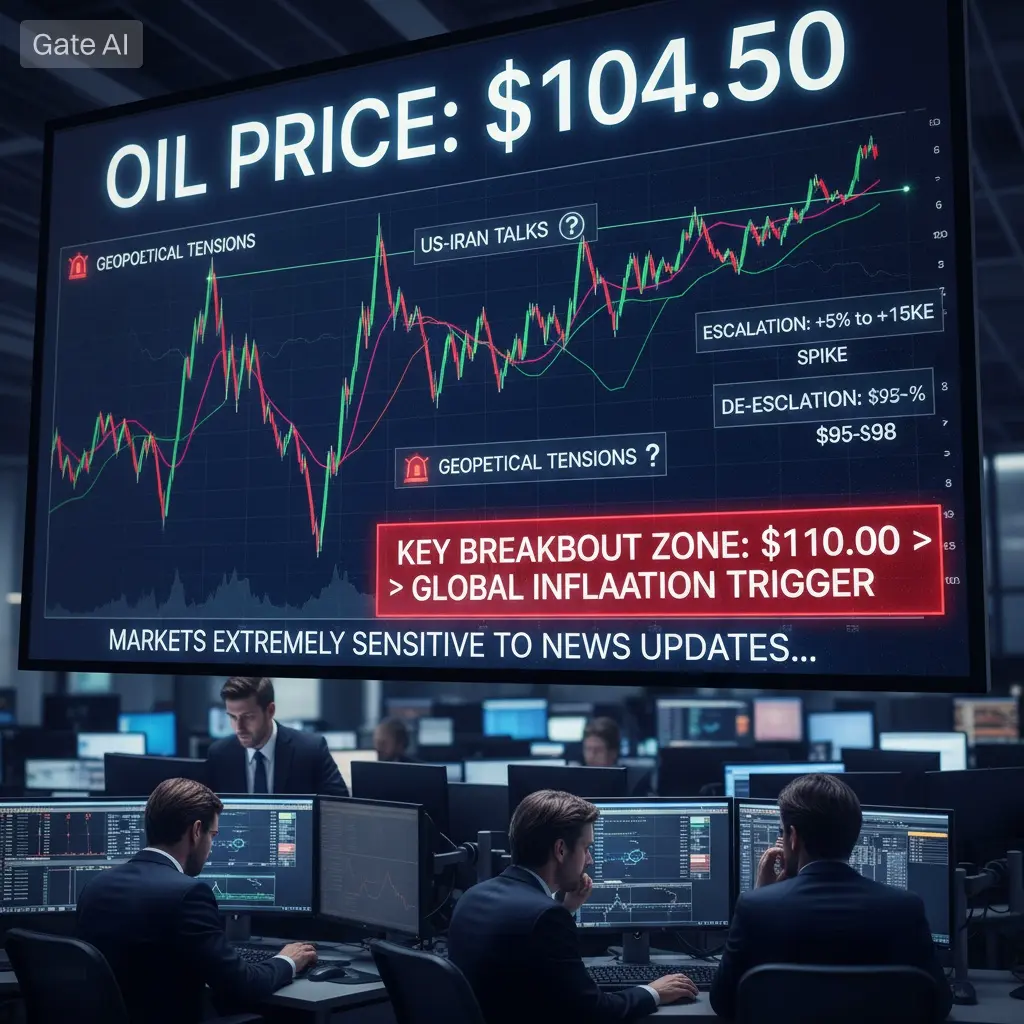
The global oil market is entering one of its most sensitive phases in recent cycles, where geopolitical tensions, particularly involving US–Iran negotiations, are directly influencing price expectations, supply risk premiums, and global inflation dynamics. While current Brent crude prices are around $104.5, the market is actively pricing in a wide range of future scenarios, including escalation risk, diplomatic breakdown, or partial de-escalation, each of which carries significantly different implications for energy prices and global financial stabilit
HighAmbition
#OilBreaks110
Oil Breaks $110 Scenario
The global oil market is entering one of its most sensitive phases in recent cycles, where geopolitical tensions, particularly involving US–Iran negotiations, are directly influencing price expectations, supply risk premiums, and global inflation dynamics. While current Brent crude prices are around $104.5, the market is actively pricing in a wide range of future scenarios, including escalation risk, diplomatic breakdown, or partial de-escalation, each of which carries significantly different implications for energy prices and global financial stability.
Oil is no longer just reacting to supply and demand fundamentals alone; it is now deeply embedded in geopolitical risk pricing, where even small developments in Middle East diplomacy can trigger multi-billion-dollar repositioning across energy futures, equities, and inflation-linked assets. The key psychological and structural threshold currently under focus is the $110 level, which acts as both a breakout trigger and an inflation shock signal for global markets.
Current Market Snapshot • Brent Crude Price: ~$104.5
• Intraday range: $102.8 – $106.2
• Weekly change: +3.5% to +6.2%
• Monthly performance: +10% to +14%
• Volatility: Elevated due to geopolitical uncertainty
• Futures positioning: Increasing long exposure with hedging overlays
Despite relatively stable pricing in the low $100s, the structure underneath shows increasing tension, as traders are positioning for a potential supply disruption scenario.
1. US–Iran Talks: The Core Price Driver
The primary catalyst behind oil volatility is the uncertain trajectory of US–Iran negotiations. Currently, talks are described as stalled with intermittent escalation risks, meaning there is no stable diplomatic framework anchoring expectations.
Key scenarios affecting oil:
• De-escalation scenario (bearish for oil):
Partial sanctions relief
Increased Iranian export capacity (+0.8 to +1.5 million barrels/day)
Price impact: potential -5% to -12% correction
Brent could retreat toward $95–$98 range
• Status quo scenario (neutral):
Ongoing diplomatic deadlock
Limited Iranian exports
Oil remains range-bound between $100–$108
Volatility remains elevated but controlled
• Escalation scenario (bullish shock):
Sanctions tightening or military tensions
Supply disruption risk in Strait of Hormuz
Potential loss of 2–3 million barrels/day globally
Price spike toward $110–$125+ (+5% to +20% immediate reaction)
2. Why $110 Level Is Structurally Critical
The $110 level is not just a technical resistance zone; it represents a global inflation trigger threshold:
• Energy input costs rise sharply • Transport and logistics inflation increases • Central banks face renewed inflation pressure • Risk assets (stocks, crypto) experience liquidity stress
Historically, oil above $110 has coincided with: • Stronger US dollar cycles
• Tightening monetary policy expectations
• Higher bond yields
• Risk-off sentiment across global markets
3. Supply–Demand Structure Breakdown
Current global oil dynamics:
• Global demand growth: ~1.2%–1.8% YoY
• OPEC+ production: tightly managed with selective cuts
• Non-OPEC supply: stable but not expanding aggressively
• Strategic reserves: partially deployed in past cycles
This creates a fragile balance where any geopolitical shock can instantly flip the market from surplus perception to deficit fear.
Estimated supply risk sensitivity: • Minor disruption: +3% to +6% price impact
• Medium disruption: +8% to +15%
• Major geopolitical shock: +20% to +30% spike potential
4. Market Volatility & Trading Behavior
Oil volatility has increased significantly due to:
• High-frequency geopolitical news trading
• Algorithmic reaction to headlines
• Futures-driven liquidity spikes
• Hedge fund macro positioning
Daily volatility range: • Normal regime: 1.5%–3%
• Current regime: 3%–6%
• Shock regime: 8%–15% intraday moves
This makes oil one of the most reactive macro assets currently.
5. Inflation Transmission Effect
If oil moves toward $110+:
• Global CPI increases by +0.3% to +0.8%
• Transportation costs rise sharply
• Energy-importing countries face currency pressure
• Central banks delay rate cuts or tighten policy bias
This indirectly affects: • Equities (bearish pressure)
• Crypto (liquidity tightening)
• Emerging markets (currency weakness)
6. Global Market Reaction Channels
Oil price increases impact multiple asset classes:
• USD strengthens (safe-haven demand)
• Gold rises as inflation hedge
• Crypto experiences short-term liquidity pressure
• Stock markets face margin contraction
• Bond yields adjust higher expectations
This is why oil is considered a global macro anchor asset.
7. Institutional Positioning
Institutions are currently: • Increasing long oil exposure as geopolitical hedge
• Maintaining optionality via futures spreads
• Using energy as inflation protection asset
• Hedging downside via options volatility structures
However, positioning is not one-directional — it is highly hedged due to uncertainty.
8. Trader Psychology & Sentiment
Market sentiment is extremely sensitive:
• $100–$105 = uncertainty zone
• $110 = breakout fear/greed trigger
• $120+ = crisis pricing zone
Retail traders often: • Chase breakout momentum
• Exit during geopolitical headlines
• React strongly to short-term spikes
Institutional traders: • Focus on supply fundamentals
• Hedge aggressively rather than speculate
9. Forward Price Scenarios
Bullish (geopolitical escalation): • $110 breakout confirmed
• Extension toward $115–$125
• Extreme case: $130+ spike if supply shock occurs
Neutral (status quo diplomacy): • Consolidation between $100–$108
• Range-bound volatility
• No structural breakout
Bearish (de-escalation): • Drop toward $95–$98
• Potential retest of $90–$92 support zone
• Relief rally in risk assets (stocks, crypto)
Final Conclusion
Oil at $104.5 is currently sitting in a high-tension equilibrium zone where geopolitical uncertainty dominates price structure. The US–Iran situation acts as the central catalyst, and the market is continuously repricing risk based on diplomatic signals.
👉 $110 is not just a price — it is a global macro trigger level
👉 Above it = inflation shock + risk asset pressure
👉 Below it = stabilization + risk recovery
Oil is no longer just an energy commodity; it is now a global financial stress indicator, directly influencing inflation, interest rates, and risk asset behavior across the entire financial system.
repost-content-media
  • Reward
  • 1
  • Repost
  • Share
HighAmbition:
Just charge forward 👊
#USSeeksStrategicBitcoinReserve
Bitcoin at $80,032:
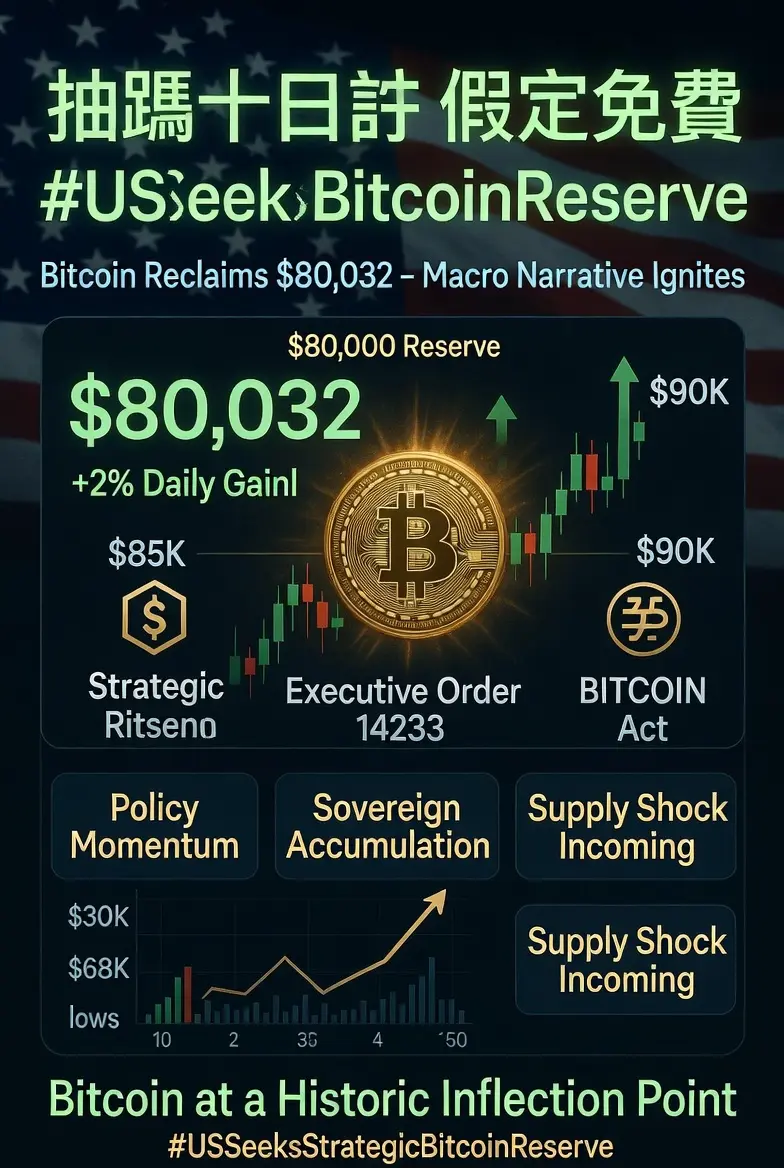
Bitcoin reclaiming and stabilizing above the $80,032 level is not just a technical breakout but a reflection of a much larger structural shift where macro narratives, sovereign-level policy discussions, and institutional positioning are merging into a single market force, because what we are witnessing now is not a retail-driven rally but a macro-sensitive revaluation of Bitcoin’s role in global finance, driven by the growing possibility that it could be formally integrated into national reserve strategies.
As of this phase, Bitcoin is tra
HighAmbition
#USSeeksStrategicBitcoinReserve
Bitcoin at $80,032:
Bitcoin reclaiming and stabilizing above the $80,032 level is not just a technical breakout but a reflection of a much larger structural shift where macro narratives, sovereign-level policy discussions, and institutional positioning are merging into a single market force, because what we are witnessing now is not a retail-driven rally but a macro-sensitive revaluation of Bitcoin’s role in global finance, driven by the growing possibility that it could be formally integrated into national reserve strategies.
As of this phase, Bitcoin is trading in the $79,800 to $80,200 range after briefly touching an intraday high near $80,500, showing a daily gain of nearly +2% with strong momentum continuation, and this move comes after a broader recovery of approximately +14% to +15% from earlier lows near $68,000, which confirms that the market structure has shifted from deep correction into controlled bullish recovery supported by both spot and derivatives activity, where aggressive buy-side volume and increased futures participation indicate conviction rather than random volatility.
The importance of this price level is amplified by the narrative surrounding a potential United States Strategic Bitcoin Reserve, which has evolved gradually from early ideological discussions into structured legislative and executive-level frameworks, and this evolution began with long-term Bitcoin advocacy that positioned BTC as a hedge against monetary debasement, later gaining political relevance during election cycles where digital asset policy became part of broader economic strategy discussions, especially with figures like Senator Cynthia Lummis introducing the BITCOIN Act concept that proposed large-scale sovereign accumulation of Bitcoin over time.
This narrative took a more concrete institutional shape with Executive Order 14233, signed on March 6, 2025, which established a dual structure consisting of a Strategic Bitcoin Reserve alongside a broader Digital Asset Stockpile, while introducing a forfeited-asset-based accumulation model where seized cryptocurrencies could serve as the initial foundation of government holdings, meaning that rather than immediately entering the open market with large purchases, the United States could gradually build exposure through existing asset recovery mechanisms, which reduces short-term market shock but still signals long-term strategic intent.
However, one of the most debated and uncertain aspects remains the actual amount of Bitcoin held by the United States government, with estimates ranging widely from approximately 28,988 BTC to over 328,000 BTC, largely due to historical liquidation events where confiscated Bitcoin was auctioned instead of retained, and this past policy choice is now being re-evaluated by markets as potentially shortsighted, especially in an environment where Bitcoin’s long-term appreciation and strategic value are increasingly recognized.
Building on this, the BITCOIN Act proposed by Senator Lummis outlines a far more aggressive long-term accumulation strategy targeting up to 1 million BTC, potentially financed through mechanisms such as gold certificate revaluation and supported by Proof-of-Reserve transparency frameworks to ensure accountability and public visibility, while simultaneously elevating Bitcoin into the category of sovereign reserve assets alongside traditional instruments like gold and foreign currency reserves.
Complementing this legislative direction, the Mined in America Act focuses on strengthening domestic Bitcoin mining infrastructure and securing supply chain independence, ensuring that if Bitcoin becomes strategically important at a national level, the United States maintains control over production capacity and network participation, while also reducing reliance on foreign mining dominance and reinforcing energy and technological sovereignty.
Further expansion of this vision is reflected in the American Reserves Modernization Act proposed by Representative Begich, which also targets a structured acquisition of up to 1 million BTC over a five-year timeline, reinforcing the idea that multiple political actors are converging toward a similar strategic conclusion, even if their execution methods and timelines differ, which in itself increases market confidence in the probability of long-term sovereign adoption.
Adding to market anticipation, remarks and teasers from figures such as Patrick Witt at Bitcoin 2026 suggesting upcoming legal and executive developments have further strengthened speculative positioning, as traders and institutions attempt to price in not just current policy but expected future actions, creating a forward-looking demand curve that contributes to sustained bullish pressure even during short-term consolidation phases.
From a market structure perspective, a strategic Bitcoin reserve implies long-term holding of large quantities of BTC by sovereign entities, which effectively reduces liquid circulating supply and introduces a structural supply shock over time, especially if multiple nations begin accumulating simultaneously, creating a competitive accumulation environment similar to a geopolitical reserve race where early adopters gain strategic advantage in digital asset positioning.
Supporters of this concept argue that Bitcoin provides diversification away from traditional reserve assets, acts as a hedge against inflation and sovereign debt expansion, enhances national competitiveness in a digital financial system, and reframes volatility as a manageable long-term characteristic rather than a disqualifying risk, particularly when viewed through multi-decade financial cycles where scarcity and adoption trends dominate price discovery.
On the opposing side, critics highlight significant risks including extreme price volatility that could introduce instability into national balance sheets, questions regarding Bitcoin’s suitability as a reserve asset compared to traditionally stable instruments, governance and custody challenges at sovereign scale, cybersecurity risks associated with large-scale digital asset storage, and ideological resistance from free-market institutions that oppose government intervention in decentralized asset ecosystems, all of which contribute to ongoing policy debate and slow legislative progression.
At the global level, this discussion is no longer isolated, as countries such as El Salvador have already adopted Bitcoin as a national asset, while other major economies including the Czech Republic, Russia, Nigeria, China, and the United Kingdom are either observing or actively evaluating their own digital asset frameworks, creating the possibility of a multi-nation reserve competition where early strategic positioning could define long-term economic influence in the digital monetary era.
Simultaneously, broader regulatory frameworks such as the GENIUS Act, along with discussions around stablecoin regulation and the CLARITY Act, indicate that policymakers are not only focused on Bitcoin but are actively building a comprehensive digital asset ecosystem framework that integrates multiple components of crypto infrastructure into national financial policy, suggesting that Bitcoin is becoming part of a larger structural transformation rather than an isolated asset discussion.
From a trading and market impact perspective, narratives like a strategic Bitcoin reserve tend to generate strong bullish sentiment because they imply long-term accumulation and reduced supply pressure, but markets rarely move in straight lines, instead cycling through phases of anticipation, reaction, and consolidation, which is exactly what is currently being observed around the $80K psychological level where liquidity, profit-taking, and new demand are actively interacting.
Technically, Bitcoin now sits at a critical decision zone where sustained volume and follow-through above $80,000 could open the path toward $82,000 and $85,000 levels, with extended momentum potentially targeting the $90,000 psychological region, while failure to hold this breakout area could lead to a healthy retracement toward support zones around $75,000 to $78,000 before another structural attempt, making this phase highly sensitive and dependent on confirmation rather than prediction.
In terms of trading strategy, this environment demands discipline, patience, and risk control rather than aggressive speculation, where traders should prioritize multi-timeframe alignment, wait for liquidity-based confirmations, avoid emotional entries near psychological resistance, and focus on high-probability setups rather than constant market participation, because in macro-driven conditions like this, overtrading often leads to unnecessary exposure while selective execution tends to outperform.
At a deeper level, the entire debate around a United States Strategic Bitcoin Reserve represents a philosophical shift in how money, sovereignty, and digital scarcity are perceived, dividing opinion between those who view Bitcoin as a legitimate evolution of global reserve architecture and those who see it as an unstable speculative asset unsuitable for national balance sheets, and this ideological conflict ensures that the narrative will continue evolving over years rather than resolving quickly.
In conclusion, Bitcoin at $80,032 is not just reacting to technical resistance but is actively pricing in a much larger macro narrative involving sovereign adoption, legislative experimentation, and global reserve competition, and while full implementation of a US strategic reserve may take time and face political complexity, the very progression of this idea is already reshaping market psychology, liquidity behavior, and long-term capital flows, making it one of the most influential and closely watched developments in the current crypto cycle.
#GateSquareMayTradingShare #CreatorCarnival #ContentMining

repost-content-media
  • Reward
  • 1
  • Repost
  • Share
HighAmbition:
Just charge forward 👊
#FirstTradeOfTheWeek
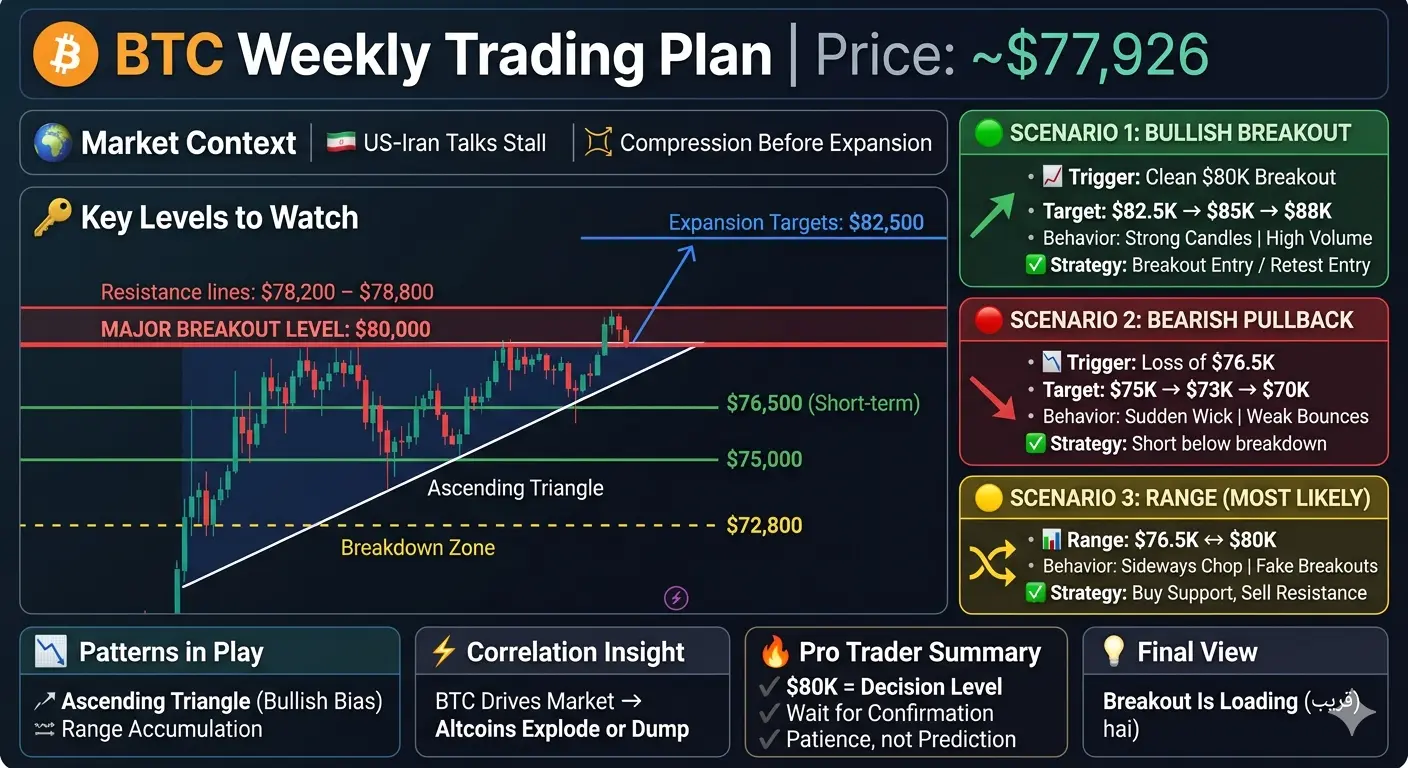
🪙 BTC Weekly Trading Plan (Price ~77,926)
🌍 Market Context (This Week)
Ongoing tension after US-Iran nuclear talks stall
Liquidity cautious, volatility compressed
Bitcoin holding strong but not breaking resistance
👉 Market = Compression before expansion
📊 Key Levels to Watch
🔑 Resistance Zones
$78,200 – $78,800 → Local resistance
$80,000 → Major breakout level
$82,500 → Expansion target
🔑 Support Zones
$76,500 → Short-term support
$75,000 → Key structure level
$72,800 → Breakdown zone
🟢 SCENARIO 1: BULLISH BREAKOUT
📈 Trigger: Clean breakout above $80K
Expected Mov
BTC0.98%
APE-1.75%
HighAmbition
#FirstTradeOfTheWeek
🪙 BTC Weekly Trading Plan (Price ~77,926)
🌍 Market Context (This Week)
Ongoing tension after US-Iran nuclear talks stall
Liquidity cautious, volatility compressed
Bitcoin holding strong but not breaking resistance
👉 Market = Compression before expansion
📊 Key Levels to Watch
🔑 Resistance Zones
$78,200 – $78,800 → Local resistance
$80,000 → Major breakout level
$82,500 → Expansion target
🔑 Support Zones
$76,500 → Short-term support
$75,000 → Key structure level
$72,800 → Breakdown zone
🟢 SCENARIO 1: BULLISH BREAKOUT
📈 Trigger: Clean breakout above $80K
Expected Move: 👉 $80K → $82.5K → $85K → $88K
🧠 Behavior:
Strong impulsive candles
High volume breakout
FOMO entries increase
✔ Strategy:
Breakout entry above $80K (confirmation candle)
Retest entry if price holds $80K as support
🔴 SCENARIO 2: BEARISH PULLBACK
📉 Trigger: Loss of $76.5K
Expected Move: 👉 $76.5K → $75K → $73K → $70K
🧠 Behavior:
Slow bleed OR sudden liquidation wick
Weak bounces (lower highs)
Fear returns to market
✔ Strategy:
Short below breakdown with confirmation
Avoid early entries (fake breakdown risk)
🟡 SCENARIO 3: RANGE (MOST LIKELY)
📊 Range: 👉 $76.5K ↔ $80K
🧠 Behavior:
Fake breakouts both sides
Liquidity grabs
Sideways chop
✔ Strategy:
Buy near support, sell near resistance
Quick scalps only
Avoid overtrading
📉 Patterns in Play
Ascending Triangle (Bullish Bias)
Liquidity Compression Zone
Range Accumulation Structure
👉 Big move is loading, but direction not confirmed yet
⚡ Correlation Insight
BTC still driving entire market
If BTC breaks → Altcoins (like APE) explode
If BTC drops → Alts dump harder
🔥 Pro Trader Summary
👉 $80K = Decision Level
👉 Above = Expansion Phase
👉 Below $76.5K = Weakness
⚠️ Trader Rule This Week
✔ Wait for confirmation
✔ Avoid chasing pumps
✔ Respect macro news (geopolitics active)
✔ Risk management is everything
repost-content-media
  • Reward
  • 1
  • Repost
  • Share
HighAmbition:
that's great
#Gate13thAnniversaryLive
The 13-Year Legacy of GATE: A Journey of Excellence, Growth, and Transformation
A Milestone Beyond Celebration
The completion of 13 remarkable years of GATE is not merely a numerical milestone; it represents a powerful journey of academic discipline, structured evaluation, and continuous evolution that has redefined how engineering talent is identified, nurtured, and elevated across highly competitive academic and professional landscapes.
This anniversary reflects years of consistent effort, refinement, and innovation, where the focus has always remained on building a
HighAmbition
#Gate13thAnniversaryLive
The 13-Year Legacy of GATE: A Journey of Excellence, Growth, and Transformation
A Milestone Beyond Celebration
The completion of 13 remarkable years of GATE is not merely a numerical milestone; it represents a powerful journey of academic discipline, structured evaluation, and continuous evolution that has redefined how engineering talent is identified, nurtured, and elevated across highly competitive academic and professional landscapes.
This anniversary reflects years of consistent effort, refinement, and innovation, where the focus has always remained on building a fair, transparent, and intellectually demanding platform that challenges students to think deeply, analyze critically, and perform with clarity rather than relying on superficial preparation.
The Vision Behind GATE: Building Merit Through Excellence
At its core, GATE was never just designed to be an examination; it was envisioned as a gateway that connects academic learning with real-world engineering and research opportunities, ensuring that merit becomes the true foundation of selection and progression.
Over the years, this vision has strengthened, and today GATE stands as a globally respected benchmark that evaluates not only knowledge but also the ability to apply concepts under pressure, solve complex problems, and demonstrate analytical depth in a highly competitive environment.
Evolution Over 13 Years: A System That Never Stopped Improving
One of the most impressive aspects of GATE’s journey is its continuous evolution, where every passing year has brought meaningful improvements in structure, pattern, and evaluation methodology to align with modern academic and industry expectations.
The system has gradually integrated advanced digital processes, improved question design standards, enhanced fairness in evaluation, and consistently refined its approach to ensure that students are assessed in the most accurate and unbiased manner possible.
This constant improvement reflects a commitment not just to maintain standards but to raise them higher with every passing year.
Impact on Students: Shaping Futures, Not Just Careers
The influence of GATE extends far beyond examination results, as it has played a transformative role in shaping the academic and professional futures of millions of students who aspire to excel in engineering, technology, and research domain
It has opened doors to prestigious institutions, created opportunities in leading public sector organizations, and encouraged students to develop a mindset focused on innovation, research, and problem-solving at a global level.
More importantly, it has taught students the value of consistency, patience, and structured preparation, which remain essential skills for lifelong success.
Personal Reflection: A Journey from Zero to Continuous Learning
On a personal level, this journey holds deep meaning, because starting from zero and gradually building understanding through consistent effort has been both challenging and incredibly rewarding.
Every step of learning has contributed to building confidence, improving conceptual clarity, and developing a stronger mindset that embraces growth rather than fearing difficulty.
I sincerely feel grateful for this journey and thank Almighty Allah for guiding me through every phase of learning, allowing me to understand complex concepts, improve my skills, and stay motivated even during moments of struggle or uncertainty.
Working and learning in this environment has not only improved my knowledge but has also given me a sense of purpose, discipline, and continuous self-improvement.
The Role of GATE Authority: Ensuring Fairness and Excellence
The GATE authority has played a crucial role in maintaining the integrity, credibility, and fairness of the entire system, ensuring that every candidate is evaluated on equal grounds without bias or influence.
Through strict standards, transparent processes, and continuous updates, it has successfully built trust among students, institutions, and organizations that rely on GATE scores for admissions and recruitment.
This level of trust is not easily achieved; it is the result of years of dedication, responsibility, and commitment to academic excellence.
Why GATE Stands Out in the Academic World
What makes GATE truly exceptional is its ability to combine academic depth with practical relevance, ensuring that students are not only tested on theoretical knowledge but also on their ability to apply that knowledge in real-world scenarios.
This balance between theory and application has made it one of the most respected and competitive examinations in the field of engineering and technology, setting a benchmark that many other systems aim to achieve.
Future Outlook: A Platform Ready for the Next Level
As GATE moves forward beyond its 13-year milestone, the future looks even more promising with the potential integration of advanced technologies, improved assessment techniques, and greater accessibility for students across different regions.
The focus will continue to remain on enhancing transparency, improving evaluation accuracy, and aligning the system with global educational standards to ensure that it remains relevant and impactful in the years to come.
Final Thoughts: More Than an Exam, A Journey of Transformation
GATE is not just an examination system; it is a journey of transformation that shapes minds, builds careers, and strengthens futures through discipline, effort, and continuous learning.
This 13-year journey stands as a powerful example of how consistency, vision, and dedication can create a platform that not only evaluates talent but also nurtures it into something far great
For me personally, being part of this learning experience has been a meaningful and inspiring journey, and I remain truly grateful for every step of growth it has brought into my life.
repost-content-media
  • Reward
  • Comment
  • Repost
  • Share
#EthereumMarketAnalysis
Comprehensive Ethereum (ETH) Market Analysis
Current Market Status
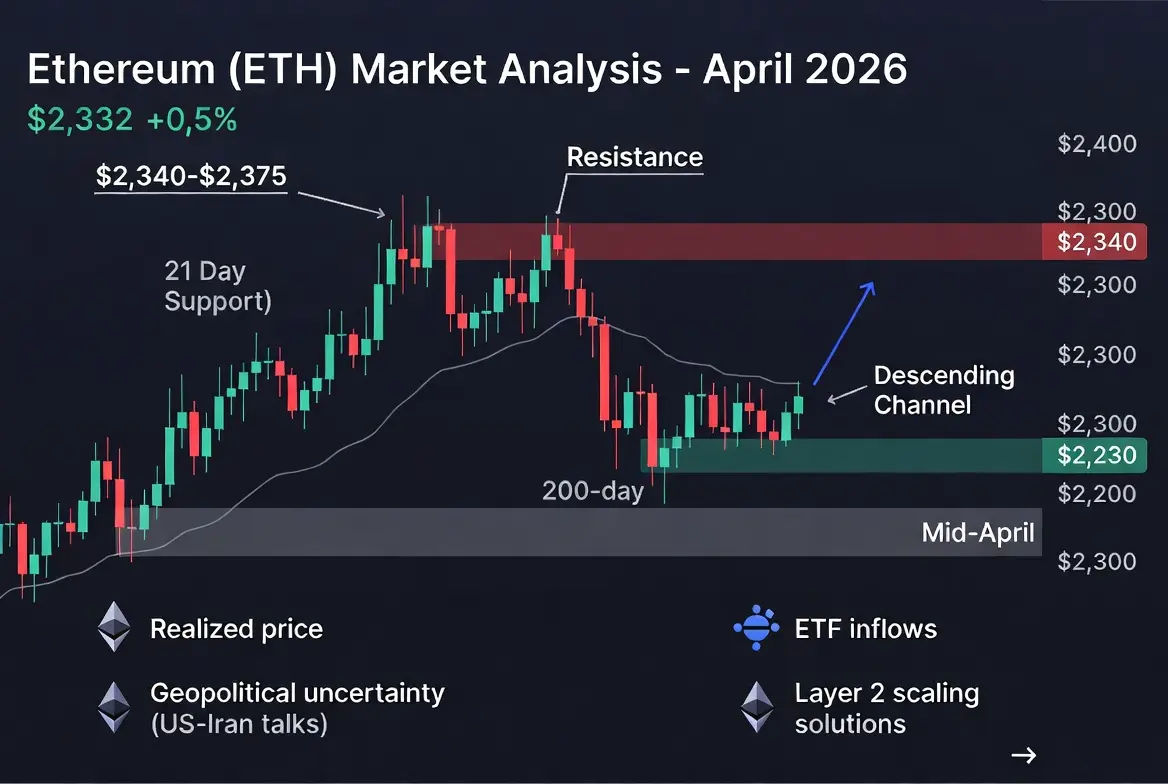
Ethereum is currently trading around $2,332, showing modest positive movement with a 0.53% gain over the past 24 hours. The price has been consolidating within a narrow range between $2,301 and $2,337, reflecting a period of indecision as market participants await clearer directional catalysts. Trading volume remains healthy at approximately $113 million in 24-hour quote volume, indicating sustained interest despite the sideways price action.
US-Iran Peace Talks and Geopolitical Impact
The stalled US-Ir
ETH-0.7%
BTC0.98%
AAVE2.39%
ARB-1.96%
HighAmbition
#EthereumMarketAnalysis
Comprehensive Ethereum (ETH) Market Analysis
Current Market Status
Ethereum is currently trading around $2,332, showing modest positive movement with a 0.53% gain over the past 24 hours. The price has been consolidating within a narrow range between $2,301 and $2,337, reflecting a period of indecision as market participants await clearer directional catalysts. Trading volume remains healthy at approximately $113 million in 24-hour quote volume, indicating sustained interest despite the sideways price action.
US-Iran Peace Talks and Geopolitical Impact
The stalled US-Iran peace negotiations represent a significant overhang on risk assets including Ethereum. Recent reports indicate that talks in Islamabad ended without breakthrough, with Iran blaming US naval blockades for the impasse. This geopolitical uncertainty has created a risk-off environment where institutional capital tends to retreat from high-beta assets like cryptocurrencies.
The connection between these talks and ETH valuation operates through multiple channels. First, successful negotiations would likely reduce oil prices and inflationary pressures, potentially allowing central banks to maintain or lower interest rates. Lower rates generally benefit crypto markets by reducing the opportunity cost of holding non-yielding assets and improving liquidity conditions. Conversely, failed talks or escalating tensions could trigger safe-haven flows into traditional assets while pressuring risk-on positions.
Recent market behavior suggests crypto may be developing resilience to geopolitical shocks. During the latest Iran-related flare-up, Bitcoin and Ethereum showed more muted reactions compared to traditional markets like oil and equities. This divergence could indicate that crypto holders who were inclined to sell on geopolitical headlines have already exited, or that spot ETF inflows are providing a more stable demand floor than previous cycles dominated by futures-driven volatility.
Technical Analysis and Key Levels
From a technical perspective, Ethereum faces immediate resistance at $2,340-$2,375, which aligns with the 21-period simple moving average and the upper band of a descending trend channel that formed in mid-April. Support levels are clustered around $2,300, $2,230 (near the 200-period EMA), and $2,180 at the lower band of the descending channel.
The price structure shows ETH trading below its 21 SMA while remaining within a descending trend channel, suggesting near-term weakness. However, the realized price around $2,340 has been acting as dynamic support, and holding above this level could signal potential for macro expansion. A decisive break below $2,230 would invalidate the bullish structure and potentially target $1,845, while a sustained move above $2,375 could open the path toward $2,900 resistance.
Factors Impacting Ethereum
Multiple fundamental factors are currently influencing Ethereum's price trajectory. On the positive side, institutional adoption continues through spot ETF inflows and increased staking participation. Major institutions like Grayscale and BitMine have expanded their ETH holdings, while the DeFi ecosystem shows resilience with initiatives like Aave's DeFi United raising substantial ETH for risk mitigation.
Technological developments also support the bull case. The Pectra upgrade has improved network efficiency, while Layer 2 scaling solutions including Arbitrum, Optimism, and Base are processing millions of transactions daily at reduced costs. Uniswap V4 Hooks and privacy proposals like EIP-8182 demonstrate ongoing innovation within the ecosystem.
Conversely, bearish pressures include tightening liquidity conditions, negative funding rates in derivatives markets, and rising Bitcoin dominance which often correlates with ETH underperformance. The broader DeFi sector faces systemic risk concerns following recent security incidents, though community responses like the DeFi United initiative show the ecosystem's capacity for collaborative problem-solving.
Trading Strategy Recommendations
For active traders, the current environment suggests a cautious approach with clear risk management parameters. Short-term traders might consider short positions if ETH rejects at the $2,375 resistance level, targeting $2,300 and potentially $2,230 on breaks below the ascending trend channel. Stop-losses should be placed above $2,400 to protect against false breakouts.
Long-term position traders may find accumulation opportunities on any dips toward the $2,200-$2,300 range, particularly if the price holds above the 200 EMA. The confluence of realized price support and long-term technical structure suggests this zone could represent favorable risk-reward entry points for multi-month positions.
Risk management remains paramount given the geopolitical overhang. Position sizing should reflect the elevated uncertainty, with traders prepared for potential volatility spikes if US-Iran talks show meaningful progress or deterioration. Monitoring funding rates, perpetual swap premiums, and options market skew can provide early signals of shifting sentiment.
Outlook and Conclusion
Ethereum sits at a critical juncture where near-term technical weakness contrasts with longer-term fundamental strength. The stalled US-Iran negotiations create uncertainty that could persist until diplomatic clarity emerges, potentially capping upside until resolved. However, the ecosystem's institutional adoption, technological progress, and demonstrated resilience to geopolitical shocks suggest underlying support.
Traders should remain flexible, prepared to adjust positions based on both technical breaks and geopolitical developments. The $2,230-$2,375 range defines the current battleground, with breaks in either direction likely to establish the next significant trend. Patience and disciplined risk management will be essential until clearer directional signals emerge from both technical patterns and macro developments.
repost-content-media
  • Reward
  • Comment
  • Repost
  • Share
#BTC
## BTC Current Status
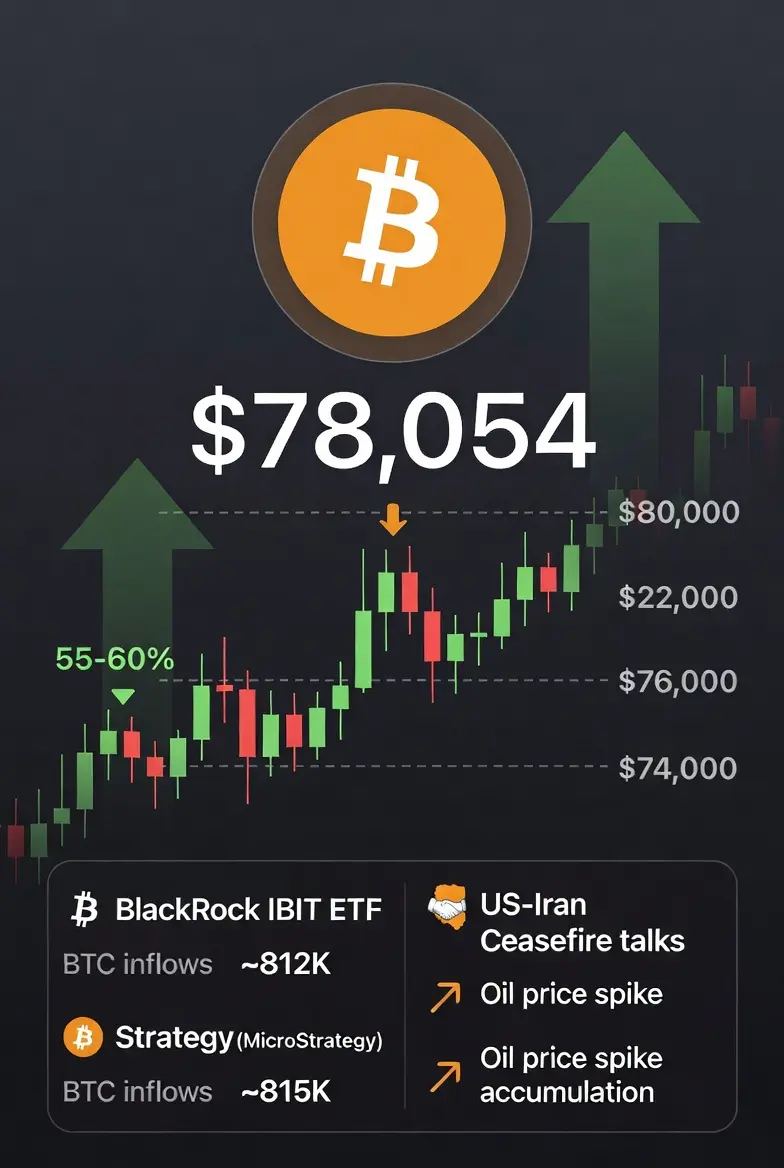
Bitcoin is trading at $78,054.40 with a 24-hour gain of 0.45%. Over the past week, it has risen 2.92%, and the monthly performance shows an impressive 17.59% increase. The price has broken above $78K and is consolidating near four-week highs. The market structure presents mixed signals: short-term momentum appears bullish with a double bottom formation visible on the charts, but daily indicators including CCI, Williams %R, and MACD suggest overbought conditions that could trigger a pullback.
US. IRAN Situation: Latest Updates
Tensions between the US and Iran remain
BTC0.98%
HighAmbition
#BTC
## BTC Current Status
Bitcoin is trading at $78,054.40 with a 24-hour gain of 0.45%. Over the past week, it has risen 2.92%, and the monthly performance shows an impressive 17.59% increase. The price has broken above $78K and is consolidating near four-week highs. The market structure presents mixed signals: short-term momentum appears bullish with a double bottom formation visible on the charts, but daily indicators including CCI, Williams %R, and MACD suggest overbought conditions that could trigger a pullback.
US. IRAN Situation: Latest Updates
Tensions between the US and Iran remain elevated, though ceasefire talks are ongoing. Recent reports indicate that extended US-Iran ceasefire talks have lifted overall market risk appetite, pushing Bitcoin to monthly highs near $78,922. Iran reimposed controls over the Strait of Hormuz during the weekend, causing Brent crude oil to jump 5.7% while Bitcoin only experienced a modest 1.6% pullback, demonstrating crypto's relative resilience compared to traditional markets. BlackRock and Strategy (formerly MicroStrategy) appear to be in an arms race for Bitcoin supply accumulation. BlackRock's IBIT ETF recorded $612 million in inflows last week, while Strategy now holds 815,061 BTC, surpassing BlackRock's 802,823 BTC holdings. Each Iran-related shock is producing smaller Bitcoin sell-offs than the previous one, suggesting that geopolitical risk is largely priced into the market. Crypto is increasingly acting as a geopolitical shock absorber.
BULLISH Scenario (Probability: 55-60%)
The bullish case rests on several catalysts. Institutional accumulation continues with ETF inflows averaging $1.9 billion weekly. The $80,000 level represents key resistance, and breaking above it would trigger approximately $619 million in short liquidations. The Coinbase premium index has remained positive for 18 consecutive days, indicating strong US buying pressure. Additionally, the SEC under Chairman Paul Atkins is taking a noticeably friendlier stance toward crypto regulation compared to the previous administration. Near-term price targets include $80,000 to $82,000, which forms a significant resistance cluster. If $82,000 breaks with strong volume, mid-term targets of $85,000 to $88,000 become achievable. Technical confirmation would come from a daily close above $79,000 with the lagging span clearing the Kumo cloud on the Ichimoku indicator.
BEARISH Scenario (Probability: 40-45%)
The bearish case presents several risks worth monitoring. Daily MACD is showing bearish divergence, with price making higher highs while momentum indicators decline. Overbought conditions on both CCI and Williams %R suggest potential exhaustion. If US-Iran talks collapse unexpectedly, risk-off sentiment could trigger a cascade of selling. A breakdown below $76,000 support would trigger approximately $645 million in long liquidations, potentially accelerating the decline. Support levels to watch include $76,000 as critical support, followed by $73,000 to $74,000 in the previous accumulation zone, and $71,000 as a major structural level.
Trading Strategy Recommendations
For short-term traders focusing on the 1-7 day timeframe, there are two primary scenarios to consider. In the breakout play scenario, enter long positions above $79,500 with confirmation, targeting $81,500 to $82,000, with a stop loss placed at $78,200 below recent support, offering a risk-to-reward ratio of approximately 1 to 2.5. Alternatively, for range-bound conditions, the current trading range sits between $77,000 and $78,200, where traders can buy dips toward $77,500 and sell rallies toward $78,000 and above, maintaining tight stops on both sides.
For swing traders with a 1-4 week horizon, a conservative approach would involve waiting for a daily close above $80,000 before adding to long positions, scaling in with 25% position sizes on confirmed breaks, while keeping 50% of capital available for dip-buying opportunities below $76,000. More aggressive traders might consider holding current longs with a trailing stop at $77,000, adding to positions on any dips into the $76,000 to $77,000 zone, with a target of $85,000 or higher over the next two to four weeks.
Risk management remains paramount in the current environment. Given the 17.5% run over the past 30 days, consider reducing position sizes by 20-30% from normal levels. For futures trading, use maximum leverage of 3-5x as volatility is likely to expand near the $80,000 level. Monitor correlations with oil prices and the US Dollar Index, as simultaneous spikes in both could cause crypto to lag traditional markets. Be aware that $80,000 represents a magnet for short liquidations while $76,000 serves the same function for long liquidations.
Key levels to watch include $82,000 as major resistance in the negative gamma zone, $80,000 as key resistance with high call open interest, $78,000 as current psychological support, $76,000 as critical support and a long liquidation trigger, and $74,000 as a strong demand zone where buyers have historically stepped in.
Bottom Line: The path of least resistance remains upward while institutional flows continue, but exercise caution near $80K resistance. The US-Iran situation is a known risk that markets have largely adapted to. Your edge lies in waiting for clean breaks rather than anticipating them.
repost-content-media
  • Reward
  • Comment
  • Repost
  • Share
#CryptoMarketSeesVolatility
As of April 27, 2026, Bitcoin trades between approximately $78,520 and $78,831, with recent values recorded near $78,581.99. It has recovered roughly 3.8% to 4.2% from lows near $75,800 earlier in the month but continues to test resistance around the $79,000–$80,000 psychological level. Ethereum moves in the $2,300 to $2,377 range, recently closing near $2,372.82 after opening around $2,319.
The total cryptocurrency market capitalization hovers close to $2.61 trillion, showing modest daily variations of about 1% within a monthly range that has exhibited 4% to 8% s
BTC0.98%
ETH-0.7%
HighAmbition
#CryptoMarketSeesVolatility
As of April 27, 2026, Bitcoin trades between approximately $78,520 and $78,831, with recent values recorded near $78,581.99. It has recovered roughly 3.8% to 4.2% from lows near $75,800 earlier in the month but continues to test resistance around the $79,000–$80,000 psychological level. Ethereum moves in the $2,300 to $2,377 range, recently closing near $2,372.82 after opening around $2,319.
The total cryptocurrency market capitalization hovers close to $2.61 trillion, showing modest daily variations of about 1% within a monthly range that has exhibited 4% to 8% swings. These levels may appear relatively stable on the surface, yet they become highly explosive when amplified by derivatives leverage and liquidity imbalances across exchanges.
Understanding Volatility: Why Crypto Moves Faster Than Traditional Markets
Cryptocurrency markets remain structurally more volatile than traditional financial systems due to 24/7 trading, shallower liquidity compared to global equities, and heavy reliance on sentiment-driven flows. Price discovery occurs without pause, allowing news events, regulatory updates, or social media narratives to impact valuations instantly.
Bitcoin’s fixed supply of 21 million coins creates scarcity dynamics. Modest demand surges can drive price increases of 3% to 7% within hours, while negative catalysts—such as security breaches or geopolitical shocks—often trigger rapid declines of 5% to 10%, especially when leveraged positions face cascading liquidations.
In April 2026, this pattern has repeated through periods of compression followed by sharp expansions tied to external pressures.
Bitcoin Price Action: Compression Zone Before Major Expansion
Bitcoin displays a classic compression pattern. The asset has traded within a weekly range of roughly $75,800 to $79,200 (about 4.5% movement) and a broader monthly range of $74,000 to $80,000 (around 8% volatility). This indicates building tension for a decisive directional move.
From a recovery standpoint, Bitcoin has gained approximately 3.8% to 4.2% from recent lows near $75,800, supported by institutional buying interest in the $75,000–$78,000 zone. However, short-term distribution pressure keeps advances capped near $79,000–$80,000. A successful break above $80,000 could spark a 3% to 7% rally targeting $82,500, $84,000, and potentially $86,000 in the short term. Failure to hold momentum might lead to a 5% to 10% correction, pulling prices back toward $75,000, $73,500, or even $70,000 if fear intensifies.
Ethereum Analysis: Higher Beta, Faster Moves, Greater Risk
Ethereum continues to act as Bitcoin’s higher-volatility counterpart. It has experienced short-term swings of 3% to 5% within the $2,287 to $2,377 range and broader monthly volatility of 8% to 12%. This profile attracts traders seeking quicker percentage gains.
After recovering around 3% from recent lows, Ethereum remains capped below the $2,400 resistance, reflecting buyer hesitation amid ongoing security concerns in the DeFi space. In bullish conditions, Ethereum could deliver 6% to 12% upside, targeting $2,500 to $2,700 and beyond. In bearish scenarios, an 8% to 15% decline could revisit $2,150 or even $2,000 if overall risk sentiment weakens.
Security Breaches and Their Market Impact: $600M+ Shockwaves
April 2026 has become one of the worst months for crypto exploits in over a year, with total losses exceeding $606 million across multiple incidents, including major attacks on protocols like KelpDAO and Drift. Each significant breach has caused immediate price drops of 2% to 6%, followed by extended volatility from panic selling and liquidation cascades.
These events not only hit prices directly but also erode investor confidence, tighten liquidity, and create a feedback loop that increases the likelihood of further swings. The scale of losses—already dwarfing the entire first quarter—has added noticeable downward pressure at key moments while highlighting ongoing risks in the ecosystem.
Geopolitical Influence: US-Iran Tensions Adding Macro Pressure
Geopolitical developments, particularly around US-Iran relations and potential risks near the Strait of Hormuz, contribute to broader uncertainty. Concerns over stalled negotiations, oil supply disruptions, and inflation fears feed into risk-off sentiment that affects crypto as a high-beta asset.
While Bitcoin is sometimes viewed as a digital hedge during turmoil, it can also suffer sharp sell-offs when global markets turn defensive. This growing correlation with traditional risk assets makes macro and geopolitical headlines powerful drivers of short-term price action around current levels near $78,600 for Bitcoin.
Altcoin Market Behavior: Short Bursts, Fast Corrections
Altcoins experience rotational flows, with selective tokens posting 10% to 25% short-term gains that are frequently followed by 5% to 15% corrections. This underscores the speculative character of much altcoin activity. Bitcoin dominance remains stable between 55% and 60%, reinforcing its leadership while altcoins function as higher-risk extensions of Bitcoin’s overall price movements.
Volatility Mechanics: The Chain Reaction Effect
Current volatility follows a clear chain reaction: a catalyst sparks initial movement, leverage amplifies it, and liquidity gaps exaggerate the outcome. This dynamic produces intraday swings of 2% to 4% and multi-day moves of 5% to 10%, even in the absence of major fundamental changes. Traders continue to debate whether this environment favors patient accumulation or agile tactical trading.
Trading Strategies: Discipline Over Emotion in a High-Risk Environment
In the present conditions, experienced participants prioritize risk management over aggressive profit chasing. Most limit individual position sizes to 1% to 2% of total capital. Range trading remains dominant between support near $75,000–$77,000 and resistance at $80,000–$82,000 for Bitcoin. Scalpers target smaller 0.5% to 1.5% intraday moves around the current $78,600 area, while swing traders look for 3% to 8% opportunities aligned with broader trends. Dollar-cost averaging into dips stays popular among those with a longer-term horizon.
Institutional vs Retail Behavior: Smart Money vs Emotional Trading
Institutional players appear to be quietly accumulating Bitcoin in the $75,000–$78,000 range with a multi-month view. Retail traders, in contrast, often react more emotionally—buying strength late and selling weakness early—which adds fuel to short-term volatility and highlights ongoing market inefficiencies. This divergence keeps the debate alive on whether rising institutional participation will eventually stabilize swings or if retail sentiment will continue driving noise.
Price Forecast and Forward Outlook: A Decisive Phase Ahead
The market is approaching a resolution point for the current compression. A bullish breakout above $80,000 for Bitcoin could drive an 8% to 12% gain toward $85,000–$88,000 in the near term. A bearish breakdown below $75,000 risks a 10% to 15% correction toward $70,000 or lower, depending on the strength of external pressures.
Ethereum would likely move in tandem, aiming for $2,700+ in bullish cases or sliding toward $2,000 if risk appetite deteriorates. Longer-term views for the remainder of 2026 range from consolidation between $75,000 and $100,000 for Bitcoin to more optimistic targets above $100,000 if adoption trends and liquidity conditions improve.
Final Conclusion: A Market That Demands Precision, Patience, and Strategy
The cryptocurrency market in late April 2026 is defined by controlled chaos, where volatility simultaneously creates opportunity and substantial risk. Success depends on discipline, strategic planning, and the ability to interpret underlying market structure rather than reacting emotionally to every headline.
With Bitcoin hovering near $78,600 and Ethereum around $2,350 inside a total market value close to $2.61 trillion, the sector stands at a critical inflection point. The next breakout or breakdown will likely set the tone for the coming weeks and months, making this a pivotal moment for traders and investors.
repost-content-media
  • Reward
  • Comment
  • Repost
  • Share
#rsETHAttackUpdate
A Defining Shock for DeFi in 2026
The rsETH exploit on April 18, 2026, didn’t just hit one protocol—it exposed a critical structural weakness across the entire decentralized finance ecosystem. What initially appeared to be an isolated bridge issue quickly evolved into a systemic liquidity crisis affecting lending markets, restaking protocols, and cross-chain infrastructure.
At the center of this crisis was Kelp DAO, which suffered a devastating loss of approximately $292 million, making it the largest DeFi exploit of 2026 so far. The attackers drained 116,500 rsETH tokens,
ETH-0.7%
BTC0.98%
AAVE2.39%
ARB-1.96%
HighAmbition
#rsETHAttackUpdate
A Defining Shock for DeFi in 2026
The rsETH exploit on April 18, 2026, didn’t just hit one protocol—it exposed a critical structural weakness across the entire decentralized finance ecosystem. What initially appeared to be an isolated bridge issue quickly evolved into a systemic liquidity crisis affecting lending markets, restaking protocols, and cross-chain infrastructure.
At the center of this crisis was Kelp DAO, which suffered a devastating loss of approximately $292 million, making it the largest DeFi exploit of 2026 so far. The attackers drained 116,500 rsETH tokens, representing nearly 18% of the total circulating supply, immediately destabilizing confidence in liquid restaking assets.
Root Cause: Not a Smart Contract Bug, But Infrastructure Failure
Unlike many previous exploits, this attack did not originate from a flaw in smart contracts or lending logic. Instead, it targeted a weaker layer—cross-chain communication infrastructure powered by LayerZero Version 2.
The most critical vulnerability was the 1-of-1 verifier setup, meaning only a single validator was responsible for confirming cross-chain messages. This created a dangerous single point of failure in an otherwise decentralized system.
Step-by-Step Attack Breakdown
The attack was highly coordinated and executed with precision:
Attack initiated at Ethereum block 24,908,285
Target: Bridge route between Unichain and Ethereum
Attackers compromised two RPC nodes
Malicious software replaced legitimate node infrastructure
Simultaneous denial-of-service attacks disabled clean nodes
System was forced to rely on compromised data feeds
This allowed attackers to forge a fake cross-chain message, tricking the bridge into releasing real assets on Ethereum without any backing.
The result:
➡️ 116,500 rsETH minted out of thin air
➡️ Sent directly to attacker-controlled wallets
➡️ Logs erased, malware self-deleted
This wasn’t just hacking—it was infrastructure manipulation at a deep level.
Exploitation Phase: Turning Fake Assets Into Real Liquidity
Once the attackers had unbacked rsETH, they moved rapidly to extract value.
They deposited around 89,567 rsETH into lending protocols like Aave V3, primarily on Ethereum and Arbitrum.
From there, they borrowed:
~82,650 WETH
Additional wstETH positions
Total borrowed value: ~$236 million
These positions were engineered with extremely tight health factors (1.01–1.03), making liquidation difficult and prolonging systemic stress.
Immediate Market Reaction: Liquidity Crisis Unfolds
Although Aave was not directly hacked, it became the primary shock absorber.
Key Impacts:
100% utilization reached in multiple WETH pools
Borrow rates adjusted downward to stabilize liquidity
rsETH collateral frozen across 11 deployments
Loan-to-value (LTV) ratios set to zero
This triggered a cascade:
Massive withdrawals across DeFi
Total Value Locked (TVL) dropped $5B–$10B+
“Bank-run” behavior spread across protocols
A notable withdrawal of ~$154 million, reportedly linked to Justin Sun, intensified panic sentiment.
Price Impact Across the Market
Ethereum (ETH)
Dropped 2%–3.7%
Traded near $2,300–$2,380
Decline driven by sentiment and liquidity stress—not protocol failure
Bitcoin (BTC)
Held relatively stable around $78,980
Acted as a risk-off safe haven within crypto
AAVE Token
Fell 16%–20%
Traded between $95–$105
Reflected direct exposure to lending ecosystem risk
Bad Debt Scenarios: Systemic Risk Quantified
Analysts modeled multiple outcomes:
Scenario 1: Distributed Loss Model
Bad debt: ~$123.7 million
Implies ~15% depeg in rsETH
Scenario 2: Isolated L2 Loss Model
Bad debt: ~$230 million
Severe impact on:
Arbitrum: up to 27% shortfall
Base: ~23%
Mantle: extreme cases up to 71%
Aave-specific exposure
Estimated between $177M–$200M
Rapid Response: DeFi Coordination in Action
Despite the scale of the attack, response speed was critical.
Kelp DAO Actions
Emergency pause activated within 46 minutes
Prevented additional $95M–$100M loss
Halted minting and bridging
Recovery Efforts – “DeFi United”
Industry-wide collaboration to restore backing
Key contributions:
Arbitrum recovered 30,000+ ETH
Mantle proposed 30,000 ETH credit facility
Aave DAO considered 25,000 ETH support
Contributions from Lido, EtherFi, Golem Foundation
Total pledged: ➡️ 43,500+ ETH (~$100M+)
Security Attribution and Investigation
Lazarus Group was identified with high confidence as the attacker.
This aligns with previous high-profile crypto exploits, reinforcing a growing trend:
➡️ Nation-state actors targeting DeFi infrastructure
➡️ Focus shifting from smart contracts to off-chain systems
Key Lessons for DeFi and Cross-Chain Systems
This exploit revealed several critical weaknesses:
1. Single Verifier = Systemic Risk
Decentralization must extend beyond smart contracts into validation layers.
2. RPC Node Security is Critical
Attackers didn’t break code—they corrupted data sources.
3. Cross-Chain Complexity Multiplies Risk
Operating across 20+ chains introduces exponential attack surfaces.
4. Liquidity Layer is Fragile
Even safe protocols like Aave can face stress under extreme conditions.
Market Psychology: Fear, Liquidity, and Trust
The exploit triggered three key psychological phases:
Shock Phase – Immediate panic and withdrawals
Liquidity Crunch – Borrowing pressure and frozen markets
Stabilization – Governance actions and recovery pledges
Interestingly, no widespread retail wallet losses occurred. The damage was protocol-level, not user-level—an important distinction that helped prevent deeper panic.
Current Status (Late April 2026)
Gradual unfreezing of assets underway
Governance votes determining final loss distribution
rsETH partially stabilized but still under scrutiny
Security upgrades being implemented across bridges
Forward Outlook: What Comes Next?
Short-Term
Continued volatility in ETH-linked assets
Tight liquidity conditions persist
DeFi TVL recovery will be gradual
Mid-Term
Mandatory multi-verifier bridge standards
Increased audits of infrastructure layers
Higher risk premiums on restaking assets
Long-Term
Stronger, more resilient cross-chain systems
Institutional confidence returns with safeguards
DeFi evolves toward security-first architecture
Final Takeaway
The rsETH exploit was not just another hack—it was a stress test for the entire DeFi ecosystem.
Despite:
$292M drained
$200M+ bad debt risk
Billions in liquidity shifts
The system did not collapse.
Instead, it coordinated, adapted, and began recovery.
That’s the real story here:
➡️ DeFi is fragile—but resilient
➡️ Interconnected—but responsive
➡️ Risky—but evolving fast
repost-content-media
  • Reward
  • Comment
  • Repost
  • Share
#US-IranTalksStall
The negotiations between the United States and Iran have reached a critical deadlock, with President Trump extending the ceasefire indefinitely while diplomatic progress remains frozen. This prolonged uncertainty is sending ripple effects across global financial markets—especially oil and cryptocurrency.
Current Status of US-Iran Negotiations
Talks between Washington and Tehran have stalled after multiple failed rounds. A planned diplomatic meeting in Pakistan was canceled, signaling deeper friction behind the scenes. While the ceasefire remains in place, both sides have op
BTC0.98%
Original content no longer visible
  • Reward
  • Comment
  • Repost
  • Share
#USMilitaryMaduroBettingScandal
The US Military Maduro Betting Scandal:
Introduction
The cryptocurrency world was shaken in late April 2026 when news broke about a US Army soldier who allegedly used classified military intelligence to profit on Polymarket, a crypto-based prediction market platform. This case represents one of the most significant intersections between government secrecy, military operations, and decentralized finance ever recorded. The scandal involves Master Sergeant Gannon Ken Van Dyke, a Special Forces soldier with 18 years of service, who allegedly turned insider knowled
Original content no longer visible
  • Reward
  • Comment
  • Repost
  • Share
#CryptoMarketsRiseBroadly
Comprehensive Analysis of the Broad Crypto Market Rise
The cryptocurrency market is experiencing a significant upward momentum with Bitcoin and Ethereum leading the charge, supported by strong institutional inflows and positive market sentiment across multiple sectors. Here is a detailed step-by-step breakdown of the current market conditions, the extent of the rise, and future projections.
Step One: Bitcoin's Dominant Performance and Institutional Adoption
Bitcoin has demonstrated remarkable strength with a 24-hour gain of 1.99 percent, currently trading at approxim
BTC0.98%
ETH-0.7%
WEN-0.06%
HighAmbition
#CryptoMarketsRiseBroadly
Comprehensive Analysis of the Broad Crypto Market Rise
The cryptocurrency market is experiencing a significant upward momentum with Bitcoin and Ethereum leading the charge, supported by strong institutional inflows and positive market sentiment across multiple sectors. Here is a detailed step-by-step breakdown of the current market conditions, the extent of the rise, and future projections.
Step One: Bitcoin's Dominant Performance and Institutional Adoption
Bitcoin has demonstrated remarkable strength with a 24-hour gain of 1.99 percent, currently trading at approximately 79,063 USDT after reaching a daily high of 79,477 USDT. The most significant driver behind this rally is the continuous institutional accumulation. United States spot Bitcoin ETFs have recorded nine consecutive days of net inflows, with major financial giants like BlackRock consistently absorbing supply. Long-term holder positions have surged by 69 percent, indicating a fundamental shift from retail speculation to institutional permanent allocation. The Coinbase premium index has maintained positive territory for eighteen straight days, reflecting sustained buying pressure from American investors. On-chain data reveals that whales are accelerating their accumulation, and the market structure has transitioned from extreme pessimism to strong FOMO sentiment, signaling a new phase of supply restructuring and power transfer.
Step Two: Ethereum's Breakthrough and Ecosystem Developments
Ethereum has outperformed Bitcoin with a more substantial 24-hour increase of 3.21 percent, trading at 2,387 USDT after touching a daily peak of 2,404 USDT. The breakthrough above the 2,400 USDT resistance level marks a significant technical achievement. United States spot Ethereum ETFs recorded inflows of 23.4 million USDT yesterday, demonstrating continued institutional interest. Major asset managers including BlackRock, Grayscale, and BitMine are actively increasing their Ethereum positions, with Grayscale staking an additional 102,400 ETH and BitMine's staking scale rising to 3.5878 million ETH. The upcoming Glamsterdam upgrade and the advancement of EIP-8182 privacy proposals are adding fundamental value. Furthermore, the DeFi ecosystem is recovering through the DeFi United collaborative rescue initiative, which has already raised over 100,000 ETH, restoring confidence in the broader Ethereum ecosystem.
Step Three: Market-Wide Gainers and Sector Rotation
The broad market rise extends well beyond the top two cryptocurrencies. Analysis of the top gainers reveals impressive performances across diverse sectors. WEN leads the pack with an extraordinary 68.82 percent surge, followed by Crypto Burger at 36.22 percent and OKZOO at 34.72 percent. Infrastructure and protocol tokens like Naoris Protocol and Infinity Ground have climbed 31.48 percent and 31.46 percent respectively. Even established DeFi tokens such as Lido DAO have posted gains exceeding 22 percent. This widespread appreciation indicates healthy sector rotation rather than isolated speculation, with AI-related tokens, infrastructure protocols, and DeFi assets all participating in the upward movement.
Step Four: Market Capitalization and Volume Analysis
The top ten cryptocurrencies by market capitalization collectively represent over 1.9 trillion USDT in value. Bitcoin maintains its dominance with a market cap of approximately 1.58 trillion USDT, while Ethereum holds around 288 billion USDT. Trading volumes remain robust, with Bitcoin recording over 382 million USDT in 24-hour volume and Ethereum exceeding 250 million USDT. These substantial volume figures confirm that the current rise is supported by genuine buying interest rather than low-liquidity manipulation.
Step Five: Fear and Greed Index and Market Sentiment
The current Fear and Greed Index stands at 47, classified as neutral territory. This reading suggests that while optimism is building, the market has not yet reached extreme greed levels that typically precede corrections. The neutral sentiment provides room for further upward movement before psychological resistance emerges. The transition from the recent fearful conditions to neutral sentiment reflects improving market confidence without the euphoria that often signals market tops.
Step Six: Future Rise Probability and Percentage Projections
Based on technical analysis and fundamental indicators, several scenarios emerge for potential further gains. Bitcoin faces critical resistance at the 80,000 USDT psychological level. A successful breakout above this threshold could trigger a move toward 85,000 USDT, representing an additional 7.5 percent gain from current levels. The confluence of ETF inflows, institutional adoption, and favorable regulatory developments in the United States, Japan, and Czech Republic supports this bullish scenario.
Ethereum shows stronger momentum with potential to reach 2,500 USDT in the near term, representing approximately 4.7 percent upside. The combination of staking growth, upgrade anticipation, and DeFi recovery provides multiple catalysts. If the broader altcoin season materializes, mid-cap and small-cap tokens could see gains ranging from 15 to 30 percent as capital rotates from majors to higher-beta assets.
Step Seven: Risk Factors and Considerations
Despite the positive outlook, several risks warrant attention. The market has risen rapidly, and profit-taking could trigger short-term corrections. Macroeconomic factors including Federal Reserve policy decisions and global liquidity conditions remain influential. Additionally, while institutional inflows are strong, any reversal in ETF flows could dampen sentiment. Traders should monitor the 77,500 USDT support level for Bitcoin and 2,300 USDT for Ethereum as critical downside thresholds.
Conclusion
The current broad crypto market rise represents a fundamentally driven uptrend supported by institutional adoption, technological improvements, and improving regulatory clarity. Bitcoin and Ethereum have posted gains of approximately 2 to 3 percent in the past 24 hours, with the potential for additional 5 to 10 percent gains in the coming weeks if resistance levels are breached. The Fear and Greed Index at neutral levels suggests room for further appreciation before reaching overheated conditions. Diversified participation across AI tokens, infrastructure protocols, and DeFi assets indicates healthy market breadth rather than concentrated speculation. Investors should maintain awareness of support levels while recognizing that the current trend has fundamental backing from institutional flows and ecosystem developments.
repost-content-media
  • Reward
  • Comment
  • Repost
  • Share
#比特币Breaks79K
🚨 Bitcoin Breaks $79K: Full Market Analysis, Liquidity Flow & Institutional Shift (April 2026)
Bitcoin has officially broken above the $79,000 level, marking one of the most important psychological and structural milestones of the current cycle. This breakout is not just a price movement—it represents a broader shift in global liquidity conditions, institutional participation, and macroeconomic positioning. However, despite the bullish momentum, the market is still operating in a high-volatility, liquidity-sensitive environment where sharp pullbacks remain possible.
🌍 1. Geopo
BTC0.98%
HighAmbition
#比特币Breaks79K
🚨 Bitcoin Breaks $79K: Full Market Analysis, Liquidity Flow & Institutional Shift (April 2026)
Bitcoin has officially broken above the $79,000 level, marking one of the most important psychological and structural milestones of the current cycle. This breakout is not just a price movement—it represents a broader shift in global liquidity conditions, institutional participation, and macroeconomic positioning. However, despite the bullish momentum, the market is still operating in a high-volatility, liquidity-sensitive environment where sharp pullbacks remain possible.
🌍 1. Geopolitical Relief Boosting Risk Assets
One of the key drivers behind Bitcoin’s recent strength is the improvement in global risk sentiment. Easing geopolitical tensions, particularly discussions around US–Iran diplomatic progress, have reduced uncertainty across global markets. When geopolitical risk decreases, capital typically rotates back into risk assets such as equities and cryptocurrencies.
This shift has created a short-term environment where investors are more willing to allocate capital into Bitcoin, supporting upward momentum across the crypto sector.
🏦 2. Institutional Accumulation Driving Structural Demand
A major force behind this rally is continuous institutional accumulation. Large financial players are not just entering the market—they are consistently building positions over time.
A key example is aggressive accumulation strategies by Michael Saylor, whose company continues to purchase Bitcoin at scale, reducing available supply in the market. Alongside this, ETF inflows and corporate adoption are expanding steadily.
This institutional participation is important because it creates a structural buy-side liquidity base, meaning that dips are increasingly being absorbed rather than causing deep corrections.
💸 3. Macro Environment: Inflation vs Tight Liquidity
The broader macroeconomic environment remains mixed. The policy stance of the Federal Reserve continues to keep interest rates elevated, limiting liquidity expansion in traditional financial markets.
At the same time, inflation remains persistent, which supports Bitcoin’s narrative as a store-of-value and currency debasement hedge.
This creates a unique market condition:
High interest rates = liquidity pressure (bearish factor)
High inflation = Bitcoin demand support (bullish factor)
👉 Result: A conflicted but structurally bullish environment
📊 4. Price Structure & Key Liquidity Zones
Bitcoin’s breakout above $79K is occurring within a clearly defined liquidity structure.
🔑 Key Levels:
Resistance Zone: $80,000 (major liquidity cluster)
Support Zone: $74,000 – $73,000 (previous consolidation base)
Deep Support: $70,000 (macro accumulation zone)
📈 Market Movement Insight:
Recent rally strength: +12% to +20% expansion phase
Expected volatility range: 5%–10% intraday swings
Current phase: Liquidity expansion, not trend completion
⚡ 5. Smart Money Behavior & Market Psychology
The current structure shows a clear imbalance between different market participants:
🧠 Retail Traders:
Entering late due to FOMO
Increasing leverage exposure near highs
Reacting emotionally to breakout levels
🏦 Institutional Players:
Accumulating on dips
Avoiding chasing price
Building long-term positions strategically
📉 Market Makers:
Targeting liquidity above $80K
Engineering volatility to trigger stop-loss clusters
Creating short-term fake breakouts and pullbacks
👉 This creates a repeating structure: Breakout → Liquidity Trap → Pullback → Re-accumulation
📉 6. Technical Market Reality
While the trend appears bullish, internal signals suggest caution:
Momentum is showing early exhaustion
Overbought conditions are present on multiple timeframes
Bearish divergence signals are forming
Price efficiency is declining
👉 Interpretation: The market can still move higher, but not in a straight-line rally
Short-term consolidation or a corrective move is statistically likely.
🔄 7. Possible Market Scenarios
📈 Scenario A: Bullish Continuation
If Bitcoin breaks and holds above $80,000:
Momentum accelerates again
Liquidity expands upward
Price targets shift toward $85K → $90K → potential all-time highs
👉 Requires strong volume confirmation and sustained inflows
📉 Scenario B: Healthy Pullback (Highly Probable Short-Term)
If rejection occurs at $80,000:
Price retraces toward $74K–$75K
Liquidity gets reset and absorbed
Market enters a new accumulation phase
👉 This would be a normal bullish correction, not trend reversal
🧠 8. Market Sentiment Overview
Current sentiment across the market is divided:
Retail investors: Strong bullish bias and FOMO
Institutions: Controlled accumulation strategy
Smart money: Waiting for liquidity sweeps before aggressive positioning
👉 This imbalance typically leads to sharp volatility events
⚖️ 9. Final Market Interpretation
Bitcoin above $79K represents:
A structurally bullish trend 📈
A liquidity-driven breakout ⚡
A technically stretched market condition ⚠️
A transition phase, not final expansion yet
The $80K level is now the most important battleground in the market. Whether Bitcoin breaks or rejects this level will determine the next major directional phase.
🔥 FINAL CONCLUSION
Bitcoin is currently in a:
“Liquidity Expansion Phase with Short-Term Exhaustion Risk”
Meaning:
Long-term trend remains bullish
Short-term volatility is increasing
Key resistance at $80K will define next move
Pullbacks remain healthy and necessary for continuation
📢 ENGAGEMENT QUESTION:
What do you think will happen next?
🔵 Bitcoin breaks $80K and enters a new expansion phase
🔴 Bitcoin rejects $80K and retests $74K liquidity zone
Drop your view below 👇
repost-content-media
  • Reward
  • Comment
  • Repost
  • Share
#WHCADinnerShootingIncident
WHCA Dinner Shooting Incident:
The White House Correspondents Association dinner on April 25, 2026, became the center of global attention when a shooting incident occurred during the event, creating chaos and raising serious questions about political security in the United States. President Donald Trump, who was attending the annual gala with First Lady Melania Trump, was evacuated from the stage by Secret Service agents after gunfire erupted near the main security screening area at the Washington Hilton in Washington DC.
The incident unfolded when 31-year-old Col
HighAmbition
#WHCADinnerShootingIncident
WHCA Dinner Shooting Incident:
The White House Correspondents Association dinner on April 25, 2026, became the center of global attention when a shooting incident occurred during the event, creating chaos and raising serious questions about political security in the United States. President Donald Trump, who was attending the annual gala with First Lady Melania Trump, was evacuated from the stage by Secret Service agents after gunfire erupted near the main security screening area at the Washington Hilton in Washington DC.
The incident unfolded when 31-year-old Cole Tomas Allen allegedly attempted to breach security with multiple weapons, including a shotgun. According to reports, the suspect was trying to force entry into the ballroom where hundreds of guests, including cabinet members, high-ranking lawmakers, and celebrities, were gathered. The shooter reportedly intended to target Trump and administration officials, attempting to shoot as many people as possible. An officer was shot during the incident but was saved by a bulletproof vest. While some reports suggest the shooter was killed, others indicate charges were filed.
The immediate aftermath saw President Trump being rushed to safety by Secret Service agents who surrounded him on stage before escorting him and Vice President JD Vance away from the venue. The chaos that ensued included guests taking cover under tables as armed security agents and SWAT teams rushed the ballroom floor. In the days following the incident, Trump suggested in a 60 Minutes interview that he was targeted because he makes the biggest impact, comparing himself to assassinated President Abraham Lincoln. He expressed hope to reschedule the event, emphasizing its importance to democratic traditions.
The reactions from prominent figures highlighted the gravity of the situation. Elon Musk commented that they are willing to die to kill the democratically elected president, while former President Obama called to reject violence in democracy. Various officials offered prayers and support, and the incident sparked widespread discussion about the state of political discourse and security in America.
This attack represents another chapter in the troubling trend of political violence targeting American leaders. It comes at a time when political polarization has reached unprecedented levels, and the security apparatus faces increasing challenges in protecting high-profile officials. The fact that a suspect armed with multiple weapons could get so close to the president and other top officials raises serious questions about security protocols and intelligence failures.
Crypto Market Analysis: Current Position and Future Trajectory
In the wake of this political turmoil, the cryptocurrency market has demonstrated remarkable resilience, with Bitcoin currently trading around 78,029 USDT, showing a minimal decline of just 0.12 percent over the past 24 hours. Ethereum has actually gained ground, trading at approximately 2,345 USDT with a positive movement of 0.63 percent. This stability in the face of significant geopolitical uncertainty speaks volumes about the maturation of the crypto market and its evolving relationship with traditional risk assets.
The broader market context reveals several positive indicators that suggest crypto is well-positioned to weather political storms. The Fear and Greed Index currently sits at 47, indicating a neutral sentiment that has recovered from previous fear territory. This shift from fear to neutral represents a significant psychological improvement for market participants. The recent data shows that Bitcoin spot ETFs recorded inflows of 824 million US dollars last week, marking the fourth consecutive week of positive flows. BlackRocks IBIT alone attracted 733 million US dollars, bringing its total historical inflows to 65.37 billion US dollars.
Institutional adoption continues to accelerate, with major players like BlackRock, Grayscale, and BitMine consistently accumulating positions. Grayscale recently staked an additional 102,400 ETH, while BitMines staking position has grown to 3.5878 million ETH. This institutional confidence provides a strong foundation for the market, creating natural support levels even during periods of uncertainty.
The technical picture for Bitcoin shows the cryptocurrency hovering just below the critical 80,000 USDT resistance level, with recent highs touching 79,477 USDT. The support level around 77,770 USDT has held firm, suggesting that buyers are stepping in at lower levels. Market structure analysis indicates a transition from extreme pessimism to strong FOMO, with long-term holders increasing their positions by 69 percent. This supply restructuring represents a fundamental shift in market dynamics, moving from retail speculation toward institutional permanent allocation.
Ethereum presents an equally compelling narrative, with the cryptocurrency breaking above the 2,400 USDT level in recent sessions. The upcoming Glamsterdam upgrade, combined with EIP-8182 privacy proposals and the DeFi United rescue initiative that has raised over 100,000 ETH, creates multiple catalysts for continued appreciation. The fact that Ethereum spot ETFs recorded inflows of 23.4 million US dollars yesterday demonstrates sustained institutional interest.
Looking ahead, the crypto market appears positioned for several potential scenarios depending on how political developments unfold. In the short term, markets may experience increased volatility as investors digest the implications of the assassination attempt and any subsequent policy responses. However, the fundamental drivers of crypto adoption remain intact, and any dip could present buying opportunities for long-term investors.
The medium-term outlook remains constructive, supported by several structural factors. First, the continued institutionalization of Bitcoin through ETF products creates persistent demand that absorbs selling pressure. Second, the regulatory environment, while still evolving, has shown signs of stabilization with the current administration maintaining a relatively crypto-friendly stance. Third, technological developments across major networks continue to expand utility and user adoption.
Bitcoins path forward likely involves testing the 80,000 USDT resistance level in the coming weeks. A successful breakout above this psychological barrier could open the door for a move toward 85,000 USDT and potentially higher levels. Support remains well-established around the 75,000 to 77,000 USDT zone, where institutional buying has consistently emerged.
For Ethereum, the technical setup appears even more bullish, with the cryptocurrency having broken out of its recent consolidation range. The next major resistance lies around 2,500 USDT, with a successful breach potentially targeting the 2,800 USDT level. The combination of staking yields, ETF flows, and upcoming network upgrades creates a compelling value proposition for both institutional and retail investors.
The broader altcoin market has shown selective strength, with projects demonstrating real utility and adoption outperforming speculative tokens. This rotation toward quality reflects a maturing market where fundamentals increasingly drive price action rather than pure speculation.
Risk factors remain present, including potential regulatory crackdowns, macroeconomic headwinds from Federal Reserve policy, and geopolitical tensions that could trigger broader risk-off sentiment. However, the crypto markets demonstrated ability to absorb shocks like the WHCA dinner shooting incident suggests increasing resilience and independence from traditional market correlations.
In conclusion, while political violence and uncertainty create near-term volatility, the cryptocurrency market underlying fundamentals remain strong. Institutional adoption continues apace, technological innovation proceeds rapidly, and regulatory clarity gradually improves. For investors with appropriate risk tolerance and time horizons, current levels may represent attractive entry points, particularly if any political-induced selloffs create temporary dislocations. The key remains focusing on projects with genuine utility, strong communities, and clear paths to sustainable value creation, while maintaining appropriate position sizing and risk management discipline in an inherently volatile asset class.
repost-content-media
  • Reward
  • Comment
  • Repost
  • Share
#IranProposesHormuzStraitReopeningTerms
Iran's Hormuz Strait Reopening Terms and US Response
Iran has proposed a workable10-point peace plan to the United States through Pakistani mediators, with the primary focus on resolving the crisis over the Strait of Hormuz and the US naval blockade. The proposal suggests postponing nuclear negotiations to a later stage, prioritizing the reopening of the strait and lifting of the blockade first. This represents a significant shift in Iran's diplomatic approach, as Tehran initially reopened the strait temporarily following a US-brokered10-day truce betwe
BTC0.98%
ETH-0.7%
HighAmbition
#IranProposesHormuzStraitReopeningTerms
Iran's Hormuz Strait Reopening Terms and US Response
Iran has proposed a workable10-point peace plan to the United States through Pakistani mediators, with the primary focus on resolving the crisis over the Strait of Hormuz and the US naval blockade. The proposal suggests postponing nuclear negotiations to a later stage, prioritizing the reopening of the strait and lifting of the blockade first. This represents a significant shift in Iran's diplomatic approach, as Tehran initially reopened the strait temporarily following a US-brokered10-day truce between Israel and Lebanon, but then warned it could close the waterway again if the US Navy blockade of Iranian ports continued.
President Trump has described Iran's proposal as a workable basis for negotiation and has pulled back on his threats to widen attacks for a two-week period. However, the situation remains highly volatile. Despite multiple ceasefire agreements and extended deadlines, the strait remains effectively closed to most commercial shipping. Nearly80 percent of oil and gas executives surveyed by the Federal Reserve Bank of Dallas believe the strait will not fully reopen until August2026 or later.
The key sticking point is Iran's demand for the US to end its naval blockade of Iranian ports, while the US insists on complete, immediate, and safe opening of the strait without conditions. Iran has explicitly stated that its acceptance of a ceasefire does not mean an end to the war, and the country has threatened military action if the US blockade continues.
Will the US Agree to Iran's Terms?
The likelihood of a comprehensive agreement remains uncertain. While Trump has shown willingness to negotiate and has delayed military action multiple times, significant gaps remain between the two sides. The US is demanding unconditional reopening of the strait, while Iran wants the blockade lifted as a precondition. Pakistan's mediation efforts have helped narrow some differences, but splits remain on core issues. The extended ceasefire provides a window for talks, but both sides continue to test each other's resolve with military posturing and conditional offers.
Crypto Market Position and Analysis
The cryptocurrency market has shown remarkable resilience and even bullish momentum amid this geopolitical uncertainty. Bitcoin has surged approximately25 percent against gold since the conflict began on February28,2026, while gold itself experienced a10 percent decline during the same period. This marks a significant shift in the traditional safe-haven narrative, with Bitcoin outperforming gold during a major geopolitical crisis.
Current market data shows Bitcoin trading around77,714 USDT, having broken above the78,000 level to reach a two-month high following news of the strait reopening. The cryptocurrency has recovered substantially from its February2026 lows around63,000 USDT, when the US-Iran war outbreak rattled global risk appetite. Technical indicators suggest mixed signals, with daily charts showing bullish momentum but short-term timeframes indicating potential overbought conditions and possible pullback risks.
Gold prices have retreated from their2026 highs near4,950 USDT per ounce to current levels around4,696 to4,726 USDT, representing a consolidation phase after a blistering40 percent surge between late2025 and early2026. Oil markets remain volatile with Brent crude trading around99 to104 USDT per barrel and WTI at approximately94 to101 USDT, reflecting persistent supply concerns despite diplomatic efforts.
Trading Strategy and Next Steps
For cryptocurrency traders, the current environment presents both opportunities and risks. Bitcoin's decoupling from traditional safe-haven assets like gold suggests growing institutional acceptance and maturity of the asset class. The technical outlook shows support levels around77,500 USDT and resistance near79,500 USDT. A break above80,000 USDT could trigger significant short liquidations and drive prices toward the84,000 USDT CME gap level.
Risk management remains paramount given the geopolitical uncertainty. Traders should monitor developments in the Iran-US negotiations closely, as any breakdown in talks could trigger renewed volatility across all risk assets. The extended ceasefire deadline provides a temporary stability window, but the fundamental issues remain unresolved.
For conservative investors, dollar-cost averaging into Bitcoin positions during pullbacks toward the75,000 to76,000 USDT range may offer favorable entry points. More aggressive traders might consider momentum plays above79,000 USDT with tight stop losses. Diversification into Ethereum and other major altcoins could provide additional upside exposure while managing single-asset risk.
The broader macro environment, including Federal Reserve policy decisions and the ongoing leadership succession uncertainty, will also influence crypto market direction in the coming weeks. Institutional flows into Bitcoin ETFs have remained strong, with BlackRock and other major players continuing significant accumulation, which provides underlying support for prices even during periods of geopolitical stress.
repost-content-media
  • Reward
  • Comment
  • Repost
  • Share
  • Pin