Leeessa

vip
Futures Trading Strategist
On-chain Analyst
Airdrop Hunter
My character is defined by respect, integrity, and a strong belief in equal opportunity for everyone
𝗧𝗵𝗲 𝗚𝗿𝗲𝗮𝘁 𝗙𝗶𝗻𝗮𝗻𝗰𝗶𝗮𝗹 𝗠𝗲𝗿𝗴𝗲𝗿: 𝗪𝗵𝘆 𝗚𝗮𝘁𝗲 × 𝗔𝗹𝗽𝗮𝗰𝗮 𝗖𝗼𝘂𝗹𝗱 𝗦𝗶𝗴𝗻𝗮𝗹 𝘁𝗵𝗲 𝗡𝗲𝘅𝘁 𝗘𝗿𝗮 𝗢𝗳 𝗚𝗹𝗼𝗯𝗮𝗹 𝗜𝗻𝘃𝗲𝘀𝘁𝗶𝗻𝗴
For more than a decade, investors have operated in two separate financial worlds. On one side stood traditional markets—stocks, ETFs, bonds, and institutional capital. On the other side emerged the rapidly expanding digital asset ecosystem powered by Bitcoin, blockchain technology, and decentralized finance. The strategic partnership between Gate and Alpaca suggests that these two worlds may finally be moving toward a single integ
BTC1.67%
MrFlower_XingChen
𝗧𝗵𝗲 𝗚𝗿𝗲𝗮𝘁 𝗙𝗶𝗻𝗮𝗻𝗰𝗶𝗮𝗹 𝗠𝗲𝗿𝗴𝗲𝗿: 𝗪𝗵𝘆 𝗚𝗮𝘁𝗲 × 𝗔𝗹𝗽𝗮𝗰𝗮 𝗖𝗼𝘂𝗹𝗱 𝗦𝗶𝗴𝗻𝗮𝗹 𝘁𝗵𝗲 𝗡𝗲𝘅𝘁 𝗘𝗿𝗮 𝗢𝗳 𝗚𝗹𝗼𝗯𝗮𝗹 𝗜𝗻𝘃𝗲𝘀𝘁𝗶𝗻𝗴
For more than a decade, investors have operated in two separate financial worlds. On one side stood traditional markets—stocks, ETFs, bonds, and institutional capital. On the other side emerged the rapidly expanding digital asset ecosystem powered by Bitcoin, blockchain technology, and decentralized finance. The strategic partnership between Gate and Alpaca suggests that these two worlds may finally be moving toward a single integrated financial system.
The significance of this partnership extends far beyond simply adding stock trading to a crypto platform. It represents a structural shift in how investors interact with capital markets. Historically, traders needed separate accounts, separate funding channels, separate risk-management systems, and entirely different analytical frameworks to participate in both equities and cryptocurrencies. The future envisioned by Gate and Alpaca eliminates much of that friction by creating a unified gateway into multiple asset classes.
One of the most powerful long-term implications is the rise of 24-hour portfolio management. Cryptocurrency markets never sleep, while traditional equities operate on fixed schedules. As financial technology advances, investors increasingly expect seamless access to global opportunities regardless of market hours. Integrating stock and crypto infrastructure is a major step toward a future where capital can move continuously between markets based on opportunity, volatility, and risk-adjusted returns.
Another overlooked opportunity lies in the growing convergence between AI investing and digital assets. Many of the world's most valuable companies are now directly involved in artificial intelligence, cloud infrastructure, semiconductors, robotics, and automation. At the same time, blockchain networks are increasingly integrating AI-driven analytics, trading algorithms, and decentralized computing models. A platform that allows investors to access both AI-focused equities and digital assets from a single ecosystem may benefit from one of the strongest investment narratives of the decade.
The partnership also arrives during a period of increasing institutional participation in crypto markets. Large asset managers, hedge funds, and family offices are no longer treating digital assets as isolated speculative instruments. Instead, they are incorporating Bitcoin and selected crypto assets into broader portfolio allocation strategies alongside equities, commodities, and fixed-income products. The ability to monitor and manage these positions through a unified infrastructure could become increasingly valuable as institutional adoption accelerates.
A particularly exciting development is the potential evolution of tokenized real-world assets. Financial markets are gradually moving toward blockchain-based settlement systems capable of representing traditional assets digitally. Stocks, bonds, ETFs, real estate interests, and private-market investments could eventually exist alongside cryptocurrencies on interoperable networks. Partnerships that connect traditional brokerage infrastructure with crypto-native ecosystems may become foundational building blocks for this transformation.
Liquidity is another critical factor. Financial history repeatedly demonstrates that markets become more efficient when barriers between capital pools are reduced. As crypto traders gain easier access to equities and stock investors gain easier exposure to digital assets, capital allocation becomes more dynamic. This enhanced connectivity may improve price discovery, reduce inefficiencies, and create entirely new opportunities for cross-market strategies.
From a strategic perspective, this partnership also strengthens the competitive positioning of platforms that embrace multi-asset investing. Investors increasingly want flexibility rather than platform fragmentation. The companies that successfully integrate equities, cryptocurrencies, tokenized assets, AI-driven analytics, and automated trading tools could emerge as the financial super-apps of the future.
MrFlower_XingChen believes the Gate-Alpaca partnership is not merely a product expansion—it is a preview of how global finance may evolve over the next decade. The future likely belongs to platforms capable of connecting traditional assets, cryptocurrencies, AI-powered investment tools, and tokenized securities within a single ecosystem. The line separating Wall Street and the crypto economy is becoming thinner every year, and partnerships like this are accelerating that convergence.
#GatePartnersWithAlpacaToBridgeCryptoAndStocks
#TradeCFDWinGold #StockTradingChallengeUpTo17000U #DailyPolymarketHotspot
@Gate_Square
@GateSquare

  • Reward
  • 1
  • Repost
  • Share
discovery:
2026 GOGOGO 👊
#SpaceXRoadshowHighlightsAsteroidMining
𝗧𝗵𝗲 $𝟭.𝟳𝟱 𝗧𝗿𝗶𝗹𝗹𝗶𝗼𝗻 𝗦𝗽𝗮𝗰𝗲𝗫 𝗘𝗳𝗳𝗲𝗰𝘁: 𝗪𝗵𝘆 𝗧𝗵𝗶𝘀 𝗜𝗣𝗢 𝗖𝗼𝘂𝗹𝗱 𝗕𝗲𝗰𝗼𝗺𝗲 𝘁𝗵𝗲 𝗠𝗼𝘀𝘁 𝗜𝗺𝗽𝗼𝗿𝘁𝗮𝗻𝘁 𝗟𝗶𝗾𝘂𝗶𝗱𝗶𝘁𝘆 𝗘𝘃𝗲𝗻𝘁 𝗢𝗳 𝟮𝟬𝟮𝟲
For years, investors have debated whether the next trillion-dollar opportunity would come from artificial intelligence, digital assets, semiconductor infrastructure, robotics, or space technology. What many failed to anticipate is that a single company could potentially sit at the center of all five themes simultaneously.
The proposed SpaceX IPO is not being valued like
MrFlower_XingChen
#SpaceXRoadshowHighlightsAsteroidMining
𝗧𝗵𝗲 $𝟭.𝟳𝟱 𝗧𝗿𝗶𝗹𝗹𝗶𝗼𝗻 𝗦𝗽𝗮𝗰𝗲𝗫 𝗘𝗳𝗳𝗲𝗰𝘁: 𝗪𝗵𝘆 𝗧𝗵𝗶𝘀 𝗜𝗣𝗢 𝗖𝗼𝘂𝗹𝗱 𝗕𝗲𝗰𝗼𝗺𝗲 𝘁𝗵𝗲 𝗠𝗼𝘀𝘁 𝗜𝗺𝗽𝗼𝗿𝘁𝗮𝗻𝘁 𝗟𝗶𝗾𝘂𝗶𝗱𝗶𝘁𝘆 𝗘𝘃𝗲𝗻𝘁 𝗢𝗳 𝟮𝟬𝟮𝟲
For years, investors have debated whether the next trillion-dollar opportunity would come from artificial intelligence, digital assets, semiconductor infrastructure, robotics, or space technology. What many failed to anticipate is that a single company could potentially sit at the center of all five themes simultaneously.
The proposed SpaceX IPO is not being valued like a traditional aerospace company. Markets are increasingly treating it as a global infrastructure platform that combines orbital transportation, satellite communications, AI connectivity, defense technology, autonomous systems, and digital asset exposure under one corporate structure. If public markets ultimately accept a valuation approaching $1.75 trillion, the implications could extend far beyond the stock itself.
The most overlooked aspect of the IPO is not rockets. It is data. Starlink has quietly become one of the fastest-growing communication networks on Earth, connecting remote regions, military operations, maritime fleets, aviation systems, and emerging AI infrastructure. As AI models become larger and more dependent on real-time global data transmission, network ownership may become just as valuable as compute ownership. Investors increasingly recognize that future AI dominance may depend not only on chips and data centers but also on who controls the movement of information across the planet.
Another emerging narrative is the possibility that SpaceX evolves into the foundational infrastructure provider for the next industrial phase of humanity. Starship is not merely a rocket project—it is a logistics platform. If launch costs continue declining, entirely new industries could emerge around orbital manufacturing, satellite servicing, space-based energy systems, lunar resource development, and eventually asteroid mining. Markets often price future optionality years before revenues arrive, and that optionality may be one of the largest hidden drivers behind the company's valuation.
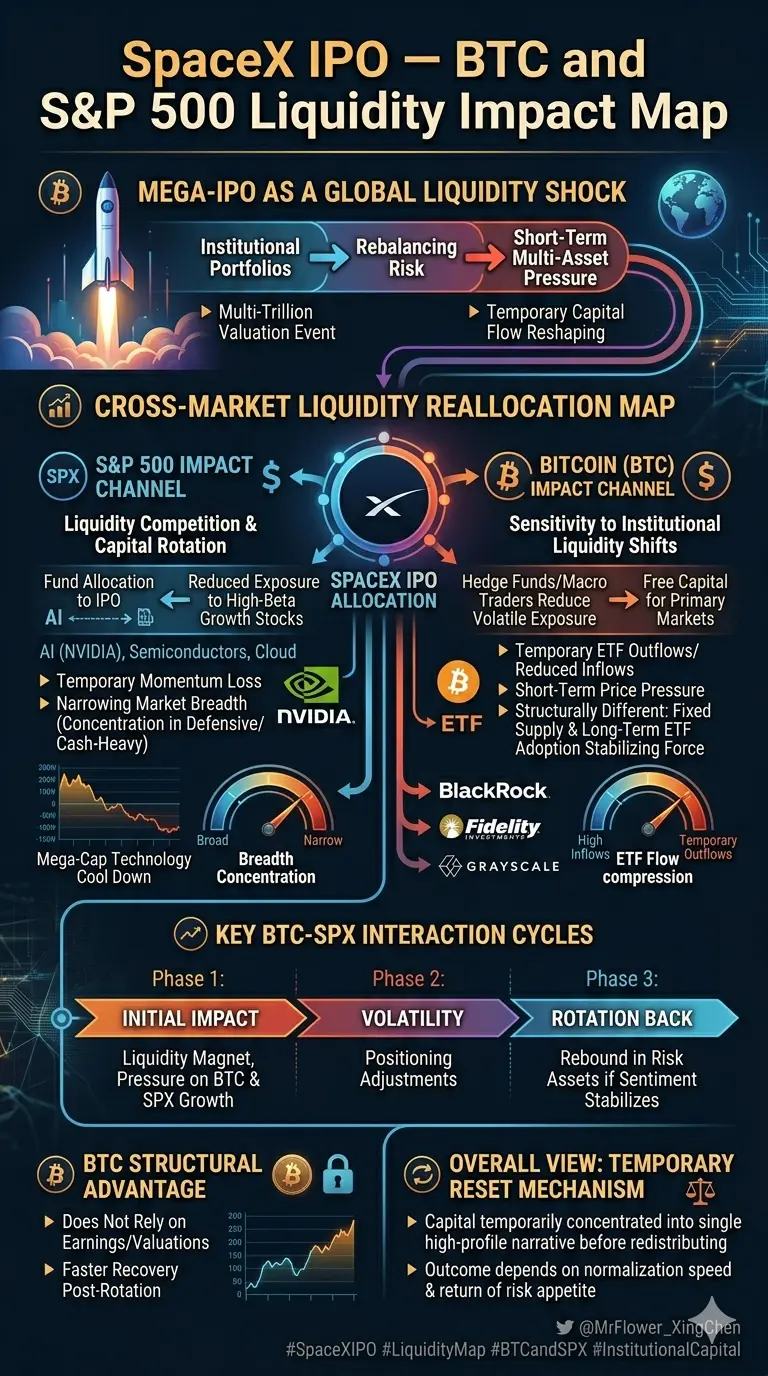
The connection to cryptocurrency markets is equally fascinating. Institutional investors are beginning to view Bitcoin, AI, and space technology as part of the same innovation ecosystem. Capital that previously flowed exclusively into crypto now competes with AI infrastructure and next-generation technology platforms. This means the SpaceX IPO could become a major liquidity magnet, temporarily attracting capital that might otherwise enter digital asset markets. At the same time, the presence of Bitcoin on corporate balance sheets strengthens the broader institutional legitimacy of digital assets.
What makes this event particularly important is the growing concentration of global capital. Instead of spreading funds across hundreds of companies, institutions are increasingly allocating massive amounts toward a handful of dominant platforms capable of controlling entire ecosystems. Nvidia controls AI compute. Major cloud providers control digital infrastructure. Bitcoin dominates digital scarcity. SpaceX is attempting to control access to space, orbital communications, and potentially future extraterrestrial logistics. The scale of these platforms creates powerful network effects that attract even more capital.
The geopolitical implications are also enormous. Governments around the world increasingly view space infrastructure as a strategic asset. Satellite communications, missile tracking, navigation systems, intelligence gathering, and secure military networks are becoming critical national priorities. This gives SpaceX a unique position where commercial growth and geopolitical demand can reinforce each other, creating revenue opportunities unavailable to most technology companies.
For investors, the biggest question is not whether the IPO succeeds. The real question is where the money comes from. A capital raise of this magnitude requires global funds, pension managers, sovereign wealth funds, hedge funds, and retail investors to reallocate resources. Every dollar flowing into a mega-IPO is a dollar that cannot simultaneously flow into another asset. This creates a direct competition for liquidity across equities, cryptocurrencies, venture capital, and private markets.
MrFlower_XingChen believes the SpaceX IPO represents the next stage of financial market evolution. Investors are no longer buying individual industries—they are buying interconnected ecosystems where AI, space technology, communications infrastructure, robotics, defense systems, and digital assets converge into a single investment thesis. If this valuation is achieved, the IPO may be remembered not as the largest space-company listing in history, but as the moment global capital officially shifted toward the infrastructure economy of the future.
#TradeCFDWinGold #StockTradingChallengeUpTo17000U #DailyPolymarketHotspot @Gate_Square @Gate广场_Official
  • Reward
  • 2
  • Repost
  • Share
HighAmbition:
To The Moon 🌕
View More
#BitcoinETFSees7272BTCOutflow
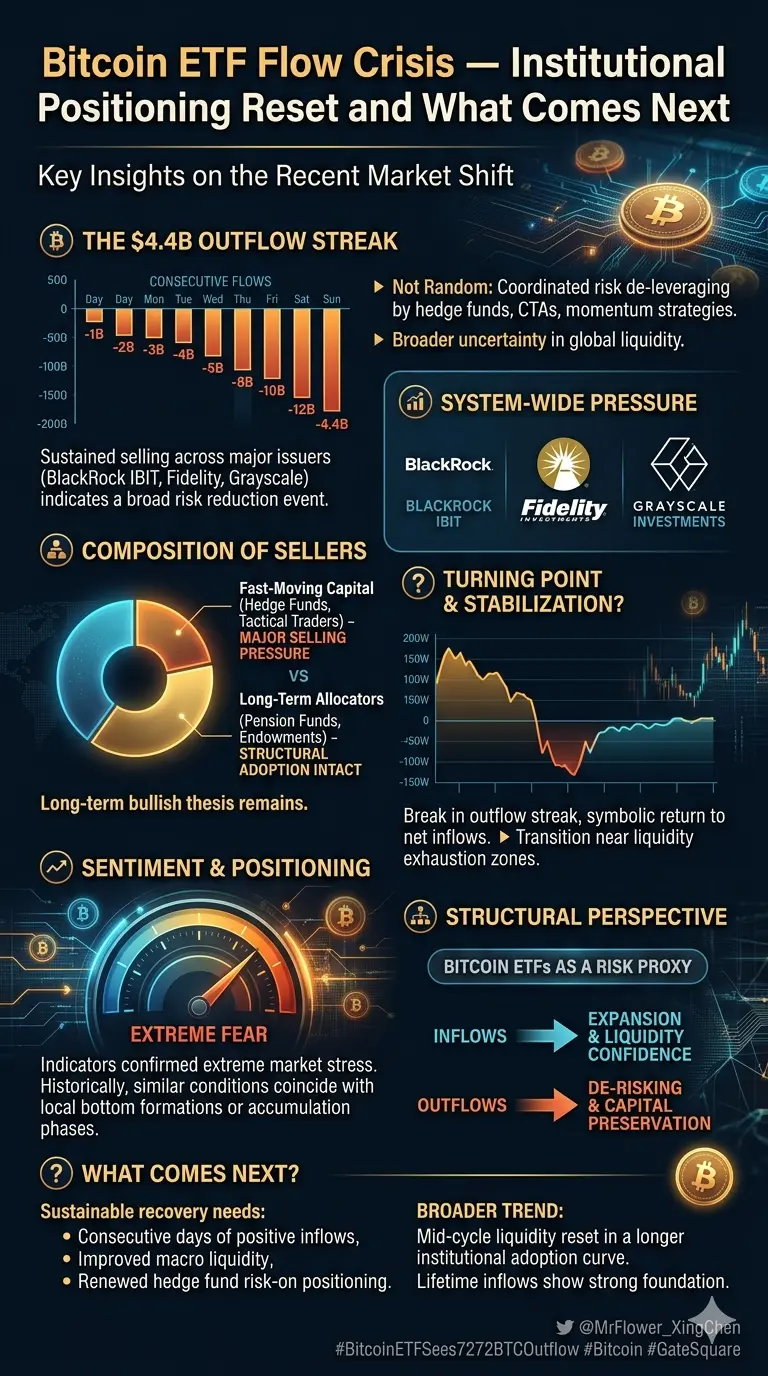
Based on the latest market data, your original thesis about ETF-driven selling pressure remains highly relevant. Bitcoin has experienced one of the largest ETF outflow periods since spot ETFs were launched, with several reports showing more than $4 billion leaving Bitcoin ETF products during recent weeks. Institutional investors have been reallocating capital toward AI infrastructure, semiconductor stocks, and large growth opportunities, creating significant pressure on crypto markets.
𝗖𝘂𝗿𝗿𝗲𝗻𝘁 𝗕𝗶𝘁𝗰𝗼𝗶𝗻 𝗠𝗮𝗿𝗸𝗲𝘁 𝗦𝘁𝗮𝘁𝘂𝘀
Bitcoin recently trad
BTC1.67%
MrFlower_XingChen
#BitcoinETFSees7272BTCOutflow
Based on the latest market data, your original thesis about ETF-driven selling pressure remains highly relevant. Bitcoin has experienced one of the largest ETF outflow periods since spot ETFs were launched, with several reports showing more than $4 billion leaving Bitcoin ETF products during recent weeks. Institutional investors have been reallocating capital toward AI infrastructure, semiconductor stocks, and large growth opportunities, creating significant pressure on crypto markets.
𝗖𝘂𝗿𝗿𝗲𝗻𝘁 𝗕𝗶𝘁𝗰𝗼𝗶𝗻 𝗠𝗮𝗿𝗸𝗲𝘁 𝗦𝘁𝗮𝘁𝘂𝘀
Bitcoin recently traded in the $63,000-$67,000 range after suffering a sharp correction from higher levels seen earlier in the year. Multiple sources identify the $60,000 region as the most critical support zone of the current cycle.
𝗞𝗲𝘆 𝗦𝘂𝗽𝗽𝗼𝗿𝘁 𝗭𝗼𝗻𝗲𝘀
Support 1: $60,000-$62,000
This is currently the most important battlefield for bulls. Several analysts view this zone as the last major support preserving Bitcoin's broader bullish structure. A strong defense here could trigger institutional accumulation and a relief rally.
Support 2: $55,000-$58,000
If $60K fails, historical liquidity models suggest buyers may attempt to defend this region. Panic selling and forced liquidations could accelerate declines toward this zone.
Support 3: $50,000-$52,000
This represents the ultimate fear scenario currently discussed across prediction markets and institutional research. A move here would likely coincide with continued ETF outflows and worsening liquidity conditions.
𝗞𝗲𝘆 𝗥𝗲𝘀𝗶𝘀𝘁𝗮𝗻𝗰𝗲 𝗭𝗼𝗻𝗲𝘀
Resistance 1: $67,000-$68,000
Bitcoin previously lost this level during the recent selloff. Bulls need to reclaim it to improve short-term sentiment.
Resistance 2: $72,000-$73,000
This area acted as a major support before the breakdown and now becomes significant resistance. Recovery above this zone would indicate renewed institutional confidence.
Resistance 3: $80,000-$85,000
A return toward this region would require ETF inflows to resume and global liquidity conditions to improve substantially.
𝗜𝗻𝘀𝘁𝗶𝘁𝘂𝘁𝗶𝗼𝗻𝗮𝗹 𝗙𝗹𝗼𝘄𝘀 — 𝗧𝗵𝗲 𝗠𝗼𝘀𝘁 𝗜𝗺𝗽𝗼𝗿𝘁𝗮𝗻𝘁 𝗜𝗻𝗱𝗶𝗰𝗮𝘁𝗼𝗿
The biggest signal to monitor is ETF flow data. During the recent decline, ETF products experienced record redemption streaks, which significantly weakened market structure. If inflows return, Bitcoin could establish a durable bottom. Without institutional demand, rallies may remain temporary.
𝗕𝘂𝗹𝗹𝗶𝘀𝗵 𝗦𝗰𝗲𝗻𝗮𝗿𝗶𝗼
If Bitcoin successfully holds above $60,000 and ETF outflows stabilize:
$68,000
$73,000
$80,000+
become realistic upside targets.
A shift in Federal Reserve expectations, improving liquidity conditions, or renewed institutional buying could fuel such a recovery.
𝗕𝗲𝗮𝗿𝗶𝘀𝗵 𝗦𝗰𝗲𝗻𝗮𝗿𝗶𝗼
If Bitcoin loses $60,000 decisively:
$58,000
$55,000
$50,000
become increasingly likely targets.
Continued ETF withdrawals, additional corporate selling, and ongoing capital rotation into AI-related assets would strengthen this bearish case.
𝗠𝗿𝗙𝗹𝗼𝘄𝗲𝗿_𝗫𝗶𝗻𝗴𝗖𝗵𝗲𝗻 𝗩𝗶𝗲𝘄𝗽𝗼𝗶𝗻𝘁
MrFlower_XingChen believes the current Bitcoin decline resembles a classic liquidity-driven capitulation phase rather than a fundamental breakdown of the Bitcoin thesis. The critical level remains $60,000. If institutions begin rebuilding ETF positions near this zone, the market could form a major cycle bottom. However, if institutional capital continues flowing toward AI infrastructure and away from crypto, Bitcoin may need additional downside before a sustainable recovery begins. The next major bull trend will likely start when ETF flows turn positive again—not when social sentiment becomes optimistic.
#TradeCFDWinGold #StockTradingChallengeUpTo17000U #DailyPolymarketHotspot @Gate_Square @Gate广场_Official
  • Reward
  • 2
  • Repost
  • Share
HighAmbition:
good information 👍👍
View More
#ShareYourUSStocksWinNvidia
𝗧𝗵𝗲 𝗔𝗜 𝗟𝗶𝗾𝘂𝗶𝗱𝗶𝘁𝘆 𝗖𝘆𝗰𝗹𝗲: 𝗪𝗵𝘆 𝗦𝗣𝗬 𝗠𝗮𝘆 𝗕𝗲 𝗧𝗵𝗲 𝗠𝗼𝘀𝘁 𝗜𝗺𝗽𝗼𝗿𝘁𝗮𝗻𝘁 𝗖𝗵𝗮𝗿𝘁 𝗢𝗳 𝟮𝟬𝟮𝟲
Most investors spend their time focusing on individual stocks, cryptocurrencies, or short-term market headlines. However, the reality is that nearly every major asset class ultimately responds to one central force: global liquidity. In 2026, the most important instrument for tracking that liquidity cycle is not Bitcoin, gold, or even a single technology stock. It is SPY, the ETF that tracks the S&P 500 and represents the collective streng
BTC1.67%
XAUUSD-3.28%
US500-2.9%
MrFlower_XingChen
#ShareYourUSStocksWinNvidia
𝗧𝗵𝗲 𝗔𝗜 𝗟𝗶𝗾𝘂𝗶𝗱𝗶𝘁𝘆 𝗖𝘆𝗰𝗹𝗲: 𝗪𝗵𝘆 𝗦𝗣𝗬 𝗠𝗮𝘆 𝗕𝗲 𝗧𝗵𝗲 𝗠𝗼𝘀𝘁 𝗜𝗺𝗽𝗼𝗿𝘁𝗮𝗻𝘁 𝗖𝗵𝗮𝗿𝘁 𝗢𝗳 𝟮𝟬𝟮𝟲
Most investors spend their time focusing on individual stocks, cryptocurrencies, or short-term market headlines. However, the reality is that nearly every major asset class ultimately responds to one central force: global liquidity. In 2026, the most important instrument for tracking that liquidity cycle is not Bitcoin, gold, or even a single technology stock. It is SPY, the ETF that tracks the S&P 500 and represents the collective strength of the world's largest publicly traded companies. Understanding SPY is no longer just about understanding equities—it is about understanding the direction of capital flows across the entire financial system.
The remarkable recovery witnessed during the second quarter of 2026 demonstrates how quickly institutional capital returns when confidence improves. After the market correction earlier in the year, buyers aggressively accumulated positions in sectors linked to artificial intelligence infrastructure, cloud computing, semiconductor manufacturing, energy expansion, and advanced automation technologies. This renewed demand pushed SPY back toward record highs and confirmed that institutional investors remain committed to long-term growth themes despite ongoing macroeconomic uncertainty.
One of the most significant developments driving the market today is the continued expansion of the AI economy. Unlike previous technology cycles that were driven primarily by software adoption, the current AI revolution requires massive investments in physical infrastructure. Data centers, high-performance GPUs, power generation facilities, networking equipment, and cooling systems all require enormous amounts of capital. Every dollar flowing into AI infrastructure ultimately strengthens corporate earnings expectations, which in turn supports higher valuations throughout the S&P 500 ecosystem.
Another major factor supporting SPY is the resilience of corporate profitability. Despite concerns surrounding inflation, interest rates, and global economic growth, many of the largest companies continue to generate extraordinary cash flows. Businesses that successfully integrate AI into operations are experiencing improvements in productivity, cost efficiency, and profit margins. Investors increasingly recognize that AI is not merely a technological trend but a structural economic transformation that may influence earnings growth for years to come.
The relationship between SPY and cryptocurrency markets has also become increasingly important. Historically, investors viewed digital assets as independent from traditional finance. In reality, both markets are heavily influenced by liquidity conditions. When institutional investors increase risk exposure and capital becomes abundant, SPY often rises alongside Bitcoin and other digital assets. Conversely, when liquidity tightens, both markets can experience significant corrections. This growing correlation highlights why monitoring SPY has become essential even for crypto-focused investors.
From a technical perspective, the market remains in a strong long-term uptrend, but momentum indicators suggest investors should remain attentive to potential volatility. Markets rarely move upward in a straight line. Periods of consolidation are often necessary to reset sentiment, reduce excessive leverage, and create healthier conditions for the next advance. Such consolidations should not automatically be interpreted as bearish events; rather, they often serve as the foundation for future rallies when supported by strong economic fundamentals.
Looking ahead, several catalysts could determine the next phase of market direction. Federal Reserve policy decisions, inflation reports, labor market conditions, corporate earnings growth, geopolitical developments, and AI investment spending will remain key variables. Among these factors, AI-related earnings growth continues to stand out as the most powerful structural driver because it directly impacts valuation models across multiple sectors simultaneously.
What makes 2026 particularly unique is the convergence between technology innovation, capital markets, and digital assets. Institutional investors are increasingly treating AI, cloud infrastructure, semiconductors, and blockchain technologies as interconnected components of the same long-term growth narrative. This convergence creates opportunities that extend far beyond individual stocks and encourages investors to focus on broader capital flow trends rather than isolated headlines.
MrFlower_XingChen believes that SPY remains one of the clearest indicators of global market health and risk appetite. As long as institutional capital continues flowing into AI infrastructure, productivity-enhancing technologies, and high-quality growth companies, the broader bullish structure remains intact. While short-term pullbacks are always possible, the long-term trajectory of capital allocation suggests that investors are witnessing the early stages of a multi-year transformation that could reshape both traditional finance and the digital asset ecosystem.
#TradeCFDWinGold #StockTradingChallengeUpTo17000U #DailyPolymarketHotspot #GatePredictionMarketAddsSmartMoneyTracking @Gate_Square @Gate广场_Official
  • Reward
  • 1
  • Repost
  • Share
HighAmbition:
thnxx for the update
#BitminePlans300MPreferredStockOffering
𝗕𝗶𝘁𝗠𝗶𝗻𝗲'𝘀 $𝟯𝟬𝟬𝗠 𝗕𝗲𝘁 𝗢𝗻 𝗘𝘁𝗵𝗲𝗿𝗲𝘂𝗺 — 𝗪𝗵𝘆 𝟭𝟭𝟭,𝟵𝟰𝟮 𝗘𝗧𝗛 𝗢𝗳 𝗪𝗵𝗮𝗹𝗲 𝗔𝗰𝗰𝘂𝗺𝘂𝗹𝗮𝘁𝗶𝗼𝗻 𝗖𝗼𝘂𝗹𝗱 𝗦𝗶𝗴𝗻𝗮𝗹 𝗔 𝗠𝘂𝗰𝗵 𝗟𝗮𝗿𝗴𝗲𝗿 𝗦𝘁𝗿𝘂𝗰𝘁𝘂𝗿𝗮𝗹 𝗦𝗵𝗶𝗳𝘁
The announcement that BitMine plans a $300 million preferred stock offering while simultaneously accumulating 111,942 ETH has attracted significant attention across digital asset markets. While short-term traders remain focused on daily volatility, whale accumulation of this magnitude often provides insight into how sophisticated capital is positio
ETH4.27%
MrFlower_XingChen
#BitminePlans300MPreferredStockOffering
𝗕𝗶𝘁𝗠𝗶𝗻𝗲'𝘀 $𝟯𝟬𝟬𝗠 𝗕𝗲𝘁 𝗢𝗻 𝗘𝘁𝗵𝗲𝗿𝗲𝘂𝗺 — 𝗪𝗵𝘆 𝟭𝟭𝟭,𝟵𝟰𝟮 𝗘𝗧𝗛 𝗢𝗳 𝗪𝗵𝗮𝗹𝗲 𝗔𝗰𝗰𝘂𝗺𝘂𝗹𝗮𝘁𝗶𝗼𝗻 𝗖𝗼𝘂𝗹𝗱 𝗦𝗶𝗴𝗻𝗮𝗹 𝗔 𝗠𝘂𝗰𝗵 𝗟𝗮𝗿𝗴𝗲𝗿 𝗦𝘁𝗿𝘂𝗰𝘁𝘂𝗿𝗮𝗹 𝗦𝗵𝗶𝗳𝘁
The announcement that BitMine plans a $300 million preferred stock offering while simultaneously accumulating 111,942 ETH has attracted significant attention across digital asset markets. While short-term traders remain focused on daily volatility, whale accumulation of this magnitude often provides insight into how sophisticated capital is positioning for the next phase of the market cycle. Large investors rarely commit substantial capital based solely on short-term price expectations. Instead, they typically focus on long-duration trends capable of reshaping entire industries over multiple years.
What makes this accumulation particularly interesting is the timing. Ethereum continues to face macroeconomic uncertainty, liquidity pressures, and risk-off sentiment across digital assets. Yet despite these headwinds, large entities continue adding exposure. Historically, major accumulation phases often occur when confidence is low, volatility is elevated, and retail participation remains cautious. Smart money generally seeks opportunities when assets are unloved rather than when enthusiasm has already reached extreme levels.
The broader Ethereum investment thesis is evolving beyond speculation. In previous cycles, ETH was often viewed primarily as a high-beta cryptocurrency tied to decentralized finance activity. Today, Ethereum increasingly functions as critical digital infrastructure supporting stablecoins, tokenized assets, decentralized financial systems, blockchain settlements, and smart contract execution. This transition from speculative asset to infrastructure layer fundamentally changes how institutional investors evaluate long-term value.
One of the most important developments is the continued reduction in liquid ETH supply. Significant amounts of Ethereum remain locked through staking mechanisms, Layer-2 ecosystems, treasury holdings, and long-term strategic allocations. As more ETH becomes unavailable for immediate trading, the market becomes increasingly sensitive to changes in demand. Even moderate institutional inflows can create outsized effects when freely circulating supply continues to tighten.
The tokenization revolution may be another reason sophisticated investors are focusing on Ethereum. Financial institutions around the world are actively exploring tokenized bonds, tokenized money market funds, on-chain settlement systems, digital identity frameworks, and real-world asset infrastructure. Ethereum remains one of the dominant ecosystems positioned to support this transition. If tokenization becomes a multi-trillion-dollar market over the next decade, ownership of the underlying infrastructure could become increasingly valuable.
Artificial intelligence may also become an unexpected catalyst. As AI systems continue expanding, demand for verifiable data, programmable transactions, digital ownership frameworks, and decentralized coordination mechanisms is likely to increase. Ethereum's smart contract architecture provides a foundation capable of supporting many of these requirements. The convergence of AI, blockchain, and digital finance could create entirely new economic models that do not yet exist at scale today.
Another factor often overlooked is the growing institutionalization of Ethereum itself. Traditional financial firms are no longer studying blockchain technology as an experiment. Increasingly, they are exploring practical implementations involving payments, settlements, collateral management, treasury operations, and asset tokenization. This gradual institutional integration creates a structural demand profile very different from previous crypto cycles that were dominated by retail speculation.
The preferred stock offering itself sends an important signal. Raising capital specifically to strengthen strategic positioning demonstrates confidence in long-term opportunities rather than short-term market conditions. When companies actively seek funding during periods of uncertainty, they are often attempting to build exposure before broader market recognition occurs. Such actions frequently reveal how professional investors view future risk-reward dynamics.
According to MrFlower_XingChen, the most important takeaway is not the exact number of ETH accumulated but what the accumulation represents. Large capital allocators appear increasingly focused on owning the infrastructure layer of the future digital economy rather than attempting to trade every short-term market fluctuation. Ethereum's role in tokenization, decentralized settlement, digital asset infrastructure, and emerging AI-driven ecosystems may ultimately prove more important than temporary price movements.
Ultimately, the BitMine accumulation story reflects a broader shift occurring throughout financial markets. The question is no longer whether blockchain technology will survive. The question is which networks will become the foundational infrastructure supporting future financial systems. If Ethereum continues strengthening its position across tokenization, institutional finance, stablecoins, and digital settlement networks, periods of whale accumulation may eventually be viewed as early indicators of a much larger structural adoption cycle still in its early stages.
#TradeCFDWinGold #StockTradingChallengeUpTo17000U #DailyPolymarketHotspot #GatePredictionMarketAddsSmartMoneyTracking @Gate_Square @Gate广场_Official
  • Reward
  • 1
  • Repost
  • Share
HighAmbition:
good information 👍👍
#ChipStocksCrashedDowHitRecordHigh
𝗧𝗵𝗲 𝗚𝗿𝗲𝗮𝘁 𝗟𝗶𝗾𝘂𝗶𝗱𝗶𝘁𝘆 𝗥𝗼𝘁𝗮𝘁𝗶𝗼𝗻 — 𝗪𝗵𝘆 𝗔𝗜 𝗪𝗶𝗻𝗻𝗲𝗿𝘀 𝗔𝗿𝗲 𝗦𝘁𝘂𝗺𝗯𝗹𝗶𝗻𝗴 𝗔𝘀 𝗧𝗿𝗮𝗱𝗶𝘁𝗶𝗼𝗻𝗮𝗹 𝗦𝗲𝗰𝘁𝗼𝗿𝘀 𝗥𝗶𝘀𝗲
The recent divergence between semiconductor stocks and the Dow Jones is not a random market event. It is a powerful signal that global capital may be entering a new phase of allocation. For nearly two years, investors rewarded anything connected to Artificial Intelligence, data-center expansion, advanced chips, and high-performance computing. Massive liquidity flowed into a small group of AI leaders,
MrFlower_XingChen
#ChipStocksCrashedDowHitRecordHigh
𝗧𝗵𝗲 𝗚𝗿𝗲𝗮𝘁 𝗟𝗶𝗾𝘂𝗶𝗱𝗶𝘁𝘆 𝗥𝗼𝘁𝗮𝘁𝗶𝗼𝗻 — 𝗪𝗵𝘆 𝗔𝗜 𝗪𝗶𝗻𝗻𝗲𝗿𝘀 𝗔𝗿𝗲 𝗦𝘁𝘂𝗺𝗯𝗹𝗶𝗻𝗴 𝗔𝘀 𝗧𝗿𝗮𝗱𝗶𝘁𝗶𝗼𝗻𝗮𝗹 𝗦𝗲𝗰𝘁𝗼𝗿𝘀 𝗥𝗶𝘀𝗲
The recent divergence between semiconductor stocks and the Dow Jones is not a random market event. It is a powerful signal that global capital may be entering a new phase of allocation. For nearly two years, investors rewarded anything connected to Artificial Intelligence, data-center expansion, advanced chips, and high-performance computing. Massive liquidity flowed into a small group of AI leaders, driving extraordinary gains and creating one of the most concentrated bull markets in modern history. Today, that concentration is beginning to unwind as investors search for the next source of returns.
The most important development is not that chip stocks are falling. The real story is that capital is no longer staying in one place. Institutional investors are rotating funds from highly valued AI names into industries that have lagged behind the technology boom. Industrial companies, financial institutions, healthcare leaders, infrastructure firms, and defense contractors are attracting fresh inflows as investors position for a broader economic expansion. This rotation explains why the Dow Jones can reach new highs while many technology leaders struggle simultaneously.
One of the defining characteristics of mature bull markets is the transition from narrative-driven investing to cash-flow-driven investing. During the early AI boom, investors paid almost any price for future growth. Today, markets are becoming more selective. Semiconductor companies are still reporting strong demand, but expectations have risen so dramatically that even exceptional results may not be enough to justify current valuations. Markets are no longer asking whether AI will grow. They are asking whether AI growth can exceed already extraordinary forecasts.
Another powerful force behind this rotation is the changing liquidity environment. Global capital is currently being pulled in multiple directions at once. AI infrastructure spending continues to expand. Mega-cap technology companies are investing hundreds of billions into compute capacity. Large IPOs are competing for institutional capital. Governments are increasing spending on defense, manufacturing, and strategic infrastructure. As new opportunities emerge, portfolio managers must make choices. Money flowing into one sector often comes directly from another sector. Liquidity is not disappearing—it is simply changing direction.
The bond market is also exerting increasing influence. Higher yields place pressure on long-duration growth assets because much of their value depends on profits expected years into the future. Companies generating stable earnings today become relatively more attractive when capital becomes more expensive. This environment naturally benefits sectors represented heavily within the Dow Jones while creating periodic valuation pressure on high-growth technology names.
What makes the current setup particularly fascinating is that AI fundamentals remain extremely strong. Data-center construction continues accelerating. Enterprise adoption of AI tools continues expanding. Cloud providers remain committed to massive infrastructure investment. The selloff therefore appears less like a collapse in demand and more like a reassessment of valuation. Investors still believe in the AI revolution; they are simply becoming more disciplined about the prices they are willing to pay for participation.
Market history shows that the healthiest bull markets eventually broaden. Early gains are usually led by a small group of innovators. Sustainable advances require participation from multiple sectors across the economy. Manufacturing, transportation, healthcare, finance, energy, and consumer industries must eventually contribute to overall market strength. The current divergence may represent the beginning of that transition rather than the end of the broader bull cycle.
According to MrFlower_XingChen, the market is undergoing a leadership transition rather than a leadership collapse. AI remains one of the most transformative investment themes of the decade, but future returns may become more evenly distributed across sectors. Investors focused exclusively on yesterday's winners risk missing where tomorrow's liquidity is moving. The biggest opportunities often emerge not when capital enters a trend, but when capital quietly begins rotating toward the next one.
Ultimately, the battle between chip stocks and the Dow Jones is really a battle between expectations and valuation, growth and cash flow, concentration and diversification. Understanding this shift is critical because the next stage of the market may not be defined by a single sector dominating everything else. Instead, it may be defined by a broader and more resilient expansion in which liquidity spreads across the entire economy. Those who follow the flow of capital rather than the headlines will be best positioned to identify the market's next major winners.
#TradeCFDWinGold #StockTradingChallengeUpTo17000U #DailyPolymarketHotspot #GatePredictionMarketAddsSmartMoneyTracking @Gate_Square @Gate广场_Official
  • Reward
  • 1
  • Repost
  • Share
HighAmbition:
thnxx for the update
#PredictNBAFinalsWin20000U
𝗧𝗵𝗲 𝗡𝗕𝗔 𝗙𝗶𝗻𝗮𝗹𝘀 𝗠𝗮𝗿𝗸𝗲𝘁 𝗠𝗶𝘀𝗽𝗿𝗶𝗰𝗶𝗻𝗴: 𝗪𝗵𝘆 𝗚𝗮𝗺𝗲 𝟮 𝗖𝗵𝗮𝗻𝗴𝗲𝗱 𝗘𝘃𝗲𝗿𝘆𝘁𝗵𝗶𝗻𝗴
Game 2 of the NBA Finals may ultimately be remembered as the turning point of the entire championship series. On paper, a one-point victory looks insignificant. In reality, the 105-104 result completely altered the psychological, statistical, and strategic landscape of the Finals.
For most of the fourth quarter, New York appeared firmly in control. The Knicks built a double-digit lead and looked ready to cruise toward a comfortable victory. Then came
MrFlower_XingChen
#PredictNBAFinalsWin20000U
𝗧𝗵𝗲 𝗡𝗕𝗔 𝗙𝗶𝗻𝗮𝗹𝘀 𝗠𝗮𝗿𝗸𝗲𝘁 𝗠𝗶𝘀𝗽𝗿𝗶𝗰𝗶𝗻𝗴: 𝗪𝗵𝘆 𝗚𝗮𝗺𝗲 𝟮 𝗖𝗵𝗮𝗻𝗴𝗲𝗱 𝗘𝘃𝗲𝗿𝘆𝘁𝗵𝗶𝗻𝗴
Game 2 of the NBA Finals may ultimately be remembered as the turning point of the entire championship series. On paper, a one-point victory looks insignificant. In reality, the 105-104 result completely altered the psychological, statistical, and strategic landscape of the Finals.
For most of the fourth quarter, New York appeared firmly in control. The Knicks built a double-digit lead and looked ready to cruise toward a comfortable victory. Then came the response that championship teams are supposed to produce. San Antonio suddenly erupted with a stunning late-game run, erasing a 14-point deficit and tying the game at 104. The arena was electric, momentum had fully shifted, and it felt as though the Spurs had stolen control of the series.
Then everything changed in a matter of seconds.
A late turnover, a critical foul, and one clutch free throw created the narrowest possible margin between victory and defeat. Championship series are often defined by a handful of possessions, and Game 2 provided another reminder that even the smallest mistakes can carry historic consequences. The final missed jumper will likely be replayed for years because it represented the difference between a tied series and a potentially insurmountable 0-2 deficit.
One of the most important storylines emerging from this matchup is the performance of Karl-Anthony Towns. While much of the attention entering the Finals focused on star power and offensive firepower, Towns has quietly become one of the most influential players on the court. His rebounding, interior defense, physical presence, and ability to create mismatches have forced San Antonio to make difficult adjustments throughout the series. If New York ultimately captures the championship, his case for Finals MVP will be extremely difficult to ignore.
From a prediction-market perspective, Game 2 creates a fascinating opportunity. Markets often struggle to adjust quickly after emotionally charged outcomes. While many traders continue to favor San Antonio based on preseason expectations and roster talent, the reality is that teams rarely recover after losing the first two games of a Finals series on their home floor. The statistical challenge facing the Spurs is enormous, and history suggests the path back becomes increasingly narrow with every passing game.
The biggest factor now is location. The series shifts to Madison Square Garden, where New York has looked nearly unstoppable throughout the postseason. Home-court energy, crowd momentum, and growing confidence could create the conditions for the Knicks to seize complete control of the Finals before San Antonio has a chance to recover.
What makes this situation particularly interesting for prediction-market participants is the gap between narrative and probability. Many investors continue to focus on the Spurs' long-term talent ceiling, while others are focusing on the current reality of the series. In markets, whether financial or sports-related, opportunities often emerge when perception and probability diverge.
MrFlower_XingChen believes Game 2 was more than just another playoff victory—it was a momentum transfer. The Knicks now possess the series lead, the confidence advantage, and home-court momentum. Unless San Antonio finds immediate solutions, the path increasingly points toward New York ending decades of waiting and bringing a championship back to Madison Square Garden.
What's your prediction: Can the Spurs produce one of the greatest Finals comebacks in basketball history, or are we watching the beginning of a championship celebration in New York?
#预测NBA总冠军赢20,000U #PredictNBAFinalsWin20000U #GateSquare
  • Reward
  • 1
  • Repost
  • Share
HighAmbition:
To The Moon 🌕
#BitcoinETFSees7272BTCOutflow
Based on the latest market data, your original thesis about ETF-driven selling pressure remains highly relevant. Bitcoin has experienced one of the largest ETF outflow periods since spot ETFs were launched, with several reports showing more than $4 billion leaving Bitcoin ETF products during recent weeks. Institutional investors have been reallocating capital toward AI infrastructure, semiconductor stocks, and large growth opportunities, creating significant pressure on crypto markets.
𝗖𝘂𝗿𝗿𝗲𝗻𝘁 𝗕𝗶𝘁𝗰𝗼𝗶𝗻 𝗠𝗮𝗿𝗸𝗲𝘁 𝗦𝘁𝗮𝘁𝘂𝘀
Bitcoin recently trad
BTC1.67%
MrFlower_XingChen
#BitcoinETFSees7272BTCOutflow
Based on the latest market data, your original thesis about ETF-driven selling pressure remains highly relevant. Bitcoin has experienced one of the largest ETF outflow periods since spot ETFs were launched, with several reports showing more than $4 billion leaving Bitcoin ETF products during recent weeks. Institutional investors have been reallocating capital toward AI infrastructure, semiconductor stocks, and large growth opportunities, creating significant pressure on crypto markets.
𝗖𝘂𝗿𝗿𝗲𝗻𝘁 𝗕𝗶𝘁𝗰𝗼𝗶𝗻 𝗠𝗮𝗿𝗸𝗲𝘁 𝗦𝘁𝗮𝘁𝘂𝘀
Bitcoin recently traded in the $63,000-$67,000 range after suffering a sharp correction from higher levels seen earlier in the year. Multiple sources identify the $60,000 region as the most critical support zone of the current cycle.
𝗞𝗲𝘆 𝗦𝘂𝗽𝗽𝗼𝗿𝘁 𝗭𝗼𝗻𝗲𝘀
Support 1: $60,000-$62,000
This is currently the most important battlefield for bulls. Several analysts view this zone as the last major support preserving Bitcoin's broader bullish structure. A strong defense here could trigger institutional accumulation and a relief rally.
Support 2: $55,000-$58,000
If $60K fails, historical liquidity models suggest buyers may attempt to defend this region. Panic selling and forced liquidations could accelerate declines toward this zone.
Support 3: $50,000-$52,000
This represents the ultimate fear scenario currently discussed across prediction markets and institutional research. A move here would likely coincide with continued ETF outflows and worsening liquidity conditions.
𝗞𝗲𝘆 𝗥𝗲𝘀𝗶𝘀𝘁𝗮𝗻𝗰𝗲 𝗭𝗼𝗻𝗲𝘀
Resistance 1: $67,000-$68,000
Bitcoin previously lost this level during the recent selloff. Bulls need to reclaim it to improve short-term sentiment.
Resistance 2: $72,000-$73,000
This area acted as a major support before the breakdown and now becomes significant resistance. Recovery above this zone would indicate renewed institutional confidence.
Resistance 3: $80,000-$85,000
A return toward this region would require ETF inflows to resume and global liquidity conditions to improve substantially.
𝗜𝗻𝘀𝘁𝗶𝘁𝘂𝘁𝗶𝗼𝗻𝗮𝗹 𝗙𝗹𝗼𝘄𝘀 — 𝗧𝗵𝗲 𝗠𝗼𝘀𝘁 𝗜𝗺𝗽𝗼𝗿𝘁𝗮𝗻𝘁 𝗜𝗻𝗱𝗶𝗰𝗮𝘁𝗼𝗿
The biggest signal to monitor is ETF flow data. During the recent decline, ETF products experienced record redemption streaks, which significantly weakened market structure. If inflows return, Bitcoin could establish a durable bottom. Without institutional demand, rallies may remain temporary.
𝗕𝘂𝗹𝗹𝗶𝘀𝗵 𝗦𝗰𝗲𝗻𝗮𝗿𝗶𝗼
If Bitcoin successfully holds above $60,000 and ETF outflows stabilize:
$68,000
$73,000
$80,000+
become realistic upside targets.
A shift in Federal Reserve expectations, improving liquidity conditions, or renewed institutional buying could fuel such a recovery.
𝗕𝗲𝗮𝗿𝗶𝘀𝗵 𝗦𝗰𝗲𝗻𝗮𝗿𝗶𝗼
If Bitcoin loses $60,000 decisively:
$58,000
$55,000
$50,000
become increasingly likely targets.
Continued ETF withdrawals, additional corporate selling, and ongoing capital rotation into AI-related assets would strengthen this bearish case.
𝗠𝗿𝗙𝗹𝗼𝘄𝗲𝗿_𝗫𝗶𝗻𝗴𝗖𝗵𝗲𝗻 𝗩𝗶𝗲𝘄𝗽𝗼𝗶𝗻𝘁
MrFlower_XingChen believes the current Bitcoin decline resembles a classic liquidity-driven capitulation phase rather than a fundamental breakdown of the Bitcoin thesis. The critical level remains $60,000. If institutions begin rebuilding ETF positions near this zone, the market could form a major cycle bottom. However, if institutional capital continues flowing toward AI infrastructure and away from crypto, Bitcoin may need additional downside before a sustainable recovery begins. The next major bull trend will likely start when ETF flows turn positive again—not when social sentiment becomes optimistic.
#TradeCFDWinGold #StockTradingChallengeUpTo17000U #DailyPolymarketHotspot @Gate_Square @Gate广场_Official
  • Reward
  • 1
  • Repost
  • Share
HighAmbition:
thnxx for the update good
g#BitcoinETFSees7272BTCOutflow
𝗕𝗶𝘁𝗰𝗼𝗶𝗻'𝘀 $𝟲𝟬𝗞 𝗕𝗮𝘁𝘁𝗹𝗲 — 𝗪𝗵𝘆 𝗜𝗻𝘀𝘁𝗶𝘁𝘂𝘁𝗶𝗼𝗻𝗮𝗹 𝗖𝗮𝗽𝗶𝘁𝘂𝗹𝗮𝘁𝗶𝗼𝗻 𝗠𝗮𝘆 𝗗𝗲𝗳𝗶𝗻𝗲 𝘁𝗵𝗲 𝗡𝗲𝘅𝘁 𝗖𝗿𝘆𝗽𝘁𝗼 𝗖𝘆𝗰𝗹𝗲
Bitcoin's recent collapse below $60,000 is more than a price correction—it represents one of the most significant tests of institutional conviction since the launch of spot Bitcoin ETFs. Over thirteen consecutive trading sessions, billions of dollars exited Bitcoin ETFs, creating the longest outflow streak in the history of these products. What began as profit-taking has evolved into a broader liquidity e
BTC1.67%
MrFlower_XingChen
#BitcoinETFSees7272BTCOutflow
𝗕𝗶𝘁𝗰𝗼𝗶𝗻'𝘀 $𝟲𝟬𝗞 𝗕𝗮𝘁𝘁𝗹𝗲 — 𝗪𝗵𝘆 𝗜𝗻𝘀𝘁𝗶𝘁𝘂𝘁𝗶𝗼𝗻𝗮𝗹 𝗖𝗮𝗽𝗶𝘁𝘂𝗹𝗮𝘁𝗶𝗼𝗻 𝗠𝗮𝘆 𝗗𝗲𝗳𝗶𝗻𝗲 𝘁𝗵𝗲 𝗡𝗲𝘅𝘁 𝗖𝗿𝘆𝗽𝘁𝗼 𝗖𝘆𝗰𝗹𝗲
Bitcoin's recent collapse below $60,000 is more than a price correction—it represents one of the most significant tests of institutional conviction since the launch of spot Bitcoin ETFs. Over thirteen consecutive trading sessions, billions of dollars exited Bitcoin ETFs, creating the longest outflow streak in the history of these products. What began as profit-taking has evolved into a broader liquidity event, forcing market participants to reconsider how capital is being allocated across global risk assets.
The most important story is not simply that ETF investors are selling. The deeper issue is that capital is being redirected toward alternative opportunities offering stronger perceived growth. Artificial intelligence infrastructure, semiconductor investment, private-market technology funding, and upcoming mega-capital raises have become the dominant destinations for institutional money. Global investors are increasingly prioritizing sectors tied to AI expansion while reducing exposure to assets viewed as highly sensitive to liquidity conditions. Bitcoin has found itself competing directly against one of the strongest investment narratives of the decade.
At the same time, ETF outflows create a feedback loop that extends far beyond Bitcoin itself. Spot ETFs have become a major bridge between traditional finance and digital assets. When institutions withdraw capital from these vehicles, selling pressure increases, sentiment deteriorates, and leveraged traders become vulnerable. This chain reaction can transform a moderate decline into a full-scale liquidation event. The recent market behavior demonstrates how interconnected ETF demand, futures positioning, and spot market liquidity have become.
Another critical factor is the changing perception of corporate Bitcoin accumulation. For years, many investors believed large holders would continue accumulating indefinitely regardless of market conditions. Recent developments challenged that assumption. Even relatively small sales from highly visible corporate holders can have an outsized psychological impact because they force investors to reconsider previously unquestioned narratives. In highly emotional markets, perception often drives short-term price action more than actual transaction size.
The macroeconomic environment has amplified these pressures. Strong employment data, elevated bond yields, and reduced expectations for aggressive monetary easing have created a difficult backdrop for speculative assets. Bitcoin historically performs best when liquidity is expanding and capital seeks higher-risk opportunities. The current environment is the opposite: investors are demanding stronger cash flows, lower volatility, and greater certainty. As a result, capital is concentrating in select sectors while withdrawing from assets dependent on abundant liquidity.
Despite the overwhelmingly negative sentiment, several indicators suggest the market is approaching conditions historically associated with major turning points. Fear metrics have reached extreme levels, volatility has surged, and long-term holders are increasingly underwater. Previous Bitcoin cycles often produced their most attractive accumulation opportunities when investor confidence was at its lowest. However, history also shows that fear alone does not create bottoms. Sustainable recoveries require genuine demand returning to the market.
The most important indicator to monitor going forward is not social sentiment or technical oscillators—it is institutional flow. Consistent ETF inflows would signal that large investors are beginning to rebuild positions. Without that participation, rallies are more likely to be corrective bounces within a broader bearish structure. Capital flows ultimately determine whether support levels become foundations for recovery or merely temporary pauses before additional downside.
From a technical perspective, the battle around $60,000 has become the defining level of the current cycle. Holding above this region would preserve a significant portion of Bitcoin's long-term bullish structure. Losing it decisively could expose lower demand zones and extend the correction further. Markets are now engaged in a struggle between forced sellers exiting positions and patient buyers seeking long-term value.
MrFlower_XingChen views the current environment as a liquidity-driven capitulation phase rather than a fundamental failure of Bitcoin's long-term thesis. The market is experiencing a repricing of risk as institutional capital temporarily prioritizes AI, equities, and cash-flow-producing assets. Whether this becomes the final washout of the cycle or merely another step lower will depend on the return of institutional demand, stabilization of ETF flows, and broader improvements in global liquidity conditions. The next major trend will likely begin not when fear disappears, but when capital quietly starts flowing back into the market.
#TradeCFDWinGold #StockTradingChallengeUpTo17000U #DailyPolymarketHotspot #GatePredictionMarketAddsSmartMoneyTracking @Gate_Square @Gate广场_Official
  • Reward
  • 1
  • Repost
  • Share
HighAmbition:
To The Moon 🌕
good
MrFlower_XingChen
#BitcoinETFSees7272BTCOutflow
𝗕𝗶𝘁𝗰𝗼𝗶𝗻'𝘀 $𝟲𝟬𝗞 𝗕𝗮𝘁𝘁𝗹𝗲 — 𝗪𝗵𝘆 𝗜𝗻𝘀𝘁𝗶𝘁𝘂𝘁𝗶𝗼𝗻𝗮𝗹 𝗖𝗮𝗽𝗶𝘁𝘂𝗹𝗮𝘁𝗶𝗼𝗻 𝗠𝗮𝘆 𝗗𝗲𝗳𝗶𝗻𝗲 𝘁𝗵𝗲 𝗡𝗲𝘅𝘁 𝗖𝗿𝘆𝗽𝘁𝗼 𝗖𝘆𝗰𝗹𝗲
Bitcoin's recent collapse below $60,000 is more than a price correction—it represents one of the most significant tests of institutional conviction since the launch of spot Bitcoin ETFs. Over thirteen consecutive trading sessions, billions of dollars exited Bitcoin ETFs, creating the longest outflow streak in the history of these products. What began as profit-taking has evolved into a broader liquidity event, forcing market participants to reconsider how capital is being allocated across global risk assets.
The most important story is not simply that ETF investors are selling. The deeper issue is that capital is being redirected toward alternative opportunities offering stronger perceived growth. Artificial intelligence infrastructure, semiconductor investment, private-market technology funding, and upcoming mega-capital raises have become the dominant destinations for institutional money. Global investors are increasingly prioritizing sectors tied to AI expansion while reducing exposure to assets viewed as highly sensitive to liquidity conditions. Bitcoin has found itself competing directly against one of the strongest investment narratives of the decade.
At the same time, ETF outflows create a feedback loop that extends far beyond Bitcoin itself. Spot ETFs have become a major bridge between traditional finance and digital assets. When institutions withdraw capital from these vehicles, selling pressure increases, sentiment deteriorates, and leveraged traders become vulnerable. This chain reaction can transform a moderate decline into a full-scale liquidation event. The recent market behavior demonstrates how interconnected ETF demand, futures positioning, and spot market liquidity have become.
Another critical factor is the changing perception of corporate Bitcoin accumulation. For years, many investors believed large holders would continue accumulating indefinitely regardless of market conditions. Recent developments challenged that assumption. Even relatively small sales from highly visible corporate holders can have an outsized psychological impact because they force investors to reconsider previously unquestioned narratives. In highly emotional markets, perception often drives short-term price action more than actual transaction size.
The macroeconomic environment has amplified these pressures. Strong employment data, elevated bond yields, and reduced expectations for aggressive monetary easing have created a difficult backdrop for speculative assets. Bitcoin historically performs best when liquidity is expanding and capital seeks higher-risk opportunities. The current environment is the opposite: investors are demanding stronger cash flows, lower volatility, and greater certainty. As a result, capital is concentrating in select sectors while withdrawing from assets dependent on abundant liquidity.
Despite the overwhelmingly negative sentiment, several indicators suggest the market is approaching conditions historically associated with major turning points. Fear metrics have reached extreme levels, volatility has surged, and long-term holders are increasingly underwater. Previous Bitcoin cycles often produced their most attractive accumulation opportunities when investor confidence was at its lowest. However, history also shows that fear alone does not create bottoms. Sustainable recoveries require genuine demand returning to the market.
The most important indicator to monitor going forward is not social sentiment or technical oscillators—it is institutional flow. Consistent ETF inflows would signal that large investors are beginning to rebuild positions. Without that participation, rallies are more likely to be corrective bounces within a broader bearish structure. Capital flows ultimately determine whether support levels become foundations for recovery or merely temporary pauses before additional downside.
From a technical perspective, the battle around $60,000 has become the defining level of the current cycle. Holding above this region would preserve a significant portion of Bitcoin's long-term bullish structure. Losing it decisively could expose lower demand zones and extend the correction further. Markets are now engaged in a struggle between forced sellers exiting positions and patient buyers seeking long-term value.
MrFlower_XingChen views the current environment as a liquidity-driven capitulation phase rather than a fundamental failure of Bitcoin's long-term thesis. The market is experiencing a repricing of risk as institutional capital temporarily prioritizes AI, equities, and cash-flow-producing assets. Whether this becomes the final washout of the cycle or merely another step lower will depend on the return of institutional demand, stabilization of ETF flows, and broader improvements in global liquidity conditions. The next major trend will likely begin not when fear disappears, but when capital quietly starts flowing back into the market.
#TradeCFDWinGold #StockTradingChallengeUpTo17000U #DailyPolymarketHotspot #GatePredictionMarketAddsSmartMoneyTracking @Gate_Square @Gate广场_Official
  • Reward
  • 1
  • Repost
  • Share
HighAmbition:
thnxx for the update
#ShareYourUSStocksWinNvidia
𝗡𝗩𝗜𝗗𝗜𝗔 (𝗡𝗩𝗗𝗔) — 𝗧𝗵𝗲 𝗖𝗲𝗻𝘁𝗲𝗿 𝗼𝗳 𝘁𝗵𝗲 𝗔𝗜 𝗘𝗰𝗼𝗻𝗼𝗺𝘆 𝗶𝗻 𝟮𝟬𝟮𝟲
NVIDIA has evolved far beyond a traditional semiconductor company. In 2026, it stands at the center of the global artificial intelligence economy, controlling the most important layer of AI infrastructure. The company’s GPUs power large language models, cloud computing systems, autonomous robotics, scientific research, defense applications, healthcare AI, and next-generation enterprise software. As a result, NVDA is increasingly viewed not only as a technology stock but also
MrFlower_XingChen
#ShareYourUSStocksWinNvidia
𝗡𝗩𝗜𝗗𝗜𝗔 (𝗡𝗩𝗗𝗔) — 𝗧𝗵𝗲 𝗖𝗲𝗻𝘁𝗲𝗿 𝗼𝗳 𝘁𝗵𝗲 𝗔𝗜 𝗘𝗰𝗼𝗻𝗼𝗺𝘆 𝗶𝗻 𝟮𝟬𝟮𝟲
NVIDIA has evolved far beyond a traditional semiconductor company. In 2026, it stands at the center of the global artificial intelligence economy, controlling the most important layer of AI infrastructure. The company’s GPUs power large language models, cloud computing systems, autonomous robotics, scientific research, defense applications, healthcare AI, and next-generation enterprise software. As a result, NVDA is increasingly viewed not only as a technology stock but also as a direct representation of global AI investment trends.
𝗖𝘂𝗿𝗿𝗲𝗻𝘁 𝗠𝗮𝗿𝗸𝗲𝘁 𝗦𝘁𝗮𝘁𝘂𝘀
NVDA is currently trading around $218.66 with a market capitalization exceeding $5.3 trillion, making it one of the largest companies in financial history. The stock remains near its all-time highs despite periodic volatility, reflecting continued institutional confidence in the long-term AI growth narrative. Over the past year, NVIDIA has significantly outperformed most major technology companies and remains a core holding for both retail and institutional investors worldwide.
𝗔𝗜 𝗜𝗻𝗳𝗿𝗮𝘀𝘁𝗿𝘂𝗰𝘁𝘂𝗿𝗲 𝗗𝗼𝗺𝗶𝗻𝗮𝗻𝗰𝗲
The primary investment thesis behind NVIDIA remains its near-monopoly position in advanced AI accelerator hardware. Modern AI models require enormous computational resources, and NVIDIA's ecosystem of GPUs, networking equipment, software tools, and CUDA development infrastructure continues to create an extremely powerful competitive moat. Most leading AI companies still depend heavily on NVIDIA hardware for both training and inference workloads.
𝗕𝗹𝗮𝗰𝗸𝘄𝗲𝗹𝗹 𝗔𝗿𝗰𝗵𝗶𝘁𝗲𝗰𝘁𝘂𝗿𝗲 𝗠𝗼𝗺𝗲𝗻𝘁𝘂𝗺
The rollout of the Blackwell generation has become one of the most important catalysts for NVIDIA's growth. Demand for Blackwell systems continues to exceed supply across multiple regions. Major cloud providers, sovereign AI initiatives, enterprise customers, and hyperscale operators are competing aggressively to secure GPU allocations, creating an environment where NVIDIA maintains substantial pricing power.
𝗗𝗮𝘁𝗮 𝗖𝗲𝗻𝘁𝗲𝗿 𝗥𝗲𝘃𝗲𝗻𝘂𝗲 𝗘𝘅𝗽𝗹𝗼𝘀𝗶𝗼𝗻
Data center revenue remains the company's dominant growth engine. AI training clusters continue expanding worldwide as organizations race to build larger and more capable AI models. Governments, corporations, and research institutions are all increasing spending on computational infrastructure, providing NVIDIA with an exceptionally large addressable market that continues growing at a rapid pace.
𝗖𝗹𝗼𝘂𝗱 𝗣𝗿𝗼𝘃𝗶𝗱𝗲𝗿 𝗖𝗮𝗽𝗘𝘅 𝗖𝘆𝗰𝗹𝗲
The largest cloud providers continue committing hundreds of billions of dollars toward AI infrastructure development. These capital expenditure programs directly benefit NVIDIA because GPUs remain the core computational resource required for modern AI deployments. As long as hyperscalers continue increasing AI spending, NVIDIA remains positioned to capture a significant share of that investment.
𝗘𝗻𝘁𝗲𝗿𝗽𝗿𝗶𝘀𝗲 𝗔𝗜 𝗔𝗱𝗼𝗽𝘁𝗶𝗼𝗻
Beyond hyperscalers, enterprise AI adoption is accelerating across industries. Financial institutions, healthcare companies, manufacturers, retailers, logistics firms, and software providers are increasingly integrating AI into business operations. This creates a second growth layer for NVIDIA beyond pure cloud infrastructure spending.
𝗖𝗨𝗗𝗔 𝗔𝗱𝘃𝗮𝗻𝘁𝗮𝗴𝗲
One of NVIDIA’s strongest competitive advantages remains CUDA. The software ecosystem built around CUDA has become deeply embedded in AI development workflows worldwide. Because developers, researchers, and enterprises rely extensively on CUDA-compatible applications, switching away from NVIDIA hardware remains difficult and expensive for many organizations.
𝗖𝗼𝗺𝗽𝗲𝘁𝗶𝘁𝗶𝘃𝗲 𝗟𝗮𝗻𝗱𝘀𝗰𝗮𝗽𝗲
While competitors continue investing aggressively, NVIDIA still maintains a substantial lead. AMD, Intel, custom AI chips from hyperscalers, and various startup initiatives are attempting to gain market share. However, NVIDIA’s combination of hardware leadership, software integration, developer adoption, and manufacturing scale continues to create significant barriers for competitors.
𝗔𝗜 𝗦𝗼𝘃𝗲𝗿𝗲𝗶𝗴𝗻𝘁𝘆 𝗧𝗿𝗲𝗻𝗱
Countries around the world increasingly view AI infrastructure as a strategic national asset. Governments are allocating billions of dollars to build domestic AI capabilities and national computing centers. This emerging sovereign AI trend could become a multi-year demand driver for NVIDIA products across numerous regions.
𝗥𝗼𝗯𝗼𝘁𝗶𝗰𝘀 𝗔𝗻𝗱 𝗣𝗵𝘆𝘀𝗶𝗰𝗮𝗹 𝗔𝗜
The next stage of AI growth may extend beyond software into robotics and physical AI systems. NVIDIA is investing heavily in simulation platforms, robotics frameworks, autonomous systems, and industrial AI solutions. If physical AI adoption accelerates, NVIDIA could gain access to entirely new revenue streams.
𝗔𝘂𝘁𝗼𝗻𝗼𝗺𝗼𝘂𝘀 𝗩𝗲𝗵𝗶𝗰𝗹𝗲𝘀
The company also maintains exposure to self-driving technology through automotive partnerships and AI-powered vehicle platforms. Although automotive revenue remains relatively small compared to data centers, autonomous transportation could become a meaningful contributor over the long term.
𝗚𝗮𝗺𝗶𝗻𝗴 𝗦𝗲𝗴𝗺𝗲𝗻𝘁
Gaming remains an important component of NVIDIA’s business despite the company's AI transformation. The GeForce ecosystem continues generating substantial revenue while supporting NVIDIA's broader technology leadership. Future gaming innovations incorporating AI-enhanced graphics could provide additional growth opportunities.
𝗙𝗶𝗻𝗮𝗻𝗰𝗶𝗮𝗹 𝗦𝘁𝗿𝗲𝗻𝗴𝘁𝗵
NVIDIA generates extraordinary cash flow and maintains strong profitability metrics. High margins allow the company to invest aggressively in research, development, software ecosystems, manufacturing partnerships, and future growth initiatives while still returning value to shareholders.
𝗩𝗮𝗹𝘂𝗮𝘁𝗶𝗼𝗻 𝗖𝗼𝗻𝘀𝗶𝗱𝗲𝗿𝗮𝘁𝗶𝗼𝗻𝘀
A key debate among investors centers on valuation. While NVIDIA's growth justifies premium multiples for many analysts, expectations are exceptionally high. Any meaningful slowdown in AI spending, cloud investment, or revenue growth could trigger valuation compression even if the underlying business remains healthy.
𝗠𝗮𝗰𝗿𝗼 𝗥𝗶𝘀𝗸𝘀
Interest rates, global economic conditions, trade restrictions, and geopolitical tensions remain important risks. Since NVIDIA operates at the center of global technology supply chains, policy changes or international trade disruptions could affect future growth trajectories.
𝗘𝗮𝗿𝗻𝗶𝗻𝗴𝘀 𝗢𝘂𝘁𝗹𝗼𝗼𝗸
Wall Street analysts generally expect continued revenue growth driven by AI infrastructure expansion. Future earnings reports will be closely monitored for signs of GPU demand sustainability, margin performance, Blackwell deployment success, and guidance regarding future AI spending trends.
𝗧𝗲𝗰𝗵𝗻𝗶𝗰𝗮𝗹 𝗣𝗲𝗿𝘀𝗽𝗲𝗰𝘁𝗶𝘃𝗲
From a technical standpoint, NVDA remains in a long-term bullish structure. Institutional accumulation, strong relative strength, and persistent demand continue supporting the broader uptrend. However, after substantial gains, periodic corrections and consolidation phases should be expected as part of normal market behavior.
𝗠𝗿𝗙𝗹𝗼𝘄𝗲𝗿_𝗫𝗶𝗻𝗴𝗖𝗵𝗲𝗻 𝗩𝗶𝗲𝘄𝗽𝗼𝗶𝗻𝘁
MrFlower_XingChen believes NVIDIA remains the most important AI infrastructure company in the world and continues to function as the backbone of the modern artificial intelligence ecosystem. While short-term volatility and valuation concerns may create temporary pullbacks, the long-term investment thesis remains centered on expanding AI adoption, sovereign computing initiatives, enterprise transformation, robotics, and the continued global race for computational power. As long as AI demand continues expanding faster than supply, NVIDIA is likely to remain one of the primary beneficiaries of the AI revolution.
#TradeCFDWinGold #StockTradingChallengeUpTo17000U #DailyPolymarketHotspot @Gate_Square @Gate广场_Official
repost-content-media
  • Reward
  • 1
  • Repost
  • Share
HighAmbition:
To The Moon 🌕
#ShareYourUSStocksWinNvidia
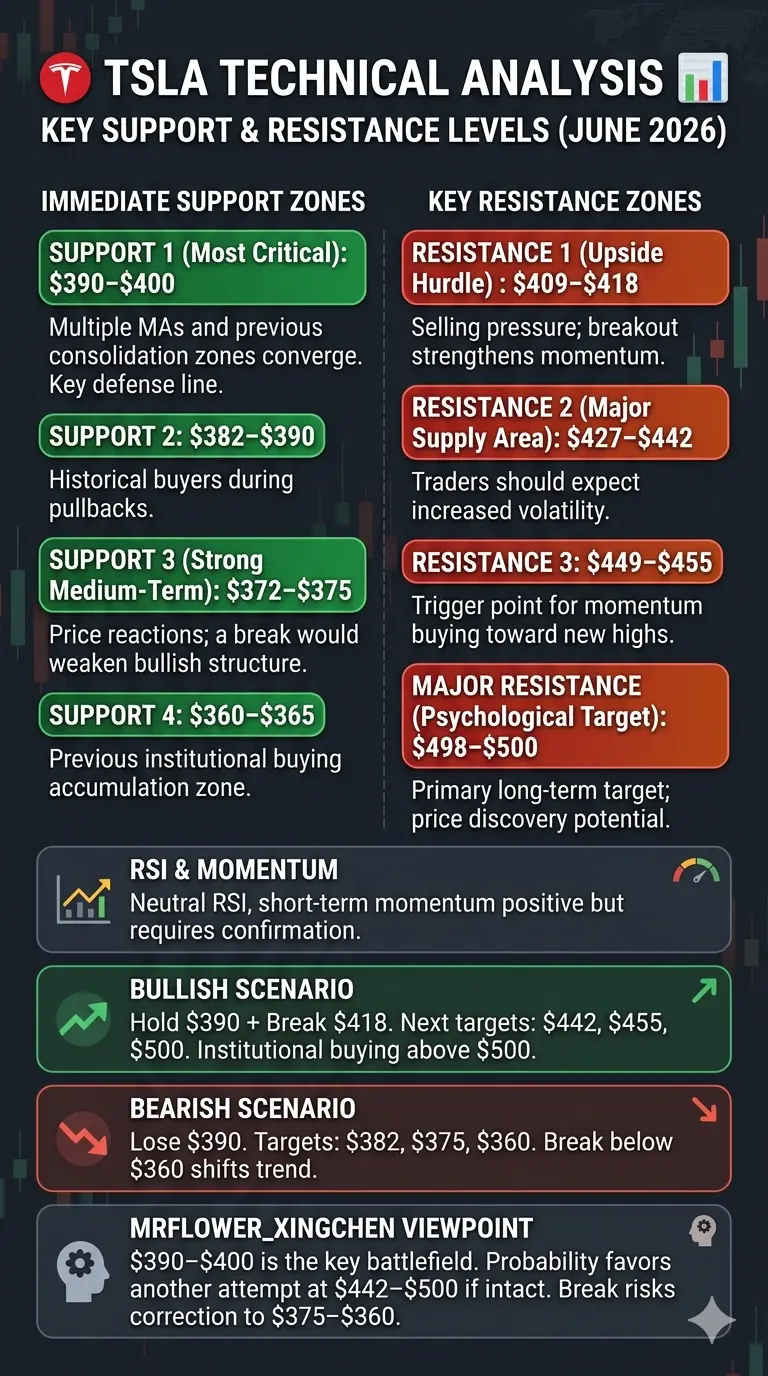
𝗧𝗦𝗟𝗔 𝗧𝗲𝗰𝗵𝗻𝗶𝗰𝗮𝗹 𝗔𝗻𝗮𝗹𝘆𝘀𝗶𝘀 — 𝗞𝗲𝘆 𝗦𝘂𝗽𝗽𝗼𝗿𝘁 & 𝗥𝗲𝘀𝗶𝘀𝘁𝗮𝗻𝗰𝗲 𝗟𝗲𝘃𝗲𝗹𝘀 (June 2026)
Tesla is currently trading near the $395–$400 zone, which is a critical technical area. The stock remains in a longer-term bullish structure but has entered a consolidation phase after failing to sustain moves toward the $500 region earlier this year. Market participants are closely monitoring support and resistance levels to determine the next major directional move.
𝗜𝗺𝗺𝗲𝗱𝗶𝗮𝘁𝗲 𝗦𝘂𝗽𝗽𝗼𝗿𝘁 𝗭𝗼𝗻𝗲𝘀
Support 1: $390–$400
This is currentl
MrFlower_XingChen
#ShareYourUSStocksWinNvidia
𝗧𝗦𝗟𝗔 𝗧𝗲𝗰𝗵𝗻𝗶𝗰𝗮𝗹 𝗔𝗻𝗮𝗹𝘆𝘀𝗶𝘀 — 𝗞𝗲𝘆 𝗦𝘂𝗽𝗽𝗼𝗿𝘁 & 𝗥𝗲𝘀𝗶𝘀𝘁𝗮𝗻𝗰𝗲 𝗟𝗲𝘃𝗲𝗹𝘀 (June 2026)
Tesla is currently trading near the $395–$400 zone, which is a critical technical area. The stock remains in a longer-term bullish structure but has entered a consolidation phase after failing to sustain moves toward the $500 region earlier this year. Market participants are closely monitoring support and resistance levels to determine the next major directional move.
𝗜𝗺𝗺𝗲𝗱𝗶𝗮𝘁𝗲 𝗦𝘂𝗽𝗽𝗼𝗿𝘁 𝗭𝗼𝗻𝗲𝘀
Support 1: $390–$400
This is currently the most important near-term support area. Multiple moving averages and previous consolidation zones converge here. A successful defense of this level would indicate that buyers remain in control.
Support 2: $382–$390
If TSLA loses the $390 region, the next major support appears around $382–$390. Historically, buyers have stepped into this zone during previous pullbacks.
Support 3: $372–$375
This is a strong medium-term support level and aligns with previous price reactions. A break below this zone would significantly weaken the bullish structure.
Support 4: $360–$365
Institutional buyers previously accumulated shares around this area. If broader market sentiment deteriorates, TSLA could revisit this region.
𝗞𝗲𝘆 𝗥𝗲𝘀𝗶𝘀𝘁𝗮𝗻𝗰𝗲 𝗭𝗼𝗻𝗲𝘀
Resistance 1: $409–$418
This is the first major upside hurdle. Tesla has repeatedly encountered selling pressure near this area. A decisive breakout above $418 would strengthen bullish momentum considerably.
Resistance 2: $427–$442
This zone represents the next major supply area. Traders should expect increased volatility if the stock approaches these levels.
Resistance 3: $449–$455
Breaking above this region would likely trigger momentum buying and potentially open the path toward new highs.
Major Resistance: $498–$500
The psychological $500 level remains the primary long-term target. A successful breakout above this area could start a new price-discovery phase.
𝗥𝗦𝗜 & 𝗠𝗼𝗺𝗲𝗻𝘁𝘂𝗺
Current RSI readings are generally neutral rather than overbought or oversold, suggesting Tesla has room to move in either direction. Momentum indicators remain positive in the short term, but confirmation requires a breakout above resistance.
𝗕𝘂𝗹𝗹𝗶𝘀𝗵 𝗦𝗰𝗲𝗻𝗮𝗿𝗶𝗼
If TSLA holds above $390 and successfully breaks $418, the next upside targets become:
$442
$455
$500
A close above $500 would likely attract substantial institutional and momentum-driven buying.
𝗕𝗲𝗮𝗿𝗶𝘀𝗵 𝗦𝗰𝗲𝗻𝗮𝗿𝗶𝗼
If TSLA loses $390, sellers could target:
$382
$375
$360
A sustained break below $360 would shift the medium-term trend toward bearish territory.
𝗠𝗿𝗙𝗹𝗼𝘄𝗲𝗿_𝗫𝗶𝗻𝗴𝗖𝗵𝗲𝗻 𝗩𝗶𝗲𝘄𝗽𝗼𝗶𝗻𝘁
MrFlower_XingChen believes the $390–$400 zone is currently the most important battlefield for Tesla. As long as this support remains intact, the probability favors another attempt toward $442–$500. However, failure to hold this region could trigger a deeper correction toward $375–$360 before the next major rally begins.
#TradeCFDWinGold #StockTradingChallengeUpTo17000U #DailyPolymarketHotspot #GatePredictionMarketAddsSmartMoneyTracking @Gate_Square @Gate广场_Official
repost-content-media
  • Reward
  • Comment
  • Repost
  • Share
#ShareYourUSStocksWinNvidia
𝗦𝗣𝗬 (𝗦&𝗣 𝟱𝟬𝟬 𝗘𝗧𝗙) — 𝗖𝗼𝗺𝗽𝗹𝗲𝘁𝗲 𝗧𝗲𝗰𝗵𝗻𝗶𝗰𝗮𝗹 𝗔𝗻𝗮𝗹𝘆𝘀𝗶𝘀 (June 2026)
SPY remains one of the most important indicators of global risk sentiment because it tracks the performance of the largest U.S. companies. Following a powerful rebound from the April correction, SPY has returned near all-time highs and remains within a strong long-term uptrend. However, technical indicators suggest the market is becoming increasingly overbought, making the next few weeks critical for determining whether the rally continues or enters a consolidation phase
MrFlower_XingChen
#ShareYourUSStocksWinNvidia
𝗦𝗣𝗬 (𝗦&𝗣 𝟱𝟬𝟬 𝗘𝗧𝗙) — 𝗖𝗼𝗺𝗽𝗹𝗲𝘁𝗲 𝗧𝗲𝗰𝗵𝗻𝗶𝗰𝗮𝗹 𝗔𝗻𝗮𝗹𝘆𝘀𝗶𝘀 (June 2026)
SPY remains one of the most important indicators of global risk sentiment because it tracks the performance of the largest U.S. companies. Following a powerful rebound from the April correction, SPY has returned near all-time highs and remains within a strong long-term uptrend. However, technical indicators suggest the market is becoming increasingly overbought, making the next few weeks critical for determining whether the rally continues or enters a consolidation phase.
𝗖𝘂𝗿𝗿𝗲𝗻𝘁 𝗧𝗿𝗲𝗻𝗱 𝗦𝘁𝗿𝘂𝗰𝘁𝘂𝗿𝗲
The broader trend remains bullish. SPY continues trading above its major moving averages, and momentum indicators remain positive. Multiple technical models still classify the ETF as a strong buy despite growing signs of short-term exhaustion after the recent rally.
𝗜𝗺𝗺𝗲𝗱𝗶𝗮𝘁𝗲 𝗦𝘂𝗽𝗽𝗼𝗿𝘁 𝗭𝗼𝗻𝗲𝘀
Support 1: $732–$735
This is the first important support area and represents the region where recent buyers have been defending the trend. A successful hold above this level would keep the immediate bullish structure intact.
Support 2: $716–$720
This is the strongest medium-term support zone and aligns with institutional accumulation areas identified by several technical models. A break below this zone would significantly weaken bullish momentum.
Support 3: $700–$705
The psychological 700 level represents major support. If macroeconomic conditions deteriorate, SPY could revisit this region before finding stronger buying interest.
𝗞𝗲𝘆 𝗥𝗲𝘀𝗶𝘀𝘁𝗮𝗻𝗰𝗲 𝗭𝗼𝗻𝗲𝘀
Resistance 1: $750
This is currently the most important resistance level. SPY has approached this area multiple times and traders are closely monitoring whether the ETF can establish a decisive breakout above it.
Resistance 2: $758–$760
A breakout above $750 would likely target the next resistance zone around $758–$760. This region represents the upper boundary of several quantitative trading models.
Resistance 3: $780–$800
If bullish momentum accelerates due to AI-driven earnings growth, lower interest rates, and continued institutional inflows, SPY could potentially challenge the $800 area later in 2026.
𝗥𝗦𝗜 𝗔𝗻𝗱 𝗠𝗼𝗺𝗲𝗻𝘁𝘂𝗺
RSI remains elevated but not yet at extreme levels. Momentum indicators continue to show bullish conditions, although overbought readings suggest that a short-term pullback or sideways consolidation would be healthy for the longer-term trend.
𝗕𝘂𝗹𝗹𝗶𝘀𝗵 𝗦𝗰𝗲𝗻𝗮𝗿𝗶𝗼
If SPY successfully holds above $732 and breaks through $750, the next upside targets become:
$760
$780
$800
Such a breakout would confirm continued institutional demand and could trigger another wave of momentum buying.
𝗕𝗲𝗮𝗿𝗶𝘀𝗵 𝗦𝗰𝗲𝗻𝗮𝗿𝗶𝗼
If SPY loses $732, sellers could target:
$720
$700
$680
A sustained move below $700 would indicate that the current rally has transitioned into a deeper correction phase.
𝗠𝗮𝗰𝗿𝗼 𝗖𝗮𝘁𝗮𝗹𝘆𝘀𝘁𝘀
The primary drivers for SPY over the coming months include Federal Reserve policy expectations, AI-related earnings growth, corporate profit margins, labor market data, inflation trends, and geopolitical developments. Strong earnings from mega-cap technology companies remain one of the biggest bullish catalysts for the index.
𝗠𝗿𝗙𝗹𝗼𝘄𝗲𝗿_𝗫𝗶𝗻𝗴𝗖𝗵𝗲𝗻 𝗩𝗶𝗲𝘄𝗽𝗼𝗶𝗻𝘁
MrFlower_XingChen believes SPY remains in a structurally bullish market environment, but the $750 level is the key battleground. A confirmed breakout above this resistance could open the path toward $780–$800, while failure at this level may lead to a healthy correction toward $720–$700 before the next major advance begins.
#TradeCFDWinGold #StockTradingChallengeUpTo17000U #DailyPolymarketHotspot #GatePredictionMarketAddsSmartMoneyTracking @Gate_Square @Gate广场_Official
  • Reward
  • Comment
  • Repost
  • Share
#ShareYourUSStocksWinNvidia
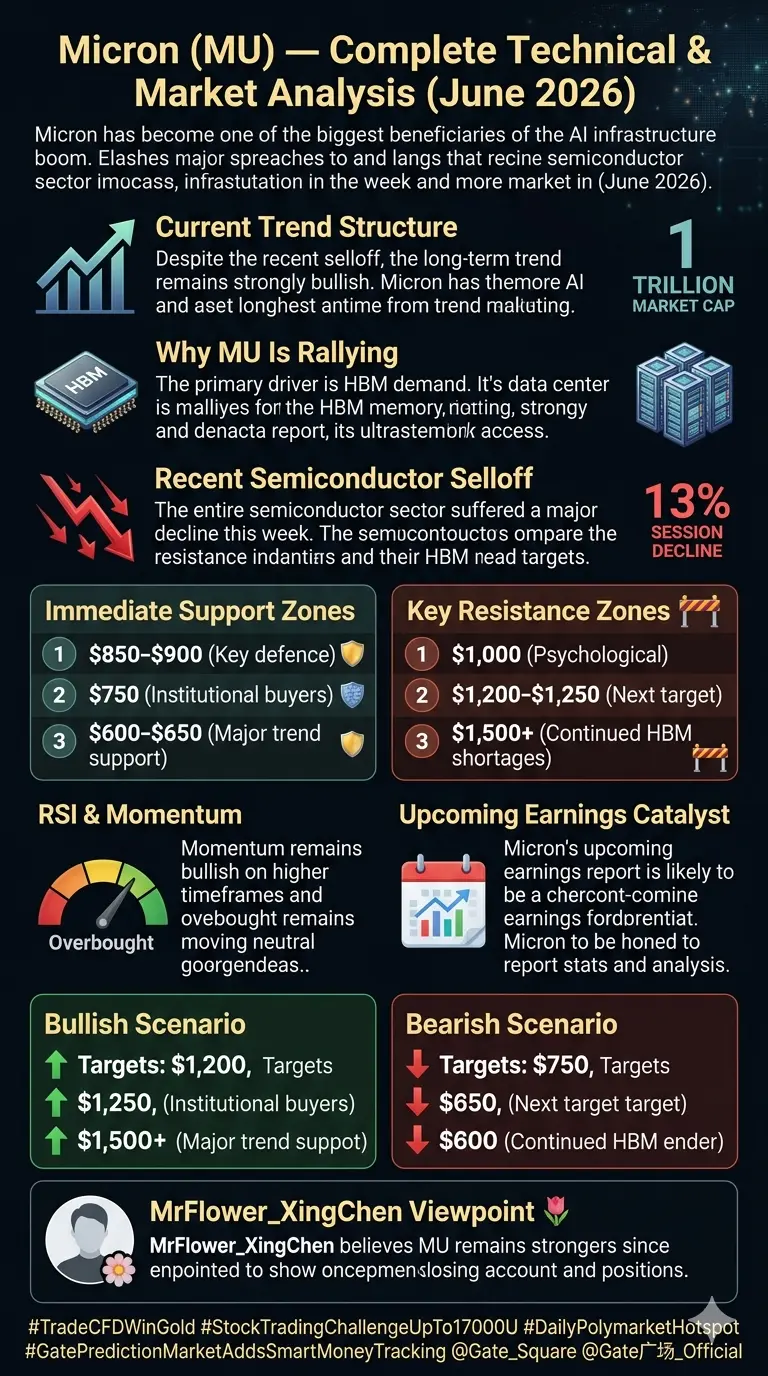
𝗠𝗶𝗰𝗿𝗼𝗻 (𝗠𝗨) — 𝗖𝗼𝗺𝗽𝗹𝗲𝘁𝗲 𝗧𝗲𝗰𝗵𝗻𝗶𝗰𝗮𝗹 & 𝗠𝗮𝗿𝗸𝗲𝘁 𝗔𝗻𝗮𝗹𝘆𝘀𝗶𝘀 (June 2026)
Micron has become one of the biggest beneficiaries of the AI infrastructure boom. The company is no longer viewed simply as a memory-chip manufacturer but as a critical supplier of High Bandwidth Memory (HBM) used in advanced AI systems. Demand from AI data centers has driven a massive rally in the stock, making MU one of the strongest performers in the semiconductor sector. However, after reaching record highs, the stock recently experienced a sharp correction as
MrFlower_XingChen
#ShareYourUSStocksWinNvidia
𝗠𝗶𝗰𝗿𝗼𝗻 (𝗠𝗨) — 𝗖𝗼𝗺𝗽𝗹𝗲𝘁𝗲 𝗧𝗲𝗰𝗵𝗻𝗶𝗰𝗮𝗹 & 𝗠𝗮𝗿𝗸𝗲𝘁 𝗔𝗻𝗮𝗹𝘆𝘀𝗶𝘀 (June 2026)
Micron has become one of the biggest beneficiaries of the AI infrastructure boom. The company is no longer viewed simply as a memory-chip manufacturer but as a critical supplier of High Bandwidth Memory (HBM) used in advanced AI systems. Demand from AI data centers has driven a massive rally in the stock, making MU one of the strongest performers in the semiconductor sector. However, after reaching record highs, the stock recently experienced a sharp correction as investors took profits and concerns emerged regarding future memory supply growth.
𝗖𝘂𝗿𝗿𝗲𝗻𝘁 𝗧𝗿𝗲𝗻𝗱 𝗦𝘁𝗿𝘂𝗰𝘁𝘂𝗿𝗲
Despite the recent selloff, the long-term trend remains strongly bullish. MU recently surpassed the $1 trillion market capitalization milestone and has gained several hundred percent over the past year due to explosive AI memory demand. The stock remains well above major long-term moving averages, indicating that institutional accumulation is still intact.
𝗪𝗵𝘆 𝗠𝗨 𝗜𝘀 𝗥𝗮𝗹𝗹𝘆𝗶𝗻𝗴
The primary driver is HBM demand. Advanced AI chips require increasingly large amounts of high-speed memory, and Micron has become one of the few companies capable of supplying this technology at scale. Reports indicate much of Micron's HBM capacity is effectively committed through 2026, creating significant pricing power.
𝗥𝗲𝗰𝗲𝗻𝘁 𝗦𝗲𝗺𝗶𝗰𝗼𝗻𝗱𝘂𝗰𝘁𝗼𝗿 𝗦𝗲𝗹𝗹𝗼𝗳𝗳
The entire semiconductor sector suffered a major decline this week. Micron dropped more than 13% in a single session as investors worried about chip-sector valuations, future memory supply expansion, and broader market volatility. Despite the decline, analysts generally view the selloff as sentiment-driven rather than evidence of collapsing AI demand.
𝗜𝗺𝗺𝗲𝗱𝗶𝗮𝘁𝗲 𝗦𝘂𝗽𝗽𝗼𝗿𝘁 𝗭𝗼𝗻𝗲𝘀
Support 1: $850–$900
This is currently the most important support area. It represents the previous breakout region and is where buyers are expected to defend the bullish trend.
Support 2: $750
If the stock loses the $850 area, the next significant support level appears near $750. This level could attract institutional buyers looking for longer-term exposure.
Support 3: $600–$650
This is the major trend support zone. A decline into this region would represent a deep correction but would still leave the broader AI-driven uptrend intact.
𝗞𝗲𝘆 𝗥𝗲𝘀𝗶𝘀𝘁𝗮𝗻𝗰𝗲 𝗭𝗼𝗻𝗲𝘀
Resistance 1: $1,000
The psychological $1,000 level remains the first major resistance. A successful recovery above this area would signal renewed bullish momentum.
Resistance 2: $1,200–$1,250
This region represents the next major upside target if AI demand remains strong and earnings continue exceeding expectations.
Resistance 3: $1,500+
Several bullish analysts believe continued HBM shortages and AI infrastructure expansion could eventually support prices well above $1,500.
𝗥𝗦𝗜 & 𝗠𝗼𝗺𝗲𝗻𝘁𝘂𝗺
Momentum remains bullish on higher timeframes, but technical indicators suggest the stock became significantly overbought following its extraordinary rally. The recent correction may help reset momentum before the next major move.
𝗨𝗽𝗰𝗼𝗺𝗶𝗻𝗴 𝗘𝗮𝗿𝗻𝗶𝗻𝗴𝘀 𝗖𝗮𝘁𝗮𝗹𝘆𝘀𝘁
Micron's upcoming earnings report is likely to be one of the most important events for the stock this month. Investors will focus on HBM demand, pricing trends, future supply commitments, margins, and management guidance regarding AI infrastructure spending.
𝗕𝘂𝗹𝗹𝗶𝘀𝗵 𝗦𝗰𝗲𝗻𝗮𝗿𝗶𝗼
If MU successfully holds above $850–$900 and regains $1,000, the next upside targets become:
$1,200
$1,250
$1,500+
Continued AI infrastructure expansion and HBM shortages would likely support this scenario.
𝗕𝗲𝗮𝗿𝗶𝘀𝗵 𝗦𝗰𝗲𝗻𝗮𝗿𝗶𝗼
If MU loses $850, sellers could target:
$750
$650
$600
The biggest risk remains a slowdown in AI spending or signs that memory supply growth is beginning to outpace demand.
𝗠𝗿𝗙𝗹𝗼𝘄𝗲𝗿_𝗫𝗶𝗻𝗴𝗖𝗵𝗲𝗻 𝗩𝗶𝗲𝘄𝗽𝗼𝗶𝗻𝘁
MrFlower_XingChen believes MU remains one of the purest AI infrastructure trades available in the market. The stock has become a direct bet on AI memory demand, HBM adoption, and data-center expansion. While short-term volatility could remain elevated after such a historic rally, maintaining support above $850–$900 would keep the long-term bullish thesis intact. A recovery above $1,000 could reignite momentum toward $1,200–$1,500+, while a break below support would likely trigger a deeper but potentially healthy correction.
#TradeCFDWinGold #StockTradingChallengeUpTo17000U #DailyPolymarketHotspot #GatePredictionMarketAddsSmartMoneyTracking @Gate_Square @Gate广场_Official
repost-content-media
  • Reward
  • Comment
  • Repost
  • Share
#ShareYourUSStocksWinNvidia
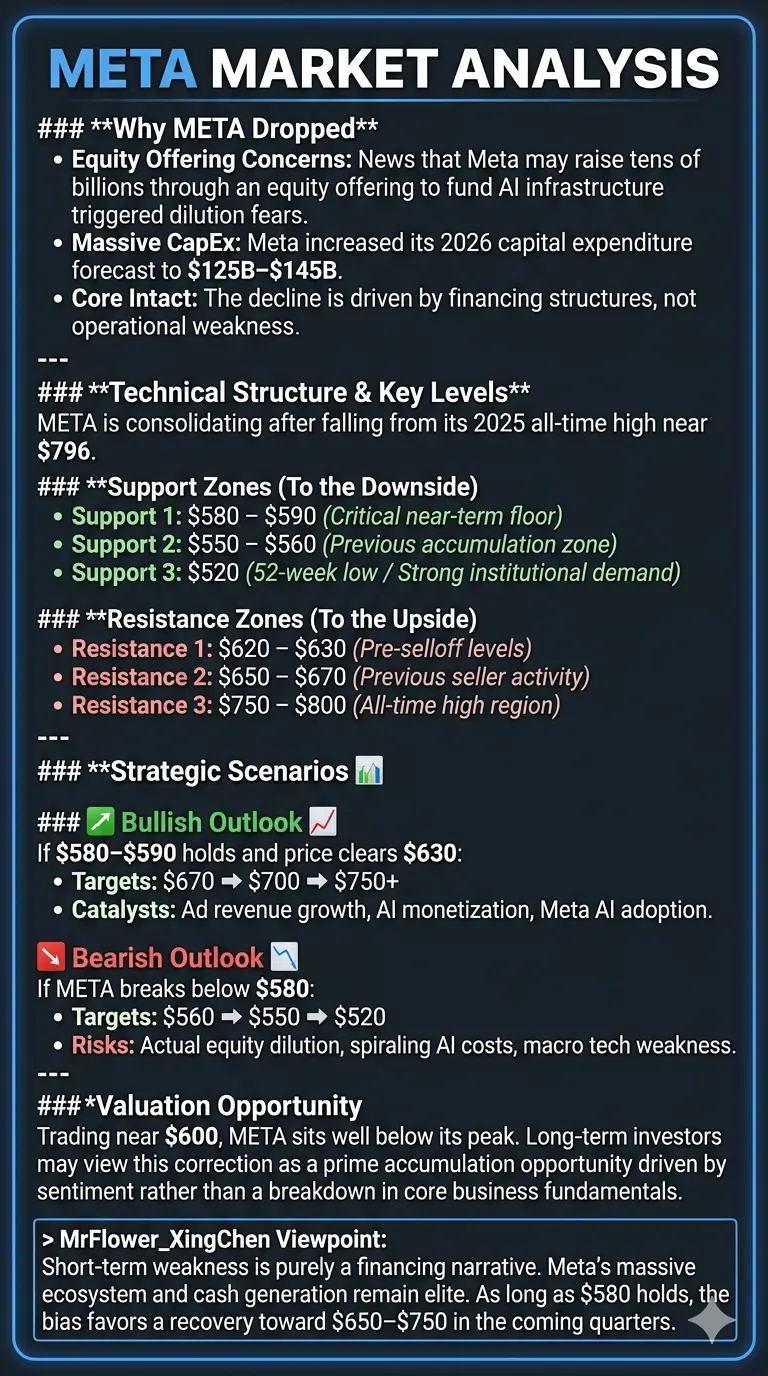
𝗠𝗘𝗧𝗔 (𝗠𝗲𝘁𝗮) —
Meta is currently trading around the $590–$600 range after experiencing a sharp selloff following reports that the company is considering raising tens of billions of dollars through a potential equity offering to help finance its rapidly expanding AI infrastructure investments. The decline was driven primarily by concerns about possible shareholder dilution rather than weakness in Meta's core business operations.
𝗪𝗵𝘆 𝗠𝗘𝗧𝗔 𝗗𝗿𝗼𝗽𝗽𝗲𝗱
The market reaction was triggered by reports that Meta may follow the path recently taken by Alphabe
MrFlower_XingChen
#ShareYourUSStocksWinNvidia
𝗠𝗘𝗧𝗔 (𝗠𝗲𝘁𝗮) —
Meta is currently trading around the $590–$600 range after experiencing a sharp selloff following reports that the company is considering raising tens of billions of dollars through a potential equity offering to help finance its rapidly expanding AI infrastructure investments. The decline was driven primarily by concerns about possible shareholder dilution rather than weakness in Meta's core business operations.
𝗪𝗵𝘆 𝗠𝗘𝗧𝗔 𝗗𝗿𝗼𝗽𝗽𝗲𝗱
The market reaction was triggered by reports that Meta may follow the path recently taken by Alphabet and raise substantial capital to fund future AI projects. Investors worry that issuing additional shares could dilute existing shareholders even though the funds would be directed toward long-term AI growth initiatives. Meta has already increased its 2026 capital expenditure forecast to between $125 billion and $145 billion, highlighting the enormous scale of the AI arms race.
𝗔𝗜 𝗜𝗻𝘃𝗲𝘀𝘁𝗺𝗲𝗻𝘁 𝗧𝗵𝗲𝘀𝗶𝘀 𝗥𝗲𝗺𝗮𝗶𝗻𝘀 𝗜𝗻𝘁𝗮𝗰𝘁
Despite the recent decline, Meta remains one of the world's largest AI investors. The company continues building massive data centers, expanding GPU capacity, developing advanced AI models, and integrating AI across its ecosystem. Long-term investors continue viewing Meta as one of the primary beneficiaries of AI adoption because it combines infrastructure ownership with direct access to billions of users.
𝗖𝘂𝗿𝗿𝗲𝗻𝘁 𝗧𝗲𝗰𝗵𝗻𝗶𝗰𝗮𝗹 𝗦𝘁𝗿𝘂𝗰𝘁𝘂𝗿𝗲
From a technical perspective, META remains in a medium-term consolidation phase after falling significantly from its 2025 all-time high near $796. The current decline has pushed the stock toward a critical support zone where institutional buyers may begin accumulating shares again.
𝗜𝗺𝗺𝗲𝗱𝗶𝗮𝘁𝗲 𝗦𝘂𝗽𝗽𝗼𝗿𝘁 𝗟𝗲𝘃𝗲𝗹𝘀
Support 1: $580–$590
This is the most important near-term support zone. The stock recently traded within this range during the selloff, making it the first level buyers must defend.
Support 2: $550–$560
If META breaks below $580, the next major support area appears near $550–$560, where previous accumulation occurred earlier in the year.
Support 3: $520
The 52-week low region remains the strongest long-term support. A move toward this level would likely attract significant institutional attention.
𝗞𝗲𝘆 𝗥𝗲𝘀𝗶𝘀𝘁𝗮𝗻𝗰𝗲 𝗟𝗲𝘃𝗲𝗹𝘀
Resistance 1: $620–$630
This is the first resistance zone and corresponds with recent trading levels before the equity-raising news triggered the selloff.
Resistance 2: $650–$670
A breakout above $630 would likely target this area where sellers previously became active.
Resistance 3: $750–$800
This remains the major long-term resistance zone and includes the previous all-time high near $796.
𝗕𝘂𝗹𝗹𝗶𝘀𝗵 𝗦𝗰𝗲𝗻𝗮𝗿𝗶𝗼
If META successfully holds above $580–$590 and recovers above $630, the next upside targets become:
$670
$700
$750+
Continued growth in advertising revenue, AI monetization, and positive developments regarding Meta AI could support this scenario.
𝗕𝗲𝗮𝗿𝗶𝘀𝗵 𝗦𝗰𝗲𝗻𝗮𝗿𝗶𝗼
If META loses $580, sellers could target:
$560
$550
$520
The biggest risk remains investor concerns regarding future equity issuance, rising AI spending requirements, and broader technology-sector weakness.
𝗩𝗮𝗹𝘂𝗮𝘁𝗶𝗼𝗻 𝗢𝗽𝗽𝗼𝗿𝘁𝘂𝗻𝗶𝘁𝘆
At current prices near $600, META trades substantially below its 2025 peak around $796. Investors who remain bullish on AI, digital advertising, smart glasses, and Meta's ecosystem may view the recent correction as a potential accumulation opportunity rather than a deterioration in business fundamentals.
𝗠𝗿𝗙𝗹𝗼𝘄𝗲𝗿_𝗫𝗶𝗻𝗴𝗖𝗵𝗲𝗻 𝗩𝗶𝗲𝘄𝗽𝗼𝗶𝗻𝘁
MrFlower_XingChen believes the current weakness in META is largely driven by financing concerns rather than operational weakness. The company's AI ambitions require enormous capital, but Meta still controls some of the world's most valuable digital platforms and generates substantial cash flow. As long as $580 support holds, the probability favors recovery toward $650–$750 over the coming quarters. However, a breakdown below support could create additional downside toward $550–$520 before a stronger long-term base is established.
#TradeCFDWinGold #StockTradingChallengeUpTo17000U #DailyPolymarketHotspot #GatePredictionMarketAddsSmartMoneyTracking @Gate_Square @Gate广场_Official
repost-content-media
  • Reward
  • Comment
  • Repost
  • Share
#ShareYourUSStocksWinNvidia
𝗦𝗡𝗗𝗞 (𝗦𝗮𝗻𝗗𝗶𝘀𝗸) —
SanDisk has become one of the most explosive AI memory / storage supercycle stocks in the market. After a massive multi-thousand percent rally over the past year, the stock is now trading in a high-volatility institutional revaluation phase, where fundamentals are extremely strong but price action is stretched and emotionally driven.
Recent data shows SNDK has delivered ~250%+ YoY revenue growth, extremely strong margins, and accelerating data-center demand tied directly to AI infrastructure expansion.
At the same time, the stock has a
MrFlower_XingChen
#ShareYourUSStocksWinNvidia
𝗦𝗡𝗗𝗞 (𝗦𝗮𝗻𝗗𝗶𝘀𝗸) —
SanDisk has become one of the most explosive AI memory / storage supercycle stocks in the market. After a massive multi-thousand percent rally over the past year, the stock is now trading in a high-volatility institutional revaluation phase, where fundamentals are extremely strong but price action is stretched and emotionally driven.
Recent data shows SNDK has delivered ~250%+ YoY revenue growth, extremely strong margins, and accelerating data-center demand tied directly to AI infrastructure expansion.
At the same time, the stock has already priced in a large portion of the “AI memory supercycle,” making it sensitive to any shift in sentiment, valuation, or forward guidance.
---
𝗖𝘂𝗿𝗿𝗲𝗻𝘁 𝗠𝗮𝗿𝗸𝗲𝘁 𝗦𝘁𝗮𝘁𝘂𝘀
SNDK is currently in a post-parabolic expansion structure:
Massive prior rally (multi-bagger + momentum explosion)
Strong institutional inflows driven by AI demand narrative
Elevated volatility due to profit-taking and positioning resets
High sensitivity to earnings and guidance changes
Even after the rally, analysts still maintain a Buy consensus, but price targets are now highly dispersed, with both upside and downside cases present depending on AI demand trajectory.
---
𝗙𝘂𝗻𝗱𝗮𝗺𝗲𝗻𝘁𝗮𝗹 𝗦𝘁𝗼𝗿𝘆 (𝗔𝗜 𝗠𝗘𝗠𝗢𝗥𝗬 𝗦𝗨𝗣𝗘𝗥𝗖𝗬𝗖𝗟𝗘)
The core thesis is not traditional storage demand — it is AI infrastructure memory bottleneck economics:
1. HBM + NAND scarcity cycle
AI data centers require:
High-speed SSD storage
Massive memory bandwidth
Enterprise-grade NAND contracts
Supply is still constrained, and multiple reports suggest:
Multi-year supply shortages in memory markets
Long-term contracts locking in demand visibility
---
2. Structural shift (not cyclical only anymore)
Unlike previous memory cycles, SNDK is now tied to:
Hyperscaler AI buildouts
Enterprise SSD migration
AI training + inference storage needs
This is why analysts are beginning to re-rate it as a “structural AI beneficiary” rather than a cyclical chip stock.
---
3. Financial acceleration phase
Recent financials show:
Strong revenue acceleration
Major EPS expansion
Increasing margins due to pricing power
Multi-year contract visibility improving stability
This combination explains the aggressive re-rating.
---
𝗧𝗘𝗖𝗛𝗡𝗜𝗖𝗔𝗟 𝗦𝗧𝗥𝗨𝗖𝗧𝗨𝗥𝗘 (𝗛𝗜𝗚𝗛 𝗧𝗜𝗠𝗘𝗙𝗥𝗔𝗠𝗘)
SNDK is no longer in a “trend up” phase — it is in a:
➤ 𝗣𝗮𝗿𝗮𝗯𝗼𝗹𝗶𝗰 𝗠𝗮𝗰𝗿𝗼 𝗖𝘆𝗰𝗹𝗲 𝗦𝘁𝗿𝘂𝗰𝘁𝘂𝗿𝗲
Characteristics:
Strong upward slope but sharp pullbacks
Institutional profit-taking waves
Rapid reclaim after dips (bull control intact)
Extremely high momentum rotation behavior
This usually happens in:
semiconductor supercycles
commodity shortages
AI infrastructure booms
---
𝗞𝗘𝗬 𝗦𝗨𝗣𝗣𝗢𝗥𝗧 𝗭𝗢𝗡𝗘𝗦
🟢 Primary Support (Institutional Zone)
Area where large buyers historically defend trend continuation
If held → trend stays bullish
🟡 Secondary Support (Momentum Reset Zone)
Pullback absorption level
Often used for re-accumulation
🔴 Deep Support (Cycle Reset Zone)
Would indicate full sentiment reset
Still bullish long-term but short-term correction phase
---
𝗞𝗘𝗬 𝗥𝗘𝗦𝗜𝗦𝗧𝗔𝗡𝗖𝗘 𝗭𝗢𝗡𝗘𝗦
🔵 First Resistance (Short-term profit-taking zone)
Where momentum traders lock gains
🔵 Major Resistance (Continuation breakout level)
Break above this = next leg of AI expansion rally
🟣 Psychological Extension Zone
Where valuation debate becomes extreme
Typically seen in final euphoric expansion phases
---
𝗠𝗔𝗥𝗞𝗘𝗧 𝗦𝗘𝗡𝗧𝗜𝗠𝗘𝗡𝗧
SNDK currently sits in a conflict phase:
Bull case:
AI memory shortage continues
Pricing power expands
Long-term contracts stabilize earnings
EPS growth remains explosive
Bear case:
Memory cycles historically mean-revert
Valuation becomes overheated
Supply expansion eventually compresses margins
Sharp correction risk after parabolic runs
Even short-sellers argue the stock may be “over-AI’d” in valuation expectations, comparing it to speculative positioning in past tech cycles.
---
𝗥𝗜𝗦𝗞 𝗖𝗢𝗥𝗘 𝗙𝗔𝗖𝗧𝗢𝗥𝗦
Memory is still cyclical (even in AI supercycle)
Extremely extended price structure
Profit-taking from insiders/institutions
High expectations already baked into price
Any AI capex slowdown = sharp correction risk
---
𝗦𝗨𝗠𝗠𝗔𝗥𝗬 𝗢𝗨𝗧𝗟𝗢𝗢𝗞
SNDK is currently:
✔ Strong structural AI beneficiary
✔ Supported by memory shortage supercycle
✔ Backed by explosive earnings growth
✔ In a highly extended technical phase
✔ Driven by institutional momentum + speculation mix
But also:
⚠ Overextended after historic rally
⚠ Extremely sensitive to sentiment shifts
⚠ Prone to sharp volatility swings
⚠ In “re-rating + exhaustion” stage of cycle
---
𝗠𝗿𝗙𝗹𝗼𝘄𝗲𝗿_𝗫𝗶𝗻𝗴𝗖𝗵𝗲𝗻 𝗩𝗶𝗲𝘄𝗽𝗼𝗶𝗻𝘁
MrFlower_XingChen sees SNDK as a pure AI infrastructure leverage play on global memory scarcity, but at current levels it behaves less like a steady growth stock and more like a macro momentum instrument tied to AI sentiment cycles. The long-term trend remains bullish as long as AI demand and data-center expansion continue accelerating, but short-term structure is dominated by volatility, profit-taking, and cycle exhaustion risk. In simple terms: the story is still strong, but the price has already moved into the “high expectation zone” where timing becomes more important than narrative.
#TradeCFDWinGold #StockTradingChallengeUpTo17000U #DailyPolymarketHotspot #GatePredictionMarketAddsSmartMoneyTracking @Gate_Square @Gate广场_Official
repost-content-media
  • Reward
  • Comment
  • Repost
  • Share
𝗕𝗶𝘁𝗰𝗼𝗶𝗻 𝗘𝗧𝗙 𝗙𝗹𝗼𝘄 𝗖𝗿𝗶𝘀𝗶𝘀 — 𝗜𝗻𝘀𝘁𝗶𝘁𝘂𝘁𝗶𝗼𝗻𝗮𝗹 𝗣𝗼𝘀𝗶𝘁𝗶𝗼𝗻𝗶𝗻𝗴 𝗥𝗲𝘀𝗲𝘁 𝗮𝗻𝗱 𝗪𝗵𝗮𝘁 𝗖𝗼𝗺𝗲𝘀 𝗡𝗲𝘅𝘁
The recent $4.4B outflow streak from Bitcoin ETFs marks one of the most important institutional positioning shifts since the launch of spot ETFs. This was not a random retail-driven correction — it was a coordinated risk de-leveraging cycle across macro hedge funds, CTA models, and short-term institutional momentum strategies, reflecting broader uncertainty in global liquidity conditions.
Over the course of 13 consecutive trading sessions, ETFs tied to
BTC1.67%
MrFlower_XingChen
𝗕𝗶𝘁𝗰𝗼𝗶𝗻 𝗘𝗧𝗙 𝗙𝗹𝗼𝘄 𝗖𝗿𝗶𝘀𝗶𝘀 — 𝗜𝗻𝘀𝘁𝗶𝘁𝘂𝘁𝗶𝗼𝗻𝗮𝗹 𝗣𝗼𝘀𝗶𝘁𝗶𝗼𝗻𝗶𝗻𝗴 𝗥𝗲𝘀𝗲𝘁 𝗮𝗻𝗱 𝗪𝗵𝗮𝘁 𝗖𝗼𝗺𝗲𝘀 𝗡𝗲𝘅𝘁
The recent $4.4B outflow streak from Bitcoin ETFs marks one of the most important institutional positioning shifts since the launch of spot ETFs. This was not a random retail-driven correction — it was a coordinated risk de-leveraging cycle across macro hedge funds, CTA models, and short-term institutional momentum strategies, reflecting broader uncertainty in global liquidity conditions.
Over the course of 13 consecutive trading sessions, ETFs tied to Bitcoin experienced sustained selling pressure, with the majority of outflows concentrated in major funds like BlackRock IBIT, alongside heavy redemptions in products offered by Fidelity Investments and Grayscale Investments. This pattern signals that the pressure was not isolated to one issuer but rather a system-wide risk reduction event.
What makes this phase particularly important is the composition of sellers. Data suggests that the largest selling pressure came from fast-moving hedge funds and tactical macro traders, not long-term allocators such as pension funds or endowments. This distinction matters because it indicates that the structural adoption thesis for Bitcoin remains intact, even though short-term speculative capital exited aggressively.
A key turning point arrived when the outflow streak finally broke, registering a small but symbolically important return to net inflows. While the magnitude was minimal compared to prior redemptions, it represented a shift in momentum behavior. Historically, such transitions often appear near liquidity exhaustion zones, where forced selling begins to fade and price stabilizes after testing psychological levels.
At the same time, broader sentiment indicators confirmed extreme stress in the market, with fear readings deep in “Extreme Fear” territory, suggesting that positioning had become heavily one-sided. In past cycles, similar conditions have frequently coincided with local bottom formations or extended accumulation phases, although they do not guarantee immediate recovery.
From a structural perspective, Bitcoin ETFs have now evolved into a real-time proxy for institutional risk appetite. When inflows dominate, markets enter expansion phases driven by liquidity confidence. When outflows dominate, the system transitions into de-risking and capital preservation mode, often leading to sideways or corrective price behavior.
The critical question now is whether the recent stabilization marks a true regime shift or simply a temporary pause. A sustainable recovery would require multiple consecutive days of positive inflows, combined with improved macro liquidity conditions and renewed risk-on positioning from hedge funds. Without that confirmation, the market remains vulnerable to another leg of selling pressure.
However, the broader ETF structure still shows strong lifetime inflows, meaning that the long-term adoption trend has not broken. Instead, what we are witnessing is a mid-cycle liquidity reset inside a longer institutional adoption curve, where short-term volatility masks a still-intact structural demand base.
MrFlower_XingChen views this phase as a transition from aggressive expansion to positioning equilibrium, where the market is searching for a new balance between liquidity risk and long-term conviction. If inflows gradually return, this zone could later be recognized as a key accumulation period in Bitcoin’s institutional history. However, failure to stabilize flows would likely extend the correction into deeper liquidity regions before a stronger base is formed.
#BitcoinETFSees7272BTCOutflow #Bitcoin #GateSquare
#BitcoinETFSees7272BTCOutflow
repost-content-media
  • Reward
  • Comment
  • Repost
  • Share
𝗦𝗽𝗮𝗰𝗲𝗫 𝗜𝗣𝗢 — 𝗕𝗧𝗖 𝗮𝗻𝗱 𝗦&𝗣 𝟱𝟬𝟬 𝗟𝗶𝗾𝘂𝗶𝗱𝗶𝘁𝘆 𝗜𝗺𝗽𝗮𝗰𝘁 𝗠𝗮𝗽
The potential SpaceX IPO at a multi-trillion valuation level represents more than a single equity event — it acts as a global liquidity reallocation shock that temporarily reshapes capital flow across Bitcoin and the S&P 500. When a mega-IPO of this scale enters the market, institutional portfolios are forced to rebalance risk exposure, creating short-term pressure across multiple asset classes simultaneously.
In the S&P 500, the primary impact comes through liquidity competition and capital rotation. Insti
MrFlower_XingChen
𝗦𝗽𝗮𝗰𝗲𝗫 𝗜𝗣𝗢 — 𝗕𝗧𝗖 𝗮𝗻𝗱 𝗦&𝗣 𝟱𝟬𝟬 𝗟𝗶𝗾𝘂𝗶𝗱𝗶𝘁𝘆 𝗜𝗺𝗽𝗮𝗰𝘁 𝗠𝗮𝗽
The potential SpaceX IPO at a multi-trillion valuation level represents more than a single equity event — it acts as a global liquidity reallocation shock that temporarily reshapes capital flow across Bitcoin and the S&P 500. When a mega-IPO of this scale enters the market, institutional portfolios are forced to rebalance risk exposure, creating short-term pressure across multiple asset classes simultaneously.
In the S&P 500, the primary impact comes through liquidity competition and capital rotation. Institutional investors typically fund large IPO allocations by reducing exposure to high-beta growth stocks, especially in sectors already trading at elevated valuations such as AI, semiconductors, and cloud infrastructure. Stocks like NVIDIA and other mega-cap technology leaders can experience temporary momentum loss as capital is redirected into IPO participation. However, this does not necessarily indicate structural weakness in the index — instead, it reflects a short-term narrowing of market breadth, where leadership becomes more concentrated in defensive and cash-heavy names while speculative growth segments cool down.
For Bitcoin, the impact channel is slightly different but equally important. Bitcoin exposure through ETFs such as those managed by BlackRock, Fidelity Investments, and Grayscale Investments makes it highly sensitive to institutional liquidity shifts. During a major IPO event, hedge funds and macro traders often reduce exposure to volatile assets like Bitcoin to free up capital for primary market allocations. This creates temporary ETF outflows or reduced inflow momentum, leading to short-term price pressure even if long-term demand remains intact.
At the same time, Bitcoin is structurally different from equities because it does not rely on earnings or valuation expansion cycles. Its supply is fixed, and long-term ETF adoption continues to act as a stabilizing force. This means that while IPO-driven liquidity drains can cause short-term volatility, Bitcoin typically retains stronger post-event recovery dynamics once capital rotation stabilizes and risk appetite returns to broader markets.
The key interaction between BTC and SPX during a mega-IPO phase is not directional but cyclical. In the early phase, liquidity is pulled into the IPO, causing both Bitcoin and growth-heavy segments of the S&P 500 to experience mild pressure or consolidation. In the middle phase, volatility increases as positioning adjusts. In the final phase, capital gradually rotates back depending on IPO performance and broader macro conditions, often leading to a rebound in both risk assets if sentiment stabilizes.
Overall, the SpaceX IPO acts as a temporary liquidity magnet rather than a permanent capital drain. It reshapes the timing of flows rather than the long-term direction of markets. The S&P 500 may experience short-term breadth weakness, while Bitcoin may see ETF flow compression, but both assets remain structurally tied to the same global liquidity cycle.
MrFlower_XingChen views this event as a cross-market liquidity reset mechanism, where capital is temporarily concentrated into a single high-profile equity narrative before gradually redistributing back into broader risk assets. The outcome depends less on the IPO itself and more on how quickly institutional liquidity normalizes afterward and whether risk appetite returns to expansion mode across equities and crypto.
#SpaceXRoadshowHighlightsAsteroidMining
repost-content-media
  • Reward
  • Comment
  • Repost
  • Share
𝗚𝗮𝘁𝗲 𝗫 𝗔𝗹𝗽𝗮𝗰𝗮 — 𝗖𝗿𝘆𝗽𝘁𝗼 𝗮𝗻𝗱 𝗦𝘁𝗼𝗰𝗸𝘀 𝗨𝗻𝗶𝗳𝗶𝗲𝗱 𝗟𝗶𝗾𝘂𝗶𝗱𝗶𝘁𝘆 𝗘𝗿𝗮
The partnership between Gate and Alpaca signals a structural shift toward unified capital markets, where crypto assets and traditional equities are no longer separated ecosystems but integrated liquidity pools inside a single trading environment.
This development reflects a broader macro trend: the gradual convergence of financial infrastructure, where investors increasingly demand seamless access to both digital assets and U.S. equities without switching platforms, accounts, or capital rails.
BTC1.67%
STABLE1.39%
MrFlower_XingChen
𝗚𝗮𝘁𝗲 𝗫 𝗔𝗹𝗽𝗮𝗰𝗮 — 𝗖𝗿𝘆𝗽𝘁𝗼 𝗮𝗻𝗱 𝗦𝘁𝗼𝗰𝗸𝘀 𝗨𝗻𝗶𝗳𝗶𝗲𝗱 𝗟𝗶𝗾𝘂𝗶𝗱𝗶𝘁𝘆 𝗘𝗿𝗮
The partnership between Gate and Alpaca signals a structural shift toward unified capital markets, where crypto assets and traditional equities are no longer separated ecosystems but integrated liquidity pools inside a single trading environment.
This development reflects a broader macro trend: the gradual convergence of financial infrastructure, where investors increasingly demand seamless access to both digital assets and U.S. equities without switching platforms, accounts, or capital rails. The result is a more efficient capital flow system where allocation decisions can happen dynamically across asset classes.
𝗨𝗻𝗶𝗳𝗶𝗲𝗱 𝗠𝗮𝗿𝗸𝗲𝘁 𝗔𝗿𝗰𝗵𝗶𝘁𝗲𝗰𝘁𝘂𝗿𝗲
The most important implication of this partnership is the creation of a multi-asset trading layer, where crypto and stocks coexist within the same execution environment. This reduces friction between markets that have historically operated in isolation.
Instead of treating Bitcoin, altcoins, and equities as separate portfolios, traders can now view them as a single risk spectrum, allowing faster rotation between high-growth technology stocks, index exposure, and digital assets depending on macro conditions.
𝗔𝗣𝗜-𝗙𝗶𝗿𝘀𝘁 𝗜𝗻𝗳𝗿𝗮𝘀𝘁𝗿𝘂𝗰𝘁𝘂𝗿𝗲 𝗦𝗵𝗶𝗳𝘁
A key structural advantage comes from Alpaca’s API-driven architecture, which enables advanced trading automation, algorithmic execution, and portfolio-level risk systems.
This creates an environment where retail and professional users can deploy quantitative cross-market strategies, including simultaneous positioning in crypto volatility and equity momentum trades. Over time, this may accelerate the transition from discretionary trading toward systematic, data-driven capital allocation models.
𝗖𝗿𝗼𝘀𝘀-𝗠𝗮𝗿𝗸𝗲𝘁 𝗖𝗮𝗽𝗶𝘁𝗮𝗹 𝗙𝗹𝗼𝘄𝘀
One of the most important long-term effects is the rise of cross-market liquidity recycling.
Capital can now move more fluidly between:
Crypto markets (Bitcoin, altcoins, ETFs)
U.S. equities (AI, semiconductors, mega-cap tech)
Macro index exposure
This creates a dynamic system where liquidity no longer stays confined within one asset class, but instead rotates continuously based on relative opportunity.
In practice, this means crypto and stocks may become more correlated during risk-on and risk-off cycles, because the same liquidity pool is actively switching between both.
𝗧𝗿𝗮𝗱𝗲𝗿 𝗕𝗲𝗵𝗮𝘃𝗶𝗼𝗿 𝗘𝘃𝗼𝗹𝘂𝘁𝗶𝗼𝗻
The most important behavioral shift is the emergence of multi-asset hedging strategies.
Traders may increasingly:
Hedge crypto exposure using AI-heavy equities like NVIDIA
Hedge equity risk using Bitcoin or stable crypto allocations
Rotate capital based on volatility differentials instead of asset ideology
This transforms portfolio construction from single-market optimization into cross-market volatility management.
𝗧𝗼𝗸𝗲𝗻𝗶𝘇𝗮𝘁𝗶𝗼𝗻 𝗔𝗻𝗱 𝗙𝘂𝘁𝘂𝗿𝗲 𝗟𝗮𝘆𝗲𝗿
A longer-term implication is the acceleration of tokenized financial instruments, where stocks, ETFs, and other real-world assets may eventually be represented on blockchain rails.
If regulatory conditions evolve, the boundary between crypto exchanges and traditional brokerages could blur further, leading to a fully interoperable capital market structure where ownership and trading are digitally unified.
𝗟𝗶𝗾𝘂𝗶𝗱𝗶𝘁𝘆 𝗜𝗺𝗽𝗮𝗰𝘁 𝗢𝘂𝘁𝗹𝗼𝗼𝗸
In the short term, this type of integration does not increase total liquidity — it redistributes it. However, in the medium term, it may improve:
Price discovery efficiency
Capital rotation speed
Cross-asset volatility transmission
Institutional participation in crypto markets
This creates a more interconnected financial system where shocks in one market can transmit faster into another.
𝗦𝘁𝗿𝗮𝘁𝗲𝗴𝗶𝗰 𝗜𝗺𝗽𝗹𝗶𝗰𝗮𝘁𝗶𝗼𝗻
MrFlower_XingChen views the Gate–Alpaca partnership as a foundational step toward unified global liquidity infrastructure, where crypto and equities are no longer separate investment universes but integrated components of a single capital network. The real transformation is not product expansion, but the removal of friction between asset classes, which may redefine how global portfolios are built over the next cycle
#GatePartnersWithAlpacaToBridgeCryptoAndStocks
repost-content-media
  • Reward
  • Comment
  • Repost
  • Share
𝗧𝗵𝗲 𝗠𝗮𝗿𝗸𝗲𝘁 𝗥𝗼𝘁𝗮𝘁𝗶𝗼𝗻 𝗦𝗵𝗼𝗰𝗸 — 𝗪𝗵𝘆 𝗖𝗵𝗶𝗽 𝗦𝘁𝗼𝗰𝗸𝘀 𝗙𝗲𝗹𝗹 𝗪𝗵𝗶𝗹𝗲 𝘁𝗵𝗲 𝗗𝗼𝘄 𝗝𝗼𝗻𝗲𝘀 𝗛𝗶𝘁 𝗥𝗲𝗰𝗼𝗿𝗱 𝗛𝗶𝗴𝗵𝘀
The recent divergence where semiconductor stocks weakened while the Dow Jones Industrial Average pushed to new record highs reflects a capital rotation phase rather than a broad market contradiction. Instead of signaling confusion, this behavior suggests that institutional money is actively repositioning across sectors based on risk, valuation, and macro expectations.
---
𝗦𝗲𝗺𝗶𝗰𝗼𝗻𝗱𝘂𝗰𝘁𝗼𝗿 𝗦𝗲𝗰𝘁𝗼𝗿 𝗣𝗿𝗼𝗳𝗶𝘁-𝗧𝗮𝗸𝗶𝗻𝗴 𝗣𝗵
US30-1.64%
MrFlower_XingChen
𝗧𝗵𝗲 𝗠𝗮𝗿𝗸𝗲𝘁 𝗥𝗼𝘁𝗮𝘁𝗶𝗼𝗻 𝗦𝗵𝗼𝗰𝗸 — 𝗪𝗵𝘆 𝗖𝗵𝗶𝗽 𝗦𝘁𝗼𝗰𝗸𝘀 𝗙𝗲𝗹𝗹 𝗪𝗵𝗶𝗹𝗲 𝘁𝗵𝗲 𝗗𝗼𝘄 𝗝𝗼𝗻𝗲𝘀 𝗛𝗶𝘁 𝗥𝗲𝗰𝗼𝗿𝗱 𝗛𝗶𝗴𝗵𝘀
The recent divergence where semiconductor stocks weakened while the Dow Jones Industrial Average pushed to new record highs reflects a capital rotation phase rather than a broad market contradiction. Instead of signaling confusion, this behavior suggests that institutional money is actively repositioning across sectors based on risk, valuation, and macro expectations.
---
𝗦𝗲𝗺𝗶𝗰𝗼𝗻𝗱𝘂𝗰𝘁𝗼𝗿 𝗦𝗲𝗰𝘁𝗼𝗿 𝗣𝗿𝗼𝗳𝗶𝘁-𝗧𝗮𝗸𝗶𝗻𝗴 𝗣𝗵𝗮𝘀𝗲
Chip stocks have been the dominant leaders of the AI-driven rally for an extended period, heavily benefiting from demand expectations tied to data centers, AI infrastructure, and advanced computing. Companies like NVIDIA became central to the global AI narrative, leading to aggressive valuation expansion and crowded positioning.
However, when a sector becomes the primary liquidity destination for a long time, even strong fundamentals eventually trigger rotation. The current weakness is better interpreted as institutional profit-taking and portfolio rebalancing, rather than a breakdown in AI demand itself.
---
𝗗𝗼𝘄 𝗝𝗼𝗻𝗲𝘀 𝗦𝘁𝗿𝗲𝗻𝗴𝘁𝗵 𝗮𝗻𝗱 𝗕𝗿𝗼𝗮𝗱𝗲𝗻𝗶𝗻𝗴 𝗠𝗮𝗿𝗸𝗲𝘁 𝗟𝗲𝗮𝗱𝗲𝗿𝘀𝗵𝗶𝗽
At the same time, the strength in the Dow reflects a broadening of market participation beyond mega-cap technology. The index is more exposed to industrials, financials, healthcare, and consumer-driven companies, which tend to benefit from stable earnings and macroeconomic normalization.
This type of rotation often occurs when investors begin to anticipate a shift from concentrated AI-driven leadership toward a more balanced economic expansion cycle, where multiple sectors contribute to returns rather than a narrow group of technology giants.
---
𝗜𝗻𝘁𝗲𝗿𝗲𝘀𝘁 𝗥𝗮𝘁𝗲𝘀 𝗮𝗻𝗱 𝗩𝗮𝗹𝘂𝗮𝘁𝗶𝗼𝗻 𝗥𝗲𝗮𝗹𝗶𝗴𝗻𝗺𝗲𝗻𝘁
Another key driver behind this divergence is the sensitivity of growth stocks to interest rate expectations. High-growth semiconductor and AI-related companies derive a large portion of their valuation from future earnings, meaning even small shifts in yields can significantly impact pricing.
When macro conditions favor stability or rotation into cash-flow-heavy sectors, investors tend to temporarily reduce exposure to high-multiple growth stocks and increase allocations to defensive or cyclical industries with more predictable earnings profiles.
---
𝗠𝗮𝗿𝗸𝗲𝘁 𝗘𝘅𝗽𝗲𝗰𝘁𝗮𝘁𝗶𝗼𝗻 𝗢𝘃𝗲𝗿𝗵𝗲𝗮𝘁𝗶𝗻𝗴 𝗶𝗻 𝗖𝗵𝗶𝗽𝘀
The semiconductor sector is also facing a classic expectation problem. After a prolonged AI-driven rally, markets are no longer pricing in whether demand is strong — they are pricing in how much stronger it can get beyond already elevated forecasts.
This creates a fragile setup where even positive earnings can lead to disappointment if they fail to exceed extreme expectations. Such conditions often lead to volatility and temporary corrections within structurally strong uptrends.
---
𝗟𝗶𝗾𝘂𝗶𝗱𝗶𝘁𝘆 𝗥𝗼𝘁𝗮𝘁𝗶𝗼𝗻 𝗥𝗮𝘁𝗵𝗲𝗿 𝗧𝗵𝗮𝗻 𝗘𝘅𝗶𝘁
Importantly, this is not a broad exit from equities. Institutional investors typically rotate capital rather than fully withdrawing it from markets. Liquidity leaving semiconductor positions is often redirected into other areas such as financials, industrials, or undervalued cyclicals.
This explains why index-level performance can remain strong even when leading sectors experience pullbacks — capital is shifting internally rather than leaving the system.
---
𝗦𝘁𝗿𝘂𝗰𝘁𝘂𝗿𝗮𝗹 𝗠𝗮𝗿𝗸𝗲𝘁 𝗠𝗲𝗮𝗻𝗶𝗻𝗴
From a broader perspective, this divergence may signal a transition from a narrow leadership bull market to a more distributed expansion phase. Early cycles are typically driven by a few dominant sectors, while later phases often see capital spread across industries as growth expectations stabilize and economic participation broadens.
This does not necessarily weaken the market — in many cases, it actually strengthens its foundation by reducing dependence on a single sector.
---
𝗙𝗶𝗻𝗮𝗹 𝗜𝗻𝘁𝗲𝗿𝗽𝗿𝗲𝘁𝗮𝘁𝗶𝗼𝗻
The combination of chip stock weakness and Dow strength highlights a key reality: markets are constantly repricing expectations about future growth distribution. The real signal is not the daily divergence itself, but the direction of capital flow beneath it.
If AI demand remains structurally strong, semiconductor leadership may resume later. If broader sector participation continues to expand, markets may be entering a more mature and balanced phase of the cycle.
#ChipStocksCrashedDowHitRecordHigh
repost-content-media
  • Reward
  • Comment
  • Repost
  • Share