

Trade
Trading Type
Spot
Trade crypto freely
Alpha
Points
Get promising tokens in streamlined on-chain trading
Pre-Market
Trade new tokens before they are officially listed
Margin
Magnify your profit with leverage
Convert & Block Trading
0 Fees
Trade any size with no fees and no slippage
Leveraged Tokens
Get exposure to leveraged positions simply
Futures
Futures
Hundreds of contracts settled in USDT or BTC
Options
HOT
Trade European-style vanilla options
Unified Account
Maximize your capital efficiency
Demo Trading
Futures Kickoff
Get prepared for your futures trading
Futures Events
Participate in events to win generous rewards
Demo Trading
Use virtual funds to experience risk-free trading
Earn
Launch
CandyDrop
Collect candies to earn airdrops
Launchpool
Quick staking, earn potential new tokens
HODLer Airdrop
Hold GT and get massive airdrops for free
Launchpad
Be early to the next big token project
Alpha Points
NEW
Trade on-chain assets and enjoy airdrop rewards!
Futures Points
NEW
Earn futures points and claim airdrop rewards
Investment
Simple Earn
Earn interests with idle tokens
Auto-Invest
Auto-invest on a regular basis
Dual Investment
Buy low and sell high to take profits from price fluctuations
Soft Staking
Earn rewards with flexible staking
Crypto Loan
0 Fees
Pledge one crypto to borrow another
Lending Center
One-stop lending hub
VIP Wealth Hub
Customized wealth management empowers your assets growth
Private Wealth Management
Customized asset management to grow your digital assets
Quant Fund
Top asset management team helps you profit without hassle
Staking
Stake cryptos to earn in PoS products
BTC Staking
HOT
Stake BTC and earn 10% APR
GUSD Minting
Use USDT/USDC to mint GUSD for treasury-level yields


More

Trending Topics
View More78.18K Popularity
34.01K Popularity
16.82K Popularity
5.93K Popularity
3.59K Popularity


Pin
Grayscale: Why is it optimistic that BTC will continue to rise?
Author: Grayscale Research
Compilation: Felix, PANews
Points
BTC rebounded 130% in 2023 after “losing ground” in 2022 and is poised to be one of the best-performing mainstream assets this year. The crypto market continued to recover in November as various macro risks in the financial markets declined. In the digital asset market, this has led to a shift in market leadership from BTC to an increasingly broad crypto segment. Grayscale believes that the fundamentals of cryptocurrencies are gradually improving, and the supply of major tokens is relatively tight (e.g. due to BTC current ownership structure). This could be in line with the rise in crypto valuations in the coming year, especially if the Fed has ended its tightening and the US economy can avoid a “hard landing” (recession).
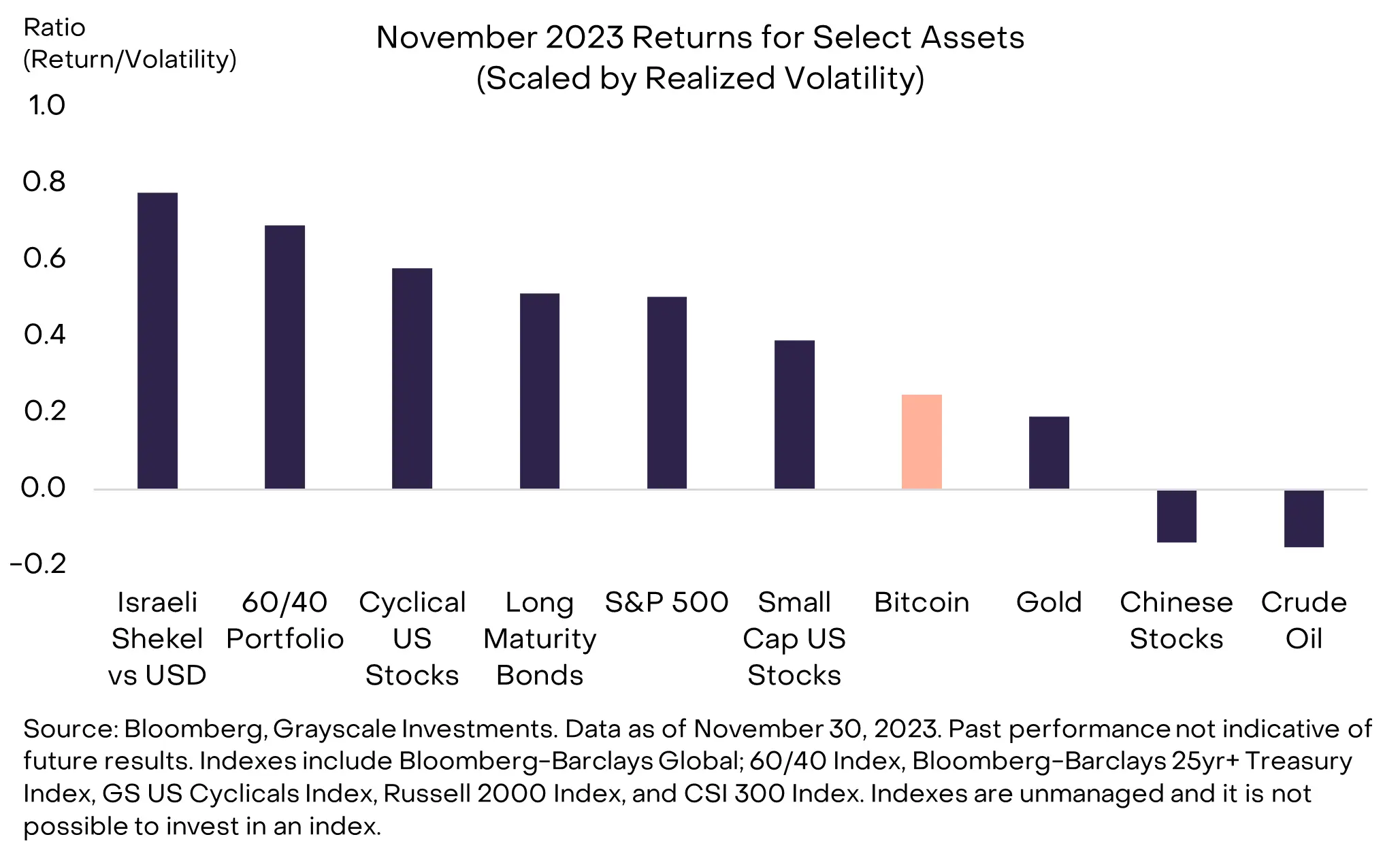
Over the past month, various tail risks in financial markets appear to have declined, helping assets that had previously underperformed to rebound. For example, positive signs of conflict in the Middle East appear to have reduced concerns about broader regional chaos, and assets tied to the Israeli economy have rebounded as a result (Figure 1). Similarly, the price of long-term government bonds rose (yields fell) after the Ministry of Finance announced that the growth in borrowing demand was less than expected. The Consumer Price Index (CPI) also continued to fall, which increased market hopes for a Fed rate cut and a possible “soft landing” for the US economy. On a volatility-adjusted basis, BTC underperformed this month (outperforming since the end of August) but still rose 9% (ETH coin rose 13% in November).
Chart 1: Reduced tail risk drives asset market recovery in November
** **
**
A broader recovery in the crypto market
BTC has been outperforming other crypto assets recently due to the demand for BTC as a digital alternative to gold and optimism about the approval of BTC spot ETFs. However, as the rally extended beyond the BTC, the leadership of the crypto market changed in November.
According to the new framework index of the crypto asset class standard* (note: Grayscale** has partnered with FTSE Russell, a subsidiary of the London Stock Exchange and a London index provider, to launch the crypto index product**, which has five different crypto industry indices: currencies, smart contract platforms, financials, consumer and culture, utilities and services, across more than 150 protocols**), the best performing market segments last month were financial indices, Utilities and Services and Consumers and Culture (Table 2). Among the financial sectors, the Thorchain (RUNE) token rose by 131%; Thorchain runs the decentralized exchange ThorSwap, which has seen an increase in trading activity recently. Among the consumer and culture sectors, the standout performance was the growth of gaming-related tokens ImmutableX and Illuvium. On November 28, Illuvium (up 119%) listed its eponymous game on the Epic Games Store, while ImmutableX, a Layer2 blockchain for crypto gaming apps on ETH Square (up 87%), announced a partnership with Ubisoft.
Chart 2: Financials, Consumer & Culture Cryptocurrencies Outperformed
In addition to the latest price moves, the market is once again focusing on the combination between cryptocurrency and AI technology after the turmoil in OpenAI’s leadership. In Grayscale’s view, there may be synergies between public chains and AI technology. Specifically, blockchain can combat or address the potential societal risks posed by AI, such as deepfakes, bots, and the proliferation of misinformation. In addition, decentralized computing protocols can counter the centralized control of AI models that hold sensitive personal information. Grayscale believes that the main crypto projects related to the AI theme include Akash and Render (GPU sharing), Worldcoin (identity), and Bittensor (open architecture AI development).
As valuations have moved higher, the fundamentals of the crypto industry have also improved. For example, BTC’s hash rate, a measure of the total amount of computing power used to secure a network, reached an all-time high in November (Table 3). This trend can be attributed to the upgrading of miners ahead of next year’s BTC halving, higher token prices (which make older machines profitable), and an oversupply of relatively new machines operated by miner equipment manufacturers. In addition, the increase in stablecoin activity is also responsible for the improvement in crypto fundamentals. Over the past month, the total market capitalization of stablecoins has increased by $4 billion, and the amount of gas used in stablecoin transactions has also increased.
Exhibit 3: BTC hash rate hits all-time high
The fundamental factors that drive BTC prices
After a period of sharp rises, position active crypto traders as relatively “long”. For example, open interest in BTC futures listed on the Chicago Mercantile Exchange (CME) hit an all-time high in November, which may indicate that institutional activity is increasing in the market (Figure 4). At the same time, exchange-traded products (ETPs), including futures products in the United States and spot products overseas, saw net inflows in November. Grayscale estimates that the global net inflow of cryptocurrency ETPs totaled $1.3 billion in November, reaching $2.2 billion for the year.
Chart 4: Open interest in CME BTC futures hits all-time high
In terms of the short-term outlook for the market, the position of a “long” trader means that it may be difficult for the price to rise further. The prices of major crypto tokens have risen sharply, and the benefits have been consumed in advance. In addition, there are some risks to the economic outlook that could undermine the positive trend this year. These include a “hard landing” (recession) for the U.S. economy, a resumption of interest rate hikes or lower-than-expected rate cuts by the Federal Reserve, and/or a prolonged delay in approving BTC spot ETFs for the U.S. market. All of these risks could hinder crypto recovery, at least in the short term.
That being said, in Grayscale’s view, financial markets and macroeconomic conditions may be favorable for BTC and other crypto assets. The supply of BTC was relatively “tight” before potential investors poured into US spot ETF products. For example, the share of BTC supply held by short-term speculators has reached record lows, according to Glassnode data (Table 5). Similarly, Grayscale’s analysis also shows that a large portion of the BTC is held by long-term holders (related reading: Grayscale revealed BTC holder pattern: only 2.3% of BTC have more than 1 coin). The BTC halving next year will also limit the growth of the new token supply. In Grayscale’s view, the combination of inelastic BTC supply and potential new investor inflows should have a positive impact on valuations.
Chart 5: Long-term holders hold **** BTC **** accounts for a large share of **** supply
However, more important than the technical background is the fundamental outlook for BTC. BTC is a macro asset that is seen by many as a digital alternative to physical gold. As a result, the price of BTC is likely to be influenced by the factors driving demand for digital gold, including the Federal Reserve’s monetary policy, the health of the U.S. economy, and the soundness of the fiat monetary system. The market’s reaction to the election of Javier Milei (BTC-friendly) as president of Argentina is the latest example of the impact these factors can have (related: A quick look at Argentina’s new president’s past and key takeaways: severing parental ties, supporting BTC). While there is uncertainty about the macro outlook, economists unanimously expect the Fed to cut interest rates next year and the U.S. economy to avoid a recession. There will also be a U.S. presidential election next year, which is expected to focus on excessive government borrowing, the independence of the Federal Reserve, and other issues that affect the long-term value of the dollar. Grayscale expects this combination to have a positive impact on demand for physical and digital gold and is likely to coincide with rising BTC valuations.
Related reading: 12 charts to interpret the crypto market in November: NFT recovery is strong, and most indicators continue to grow